The Project M android... haven't I seen you somewhere before?
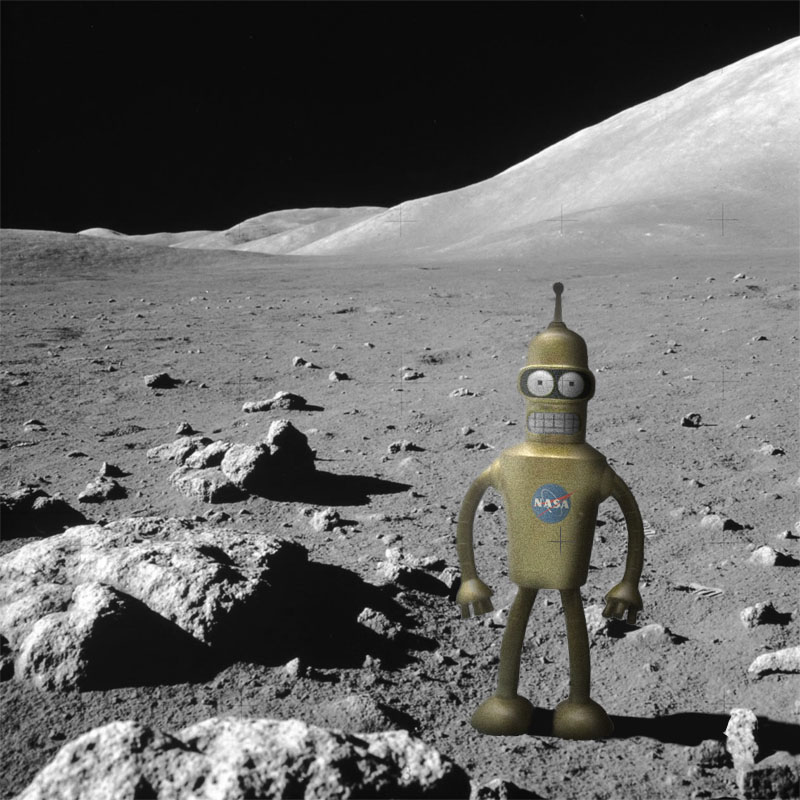
As you know, I’m highly dubious about this “Project M” that has just surfaced on the intertoobs (I strongly suspect it’s a hoax). But doubts aside, I kept looking at that android throwing stones on the lunar surface thinking I’d seen that guy somewhere before. At first, I thought C3PO from Star Wars… but no! It’s this guy:
It's uncanny! Bender from Futurama explores the lunar surface (NASA/20th Century Fox/Ian O'Neill).
I think Futurama’s Bender would do a fine job exploring the moon.
Doing for NASA what Star Wars did for sci-fi, send C3PO to the Moon! Huh?
OK, so I have little idea about this project because there’s not much information circulating, but I hope it’s not real.
It looks like NASA’s Johnson Space Center is heading up a robotic mission to the Moon. No big surprises there as that plan is pretty much in alignment with the “Flexible Path” for the future of space exploration for the U.S. space agency. Also, now the Constellation Program has bitten the dust, we’re not going to see man return to the Moon any time soon.
So what’s the answer? Send a robot that looks like a human to the Moon instead!
As I said, there’s little information about “Project M” apart from what’s been posted on AmericaSpace:
Project M is a JSC Engineering Directorate led mission to put a lander on the moon with a robot within a 1,000 days starting Jan 1., 2010. “M” has significance in two ways. First, it is the Roman numeral for 1,000. And “M” is the first letter for “Moon”.
How is Project M different from past NASA projects?
No prime contractors.
No roadblocks.
Just use the best engineers in the world to get the job done on time.
There will be full press on this… including embedded media, full multimedia and social networking. Can you say “The Apprentice goes to Space?”
When will Project M begin? Next month? Next year? No, Project M has been “go” since Monday, November 9th.
But “M” is the first letter of “Missing the Point” too, but that hasn’t been mentioned.
The enthusiasm for a robotic mission to the lunar surface sounds fine and dandy, and it’s to be expected, but if they really intend to send a bipedal robotic man to the Moon within 1000 days, then NASA hasn’t learnt anything from the Constellation debacle. This smells like a publicity stunt with little to no direction and it would be a shame if serious funding is being put into it.
Could the bipedal robot just be a metaphor for the project? Possibly, but I’d have to question the common sense in doing that too.
Also, where’s the incentive (indeed urgency) to create a Manhattan Project-style group of engineers to rush this project to completion within 3 years? If the members of Project M think they can avoid the cumbersome red tape and cost overruns that NASA and its contractors have faced in the past, then great, but I don’t think that’s a reality for such an ambitious project that lacks direction.
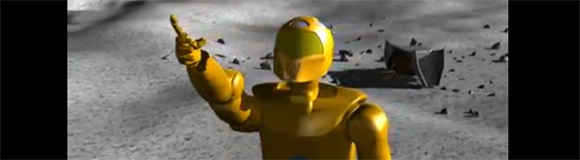
Sure, there’s funding being ploughed into humanoid robot technology — such as the “Robonaut” that is being developed by JSC engineers and the car maker GM — but the real-world application of androids (robots designed to look and act like a human) is that they can assist human operators. Bipedal androids such as the one depicted in this promo video would be exploring (read: “picking up stones”) space by themselves. There are no humans working along side them and therefore no real reason to create them in the inefficient form of a human.
The human body isn’t exactly an optimized one for space exploration. The next robotic missions to the Moon and Mars will be rovers, with wheels, because guess what? That makes more sense than revolutionizing android technology, sending it to the Moon within 1000 days, only for it to fall over and not be able to stand back up. (I’m sure Project M would counter this argument and say that the technology would have matured to such an extent that the android would be able to stand up again, but why let it fall over at all?) The center of gravity needs to be low for stability and no matter how big you make a robot’s feet, it’s simply not going to be able to explore as efficiently as a wheeled or multi-legged all-terrain vehicle.
What you see here is something mankind has never seen before, the aftermath of an asteroid collision. This conclusion comes after the Hubble Space Telescope was commanded to take a closer look at a strange comet-like object pottering around in the asteroid belt between the orbits of Mars and Jupiter.
“The truth is we’re still struggling to understand what this means,” said David Jewitt, a planetary physicist from UCLA. “It’s most likely the result of a recent collision between two asteroids.”
After P/2010 A2 was discovered in January, Jewitt managed to get observation time on Hubble to get a closer look of what was thought could be a rare asteroid-comet hybrid.
In the image, the object named P/2010 A2 has a very obvious “X” on its surface shaped pattern in its tale, possibly the location where a smaller body slammed into it at high speed. The result of this hyper-velocity impact produced a lot of debris and scientists think the comet-like tail being swept back by the pressure of the solar wind is dust and outgassing volatiles (like subliming water ice).
Although this kind of event has never been observed before, over the lifetime of the evolving solar system, events like this occur on a regular basis, in fact asteroid collisions have shaped the asteroid belt. Interestingly, it is thought this impact was caused by a collision of a “Flora family” asteroid, a type of object that may have wiped out the dinosaurs 65 million years ago. (Don’t worry, this collision won’t affect Earth in any way, the dinosaur thing is simply an interesting connection!)
What an incredible discovery, it’s fortunate that we have Hubble’s excellent eyesight to peer deep into the asteroid belt…



 astroengine.com