
Lasers. Very cool and exciting toys. They have also revolutionized science and technology. Through a comparatively simple process, photons are bounced backward and forward within an optical cavity. Stimulated emission from the quantum states of the material within the cavity causes more and more photons to be generated. Eventually a threshold is reached and laser emission results, producing a collimated beam of a defined wavelength.
So where do black holes come into all this? Well, it is theorized that black hole event horizons produce radiation. Hawking radiation, although not yet proven, is probably responsible for the only emission from a black hole. It may even cause the black hole to evaporate. But what if this radiation could be used in the ultimate laser cavity? Some Scottish researchers think it might be possible… in theory…
Yes it sounds ridiculous when we read: “Synthetic Black Hole Event Horizon Created in UK Laboratory” (ahem, one of mine!), but it isn’t that far from reality. Drawing the reader’s attention to the word “synthetic”, we are obviously not talking about a real, bona fide black hole sitting on a desk in some professors lab causing all sorts of havoc to the space-time in some university campus! We are referring to a black hole “analogue”, or more precisely an event horizon analogue.
In science terms an analogue is used to simulate a “thing” far more complex but demonstrates the physics behind that “thing” accurately all the same. Looking at the simulated Mars missions, we currently have a “Mars base”, the Mars Desert Research Station (MDRS) running in the Utah Desert, where a group of people get sealed away from the rest of the world for months on end. All in the hope to simulate what it is like to live on Mars. This is commonly known as a Mars habitat analogue.
Black hole or event horizon analogues aren’t for people to live in. In the case of the laser experiment I mention in the above article, the event horizon is simulated when two pulses of laser light of two different wavelengths are fired through an optical material. The first travels slowly, the second faster. As the first laser changes the properties of the optical material behind it, the second laser pulse is slowed down. The second pulse can never overtake the first pulse; it is effectively slowed to a stop (relative to the first pulse).
Sound familiar? This is a basic simulation of how an event horizon works as light tries to escape a black hole – it can’t. Hey presto! We have a simulated black hole, or as I’d put it, a “synthetic black hole”.
So, experiments are being carried out on laser light to see how the event horizon within an optical material acts. Could it be possible to demonstrate things like Hawking radiation? Could particles, or photons for that matter, appear to jump out of the leading edge of the horizon? I’m not totally convinced this can be proven, but then again the mathematics may prove otherwise.
OK, so there might be a possibility that an event horizon could be demonstrated in the laboratory using lasers as a method to simulate a black hole. Turning this idea around, could event horizons and our good friend Hawking radiation combine to create a type of laser emission itself?
I’ve been grappling with this publication by Ulf Leonhardt and Thomas Philbin (“Black Hole Lasers Revisited”) in a research group in St. Andrews University, Scotland, for a few days now. The more I read it, the more amazed I get. But I also become more confused, the theoretical physics behind the concept of a “black hole laser” is, as you’d expect, top drawer. While I’ve been compelled to write about it, I’ve been reluctant as it is tough to digest. I’m going to give a very rough rundown about some of the conclusions. If you’re feeling brave, dive in, a preprint is waiting for you on arXiv…
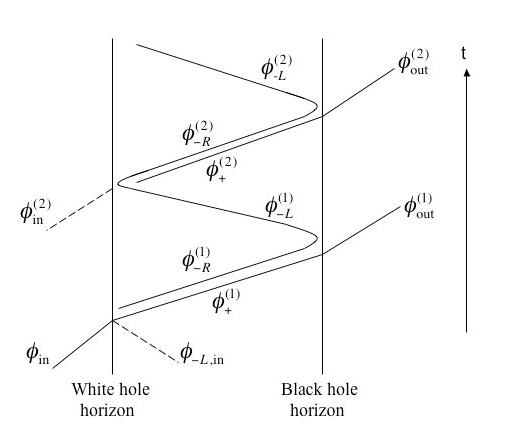
Using a Bose-Einstein condensate, a rather exotic substance itself, sonic waves could be generated to simulate an event horizon. Where one horizon is apparently pretty useless for laser generation, two horizons, side by side actually turns out to be fairly useful. In this case, a black hole horizon and a white hole horizon are required. A white hole is very similar to a black hole (i.e. in cosmology, they will both have the same gravitational influence on matter – matter is attracted – and will therefore be indistinguishable to observers), but there are some very subtle differences at the event horizons of both.
In this analogue substance, sonic waves that travel across the white hole horizon will have a negative and positive frequency component. After some blue shifting and red shifting (increase in frequency and decrease in frequency, respectively) on each “bounce” between horizons, the product waves will have greatly increased in amplitude. In fact, theoretically, the process is exponential, simulating stimulated production of waves, similar to a laser process.
The big thing to come out of this paper is that it is not advocating bouncing radiation between a cosmological black and white hole (if you think you know how this might be done, I’d love to get your theory in the comment section below), nor is it suggesting stimulated generation of Hawking radiation from an actual black hole event horizon, it is using a theoretical model for a possible situation. Sonic wave production in a Bose-Einstein condensate perhaps isn’t that far out of the realms of possibility, using such an analogue may even prove or disprove the existence of Hawking radiation without even looking into the horizon of a stellar black hole…
…fortunate really…
 astroengine.com
Sure, I tell you. Then you tell so and so.. and soon the whole world wkows my formula.
Hahaha… what’s in your formula that you are afraid to tell everybody.:-)
Drinking Water to lose weight
Valuable information(easy to understand newbie
like me).i found these article sites are greatly useful for me in my
project work. i just bookmarked it in my system. thanks for your
wonderful post. camps bay property
Extremely fascinating post on lasers and black holes, haven’t read anything like it before and enjoyed the analysis and explanation very much http://dollhouseworld.org/kidkraft-annabelle-dollhouse/
Good point you made there. What is your formula? Will you share it with the world please?! We’d all appreciate it! 😉 From http://dollhouseworld.org/kidkraft-savannah-dollhouse/
I really loved reading your blog. It was very well authored
and easy to understand. Unlike additional blogs I have read which are really
not tht good. I also found your posts very interesting. In fact after reading,
I had to go show it to my friend and he enjoyed it as well!
This is a mouth watering blog. I never thought that a person can create a
blog regarding such a simle thing. Really a work of art presented by
the blogger. Keep it up.
sexy lingerie
Sound familiar? This is a basic simulation of how an event horizon works as light tries to escape a black hole – it can’t. Hey presto! We have a simulated black hole, or as I’d put it, a “synthetic black hole”.
Read more: http://www.astroengine.com/2008/03/how-do-you-build-a-laser-with-a-black-hole/#ixzz1gYLmS8tc
credit union
What formula are you talking about? Do you have any formula then?
interesting to apply this theory of the black hole laser
http://www.102casino.com
lol, very interesting site. http://burlingtonbaby.net
good~
Nice Article thank for share http://camcordercase.co.cc
You almost had me there, until you explained that it was synthetic. I was thinking along the lines of a black hole in a professors' lab wreaking havoc. Great scientific work you're doing.Thanks and God bless.
Wow, I never knew it was like that. Thanks for explaining it so that we all could understand. baby stroller reviews
Very useful article, and very interesting indeed!
This is some heavy science. Way above my pay grade. however, I still enjoy the post.
http://www.webrankingseo.com
This is cool
http://www.muskeln-aufbauen.org
An impressive share, I just given this onto a colleague who was doing a little analysis on this. And he in fact bought me breakfast because I found it for him.. smile. So let me reword that: Thnx for the treat! But yeah Thnkx for spending the time to discuss this, I feel strongly about it and love reading more on this topic. If possible, as you become expertise, would you mind updating your blog with more details? It is highly helpful for me. Big thumb up for this blog post!
Pay Dirt
Nice. Use the virtual horizons to create the lasing cavity. Should've thought of that one… 😉 Using Bose-Einstein condensates does mean it has to occur in extreme cryogenic conditions doesn't it?
Hi would you mind stating which blog platform you’re using? I’m looking to start my own blog soon but I’m having a difficult time choosing
med certification
Cool Technology…
“Any sufficiently advanced technology is indistinguishable from magic.”
Arthur C. Clarke
http://www.bvdservices.com
Yeah it feel really nice to see latest and cool technology
http://www.bdplay.com
Wow thats cool
Ah! This is great. Just what I was looking for. Thank you!
We heart your style, the fact that your blog is a little bit different makes it so interesting, I am bored of coming across the same same all of the time. This page is now in my Digg
http://WWW.ONLINE-GUCCI-OUTLET.COM
thanks….
visit my blog
http://www.pushtotalkcellphones.com/
visit me
http://cupre.info
Great Article,
Please visit my site. http://www.prosoccerstore.biz/
Thats kinda interesting concept for a laser freak
I have no idea how this might be done but I do think this idea is neat. I did not know there was a white hole until I read this blog. I have learned something and I thank you for that. I am amazed at the use of lasers and how they work and how they are profiting some people. content writing http://www.websitetask.com/content-writing/
good formula.
but,
Hello, I like your article. It is very informative to me. Thank you for posting here
http://www.webhosterindia.com
Yes , This article is very informative
http://www.hedeya.net
hey intersting stuff.
I wish I could build one of these. I’m a laser fan boy.
lol I did not know that utah desert has Mars similar environment
What exactly is a black hole
I didn’t either till family move up there and I went for a visit. Why would anyone live here I asked. This is a very interesting site though…thanks for letting me learn from your hard work.
http://productwho.com/category/electronics/
http://www.feevoo.com/IBM-Adapter/IBM-57Y6415-AC-Adapter-16V-3.5A.html
Output: DC16V 3.5A )
This is some heavy science. Way above my pay grade. however, I still enjoy the post.
http://www.buypumashop.com/
http://www.feevoo.com/HP-Keyboard/HP-530580-001-Keyboard-Glossy.html
http://www.feevoo.com/15.4-Inch-Screen/HP-530.html
http://www.feevoo.com/HP-Adapter/HP-530-AC-Adapter-65W.html
I think the formula needs more revisions… but it seems understandable
“Any sufficiently advanced technology is indistinguishable from magic.”
Arthur C. Clarke
Really beautiful quote.
Your website inculudes usefull information. I added your website to Google Reader and i will follow it when i have time.
Best regards…
http://www.trafikcezasisorgulama.com
Finally, an issue that I am passionate about. I have looked for information of this caliber for the last several hours. Your site is greatly appreciated.
White hole horison…i like it!
visit my site : http://free-mobilethemes.com/
wow keren artikelnya
http://www.kangdadang.com
thanks to share this great stufff!
Agree, found it very interesting.
Article is really interesting,a bit difficult to understand but interesting
http://www.FeeVoo.com/Gateway-Adapter/Gateway-MX6008m-power-adapter.html
Hello Everyone !
I want to thanks to admin for sharing helpful information with us. I hope for getting more helpful information from you in future & I must say that you site/blog have well designed & manage by webmaster. I waiting for your next useful tips. Thanks !
African Mango
Your web site inculudes usefull information. I added your site to Google Reader i will observe it when i have time.
it is an amazing technology thanks for the post it was really interesting
This is my first time i visit here. I found so many interesting stuff in your blog especially its discussion. From the tons of comments on your articles,seo consultants london
Great article, I enjoyed it very much. Sounds a little bit like those Star Trek things
It’s a black hole is really ?
Can a human being live in mars for the next generation ?
It’s a black hole is really ?
Can a human being live in mars for the next generation ?
Nice and Great Article http://www.gudangblog.co.cc
very good idea
http://www.omtimo.org
Lasers, gotta love em!
I love lasers their so cool 😀
http://inktattoodesigns.net
Very interesting and at the same time scary 🙂
http://www.bestsellingproduct.co.uk/
I have submitted this site to my facebook friends
I hope it’s ok to do this
http://www.bestsellingproduct.co.uk/samsung50c6900/
To order, first choose your standard binder. There are three different options for colors as well as 3 different options for the types of coupon pages included. You can also choose to order “Everything But The Binder” to get everything listed above except for the actual binder.
how to be an image consultant
Mekanik Tesisat
Mekanik Tesisat
This is my first time i visit here. I found so many interesting stuff in your blog especially its discussion. From the tons of comments on your articles, I guess I am not the only one having all the enjoyment here keep up the good work.
I disagree with most people here; since I started reading this blog post I couldn’t stop until I was done, while it wasn’t just what I had been trying to find, was still a great read though. I will instantaneously get your blog feed to keep in touch of future updates.
In science terms an analogue is used to simulate a “thing” far more complex but demonstrates the physics behind that “thing” accurately all the same.
nice posts…
http://www.apaan.co.tv
I did not know this artikle
interesting artikle
Building a laser with a black hole, very interesting. Thanks for the post, I’ll be back for more!
The below is from Allan Burns. He is running against John Linder in GA-7. In case you have forgotten about him, Linder is the guy who told an elderly woman she had no excuse for being afraid to sign up for Medicare Part D. He also told a Pakistani-American who’s son has been deployed to Iraq TWICE that if he had a problem with America’s image in the world to go talk to Osama bin Laden.
Fishing Lodges Alaska