
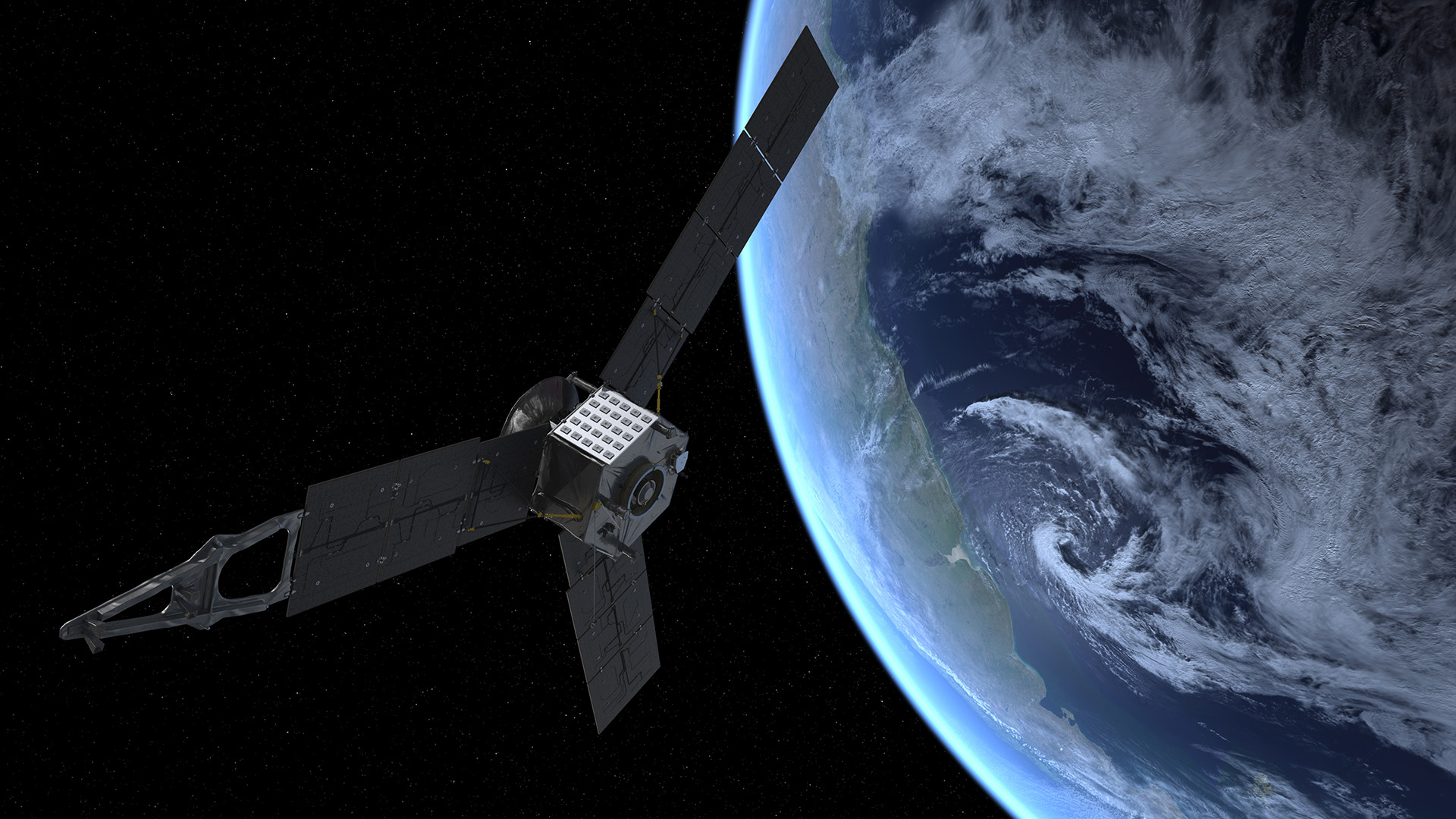
Last week’s Juno flyby of Earth was an exciting event. NASA’s Jupiter-bound mission buzzed our planet on Wednesday (Oct. 9) only 350 miles from the surface, providing amateur astronomers with an opportunity to snapshot Juno as she flew past, stealing a little momentum from Earth and sling-shotting toward the largest planet in the Solar System. Alas, the flyby event wasn’t without incident.
The spacecraft dropped into “safe mode” shortly after its terrestrial encounter. Safe mode is a fail safe on spacecraft that protects onboard instruments from an unexpected condition. This can come in the form of a power spike or some other instrumental error. It is not known at this time what triggered this particular event, but the upshot is that Juno is back in its nominal state.
From a Southwest Research Institute news release:
“Onboard Juno, the safe mode turned off instruments and a few non-critical spacecraft components, and pointed the spacecraft toward the Sun to ensure the solar arrays received power. The spacecraft acted as expected during the transition into and while in safe mode.”
Juno’s planned trajectory was not impacted during the flyby and it is expected to make orbital insertion around Jupiter in July 2016.
First JunoCam image of the day! Taken at 11:07 UTC when #Juno was 206,000 Kilometers from the Moon (via MSSS) – pic.twitter.com/86amdfgF6X
— NASA Juno (@Juno_101) October 9, 2013
The mission was launched from Cape Canaveral, Fla., in 2011 and, through a wonderful bit of orbital mechanics, was commanded to do one 2-year orbit around the Sun. Then, last week, it ended up where it started to use our planet as a speed booster, flinging it further out into the Solar System toward Jupiter’s orbit. This acceleration “freebie” was needed as the launch vehicle, an Atlas V rocket, didn’t have the oomph to propel the spacecraft deeper into space.
Once Juno arrives at Jupiter, it will give the gas giant a thorough full-body examination, investigating what lies beneath its clouds, how it generates its powerful magnetic field and how it evolved. The repercussions of Juno’s one-year primary mission will hopefully expose not only how Jupiter is formed, but how Earth evolved into its current state.
As Juno sped past on Wednesday, I allowed myself an early celebration of some fine flying by NASA scientists with a Gin & Tonic (or a Juno & Tonic) in my special JPL-bought Juno glasses.
Good luck Juno, will look forward to seeing you at Jupiter in a little under three years time!
It's Juno & Tonic O'Clock! pic.twitter.com/USix6FVAVk
— Dr. Ian O'Neill (@astroengine) October 11, 2013
The edge of Earth as seen by #Juno through its JunoCam Methane Filter. (Raw image via MSSS – http://t.co/q6Pb4CPW12) pic.twitter.com/QhJ6QOOHux
— NASA Juno (@Juno_101) October 10, 2013

 astroengine.com