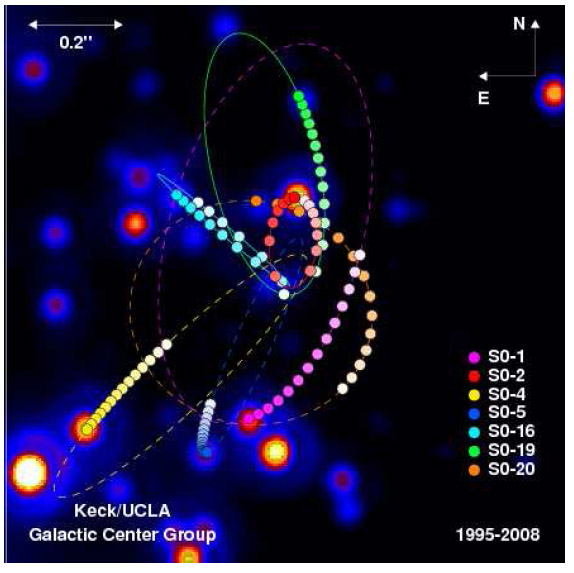
Meet Sagittarius A*, Our Very Own Supermassive Black Hole

Yearly location of stars within 0.2 parsecs from Sagittarius A* orbiting the common, compact radio source (A. Ghez)

We are told there is a supermassive black hole living in the centre of our galaxy. Apparently, supermassive black holes can be found in the centre of most galactic nuclei, and all the stars within the surrounding galactic disk will orbit around it. But how do we know there is a huge black hole in the centre of the Milky Way? What evidence is there? It turns out there is quite a lot, actually.

In a recent review of the subject, the radio emissions observed since the 1950’s are examined. However, probably the most striking piece of evidence is the figure to the left. Of course, we know black holes exert a massive gravitational pull on local space, and by observing the centre of our galaxy, we find there is a huge gravitational influence over a compact cluster of stars, all orbiting a common point, reaching orbital velocities of 5000 km/s…
Continue reading “Meet Sagittarius A*, Our Very Own Supermassive Black Hole”

The NASA Rocket Failure – Routine Access to Space Still Not Available, But We’re Getting Closer

Moment of detonation: the ATK ALV X-1 rocket and $17 million NASA payload scrubbed in an instant (Explorer Fish)

Early yesterday morning an Alliant Techsystems (ATK) ALV X-1 rocket launched from NASA’s launch facility at Wallops Island, VA. However, only 27 seconds and 11,000 feet into the flight, a launch anomaly prompted the range safety officer to hit the self-destruct button. According to sources, the ALV X-1 was a new type of launch vehicle costing $17 million (including NASA payload).

The ALV X-1 rocket is a sub-orbital design, otherwise more commonly known as a sounding rocket. Intended to carry instrumentation into the atmosphere, rather than into orbit, the ALV X-1 would complete a parabolic flight path, delivering the payload at a predetermined altitude to carry out experiments and parachute to Earth. At 5am Friday morning, this obviously didn’t happen.

It would seem that regardless of whether spaceflight is initiated by private enterprise, established space agency or Middle Eastern government, the challenges are the same, nobody has risk-free, routine access into space…
Continue reading “The NASA Rocket Failure – Routine Access to Space Still Not Available, But We’re Getting Closer”

Why Can’t we see the Oort Cloud?

Hubble Space Telescope observation of Polaris – looking through the Oort Cloud, but not resolving any comets (Hubble)

The Oort Cloud is a mysterious entity. Located on the outskirts of the Solar System, this hypothetical region is probably the source of the long-period comets that occasionally pass through the inner planets’ orbits. The strange thing about these comets is that they have orbits inclined at pretty much any angle from the ecliptic which suggests their source isn’t a belt confined to the ecliptic plane (like the asteroid belt or Kuiper belt). Therefore, their proposed source is a cloud, acting like a shell, surrounding the Solar System.

OK, so we think the Oort Cloud is out there, and there is a lot of evidence supporting this, but why can’t we see the Oort Cloud objects? After all, the Hubble Space Telescope routinely images deep space objects like stars, galaxies and clusters, why can’t we use it to see embryonic comets within our own stellar neighbourhood?
Continue reading “Why Can’t we see the Oort Cloud?”

Carnival of Space Week 68 – Crowlspace

Schematic showing Sagittarius A crossing the beam of Indlebe on 28 July 2008 (Stuart MacPherson)

For this week’s outing into the wild world of space blogging Carnival style, we dock at Crowlspace.com for a superb mix of space news, views and opinions. It’s entitled “…star travel won’t be easy,” and they’re not kidding! It seems this week has focused around the conventional, and sci-fi modes of transportation (although the question of energy in either case will be the limiting factor). For my part, I submitted my opinions about the recent misinterpretation of a radio signal from the centre of our galaxy. No, it isn’t aliens, it’s totally natural, I promise

Breaking News: We Have Sunspots, First for Over a Month

New sunspots observed on Aug. 21st (© Pavol Rapavy)

Just as we were getting concerned that the Sun may be facing an extended solar minimum, amateur astronomers, in the last few hours, have observed a new sunspot pair appearing around the Sun’s south-eastern limb. They are young, emergent spots, gradually getting larger. It will be interesting to see how they evolve. The observation above was taken by Pavol Rapavy in Rimavska Sobota, Slovakia, and now we have detailed images of the region by a British astronomer too (sounds like the Sun might be making an appearance for the UK summer at last!)…
Continue reading “Breaking News: We Have Sunspots, First for Over a Month”

Travelling to Another Star? Unfortunately Starship Fuel Economy Sucks

The Daedalus star ship, proposed in the 1970s, would propel itself forward using controlled fusion explosions (Nick Stevens, www.starbase1.co.uk)
The Daedalus star ship, proposed in the 1970s, would propel itself forward using controlled fusion explosions (Nick Stevens, http://www.starbase1.co.uk)

On writing the Universe Today article Bad News: Interstellar Travel May Remain in Science Fiction yesterday, I couldn’t help but feel depressed. So far, in all my years of science fiction viewing, I have never thought that travelling to another star would be impossible. Although I knew it would be hard, and something we won’t be able to consider for a century or so, I always assumed it could be possible. Well, in a recent meeting of rocket scientists at the Joint Propulsion Conference in Hartford, Connecticut, they concluded that even the most advanced forms of propulsion would require gargantuan quantities of fuel to carry a starship over the few light years to the nearest star. Suddenly I realised I had been looking at the question of interstellar travel in the wrong light; it’s not that it would take a stupid number of generations to get from A to B, we would require 100 times the total energy output of Earth to make it there. Where’s Captain Kirk when you need him…
Continue reading “Travelling to Another Star? Unfortunately Starship Fuel Economy Sucks”

2012 Doomsday Fabrication: Abusing Science and Making Money

Ancient prophecy plus a dash of scientific disinformation equals fear (and the potential to make a lot of money)

The Mayan long-count calendar ends on December 21st 2012. For many reasons, this is a very important event, religiously and spiritually. However, there are a huge number of doomsday scenarios that are being pinned on this day too. Why? Well your guess is as good as mine. This is a very strange phenomenon. We’ve heard “end of the world” theories for millennia; from Nostrodamus, the Bible to the Y2K Bug, but as yet (as far as I can tell) the Earth has not been destroyed. Many historic prophecies have been made deliberately vague to make a future event more likely to match the future prediction by the prophet. That’s fine, I have no problem with a mystical historic figure telling us the world is going to fry at an undetermined date by an undetermined harbinger of doom. But I have a huge problem with modern-day authors publishing scientific inaccuracies for personal gain.

I am writing this article after a number of emails were sent to me concerned about yet another 2012 Doomsday scenario, so I decided to investigate. This is what I found…
Continue reading “2012 Doomsday Fabrication: Abusing Science and Making Money”

ExoMars Pasteur Rover In Action, Dominating the Regolith

If you were in any doubt as to how awesome the ExoMars rover will be dominating the Martian regolith, here’s a video I’ve just stumbled across (it was posted last year):

I love the concept of automated roving. This animated sequence from rolling off its lander platform to drilling (oh yes!) two metres under the surface is simply stunning.

Anyhow, slow news day…

ExoMars Rover Will be the Coolest Martian on Six Wheels

The ESA Pasteur Rover, the Mercedes Benz of Martian roving (ESA)

Preparations for the European ExoMars mission appear to be in full swing for a 2013 launch to the Red Planet. This will be a huge mission for ESA as they have yet to control a robot on another planet. Yes, us Europeans had control of the Huygens probe that drifted through the atmosphere of Titan (and had a few minutes to feel what it was like to sit on another planet before Huygens slipped into robot heaven), but it’s been NASA who has made all the strides in robotic roving technology. Although Russia gave the rover thing a blast back in 1971, the roads have been clear for the 1998 Mars Pathfinder Sojourner rover and the current NASA’s Mars Exploration Rovers. Spirit and Opportunity are still exploring the planet (regardless of the limping and stiff robotic arms), several years after their warranty expired. But the Exploration Rovers won’t be the most hi-tech robotic buggies to rove the Martian regolith for much longer.

Enter the ESA Pasteur Rover, possibly the meanest looking rover you will ever see, with the intent of probing Mars to its core…
Continue reading “ExoMars Rover Will be the Coolest Martian on Six Wheels”

The Anatomy of a Rocket Launch Anomaly; SpaceX Falcon 1 Failure

f1-003_liftoff

SpaceX recently posted the launch video of the ill-fated Falcon 1, flight 3 launch on August 2nd. At the time, I was glued to the screen watching the live video broadcast of the event seeing the launch unfold. The first launch attempt was terminated due some minor parameter fluctuations, but the rocket was re-fuelled and prepped for a second attempt within the hour. However, although Falcon 1 made it to well above 200 km altitude, a very small thrust anomaly during stage separation had huge consequences for the space vehicle and payload…
Continue reading “The Anatomy of a Rocket Launch Anomaly; SpaceX Falcon 1 Failure”