Having seen some footage of the South African fireball last weekend, I thought it was quite impressive. However, a new video looking along a Johannesburg motorway has appeared online, and it’s superb.
I can’t find much information about this event, but it happened on November 21st and no fragments have been found so far.
Just in case you were in any doubt as to how much energy is released when a chunk of rock hits our atmosphere, this should give you a good impression:
I could almost feel the heat and hear the *KABLAAAM*.
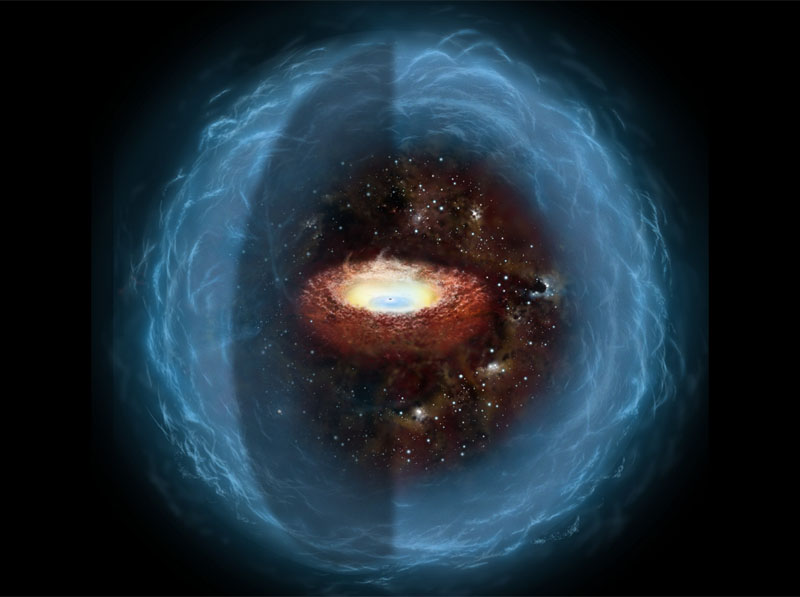
Artists impression of an ultra-luminous galaxy heating the surrounding dust (JAXA/ISAS/LIRA)
In the early 1980’s, NASA’s Infrared Astronomical Satellite (IRAS) detected a number of unknown objects lurking in the depths of the cosmos.
At the time, these IRAS objects stirred speculation in the press. Were the infrared signals being emitted by comets inside the Solar System? Or were they failed stars (brown dwarfs) lurking beyond the orbit of Pluto? The latter theory spawned the idea that the hunt for Planet X was back on (stoking the smoldering conspiracy embers of the flawed doomsday theory that Nibiru is coming to get us). Alas, it was neither, these intense infrared signals were coming from much, much further away.
It turned out that the infrared emissions were being generated by galaxies that, bizarrely, had little optical signal. Although a high proportion of them were known to be interacting galaxies (i.e. they were colliding with other galaxies), the exact energy mechanism driving their emissions was not known.
Ultra-luminous galaxies have the luminocity of a trillion Suns, whereas our galaxy has the luminosity of a pedestrian ten billion Suns. Obviously, ultra-luminous galaxies are different animals to the Milky Way, but a galaxy is a galaxy and the energy sources are similar whether they are ultra-luminous or not. It would appear that the only difference is how active the galaxy is.
The first obvious energy source in a galaxy is star formation; the more stars that are forming, the brighter the galaxy. Secondly — as with our galaxy — the central supermassive black hole’s accretion rate contributes to the galaxy’s energy budget; the more matter being accreted by the black hole, the more energy is being generated (and therefore the brighter the galaxy).
So, when observing these ultra-luminous galaxies, surely it should be an easy task to work out where all this energy is coming from? Actually, this isn’t the case, astronomers are having a difficult job in understanding the nature of IRAS galaxies and the reason for this comes from the source of the infrared emissions. Galactic dust is being heated by the energy source, but this dust obscures the source of this heating (it is opaque to optical wavelengths).
Smithsonian Astrophysical Observatory (SAO) researcher Guido Risaliti and his team have been analyzing Spitzer data to try to characterize the infrared emissions from 71 ultra-luminous galaxies. Using a “dust emission diagnostic technique,” the team have deduced that approximately 70% of the galaxies have active nuclei (i.e. their supermassive black holes have high accretion rates). Although most of the galactic nuclei are active, it is star formation that dominates the energy production in two-thirds of the galaxies. Also, these account for the highest fraction of the brightest galaxies.
This is a significant finding as it demonstrates how a galaxy reacts when it interacts with another galaxy. It would appear that the black hole in the core of the galactic bulge is kick-started during the massive gravitational interaction, boosting energy output as it eats more matter. The interaction also boosts star birth and this energy source becomes a dominant factor. Both energy sources heat up interstellar dust, making the galaxy glow in infrared wavelengths while optical light is masked.
I love today’s XKCD comic. It depicts Sagan-Man, a superhero who possesses Carl Sagan’s ability to communicate science to the world. In this case Sagan-Man uses his inspirational tone to stop a thief in the act.
Unfortunately, I was too young to experience Carl Sagan when he was in his prime years presenting Cosmos, and it is only comparatively recently that I have been watching recordings of this legendary series. I have since brought the book too.
Sagan captures the child-like wonder of the Universe that is so often missing in the world today, and while there are many outstanding scientists and presenters who fill this roll of outreach, nobody does it quite like he did.
Update: With thanks to @acsnotsettled for the suggestion, perhaps the next Carl Sagan should team up with Buzz Aldrin. That way they can really smack down the crazy conspiracy theorists (i.e. if Sagan can’t convince then the Universe is way cool without UFOs and Bigfoot, Aldrin will beat it into ’em).
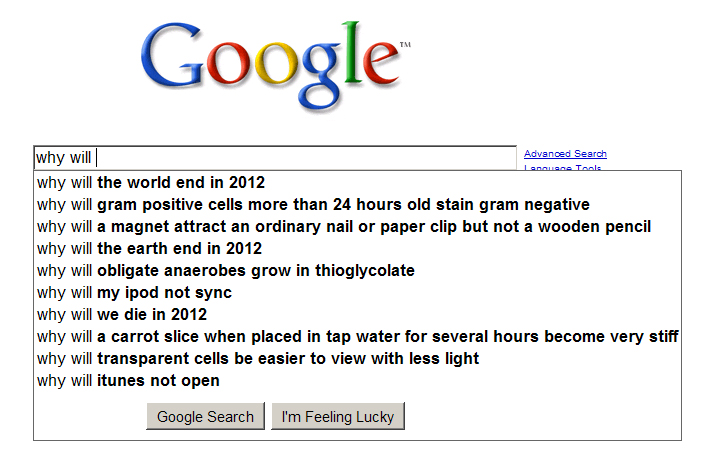
But what’s this? @Mactavish shoots me a tweet telling me to check out typing in “why will” to the Google Search box. As innocuous as it may sound, the auto suggestions are not. I mean, why the heck would anyone need the suggestion: “why will a carrot slice when placed in tap water for several hours become very stiff”?
Kidding. Mary isn’t referring to stiff carrots, I think she might be pointing out the sheer amount of doomsday Crazy going on. Wow. Type in “why will” and you get “why will the world end in 2012”? How about typing in “why won’t” and get redirected here.
You may have noticed the increased chatter about the quality of sci/tech reporting in recent years. I know I have.
In this age of incredible technological advancements and scientific discovery, it can often be very hard for reporters to root out what is important and what isn’t. Also, with the increasing reach of online media, there’s a massive opportunity for media outlets to communicate science through good science journalism. This is essential, as pseudo-science and bad science reporting is often being communicated faster. Unfortunately, with the continuing cutbacks being made by traditional media sources of their science coverage, disinformation is finding an unprecedented foothold in popular culture, culminating in irrational fears of scientific achievement and scaremongering hype.
But this has created an unprecedented opportunity for a small band of professional correspondents, editors, producers and publishers known as Discovery News.
For the last 11 years, Discovery News has been working hard to report on advancing sci/tech trends as the news body of the Discovery Channel. On Sunday, Discovery News came of age; it was re-launched and re-branded with a new design and URL.
At a time where cutbacks are becoming the norm, it might seem strange to see a new sci/tech news resource appear on the Internet, but we have identified a gap in reporting that needs to be filled urgently. What makes us even more special is the fact we are coming from a TV-based network (rather than the bedraggled press-based news), so we already know how to “do” online media through a variety of platforms.
On the new-look Discovery News, you’ll find the main 3 Discovery topic hubs (Space, Earth and Tech) combined seamlessly with news across 8 key topic areas (from Dinosaurs to History). We have combined the skills of dozens of correspondents, media experts and scientists to ensure that we have an unparalleled coverage of breaking news as well as in-depth analysis. We are also addressing the need for a massive reader-based interaction by incorporating reader comments and connecting with the rapidly growing population of social media users. The site is personality-driven so our readers can interact directly with the people who are producing the news at ground level.
But the best thing is that all of our producers and contributors are professionals in the fields they are reporting on, ensuring a high level of journalistic integrity and knowledgeable opinion.
On the red carpet: John Cusack tells me what he'll be doing on Dec. 21st, 2012. Skiing (credit: Debra O'Neill/Discovery News)
Currently sitting in the departure lounge in LAX before I fly out to Washington D.C. to meet up with the Discovery News crew ahead of the launch of our brand new site (keep an eye on Discovery Space, it will soon be integrated into the Discovery News redesign — the beta version looks awesome).
Before I fly, I just wanted to post the news that the Discovery Channel will be airing the documentary I was interviewed for by KPI Productions in August. According to my DVR, the show “Surviving 2012” will be showing on Sunday (Nov. 8th). I’m not certain when it will be showing internationally, but in the US it will be on at 9pm PDT — so check your local listings for any slight changes in schedule. I think it’s going to be a great show as science is the focus, not the hype (unlike the idiotic History Channel-esque Nostradamus nonsense). However, I think fellow interviewee Dr. Alex Young and myself arrived at a very interesting conclusion as to the realities of being hit by an aggressive solar storm. Although our conclusions are far from the rip-roaring, solar blowtorch popular in sci-fi, we do point out that solar physics research is horribly underfunded considering our dependence on vulnerable power and communications systems.
This is hardly surprising if we consider that the lifespan of Spirit should have been 3 months, the fact that it has lasted 69 months (so far) is nothing short of miraculous. In rover-mission-lifetime years, doesn’t that make Spirit and her twin sister Opportunity 1380 years old? (I decided that a “lifetime” is 60 years, in case you were wondering.) Perhaps that’s not how it works, but for NASA to build a robot that has lived 23 times longer than the mission specified is pretty damn impressive. No wonder Spirit is losing her memory. I’m surprised she hasn’t lost the will to live.
Spirit has lost the use of one of her wheels and remains stuck in the sand… so she is showing her age. But still, 23× longer than planned? When I’m 1380 years old, I hope I’m only suffering amnesia every now and again.






 astroengine.com