Earth is no Longer ‘One of a Kind’

For this special little planet, today has been a very big day.

Although we’ve speculated that planets the size of Earth must exist elsewhere in the cosmos, it wasn’t until one of the co-investigators working with the Kepler Space Telescope said he had statistical evidence that worlds of the approximate size of Earth appear to dominate our Milky Way.

We now know Earth isn’t unique.

Alas, this historic news didn’t come without controversy. It was unofficially broken at a TED conference in Oxford earlier this month and only after a recording of a presentation given by Dimitar Sasselov was posted online did the news get out. What’s more, the announcement only became clear when Sasselov referred to a presentation slide depicting a bar chart with the different sizes of exoplanets discovered by Kepler:
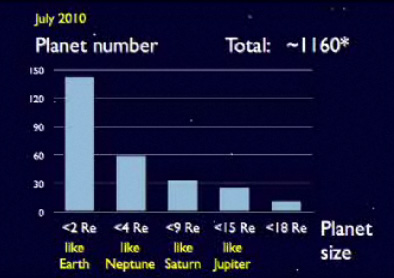
A slide from Dimitar Sasselov's TED presentation.

This slide shows the number of exoplanets discovered up until this month, binned by size. We have Jupiter-like exoplanets, Saturn-like exoplanets and Neptune-like exoplanets, all compared with Earth’s radius.

The heart-stopping moment comes when looking at the bar that represents Earth-like exoplanets (i.e. worlds with a radius of below 2 Earth radii, or “<2 Re"). According to Sasselov, Kepler has detected a lot of Earth-like worlds, so many in fact that they dominate the picture. From what we have here, it would appear that around 140 exoplanets are considered to be like Earth.

“The statistical result is loud and clear,” said Sasselov. “And the statistical result is that planets like our own Earth are out there. Our Milky Way galaxy is rich in these kinds of planets.”

But why the controversy? Isn’t this good news?

It would appear that the Kepler co-investigator chose not to wait until the official press release from NASA. He publicized these groundbreaking results in the U.K. at an event where you had to buy tickets to attend. This isn’t usually the stage you’d expect this kind of discovery to be announced — a move that will undoubtedly upset many.

“What is really annoying is that the Kepler folks were complaining about releasing information since they wanted more time to analyze it before making any announcements,” Keith Cowing, of NASAWatch.com, wrote in a SpaceRef article today. “And then the project’s Co-I goes off and spills the beans before an exclusive audience – offshore. We only find out about it when the video gets quietly posted weeks later.”

This sentiment is understandable. Only last month there was some frustration vented at the Kepler team for holding back data on 400 exoplanet candidates. While this might be standard practice — the discovering team should be allowed some time to publish work on any discoveries they have uncovered — telling the world’s scientists they will have to wait until February 2011 before they can get their hands on this invaluable data was a bridge too far.

In light of this, for a Kepler scientist to then jump the gun and disclose a groundbreaking discovery at an international conference without the backing of an official NASA release seems a little hypocritical.

But there is another argument to put out there: Why should anyone sit on such a profound discovery? Perhaps NASA and the Kepler team should have issued an earlier press release announcing to the world that 140 candidate Earth-like worlds have been detected and that further work will need to be done to confirm.

Ultimately, this controversy is just background noise when compared to what we have learned today. Official confirmation or not, Dimitar Sasselov’s message is clear. Although these detections need to be confirmed (hence why these worlds are referred to as “candidates”), it would appear there is an overwhelming preponderance of exoplanets measuring 2 Earth radii or less.

For me, that fact alone is astonishing — the first scientific evidence that worlds of Earth dimensions are not rare.

Earth is no longer unique.

For more, read my Discovery News article, “Kepler Scientist: ‘Galaxy is Rich in Earth-Like Planets‘”

Did the Cosmos Deliver a Googly? ‘Meteorite’ Lands on Cricket Pitch

While enjoying a cricket county match, two spectators were apparently treated to one of the rarest of cosmic events: a meteorite falling from the sky, landing right in front of them. The “dark” rock, measuring 5 inches wide, broke in two on impact. Amazingly, a piece hit one of the witnesses.

“One piece bounced up and hit me in the chest and the other ended up against the boundary board,” said Jan Marszel. “It came across at quite a speed – if it had hit me full on it could have been very interesting.”

It’s not clear from the Telegraph‘s minimally skeptical article when this happened (I’m assuming it was during the recent Middlesex vs. Sussex game in Uxbridge, northwest London, using the tidbits of information from the text) and the only expert opinion cited is that of Dr. Matthew Genge, a meteorite expert at Imperial College, who hasn’t handled the evidence yet.

“If this turns out to be a meteorite it’s very exciting and would be the first fall in the UK since 1992,” Genge points out.

(That last statement isn’t very accurate. I’m certain that there have been many meteorites falling onto the UK since 1992. If proven true, this would be the first witnessed fall in the UK since 1992.)

UPDATE (July 27, 10:22 am PT): With thanks to Philip Stobbart, who also commented on the Uxbridge object, some clarification of Genge’s quote has been provided, I stand corrected:

Ian O’Neill does a good job of debunking this, with one minor error. A ‘fall’ to a meteor expert is one of two categories of meteorites, falls and finds, referring to when they were seen – falling, or found later – not to meteorites actually physically falling. The papers made the same error, although they accepted the idea of this being the first fallen meteorite since 1992…

Original post continues:

Thank goodness the eyewitness account didn’t include a description about smoke bellowing from an incendiary-like pebble (i.e. the recent Israel spoof/weapon), but there are some huge question marks hanging over the validity of the Uxbridge object.

The first red flag is that one of the witnesses said: “…out of a blue sky, we saw this small dark object hurtling towards us.” I might be wrong, but spotting a 5-inch wide object flying through the air, at speed, ain’t easy. I would have thought the only time they were alerted of the ‘meteorite’ would have been when it hit the ground. Or when it hit Marszel in the thorax.

Secondly, was the ‘meteorite’ really 5 inches wide? After a quick search, I found a photograph of the offending object:

5 inches? Are you sure? I know us guys are known for overcompensating, but this is ridiculous. Granted, it’s probably just shoddy reporting, but that piece of rock is barely an inch wide.

Also, when a meteoroid blasts through the Earth’s atmosphere, a huge amount of heat is generated around it, creating a ‘fusion crust.’ This crust should be very obvious surrounding recently fallen meteorites. Looking at this picture, no fusion crust is visible. It could be that we are looking at the interior of the broken ‘meteorite,’ and the black fusion crust is on the other side, but there’s no indication in the photo that this is a bona fide space rock.

If I were to place a bet, I’d say that this is not a meteorite. However, it will be interesting to see what the experts think once they are able to study the sample.

Special thanks to Twitter buddy Madge Leebman for the tip!

Strasbourg July Lightning

A bolt of lightning strikes over Strasbourg, France (Ian O'Neill)

As you may have noticed, things have been rather quiet on Astroengine of late. This is partly due to my pan-European trek and my work on Discovery News, but mainly due to my horrid affliction of procrastination. Hence why I’m late in posting this pretty awesome picture of a lightning bolt blasting across the French skies.

What was I doing in France? Well, I was asked to do a lecture all about asteroid mining and space commercialization at this year’s Space Studies Program 2010 (SSP10) at the International Space University (ISU) in Strasbourg earlier this month.

It was an incredible experience and I got to meet some incredible people. Hoping to get a blog post up about the whole thing some time over the coming days, but for now, I’ll leave you with this picture of the storm that hit Strasbourg while I was there. For the full set, check out my Posterous gallery.