Penn & Teller & Astroengine: Bullshit!

ptbullshit

One day, many, many months ago, I was approached by the producer of the Emmy Award winning TV show Penn & Teller: Bullshit! to make a skeptical appearance for one of their Season 7 episodes. Apparently it was all going to be about doomsday, Mayans, Planet X and all that jazz. As I was halfway through my “No Doomsday in 2012” series over at the Universe Today, I jumped on the chance to be involved with such an awesome production.

This is me, on TV (by @cbrannon)

Until this week I’d forgotten about the filming, but then the episode called “Apocalypse” popped up… could it be?

Unfortunately, I don’t have Showtime, so I’ll have to watch it on the DVD, but an eagle eyed Twitter friend @cbrannon sent me this sighting… they used my stuff! I can’t wait to watch it.

As the new episode aired tonight, you might have missed it, but it looks like it’s going to be repeated for a long while yet, so check out the schedule and tune in!

BREAKING: Greg “Weird Things” Fish Gets Assimilated

The Blorg

There he was, happily blogging on his kick-ass World of Weird Things website when *BLAM* something happened. Looking out the window to see if there had been a car crash, Greg saw nothing. But as he sat back down, he realized it wasn’t a noise that he’d heard… it was more of a feeling.

Was this what Creationists would consider to be a “sign”? Was this a ghostly apparition? Could it be that Greg had just witnessed the Second Coming? Oh no, had he slipped down a wormhole, appeared in 2012, and he was experiencing, first hand, how the planet will be blended into a particularly creamy doomsday smoothy? (“Those Mayans! Why did I annoy them so?” he cried.)

But no, this is far worse, he could feel it in his divining rods, there was a force upsetting his chi, an oscillation in his aura, a one-part-per-billion-ths-ish too much salt in his homoeopathic remedy… this was big, and it was coming straight for him… he was about to be assimilated by the Blog Borg (a.k.a. The Blorg)*…

*Thank you to @2012Hoax for that gem of a name… “Blorg” – love it!

</conspiracyville>

As you might have figured out, something big is happening to my friend and co-author Greg Fish. He’s been noticed by the awesome blogging network True/Slant and now he’s moving World of Weird Things over there.

There’s going to be no break in service, in fact, knowing Greg, he will attack this new opportunity with his skeptical barrels fully loaded and scientific nunchucks at the ready.

I’ve been following Greg’s writing religiously (or should that be skeptically) ever since he started up less than a year ago, and he’s probably one of the most talented young writers I have ever come across. He approaches every topic (of which none seem to be out of bounds) with a huge amount of understanding, and he has created one of the most active and powerful skepticism blogs out there.

The move to True/Slant means he gets to widen his audience even more and mix with many more talented writers. I for one can’t wait to follow Weird Things when he’s set up and ready to go.

Congratulations Greg!

Spirit And The Amazing Technicolour Dust Devils

spirit_dust_devils

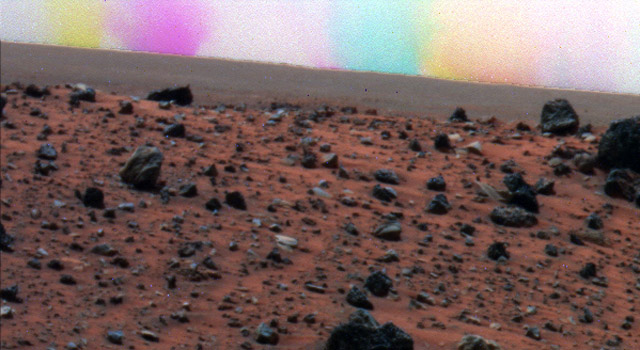
What are they? I’ve seen some odd photos from the Martian surface, but when I first saw this image, the pinks, blues and yellow smudges looked… alien. The surprise probably comes from the fact that we are so used to the rusty red pictures to come from the various rovers, landers and satellites, that any colour not a variation of red comes as a shock.

Although it looks odd, there is in fact a sensible answer to these ghostly splodges on the horizon. This photo was snapped by Mars Expedition Rover (MER) Spirit back on sol 1919 of the MER mission on May 27th, 2009.

Using its panoramic camera (Pancam), Spirit performed a number of exposures, each one using a different colour filter. With some luck during the photography session of the Martian landscape, a dust devil (a mini whirlwind) meandered through the Pancam’s field of view. In each frame taken with different filters, the only feature moving would have been the swirling dust, so that’s why it appears as a different hue than the surrounding landscape.

Dust devils occur on both Mars and on Earth when solar energy heats the surface, resulting in a layer of warm air just above the surface. Since the warmed air is less dense than the cooler atmosphere above it, it rises, making a swirling thermal plume that picks up the fine dust from the surface and carries it up into the atmosphere. This plume of dust moves with the local wind.NASA/JPL

Dust devils have provided some unexpected fun for the rovers, often tuning up unannounced. These make for interesting observations of local weather conditions, but they also provide an essential mini-undusting service for the wheeled robot’s solar panels.

And now they’ve been pictured in technicolour. How nice.

Source: NASA/JPL

Bloggers Must Fill the Public-Science Gap

public_disconnect

So, there appears to be a growing fissure between what public opinion considers to be “science” and what “science” really is. I could start making some huge proclamations that this might explain modern pseudo-science (like this, this or this) or this gaping hole is a new one causing a frenzy of media hype (like this, this or this), but I don’t think it’s quite as simple as that.

Although I love statistics, and a recent poll gives me plenty of ammo, I seriously doubt we can start making any conclusions about scientific advancement and the inverse correlation with public intelligence. No, pseudo-science, fear of science, mad scientists, scientific misinformation, outright lies of science claims and I Just Made This Up™ have always been around, it’s just that media is propagating faster than ever before; and as information spreads quickly, misinformation spreads faster.

Public-science is a weak link

If a physics researcher can set up a blog, so can your average crazy doomsday theorist with a brand new theory about the universe being driven by a galactic hamster on a treadmill. Actually, as physics researchers are very busy, crackpots probably have more time to set up their text-heavy, science-lite websites.

Crazy websites to one side, another factor to consider is that there’s a stronger public-media relationship than a public-science relationship. This is why quality, specialist reporters are needed, to communicate science to their readers in a rational, relevant way. Unfortunately, this is probably the weakest link for science communication in this world of ultra-fast media.

As the “old media” behemoths start to suffer, trying to make profit while sinking in a tide of free online content, cutbacks are inevitable. I’ve seen this first hand at a recent conference, where the press room was occupied by bloggers, podcasters and vidcasters. Only one New York Times correspondent was present; a politics correspondent. This was an astrophysics conference. He was only there for a few hours, looking perplexed.

The disconnect widens

So the traditional media has to make cutbacks, so what? That’s business. Unfortunately, there are few science reporters, so when cutbacks happen, reliable reporting of science is lost, and reporters who probably haven’t studied any science in their lives find themselves being sent to report on the next great Hubble discovery or… the LHC (we all know how that went).

So it is little wonder we start seeing statistics like this surfacing:

On the whole, scientists believe American research leads the world. But only 17 percent of the public agrees, and the proportion who name scientific advances as among the United States’ most important achievements has fallen to 27 percent from nearly 50 percent in 1999, the survey found.

Almost a third of ordinary Americans say human beings have existed in their current form since the beginning of time, a view held by only 2 percent of the scientists. Only about half of the public agrees that people are behind climate change, and 11 percent does not believe there is any warming at all.

The report said 85 percent of science association members surveyed said public ignorance of science was a major problem. And by large margins they deride as only “fair” or “poor” the coverage of science by newspapers and television.

(emphasis added by me)

Playboy science

So why is there a growing disconnect between the public and science? I think it’s a combination of factors (fast online media, a lack of good quality science journalism etc.), but the result is pretty worrying. When you see celebrities such as Jenny McCarthy spewing her dogma about the link between child autism and vaccines, alarm bells should be ringing. McCarthy has decided to battle against science (and the BigPharma overlords, of course), and she’s gathered quite a following; parents who have decided to turn their back on science and trust an ex-Playboy model instead.

This is just one example of the impact of science distrust. Using this slack in the public-science communication, there’s been a huge surge in conspiracy theories and individuals using science as a means to “prove” their “belief.” This is an uncomfortable situation where you have large groups of people who are willing to promote their pet theory as science fact (I’m not talking Creationism here, there are a fair few odd physics theories knocking around too). And when you have a very polished theory that sounds reasonable on the surface, but fails after a small bit of scientific rigour (despite the fact they use out of date science to point the finger and say, “I told you so!”), it can be hard for the public to understand what is “science” and what is bunkum.

Science blogging standard

So, as trusted media sources — such as major newspapers and news channels, traditionally the ‘ground zero’ of reporting — desperately try to grasp this new world of free and fast media, science journalism falls by the wayside, watering down the facts. To “go viral,” often stories will be of very low science merit, but headline grabbing. This could be the key reason why we have this current bout of public misunderstanding of science, allowing cranks some room to manoeuvre their next insane theory into position.

This is where science bloggers are flourishing. In fact, science blogging is almost like the Internet’s immune system (that’s an analogy, not scientific ‘proof’), and because bloggers can knock out articles very quickly, they can often be the first on the scene to fight off the next flawed conspiracy theory or crackpot ramblings. Of course, you don’t have to be a scientist to blog, but there is a huge, wonderful infrastructure of skeptical websites that make a very healthy existence debunking false claims and pseudo-science.

Although many skeptical bloggers view debunking nutty theories to be an enjoyable pastime, it turns out they are doing something the mainstream media cannot: they are connected with their audience, they are usually professionals of their field and they will highlight the abuse of science, exposing these theories for what they really are (crap).

So if you’re ever confused about a website’s claims, keep in mind Carl Sagan’s famous (and very relevant) quote, “Extraordinary claims require extraordinary evidence.” If a website is telling you that the Sun is actually driven by a magical force, other than gravitational pressure and nuclear fusion, ask ‘where’s your proof?‘ — you’ll find there will be no satisfactory answer to that question.

A special thanks to ace Norwegian science reporter Geir Barstein for inspiring this post after a recent chat we had during his visit to LA…

District 9… Could Happen

d-9

Occasionally, out of the CGI’d dust of orgasmic fight sequences of Transformers 2 and the predicted lack of plot in the forthcoming 2012, the movie industry churns up a gem of a sci-fi flick.

I suspect Moon is one of those rare movies (I am still trying to find time to get my bum down the cinema to watch it) that combines plot, effects and scientific accuracy (just about) to arrive at a genuinely good film.

And then there’s District 9, due for release in August. At first look of the trailer, you’ll see why I’m getting a little excited:

I was expecting the same old aliens invade, world on fire, Will Smith punches alien, USA saves the world storyline at first, but if you read the IMDB plot summary (spoilers!), you’ll be pleasantly surprised.

Damn, I have to share the plot… stop reading now if you want to be totally vague about the story of District 9.

That's what those posters are all about! The movie viral campaign poster from District 9.
That's what those posters are all about! The movie viral campaign from District 9.

[Micro-spoiler below]

Basically, rather than invading Earth, these alien dudes have landed on our planet seeking refuge after their home world died. Their spaceship arrives over South Africa and thirty years later, these once-advanced alien beings have been turned into social outcasts, restricted to an alien slum called District 9. People have lost patience with looking after these creatures, but agencies hold onto these aliens against their will to learn about their technologies. Then, it would appear the aliens start to fight back…

It’s set in a gritty Johannesburg location, the CGI looks subtle, plus Peter Jackson (Lord of the Rings director, say no more) is involved, so there’s some hope this might be a unique and thrilling sci-fi. I get the feeling there is a lot of play on alien rights, the welfare of ET integrated in society (or not), with a healthy dose of alien-racism (alienation?) thrown in.

Us humans will be the bad guys! Awesome! Filthy aliens…

Source: SlashFilm via @StuartForsyth

Celebrating Apollo 11

73-percent

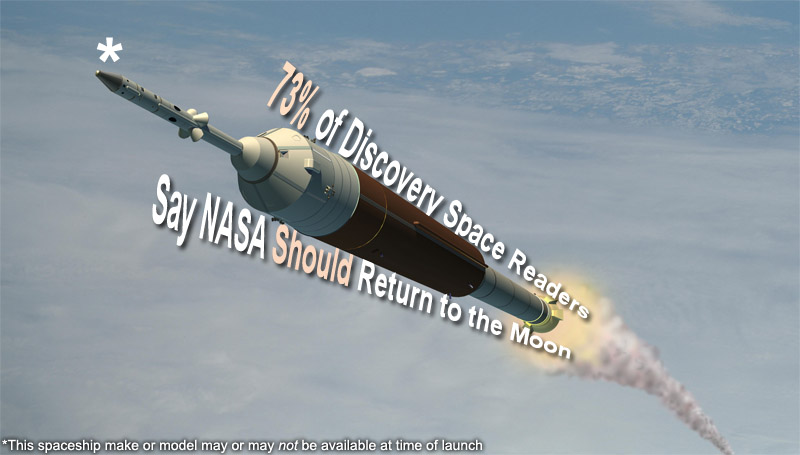
We’re currently having loads of fun over at Discovery Space, celebrating mankind’s biggest space achievement: when Apollo 11 landed on the moon 40 years ago. On July 20th 1969, Neil Armstrong and Buzz Aldrin made history while Michael Collins orbited overhead. This was a key moment in space exploration that was followed by another 5 lunar landings until 1972. Unfortunately, that was it and the Apollo Program was gradually wound down…

However, the current plan is to get astronauts back to the moon by 2020, but how are we going to do it? Actually, the answer is far from clear-cut, and although NASA is pushing ahead with the development of Constellation, outspoken space advocates, such as Buzz Aldrin, are presenting some alternatives.

But in an interesting twist, after carrying out a two-week poll on Space Disco, I found that general opinion is stacked firmly in favour of a NASA return mission to the moon…

To find out more, dive right into the Discovery Space Wide Angle: The Moon Landings:

    • Interview with Buzz Aldrin: Should We Return To The Moon?

      Irene Klotz discusses the Apollo 11 landing with the second man on the moon. What are his opinions about NASA’s plans for a return trip?

    • Opinion: One Small Step: Why Step Back?

      We did it 40 years ago, what’s the point in retracing our steps when we could just mount a manned mission to Mars? Ian O’Neill discusses the pros and cons about NASA’s future exploration plans. Including results from the Discovery Space reader poll.

NEWS

SLIDE SHOWS

    • Things You Didn’t Know About Apollo (HowStuffWorks)

      Did you know the Apollo 17 astronauts had to fix their lunar buggy with duct tape? Or that the Saturn V carrying Apollo 12 was struck by lightning 37 seconds after lift off? We investigate the little-known facts about the Apollo missions.

    • Top Ten Moon Mysteries (HowStuffWorks)

      It may be our natural satellite, easily observable in the night sky, but the moon still hides many secrets. Explore the lunar surface with us as we investigate some of the moon’s best kept secrets.

VIDEOS

FEATURE ARTICLES

  • Mining the Moon (IEEE Spectrum)

    We are told that one of the key reasons to set up a lunar base is to mine the moon for its abundance of natural resources, but is this realistic? In some ways yes, but there’s a lot of economics and politics to wade through first.

  • The End Of The Cult Of The Astronaut (IEEE Spectrum)

    Many in-space activities could be automated, negating the need for a human presence. However, taking astronauts out of the space exploration loop is as attractive as it is unpalatable. Is the astronaut surplus to requirements?

2012: Hardcore Disaster Pr0n

2012b

This video made my day.

Fortunately I’ve been hard-wired to Twitter today, so I’ve spotted some awesome links pop up from my ace tweeters. But I wasn’t prepared for the awesomeness that was encapsulated in @jimmynewland tweet titled, “2012: All the Disaster Pr0n you can take!

To be honest, I was expecting the movie trailer for the John Cussak disaster flick “2012” (coming to a deafening surround sound theatre near you), but no… this is better… far better. Take a look, it gets funnier the more you watch it:

As I made all too clear in my previous post on this subject, I made the pre-preview prediction (and I didn’t need a crop circle to predict this) that 2012 is going to be heavy on the CGI, but light on the plot.

Basically, it looks like Emmerich’s wet dream, probably an opportunity he’s been waiting for all his career. If you thought The Day After Tomorrow was an Earth-crunching death-fest, think again, this movie has rolling buildings, flying Bentleys, flying giraffes, spaceships, exploding cities, exploding fireballs, exploding… rocks… Hell, where’s the nukes! We need nukes! I hope Emmerich remembered the nukes.

And this video sums the whole thing up, and I love it. As described by the creator on io9, Garrison Dean:

Every so often I feel a film is just being marketed poorly. This is often laziness and misdirection on their part. Occasionally it is arrogance when they think there is more to their film than is actually there. So, in my own arrogance, I try to help them along. Last year I felt “Hulk” needed some help. Today my mission is one that blends swimmingly with my own love of Disaster. Please enjoy this special holiday treat that I made just for you.

Dean is referring to 2012, and watching it, I can’t help but be entertained and enthusiastic for the movie. He’s done a great re-edit. It now has the 1970’s classic disaster movie atmosphere of Towering Inferno with the cutting edge Big Flaming Balls Of Fire™ we are now accustomed to in modern Hollywood.

It’s not going to be a good film, films kinda need plots. Perhaps the experienced cast might be able to pull it out of the frenzy of tsunamis, burning cities and crying children, but I’m not going for the plot, I’m going for the CGI… and the science errors, of course.

Arizona State Senator: ‘This Earth’s Been Here 6,000 Years…’

…I know I’m going on and on and I’ll shut up.” Yes, please do.

I’m not sure what’s going on these last few days, but Astroengine has been filled with pseudo-science, media insanity and conspiracy theories. I suspect we’re seeing the first few cases of the Stupid pandemic (I’m joking, we all know you can’t “catch” Stupid — but can somebody please make sure Jenny McCarthy gets the memo this time?).

I’m beginning to miss real science. I promise I’ll resume normal service, after you’ve seen this video:

It looks like there are some basic educational failings, or some very strong Creationist teachings in Arizona. But to hear, “the Earth’s been here 6,000 years,” so casually stated during a hearing about uranium mining, it’s a little concerning as to how many individuals in positions of power genuinely ignore science and opt for belief instead.

Thank you to @MrGuilt for pointing me to this little piece of craziness.

For more, check out The Universe Could Soon Be 6,000 Years Old… In Texas.

Crop Circles Do Not Predict Solar Storm on July 7th…

Stunning art, UFOs not included (© Lucy Pringle)

Alternative title: “Jumping to Conclusions and Bullshit”

Crop circles are amazing. They are, quite literally, works of art. And like all other known forms of art, they are constructed by people with time on their hands. No UFOs have been braiding our crops, no aliens have been playing let’s-confuse-the-stoopid-humans-with-this-cryptic-message-we-travelled-hundreds-of-light-years-to-deliver. Crop circles are made by hoaxers and enthusiasts.

So yesterday, I read a terribly fascinating, yet terribly painful article that seamlessly combines three disparate facts to arrive at a terribly flawed conclusion: a coronal mass ejection (CME) will hit us on July 7th, possibly causing global damage, according to a crop circle prediction.

This may seem a little shocking, considering this equivalent of a micro-doomsday is only two days from now, but the “Exopolotics Examiner” Dr. Michael Salla discusses it with great excitement:

The Alert is for Sunspot 1024 which suddenly appeared on July 3 and 4 […] It typically takes CMEs, traveling at around a million miles per hour, three to four days to reach the Earth. So if Sunspot 1024 does generate CMEs towards the Earth, they would arrive right on the predicted date of July 7.

Apparently, we now have an infallible space weather prediction method. Sunspot 1024 could generate a CME directed toward Earth, therefore fulfilling the prediction that we are going to get hit by a CME in two days. Amazing right? Obviously Salla is referring to the work of a solar physicist, with a new hi-tech computer simulation, or with access to cutting-edge observational data. Wow, it looks like we have found the Holy Grail of sunspot characterization methods!

(Guess again)

Actually, the July 7th prediction is purely based on crop circles at Milk Hill, in Wiltshire, UK. How do we know these flattened fields of corn predict a CME? Actually, they don’t. Even the crop circle experts make no convincing connection with crop circles and the Sun, apart from pointing out that the patterns resemble an orrery — but even if it is an orrery, the corn has been flattened by a team of hoaxers, they could make it mean anything. (I’m still waiting for a massive Micky Mouse crop circle.)

Although I find all this highly entertaining, the thing that made me laugh the most was the point that the Milk Hill patterns were made in “3 Phases.” However, looking at the incredibly beautiful design of that thing, it’s little wonder the aliens had to build the design in shifts. After all, extraterrestrials need tea-breaks too… perhaps their little feet got tired stomping all that corn… or perhaps it was constructed by slacking crop circle hoaxers who couldn’t get it all done in one night?

My money is on the latter.

So, there is a dubious link between the crop circle and the Sun (apart from ‘it faces that way,’ directly along the tractor tracks… hmm, interesting), what could Salla be talking about? Oh that’s it! The Earth’s magnetosphere has a hole in it! Hell, dig your lead-lined bomb shelters now!

Now this is one point I’m actually a little annoyed about. Apparently Dr. Salla is also qualified in solar-terrestrial physics, as he seems to dredge up some pretty compelling science recently published by NASA. Salla says:

Importantly, scientists will be able to directly study the impacts of large amounts of solar plasma penetrating a breach in the magnetosphere first reported by NASA scientists in December 2008 […] If the interpretations of crop circle researchers are correct, then we will shortly directly observe the impact of solar energy from CMEs passing through the magnetosphere breach. –Dr Salla (emphasis not added by me, used for dramatic effect I suspect).

Now this is good stuff, perhaps this guy is on to something. In summary:

  1. The Milk Hill crop circle predicts a solar storm on July 7th (but it’s not very clear where in the corn this is printed).
  2. An active sunspot has appeared at a high latitude on the solar surface (this is true, although only B Class solar flares have been detected… not in Earth-killing leagues I’m afraid).
  3. This sunspot could generate an Earth-directed CME (this is true, again, but the odds are pretty damn low).
  4. The CME will hit us on July 7th (read #3).
  5. Now that NASA has detected a hole in our magnetosphere, deadly solar particles could penetrate our atmosphere!

In other words, Salla has strung together some dubious “signs” from a crop circle, tied it into this new sunspot, gotten all excited that it could generate some pretty feeble CMEs, somehow assumed they will be Earth-directed and then chucked in a very incorrect opinion as to what this “hole in the magnetosphere” means.

Although the magnetospheric breach is certainly an amazing discovery — made by the Time History of Events and Macroscale Interactions during Substorms (THEMIS) satellites in 2008 — I think Salla misses the point. The magnetospheric breach hasn’t just appeared, it wasn’t caused by human activity (like the hole in the ozone layer, which I think he thinks this is), it’s always been there in some way, shape or form.

NASA’s five THEMIS spacecraft have discovered a breach in Earth’s magnetic field ten times larger than anything previously thought to exist. Solar wind can flow in through the opening to “load up” the magnetosphere for powerful geomagnetic storms. But the breach itself is not the biggest surprise. Researchers are even more amazed at the strange and unexpected way it forms, overturning long-held ideas of space physics.NASA release.

Obviously overcome with the NASA terminology “giant breach,” Salla assumes this is a new hole in the magntosphere leaving us open to the ravages of the Sun. Actually it doesn’t, it’s simply an observation of a previously unknown piece of magnetospheric dynamics. Yes, the breach is linked with solar storms and the aurora, but there’s every likelihood this phenomenon has always existed, even when the Earth’s magnetic field was battered by X-class solar flares and jumbo CME’s during the last solar maximum (are we still here? Yes, I think we are). To think we are going to even notice a make-believe low-energy CME produced by a feeble region of the Sun generating B-class solar flares is laughable.

So the physics is flawed, the prediction is totally far-fetched, and apparently you need a PhD in exopolitics to understand how crop circles come into it. It’s just a fear-mongering article that is becoming all too common on the Examiner these days.

No, this is another huge FAIL for the Examiner… where are all the Skeptical, Science and Common Sense Examiners?

Thank you @mactavish for reminding me to finish this article!

The Guardian Tackles the Moon Landing Hoax… Badly

apollo

I despise the so called Moon landing hoax with every fibre of my being, this is probably the reason why I don’t write about it much. Besides, other bloggers do a great job of slamming the conspiracy theorist claims, so there’s little point in me weighing in to pick at the left-overs. Every hoax claim has been debunked to the point that there really can be no doubt that 40 years ago, we landed on the Moon. In fact, we did it six times.

Hoax rehash

As we fast approach the 40 year anniversary of the Apollo 11 landing on July 20th, there’s bound to be articles posted about the hoax, but I find that rather frustrating. Here we are, preparing to celebrate mankind’s biggest accomplishment, and there’s that annoying background static of conspiracy theorists trying to divert attention to their small minded idiocy. Oh well, that’s life.

Unfortunately it’s another day, and another occasion where the UK media lets us down. Sure, I get the fact that we’re nearing the lunar landing anniversary, I also get the fact that everyone loves a good conspiracy, I even get the fact that the media wants to exploit this opportunity to get more traffic, but this Guardian.co.uk slideshow seems very… uncomfortable.

The worst thing about it is that they’ve switched the goal posts. They call the conspiracy theorists “skeptics” and the logically-minded, “believers.” I might be nit-picking, but that is a terrible way to look at it.

We went to the Moon

In 1969, Neil Armstrong, Buzz Aldrin and Michael Collins went to the Moon. Neil and Buzz had a wander around on the lunar surface, checked it out, gave the Apollo Program their seal of approval and we then saw another five Apollo launches until 1972. These are all facts. This is history. Granted, we haven’t been back in 40 years, but the point is, we’ve done it.

There has never been one NASA employee that has shouted “conspiracy,” which seems surprising considering the sheer number of NASA staff that would have had to fake the landings to make them happen. No, judging by the scale of such a scam, it would be easier to send man to the Moon instead! So, did we go to the Moon in 1969? YES!

Skeptical believers? Believable skeptics? What?

Going back to the Guardian slideshow, it might be a good summary of the conspiracy theorist claims, but it’s a tired, re-hashing of all the old bunkum even the Mythbusters ground into the lunar dust a long time ago. Plus, it puts way too much weight behind the conspiracy theory itself; the text causes confusion as to what a “skeptic” is and what a “believer” is.

A skeptic is a person who uses skeptical thought to look at the evidence rationally to arrive at a logical conclusion. All the evidence points to the fact we’ve been to the Moon. Therefore, no Moon landing hoax. We went to the Moon, simple.

A believer is a person who depends on faith, not evidence, to arrive at a conclusion. The “believers” in this case should be the ones who believe there was a hoax, and not vice versa.

Sorry, but the Guardian got it ass-backwards this time.

Source: Guardian.co.uk