How Do You Spot Science Abuse in the Social Media Soup?

Heads should be held in shame...

You know the drill, we’ve all been there.

There you are, minding your own business, participating in the Web 2.0 phenomenon, scanning through the webpages on one of the countless social media sites. And then you see them, like coffee stains on your white upholstery, pages that seem a little out of place. One entry tells you that the world is coming to an end. Another tells you that the Illuminati have built a base on Pluto (with the obligatory IT’S A PLANET!!! comment underneath). Oh, and there’s another, claiming that a comet, twice the size of Jupiter is actually Planet X… and it’s coming right for us!

Of course, our common-sense neurons usually kick in, telling us that the author of the article is either a) nuts, b) an idiot, c) flying at half-mast or d) a troll. In which case, we are able to flex our social media muscles by burying, down-thumbing, down-arrowing, reporting or ignoring the offender.

There we go, social media in practice. One BIG victory for online democracy!

However, sometimes it’s not that simple. What if the author seems to be bona fide? What if the author is a so called “expert”? Say if the article uses some real science to explain their hopelessly flawed theory?

I may have been trawling around the dregs of the doomsday theory ilk for the past year, but the following list applies to pretty much any daft conspiracy theory or outrageous science claim, intended to misinform, scare or cause an online headache as you voyage through the increasingly accessible social media…
Continue reading “How Do You Spot Science Abuse in the Social Media Soup?”

Another Satellite Collision Simulation

50 minutes after collision, over the South Pole (University of Southampton)

On February 10th, Iridium 33 and Cosmos 2251 became the first ever satellites to collide in orbit. The event was unprecedented. Quickly, visualization companies (such as AGI) created stunning 3D animations of the event unfolding, modelling the resultant debris. Now, there’s another animation available, this time from the University of Southampton Astronautics Research Group.

Watch the University of Southampton simulation »

I really like this version, as a) it is modelled by software called “DAMAGE”, b) you get a real sense of orbital speed vs. the vanishingly tiny chance that two satellites, of that size, could possibly collide, and c) you can almost hear the *BOOM* when contact is made (it is a fanciful *BOOM*, because in space no one can hear a satellite scream).

Let’s just hope those hundreds of pieces of debris don’t amplify the space junk problem up there…

Source: Flightglobal/Hyperbola

Astroengine Live Show #11 – Is There Anything That Didn’t Happen?

astroengine_live2

It’s not only been a busy week in space, it’s been a busy two weeks in space… yes, I’m going to attempt to cram two weeks of space news into two hours in Wednesday’s Astroengine Live! Apologies for the break in service last week, but all going well I’ll make up for it this time ’round.

So where do I begin? We’ve had satellites colliding, “liquid water” discovered on Mars, fireballs over Texas, stimulus packages investing cash in science (yes, really), possible space tourism from Hawaii… and loads, loads more. I’ll try to fit as much in as possible, so it sould be a good one. Plus there will be plenty of superb tunes from my favourite artists…

Get Involved!

Have any articles or stories you want to contribute? Have an opinion on anything in the world of space? Email me on astro@wprtradio.com and I’ll be sure to give it a mention. Eventually, I hope to have telephone call-ins, but for now, email will do.

Listen to Astroengine Live using the Paranormal Radio player. Or, pick up the podcast feed to activate your favourite audio software.

Liquid Water on Mars?

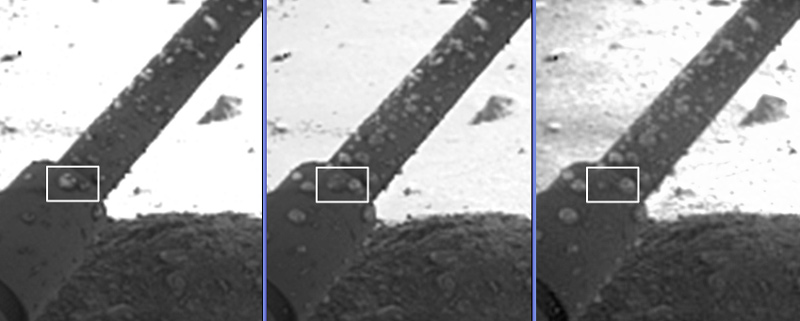
Water droplets appear to be growing on Phoenix's leg shortly after landing on Mars (NASA)
Water droplets appear to be growing on Phoenix’s leg shortly after landing on Mars (NASA)

NASA scientists are currently trying to understand a set of images taken by the Phoenix Mars Lander shortly after it landed on the Red Planet in May 2008. The images in question show one of the robot’s legs covered in what appears to be droplets of liquid water. The droplets remain on the lander for some time, appearing to get larger and changing shape.

By now, we know that liquid water (apparently) hasn’t existed on the Martian surface for hundreds of millions of years; the atmosphere is currently too thin and too cold to support liquid water. However, the confirmed presence of perchlorate in the regolith may provide an important clue as to what might be going on…
Continue reading “Liquid Water on Mars?”

Bad Astronomy Scoops Time “25 Best Blogs 2009” Award

Bad Astronomy - One of Time's top 25 blogs of 2009

It is always fantastic to hear blog has been recognised by the mainstream media, but when a site from the space blogosphere is recognized by Time.com as one of 25 best blogs of 2009, that’s a big deal. Phil Plait’s Bad Astronomy is officially up there with other blog monsters such as the Huffington Post, BoingBoing and Mashable (although few would argue against Bad Astronomy being the biggest space/astronomy/sceptical blogs out there).

So here is Phil, stepping up to the podium to accept his award:

They seemed to like the idea of a skeptical blog, which is probably what I like most about what they wrote. It’s very gratifying indeed to know that people out there appreciate a reality-based opinion. One of my overarching goals is to avoid dogma and bias and use only factual evidence on which to base my opinions. I know some people will disagree with this, but in general I think that’s because they don’t like the conclusions I reach. But I have found over the years that the hardest thing to accept as a skeptic is that the Universe doesn’t care what you think is true, it only cares about what is true.

There’s a big difference, sometimes.

–Phil Plait, Bad Astronomy (Feb. 17th, 2009)

Congratulations Phil! Your blend of healthy scepticism, astronomy, science and humour continues to inspire and motivate the rest of the science blogging world, this award recognizes Bad Astronomy as being one of the few “standard candles” cutting through the noise that is the Internet.

Grab Your Mai Tai and Helmet, We’re Flying into Space… from Hawaii!

Coming to a tropical island near you (NASA, edited by Ian O'Neill)

Hawaii state officials are seriously considering applying to the Federal Aviation Administration (FAA) for a spaceport licence. According to local media, Hawaii has been approached by four space tourism companies wanting to launch their spaceplanes from the Pacific islands. I’m assuming that includes Rocketship Global (as their promo video was being used in the report), XCOR (as their Lynx would be more than capable of using existing runways) and possibly Virgin Galactic? Richard Branson is making moves to launch passengers through the Aurora Borealis from the Swedish town of Kiruna, why not launch passengers from a tropical location too? Makes perfect sense.

At first, I was a little sceptical about this possibility, after all who really wants spaceplanes blasting into suborbital space from one of the most beautiful locations on the planet? I’ve visited Maui and Oahu, and I would hate to see any (more) damage done to the place. However, these commercial spaceplanes aren’t exactly huge polluters (no more than your average airliner that lands at Honolulu International in any case) and the launches would be a great source of revenue for the islands in the form of taxes (as will be the case in New Mexico) and tourism. And then there’s the possibility of accessing Hawaii via suborbital flightpaths from California and Japan. Flight-time from Hawaii to mainland US will be slashed from five hours to 90 minutes. If that means I can leave my house and be on Waikiki in about two hours… who am I to stand in the way of progress?

Unfortunately a lot of misplaced hope and optimism is placed on commercial spaceflight, so we’ll have to see how the Hawaii Spaceport idea develops before we go getting too excited…

For more, check out Space Tourist Suborbital Flight from Hawaii?

Twitter Physics: #physics140

physics140

If you are familiar with Twitter, you will have come across search tags (words with the hash character in front, i.e. “#searchterm”). So today I decided to create #physics140 where any Twitter user can submit an everyday example of physics.

Examples:

@MDBenson: Cat with wet paws jumps on handbasin for a drink, slips and falls off with a crash and a lot of spitting. Friction Fail #physics140

@astroengine: Turns out that putting ur coffee mug ontop of a subwoofer during NTrance “Set You Free” vibrates said mug onto the floor. #physics140

We’ll see how this works out, but it could be fun as well as educational. So, get onto Twitter and include your piece of everyday physics in 140 characters or less!

For easy tag browsing, check out the #physics140 @tagalus listing (thanks @natronics!)

The MSL is Too Expensive? Who Cares! We’re Searching For Life!

$2.2 billion eggs. One basket. The MSL "Skycrane" lowers the 850kg rover to the Martian surface (NASA)
$2.2 billion eggs. One basket. The MSL Skycrane lowers the 850kg rover to the Martian surface (NASA)

Don’t get me wrong, I am incredibly excited about any planetary mission, no matter how much it costs. However, there is something about the Mars Science Laboratory (MSL) that makes me uneasy. The project may be delayed (the MSL is scheduled for a 2011 launch) and it may be costing more than NASA projected, but it’s not these factors I’m worried about.

The MSL is built on a “bigger and better” mentality; it dwarfs both of the Mars Exploration Rovers Spirit and Opportunity, plus it is packing a rather impressive suite of 10 complex scientific instruments to carry out an unprecedented campaign in the Martian dirt. Oh, and did I mention it will be powered by radioisotope thermoelectric generators (RTGs), a complete departure from the tried and tested solar panelled rovers? Oh hold on, as the MSL weighs nearly a tonne, a brand new method of landing the thing is required (simply parachuting, air bag bouncing or rocket thruster powered landings are now passé). The “Skycrane” that looks like one of those hoverboards from Back to the Future II has been invented to gently lower the MSL (pictured above).

Still, I’m not too concerned, NASA has proven itself countless times at overcoming technological challenges. That’s why NASA is there, to research and develop new technologies and science. But what if the MSL has gone too far? What if the technology is too untried and untested? Unfortunately, it looks like the recent turn of events have taken even the MSL program manager by surprise
Continue reading “The MSL is Too Expensive? Who Cares! We’re Searching For Life!”

Sci-Fi Romance and the Carnival of Space Love

WALL-E, the best animated-sci-fi-robot-romantic-comedy of all time (yep, I teared up at the end)
WALL-E, the best animated-sci-fi-robot-romantic-comedy-adventure of all time (yep, I even teared up at the end).

I couldn’t resist. As it is the day of romance, love and *pinging* cash registers, I thought I’d post a special Astroengine commentary of Valentines Day. Everyone is doing it; the Google logo is loved up, the news websites are buzzing about it, even the blogs seem to be obsessed with relating their craft with the desire for some romance (even this week’s Carnival of Space over at 21st Century Waves is “doing it”), so here’s some random Valentine’s Day paraphernalia for your reading pleasure…
Continue reading “Sci-Fi Romance and the Carnival of Space Love”

A Windy Day on Mars Gives Spirit an Energy Boost

On Mars, there are no car washes, no windscreen wipers, no rain, no fans... you get the picture... (NASA)
On Mars, there are no car washes, no windscreen wipers, no rain, no fans... you get the picture. (NASA)

By far the biggest difficulty for robotic operations on the Martian surface are Sun-blocking dust storms. Not only do red-tinted dust clouds block the Sun from penetrating the atmosphere, the dust grains fall on solar panels, creating a layer of dusty sunscreen, reducing the amount of light falling on the photovoltaic cells. This is a special problem for long-term missions on the Red Planet. The rovers Spirit and Opportunity have been pottering around in the Martian regolith for over five years, mission planners had little idea their tough explorers would live much beyond their designed 3 month lifespan; long-term accumulation of dust was of no concern… until now.
Continue reading “A Windy Day on Mars Gives Spirit an Energy Boost”