The biggest experiment ever conceived by mankind was powered up today (Wednesday morning, GMT) and successfully circulated the first beam of protons. This is the first step toward LHC particles attaining relativistic velocities, completing 11,000 laps of the 27 km (17 mile) Large Hadron Collider (LHC) per second. This incredible feat of accelerator engineering is unparalleled, eventually allowing two counter-rotating beams of particles to be focused and collided within scales previously unimaginable. It is hoped the LHC will accelerate particles to such high energies that 14 TeV collisions will be possible by 2010, possibly revealing undiscovered particles, including the much sought-after Higgs Boson.
Although today is a hugely significant time for science (and a historic one for mankind), the first collisions will take place in October; today is a “dry run,” allowing the protons to circulate one-way. According to sources, today’s protons were accelerated around the instrument without issue, prompting LHC engineers to cheer when it was confirmed everything was on track… Continue reading “Success! Engineers Cheer as Particles Blast Around LHC”
On writing the article “Anyone Who Thinks the LHC Will Destroy the World is a Tw*t.” on Astroengine.com, I had no idea it would hit the front page of Digg.com and generate thousands of hits (booting Astroengine offline for 20 minutes). I wrote the supportive post as I believe Brian’s quote (from the Telegraph website), summed up the strain particle physicists are beginning to feel.
The original quote could be misconstrued as being offensive, but I believe the vast majority understood what he was saying. Brian was responding to reports that LHC scientists had received death threats in the run-up to the September 10th start date of the particle accelerator. With a combination of disinformation being spread by certain ill-informed individuals, media hype and mass hysteria, a solid statement was needed by a leading physicist to tame the unnecessary fear being whipped up.
I’ve been banging on about how safe the LHC is for some time, and I even vowed not to post another LHC doomsday debunking article as, quite frankly, I’m sick to death with the idiotic claims that micro-black holes, stranglets or gremlins could be produced by the LHC. The fact is that there is no danger and Brian explains why… Continue reading “A Statement By Professor Brian Cox”
I’m a huge fan of Brian Cox. He’s often referred to as the “rockstar of physics,” which is a big complement considering the stereotypical physicist in everyone’s mind. From the get-go you know that Professor Cox is a guy you want in your laboratory, and you can see why from this excellent TED lecture he gave in Monterey, CA, this year. He is a tireless advocate of communicating science to the world and his outreach style is second-to-none. But like many modern scientists who are working on cutting-edge research, they are often at the mercy of public misconception, media hype and personal attacks. So when I hear news that some Large Hadron Collider (LHC) physicists are receiving death threats, I lose my faith in humanity… Continue reading ““Anyone Who Thinks the LHC Will Destroy the World is a Twat.””
Over a month ago, I was asked to be a surprise guest over on Paranormal Radio with Captain Jack. And what was the discussion? Walter Wagner was on air discussing his “Doomsday Suit” against the US partners of the Large Hadron Collider at CERN and I had the great opportunity to put some questions to him. Critically for me, at about 99 minutes into the three-hour show (as I make my entrance), I ask Walter about his previous attempts at suing other particle accelerators (such as the Relativistic Heavy Ion Collider – RHIC – back in 1999). From that point on I believe the validity of the current LHC lawsuit seemed purely academic, but it certainly made for some great discussion.
Walter put across his views in a coherent and knowledgeable way and I made a point that scientists need to be challenged so the LHC can be fully justified (but I did also point out that filing a lawsuit might have pushed it a little too far). Although enjoyable, Walter didn’t convince me to change my views…
(Listen out for how many times I say “speculative”…)
The decay rate of the radioactive isotope 32Si appears to correlate with orbital distance from the Sun (Jenkins et al. 2008)
Wouldn’t you think that the decay rates of isotopes found on Earth would remain fairly constant under controlled conditions? Statistically-speaking one would be able to make a pretty good prediction about a radioactive element’s decay rate at any point in the future, regardless of external influences. However, a group of researchers have found the radioisotope decay rates of radium (226Ra) and silicon (32Si) varies periodically. This may not seem strange at first, but when measured, this fluctuation in decay rate has a period of approximately a year. Does this relate to the Earth’s position in its orbit? Does this mean radioactive decay rates are influenced depending on how far the element is from the Sun? Perhaps decay rates are not as predictable as we think… Continue reading “A Strange Connection: Could Nuclear Decay Rates be Influenced by Distance From the Sun?”
…actually, it’s 50 days until the first particle collisions, but who’s counting?
Right, this is officially the last Astroengine.com article I will write about the fear surrounding the Large Hadron Collider at CERN. All future articles will be consumed by the stunning science being carried out at this historic facility near Geneva in Switzerland. I realised months ago that scientists are on a losing battle when it comes to using scientific reasoning to quell the misinformation being communicated about what the LHC can do. Firstly, micro black holes will most likely not be produced (and besides, if they are, they will only live for an infinitesimally short period of time). Secondly, stranglets and magnetic monopoles have a vanishingly small chance of even existing in theoretical physics (they are speculative at best), let alone the nigh-on impossible event any man-made experiment could ever generate them. They are hypothetical particles.
To put the probability of the LHC creating a doomsday scenario into perspective, there is a better probability that a) all the air in my office will spontaneously drift to the other side of the room, leaving me to suffocate; b) I will spontaneously disappear as every single subatomic particle in my body decides to return their energy to the vacuum, or c) our four-dimensional space (three spatial and one temporal) will instantaneously become more “space-like,” freezing us in a strange new Universe where nothing happens (sorry, I’m getting a little carried away now). The point I am trying to make is that there is a higher risk of something “strange” happening to us in the “real world” than there is of something “strange” happening to the entire planet after being triggered by the LHC…
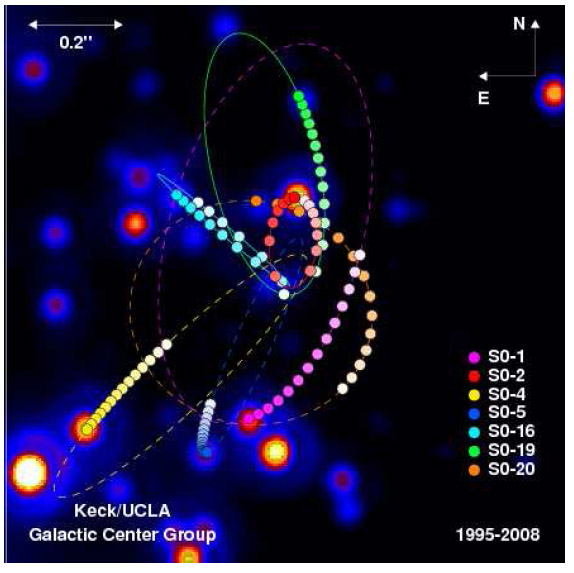
Yearly location of stars within 0.2 parsecs from Sagittarius A* orbiting the common, compact radio source (A. Ghez)
We are told there is a supermassive black hole living in the centre of our galaxy. Apparently, supermassive black holes can be found in the centre of most galactic nuclei, and all the stars within the surrounding galactic disk will orbit around it. But how do we know there is a huge black hole in the centre of the Milky Way? What evidence is there? It turns out there is quite a lot, actually.
In a recent review of the subject, the radio emissions observed since the 1950’s are examined. However, probably the most striking piece of evidence is the figure to the left. Of course, we know black holes exert a massive gravitational pull on local space, and by observing the centre of our galaxy, we find there is a huge gravitational influence over a compact cluster of stars, all orbiting a common point, reaching orbital velocities of 5000 km/s… Continue reading “Meet Sagittarius A*, Our Very Own Supermassive Black Hole”
Just as we were getting concerned that the Sun may be facing an extended solar minimum, amateur astronomers, in the last few hours, have observed a new sunspot pair appearing around the Sun’s south-eastern limb. They are young, emergent spots, gradually getting larger. It will be interesting to see how they evolve. The observation above was taken by Pavol Rapavy in Rimavska Sobota, Slovakia, and now we have detailed images of the region by a British astronomer too (sounds like the Sun might be making an appearance for the UK summer at last!)… Continue reading “Breaking News: We Have Sunspots, First for Over a Month”
Artist rendition of Higgs bosons generated after a particle collision. Created for Niels Bohr institute by artist-in-residence Mette Høst
Billions of Euros have been ploughed into the construction of the largest experiment known in the history of mankind. The Large Hadron Collider (officially due to be “switched on” September 10th 2008) will eventually create proton-proton collision energies near the 14 TeV mark by the end of this decade. This is all highly impressive; already the applications of the LHC appear to be endless, probing smaller and smaller scales with bigger and bigger energies. But how did the LHC secure all that funding? After all, the most expensive piece of lab equipment must be built with a purpose? Although the aims are varied and far-reaching, the LHC has one key task to achieve: Discover the Higgs Boson, the world’s most sought-after particle. If discovered, key theories in particle physics and quantum dynamics will be proven. If it isn’t found by the LHC, perhaps our theories are wrong, and our view of the Universe needs to be revolutionized… or the LHC needs to be more powerful.
Either way, the LHC will revolutionize all facets of physics. But what is the Higgs boson? And why in the hell is it so important?
I’ve read many very interesting articles about the Higgs boson and what its discovery will do for mankind. However, many of these texts are very hard to understand by non-specialists, particularly by the guys-at-the-top (i.e. the politicians who approve vast amounts of funding for physics experiments). The LHC physicists obviously did a very good job on Europe’s leaders so this gargantuan particle accelerator could secure billions of euros/dollars/pounds to be built.
There is a classic physics-politics outreach example that has become synonymous with LHC funding. On trying to acquire UK funding for the LHC project in 1993, physicists had to derive a way of explaining what the Higgs boson was to the UK Science Minister, William Waldegrave. This quasi-political example is wonderfully described by David J. Miller; Bryan Cox also discusses the same occasion in this outstanding TED lecture.
What is the Higgs boson? The Short Answer
Predicted by the Standard Model of particle physics, the Higgs boson is a particle that carries the Higgs field. The Higgs field is theorized to permeate through the entire Universe. As a massless particle passes through the Higgs field, it accumulates it, and the particle gains mass. Therefore, should the Higgs boson be discovered, we’ll know why matter has mass.
What is the Higgs boson? The Long Answer
Firstly we must know what the “Standard Model” is. In quantum physics, there are basically six types of quarks, six types of leptons (all 12 are collectively known as “fermions”) and four bosons. Quarks are the building blocks of all hadrons in the Universe (they are contained inside common hadrons like protons and neutrons) and they can never exist as a single entity in nature. The “glue” that holds hadrons together (thus bonding quarks together) is governed by the “strong force,” a powerful force which acts over very small distances (nucleon-scales). The strong force is delivered by one of the four bosons called the “gluon.” When two quarks combine to form a hadron, the resulting particle is called a “meson“; when three combine, the resulting particle is called a “baryon.”
The Standard Model. Including 6 quarks, 6 leptons and four bosons. Source: http://tinyurl.com/6z3tb3
In addition to six quarks in the Standard Model, we have six leptons. The electron, muon and tau particles plus their neutrinos; the electron neutrino, muon neutrino and tau neutrino. Add to this the four bosons: photon (electromagnetic force), W and Z bosons (weak force) and gluons (strong force), we have all the components of the Standard Model.
However, there’s something missing. What about gravity? Although very weak on quantum scales, this fundamental force cannot be explained by the Standard Model. The gravitational force is mediated by the hypothetical particle, the graviton.
The Higgs Field
The Standard Model has its shortcomings (such as the non-inclusion of the graviton) but ultimately it has elegantly described many fundamental properties of the quantum and cosmological universe. However, we need to find a way of describing how these Standard Model particles have (and indeed, have no) mass.
Permeating through all the theoretical calculations of the Standard Model is the “Higgs field.” It is predicted to exist, giving quarks and gluons their large masses; but also giving photons and neutrinos little or no mass. The Higgs field forms the basic underlying structure of the Universe; it has to, otherwise “mass” would not exist (if the Universe is indeed governed by the Standard Model).
People evenly distributed in a room, akin to the Higgs field (CERN)
As a particle travels through the Higgs field (which can be thought of as a 3D lattice filling the Universe, from the vacuum of space to the centre of stars), it causes a distortion in the field. As it moves, the particle will cause the Higgs field to cluster around the particle. The more clustering there is, the more mass the particle will accumulate. Going back to David J. Miller’s 1993 quasi-political description of the Higgs field, his analogy of the number of people attracted to a powerful politician rings very similar to what actually happens in the Higgs field as a particle passes through it (see the cartoon left and below).
Using the cartoon of Margaret Thatcher, ex-UK Prime Minister, entering a crowded room, suddenly makes sense. As Thatcher enters the room, although the people are evenly distributed across the floor, Thatcher will soon start accumulating delegates wanting to talk to her as she tries to walk. This effect is seen all the time when paparazzi accumulate around a celebrity here in Los Angeles; the longer the celeb walks within the “paparazzi field,” more photographers and reporters accumulate.
Then Thatcher enters the room, people gather, mass increases (CERN)
Pretty obvious so far. The Thatcher analogy worked really well in 1993 and the paparazzi analogy works well today. But, critically, what happens when the individual accumulates all these people (i.e. increase mass)? If they are able to travel at the same speed across the room, the whole ensemble will have greater momentum, thus will be harder to slow down.
The Higgs Boson
So going back to our otherwise massless particle travelling through the Higgs field, as it does so, it distorts the surrounding field, causing it to bunch up around the particle, thus giving it mass and therefore momentum. Observations of the weak force (exchanged by the W and Z particles) cannot be explained without the inclusion of the Higgs field.
OK, so we have a “Higgs field,” where does the “Higgs boson” come into it? The Higgs particle is simply the boson that carries the Higgs field. So if we were to dissect a particle (like colliding it inside a particle accelerator), we’d see a Higgs boson carrying the Higgs field. This boson can be called a Higgs particle. If the Higgs particle is just an enhancement in the Higgs field, there could be many different “types” of Higgs particles, of varying energies.
British particle physicist Peter Higgs (as seen in the 1960s), Higgs boson namesake and lead researcher on the Higgs mechanism (Peter Tuffy)
This is where the LHC comes in. We know that the Higgs boson governs the amount of mass a particle can have. It is therefore by definition “massive.” The more massive a particle, the more energy it has (i.e. E = mc2), so in an effort to isolate the Higgs particle, we need a highly energetic collision. Previous particle accelerator experiments have not turned up evidence for the Higgs boson, but this null result sets a lower limit on the mass of the Higgs boson. This currently holds at a rest-mass energy of 114 GeV (meaning the lower limit for the Higgs boson will be greater than 114 GeV). It is hoped that the high energy collisions possible by the LHC will confirm that the Higgs exists at higher masses (predicted in the mass range of 0.1-1 TeV).
So why is the Higgs boson important?
The Higgs boson is the last remaining particle of the Standard Model that has not been observed; all the other fermions and bosons have been proven to exist through experiment. If the LHC does focus enough energy to generate an observable Higgs boson with a mass over 114 GeV, the Standard Model will be complete and we’ll know why matter has mass. Then we will be working on validating the possibility of supersymmetry and string theory… but we’ll leave that for another day…
But does the Higgs boson give hadrons the ability to feel pain? I doubt it…
Special thanks to regular Astroengine reader Hannah from São Paulo, Brazil for suggesting this article, I hope it went to some way of explaining the general nature of the Higgs boson…
Hold on, I’ve just found out some worrying news from the Large Hadron Collider (LHC). This mammoth experiment goes online in one month and two days and I don’t think we’ve fully grasped what this machine is going to do.
It will kill hadrons, by their millions.
I know, I felt the same way. What kind of deprived mind would think up such a plan? There we are being told by the physicists that colliding hadrons at high energies will somehow benefit mankind. We are also being told by the doomsayers that the LHC will create a micro black hole, killing us all. But so far there has been little thought for the tiny elemental particles caught in the middle of all this. Do you think they want to be accelerated to the point where they resemble a wave more than a particle? No. Do you think they want to be bashed at high speed, splattering their innards around the inside of a detector chamber? No.
Please, spare a thought for all those innocent quarks, they don’t have a voice…




 astroengine.com