Something pretty cool has just happened over at that “2012 Comet” doomsday site (I won’t link to it, I can’t stomach sending any traffic to it, but here’s my Universe Today article about the subject).
I’ve had equal measures of praise and criticism for my most recent “No Doomsday in 2012” article. Most of the praise came in the form of: “I’m really glad you addressed the 2012 comet scenario, those ads were p***ing me off!“. However, it did get criticised for chasing after a “small website” with “very little written on it” which “obviously confuses” what a comet is and what Planet X is.
However, this “small website” (which actually receives an awful lot more traffic than Astroengine.com), has decided to comment on my views on the subject. And you know what? I think it has enhanced their content ten-fold.
As I type, the next Shuttle mission is STS-119, scheduled for launch on February 12th, 2009. The crew of Space Shuttle Discovery will deliver the final component of the International Space Station’s solar arrays, boosting power output from the solar panels to ensure the ISS can power all the facilities for space station crew expansion later this year.
As we are fast approaching the final handful of Shuttle launches before the whole fleet (Discovery, Atlantis and Endeavour) is retired in 2010, each and every launch will draw a lot of attention. When a shuttle launch is under way however, it is always nice to track the shuttle from Cape Canaveral until it reaches its final destination (in the case of STS-119, it will be the ISS. In May, the STS-125 Hubble Servicing Mission will dock with the orbiting telescope). For astronomers and observers, if you want to have the chance to spot the orbiting craft from the ground, you’ll need to track the spaceship to see if it is going to orbit over your location.
So, in preparation for STS-119 (and the rest of the Shuttle launches), here’s some useful tracking resources I use on a regular basis:
The day has come. Finally, I get to promote my excitement for the importance of Space Beer. Ohhh yes! Incidentally, Space Beer has been the theme of the last few days of the AAS conference (free beer, special free Galileo limited edition Sierra Nevada beer. Did I mention it was free?), so it seems fitting to have my 365 Days of Astronomy podcast broadcast the day after returning from the conference fuelled by (free) space-themed booze.
To top the whole experience off, I had the superb fortune to meet the musician behind the 365 Days of Astronomy theme tune, plus we were also treated to a mini-concert by him during the official USA opening of the International Year of Astronomy 2009 at the AAS conference on Tuesday. Written and performed by George Hrab, the entire audience at the IYA2009 grand opening ceremony had a great time singing along to the lyrics. I’m assuming the song is called “Far”, for obvious reasons. Funnily enough, in the audience participation parts of the tune, avatars participating in the Second Life virtual world were also singing along. George not only entertained the real world, he transcended this life to make the Second Life rock! Now that is inspirational!
A unique beer-fuelled AAS camera angle. Clockwise from top right: Pamela Gay, Fraser Cain, Chris Lintott and Ian O'Neill
It’s Thursday afternoon and the hangover is finally subsiding. This morning wasn’t a nice experience, having stumbled back to the hotel at 2am, knowing very well I had to get up at 7am for the final round of sessions at the AAS conference, I knew the lack of sleep might be a problem.
After all, there would be no presentations in the afternoon and I was very motivated to get the scoop on some more breaking astro news. Unfortunately, 7am turned into 10:30am, and although I tried, I couldn’t make it past the hotel lobby. For me, Thursday was cancelled. Oh well, at least the previous night was awesome… Continue reading “The AAS Finale: Astronomy Cast Meet-up (Photos)”
Events are amping up at the AAS conference in Long Beach. Tonight, we were treated to the official US opening of the International Year of Astronomy 2009 (plus superb live music by George Hrab, a Second Life IYA2009 ribbon-cutting and the premier of “400 Years of the Telescope“). In the day, I had a stack of presentations to go to including a session on black holes and another on white dwarfs… I never knew white dwarfs were so interesting!
The galactic centre in unprecidented detail from Hubble (NASA, ESA, and Q.D. Wang)
Day One: Information overload! When Fraser and I turned up in Long Beach, CA yesterday for the 213th American Astronomical Society meeting, I had an overwhelming feeling that I should have done my homework before travelling to the event. Hundreds of participants, hundreds of posters and hundreds of presentations… as an astrophysicist, I feel like a kid in a candy shop, but as a blogger, it’s hard to know where to start!
A shredded asteroid around a white dwarf star (NASA/JPL)
Fortunately Team Universe Today has some strong backup in the form of Nancy Atkinson who is operating from home, delivering a huge amount of AAS coverage on the Universe Today. This is good, as the Internet connection at the Long Beach Convention Center is patchy at best. It’s great to meet Pamela and everybody else involved in the Astronomy Cast effort, and everyone seems to be finding articles and lining up the press releases rather nicely.
I am just about to attend the 10am Session 328 Black Holes I presentations, and I’ll hopefully be adding a long “live blogging” post about each of the speakers. All going well a couple of interviews might come out of the session too. Until then, here’s a brief run-down of the Universe Today coverage of the various press releases, from supermassive black holes, brand new Hubble views of the galactic centre, shredded asteroids around white dwarfs to the heavy Milky Way…
Apollo 10 commander Tom Stafford pats the nose of a stuffed Snoopy held by Jamye Flowers (Coplin), Gemini astronaut Gordon Cooper's secretary (NASA)
On May 1969, Apollo 10 astronauts Gene Cernan, John Young and Thomas Stafford orbited the Moon on a reconnaissance mission that would lead to the first lunar landing by Apollo 11 later that year. During the mission, the lunar module came within 50,000 feet of the surface, to “snoop around”. It is therefore fitting that the module should be called Snoopy and the Apollo command module be named Charlie Brown.
In the scene above, Jamye Flowers Coplin (Gemini astronaut Gordon Cooper’s secretary) hugging a stuffed Snoopy, sees off the Apollo 10 crew as they make their way to the launch pad. Mission commander Tom Stafford gives Snoopy a rub on the nose.
Later this month, Charles M. Schulz Museum in Santa Rosa, will be celebrating the 40th anniversary of the Apollo 10 mission with an exhibition of the connection between the three pioneering astronauts and the tenacious cartoon beagle.
Snoopy’s connection with NASA actually began before Apollo 10. In 1968, NASA chose the beagle as an icon who would “emphasize mission success and act as a ‘watchdog’ for flight safety.”
Established that same year, the agency’s “Silver Snoopy Award” is considered the astronauts personal award, given for outstanding efforts that contribute to the success of human space flight missions. Award winners receive a sterling silver Snoopy lapel pin flown in space, along with a certificate and letter of appreciation from NASA astronauts. Fewer than 1% of the workforce is recognized with a Silver Snoopy annually, making it one of the most prized awards in the industry.
For me, the scene captures a very special moment in space flight history, one that I find strangely moving. The pride, excitement and bravery of the time are communicated wonderfully.
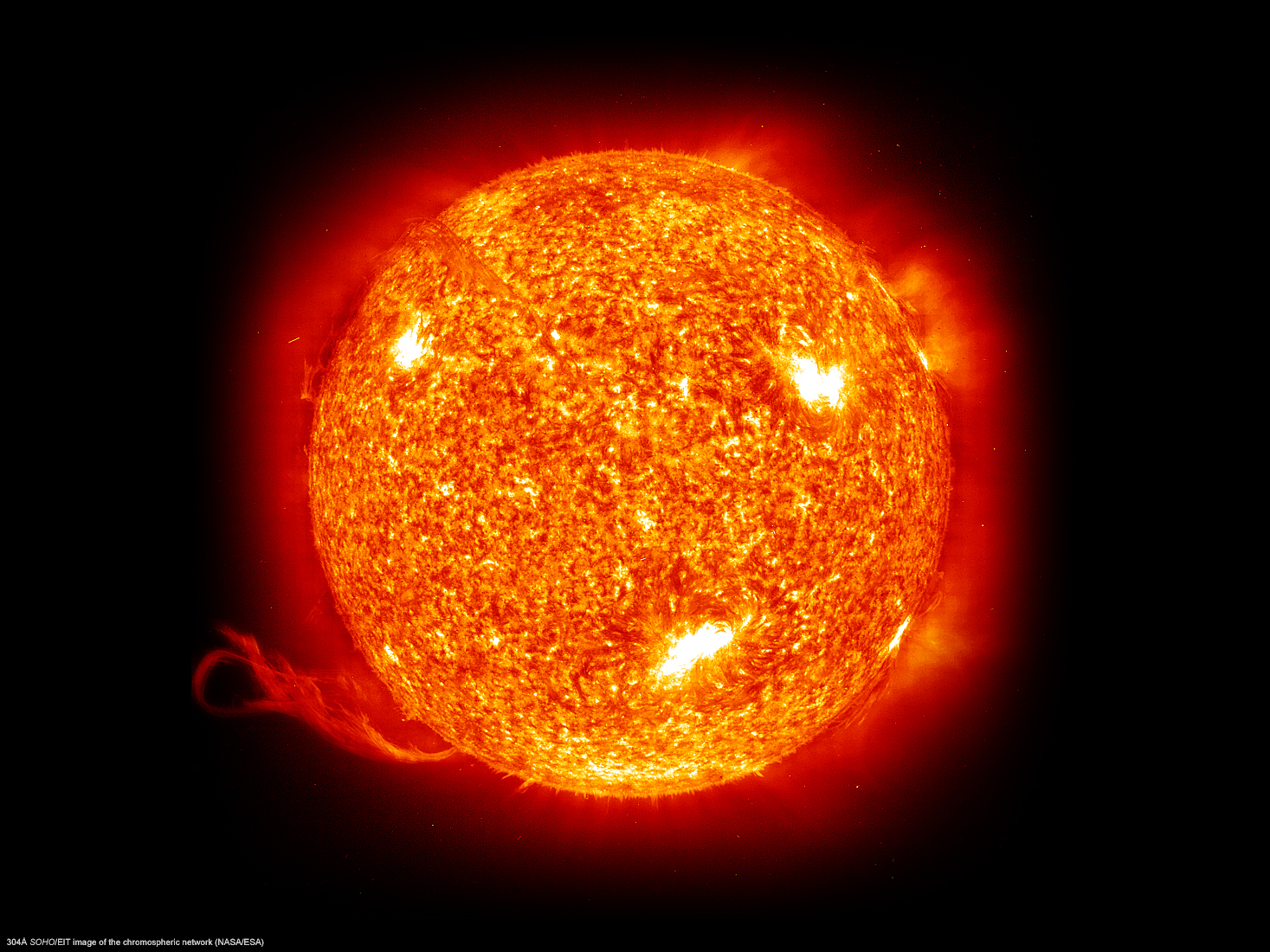
Back in 2006, I was feeling a bit nostalgic about my four years of research at the University of Wales, Aberystwyth Solar Group, so I decided to try to find some high resolution prints of the Sun. After a lot of effort, I didn’t find any prints I could buy or download, but I did find some high resolution images from the Solar and Heliospheric Observatory (SOHO) image archive. Although some were a bit noisy, I was able to clean them up with Photoshop and did some layer tweaking/saturation/balance to draw out the fine detail of the chromospheric network–as seen above in the 304A Extreme ultraviolet Imaging Telescope filter–plus a distinct prominence (in the bottom left-hand of the image).
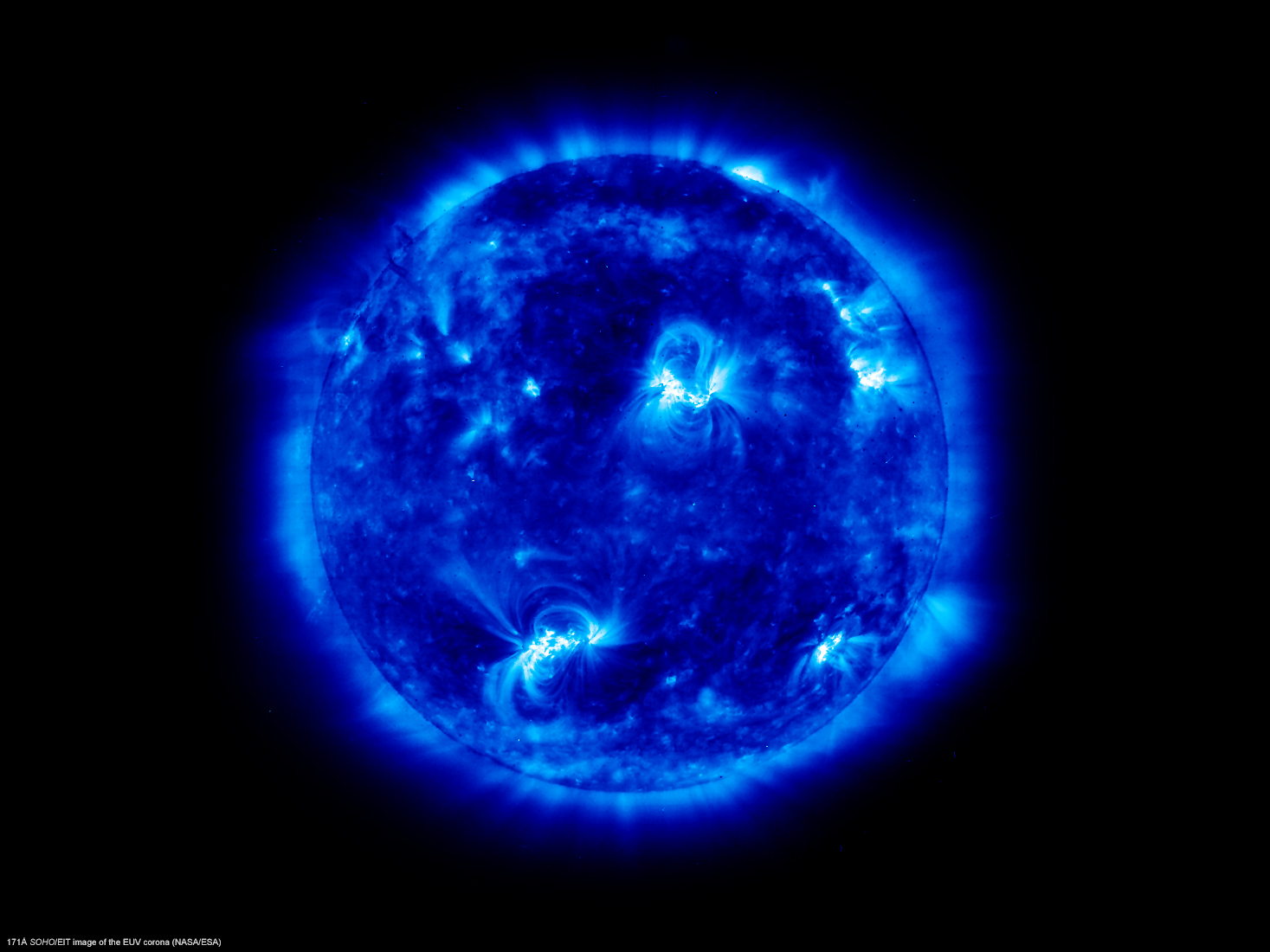
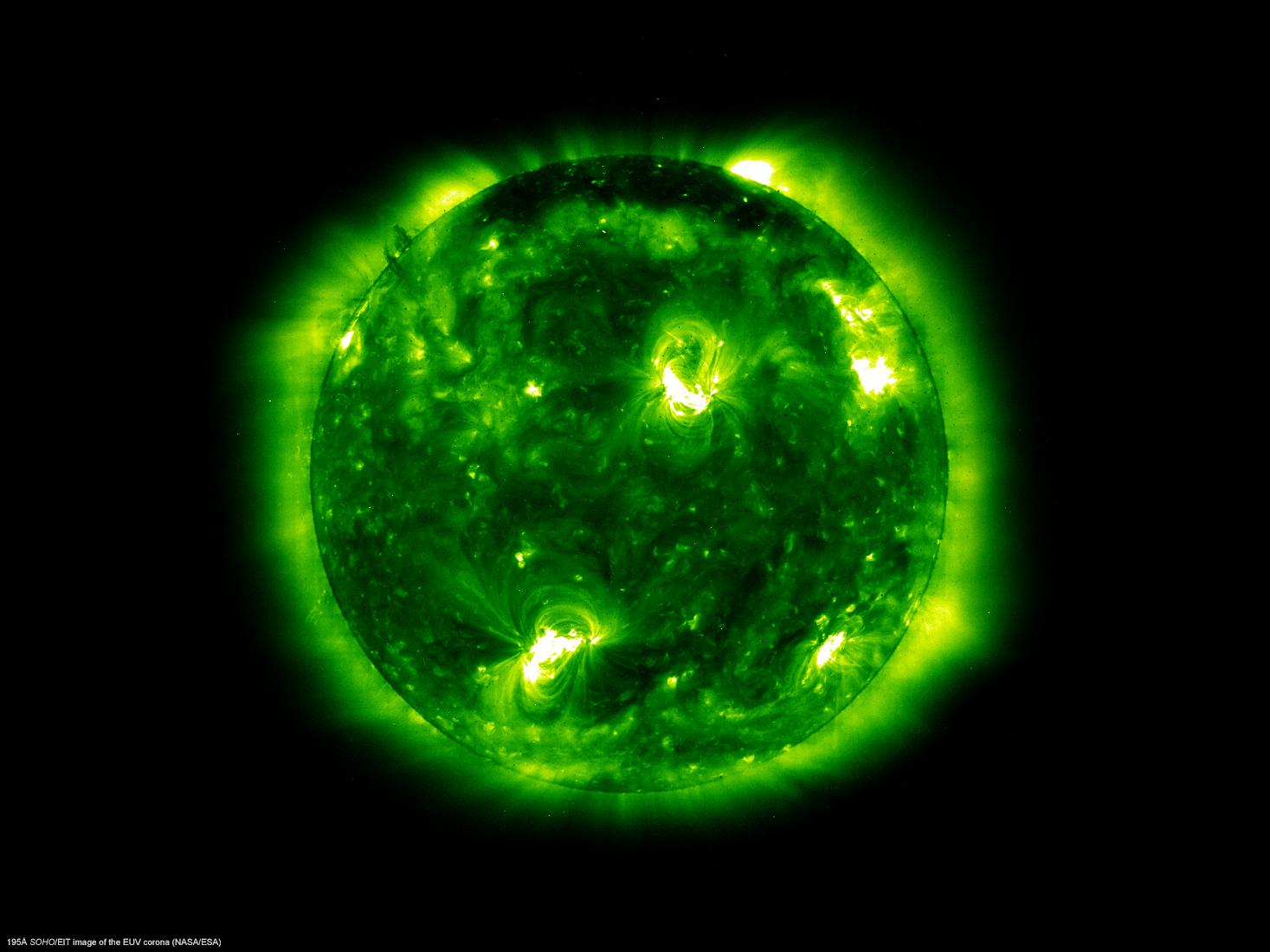
Not stopping there, I decided to give the same treatment to high resolution 171A and 195A images. They came out very well and I kept rotating them as my wallpaper for months. Having just read Phil’s post on today’s perihelion (the time of year when the Earth is at its closest to the Sun during its orbit), I came across a comment asking whether anyone had any wallpapers of the same 304A EIT image. Well, here it is! Plus two more!
If anyone wants to find out how the images were edited, feel free to ask and I’ll let you know. Truth be known, there’s thousands of space images held by NASA, ESA etc. open to the public domain that rarely get the “airtime” they deserve. So it’s about time I dust off these three-year old edits and share the magnetohydrodynamic love.
I miss active regions, I wish the Sun would amp it up a bit so we can see all those lovely flares, CMEs, filaments and coronal loops… ahhhh… coronal loops…
The January AAS meeting is being held in Long Beach, CA (Image by Kevin Stanchfield)
I’m currently organizing myself for this week’s AAS meeting down in Long Beach, so expect a feast of breaking news and information from one of the biggest astronomical conferences on the planet! Dictaphone? Check. Pen? Check. Laptop? Check. Camera? Check… Beer money? What do you think?
Who?
I’ll be travelling down to Long Beach tomorrow to join forces with the rest of the New Media crowd, including my Universe Today publisher, Fraser Cain. Joining us will be Pamela Gay (a.k.a. Star Stryder), Chris Lintott, Michael Koppelmann, Georgia Bracey and Jordan Raddick. It will be great to finally put a face to all these names I’ve become so used to in the last year of blogging.
What?
This will be a new experience for me, as although I’ve been to many conferences, this will be the first time I’ll be reporting on other people’s research. So, the pressure is off and I can enjoy the vast ocean of knowledge being shared with the world. However, this isn’t going to be your normal reporting gig. Pamela and Fraser have been organizing this New Media venture to distribute information accurately and rapidly. This is the power of blogging; we are on the ground publishing articles as the news becomes available. This means you don’t have to wait to get your conference news fix, it will appear on the blogs as soon as we hear it.
Astroengine Live!
Internet connections permitting, I’ll be running my Wednesday Astroengine Live from the scene at the Long Beach Convention Center. I’ll see if I can get some interviews in, and a lot of the reporting will be done on-the-fly, but it should make for an interesting show! That’s 4pm PST, Wednesday January 7th, Astroengine Live via WPRT Radio!
When?
So, from Monday Jan. 5th, to Thursday Jan. 8th, I hope to stack Astroengine.com full with breaking news articles from the frontier of astrophysics, astronomy and space exploration.
How?
I will also be dumping as much information onto the Universe Today as possible. Plus, ace Universe Today writer Nancy Atkinson will be back at UT Mission Control overseeing the whole event. This way, you don’t only get your regular news updates, you also get the best the AAS has to offer!
All blog posts on every space news website will be linked to via Astronomy Cast LIVE, so be sure to check on that regularly for your up-to-the-minute news.
Don’t forget Twitter! I will be firing microblog posts out every time I get a new piece of news, so be sure to follow Astroengine.com’s Twitter Feed. I might even activate the Twitter feed though my main blog on Astroengine.com, but we’ll see how quickly the news breaks before I do this (I don’t want to create a bottleneck of news overflow!).
Meet Us!
Rock Bottom Brewery... Location for the Wednesday meetup!
If you just happen to be in the Long Beach area on Wednesday, drop by the Rock Bottom bar and restaurant from 6pm-9pm to meet me, Fraser and the whole New Media/Astronomy Cast LIVE team!
Rock Bottom is located at 1 Pine Ave, at the E Ocean Blvd./Pine Ave. cross street. This place is big, in a prominent location on the corner of Pine, so you shouldn’t miss it. Check out Google Maps for the location.
So, keep an eye on Astronengine.com, Universe Today, Astronomy Cast LIVE and my Twitter feed for the full spectrum of the conference… it’s going to be awesome.
The hot spring, Sapphire Pool at the Biscuit Geyser Basin in Yellowstone National Park (Getty)
Since December 26th, hundreds of small earthquakes have shimmied Yellowstone National Park.
Earthquake swarms are a collection of small earthquakes over a short space of time. These aren’t aftershocks of one primary, larger quake, they are quakes in their own right. Yellowstone National Park, located mainly in the state of Wyoming (stretching into Montana and Idaho), plays host to the Yellowstone Caldera, a volcanic hotspot where molten mantle rock bubbles to the surface. This activity creates hot springs and is the energy source of many geysers.
The last Yellowstone “supereruption” occurred 640,000 years ago, but there have been many smaller eruptions and lava flows since then; the most recent being 70,000 years ago.
Any earthquake in the largest volcanic system in North America will therefore cause excitement and a little concern, and these recent earthquake swarms are an oddity. Yellowstone is no stranger to earthquake swarms, but the recent frequency of events are unusual scientists say.




 astroengine.com