Supermassive Black Hole Flare Lights Up Mysterious Molecular Torus

Artists impression of a light echo from the surrounding torus of a supermassive black hole (Max Planck Institute)

Theoretically, supermassive black holes that occupy the centre of galaxies (including our own) are surrounded by a vast cloud of gas. Depending on the angle you are viewing this molecular torus will obscure the supermassive black hole’s bright accretion disk. Until now, this vast doughnut of matter has never been observed, but with the help of the supermassive black hole accretion disk and a dying star, there’s a possibility that the molecular torus will not only be observed, but also mapped…
Continue reading “Supermassive Black Hole Flare Lights Up Mysterious Molecular Torus”

What Happens When Two Galaxies Collide?

A galactic collision between NGC 2207 and IC 2163 (HST)

So what does happen? Will the stars crash into one another, sending out huge emissions of gamma radiation and gravitational waves? The effects of two galaxies meeting and colliding are actually a little more elegant than that – for starters, it’s most likely that none of the stars will meet due to the huge distances between star systems. Also, the merging of the systems will spark a huge campaign of star creation within the newly formed fertile gas clouds. So what will we see long after the galaxies have ripped each other apart? Simulations show huge arcs of tidally-formed dust and stars, looking strangely like the precursors to the galactic ghosts recently observed
Continue reading “What Happens When Two Galaxies Collide?”

Carnival of Space #50 @KySat

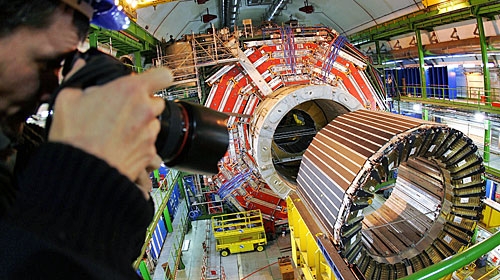
The LHC at CERN (CERN)

This week’s 50th edition of the Carnival of Space is hosted by Wayne Hall over at KySat in Kentucky. The Kentucky space science movement seems to be in full swing, culminating in the excellent KySat website. This week, we have stories ranging from rocket racing, monkeys in space (my personal favourite!), Saturn’s moon Titan and my contribution: LHC Worries are Based on Fear of the Unknown, not Science.

Superb space science reading from the entire space-science blogosphere, so go and check it out

The Sinister Side of the Cosmos: Killer Galaxies, Cosmic Forensic Science and Deadly Radiation

The ghost of a dead dwarf galaxy hangs around the killer, spiral galaxy (R. Jay Gabany)

It’s been a busy day with a range of topics posted on the Universe Today, but all have a common thread: the universe is a deadly place for man and galaxy. For starters, research into the radiation mankind will face when settling on Mars and the Moon could prove to be one of our main challenges in space. The threat of a massive dose of radiation from a solar flare is bad enough, but the gradual damage to our cells and increased risk of cancer is a problem we need to solve, or at least manage. But that’s nothing compared with what dwarf galaxies have to put up with; their larger spiral cousins like to eat them for dinner, leaving behind galactic ghosts of the dwarfs that were…
Continue reading “The Sinister Side of the Cosmos: Killer Galaxies, Cosmic Forensic Science and Deadly Radiation”

LHC Worries are Based on Fear of the Unknown, not Science

The construction of the LHC is nearing completion, exciting or worrying? (AP)

I’ve heard some crazy talk in my time, but the fear surrounding the Large Hadron Collider (LHC) at CERN has really surprised me. On writing a story last month that a guy in Hawaii (with a scant background in physics) was trying to pass a lawsuit to put a stop to the construction of the LHC, I realised the pressures physicists at the cutting edge of science are under. Physicists the world over have defended the science behind the LHC, and although some of the products from high energy particle collisions are as yet unknown, there is an infinitesimal chance that a black hole will swallow Earth… (I actually want a black hole to be created, the scientific implications will be revolutionary.)
Continue reading “LHC Worries are Based on Fear of the Unknown, not Science”

Carnival of Space #49 @WillGator.com

It’s that time of the week again, when all the space blogs get together for one almighty shindig, discussing the news, views and opinions on the blogosphere. It’s the Carnival of Space!

This week’s edition is hosted by fellow Englishman Will Gator, science writer for the BBC Sky at Night magazine. The stories are wide-ranging and diverse, and my contributions includes how Wolf-Raynet stars may be gamma ray bursts precursors (with a little help from their neutron star buddies) and I discuss some of the implications behind setting up a distributed Internet on future Mars colonies.

Thanks Will!

Will the First Mars Settlements have Internet Access?

A map on terrestrial internet. Credit: Lanet-vi program of I. Alvarez-Hamelin et al.

Imagine that you have just set up camp on Mars. Everything is up and running. You and your team have not only survived the journey from Earth, you’ve also made it through fiery re-entry and landed within a metre of your planned location. Success! So you crack open a miniature bottle of vintage whisky bottled in the year 2000 and share a sip with your companions. You want to tell the world, you want to check in with your family to say that you are “OK”.

It would be very poor if you were restricted to relaying a message though mission controllers. Simply “phoning home” for a chat wouldn’t be possible (the lag time between sentences would be at least 16 minutes). Could there be a way of sending emails? Possibly; voice messages will be fine too. But could our explorers set up a website or some “Mars blog” to document their travels? This could obviously be done remotely, with a terrestrial website, but there are strong arguments for a distributed Internet service on the Red Planet too. Can a “MarsNet” or “RedNet” be integrated with Earth’s Internet, establishing an “Interplanetary Internet”?
Continue reading “Will the First Mars Settlements have Internet Access?”

How Big is the Biggest Star in the Universe?

A comparison between the Sun and a hypermassive star. Credit: NASA

So how big is it? According to Fraser at the Universe Today, the largest known star is VY Canis Majoris. This is a massive star, otherwise known as a red hypergiant star and this one sits in the constellation Canis Major, about 5000 light years from Earth. Apparently it is more than 2100 times the size of our Sun, a monster! This star is so big that light takes more than eight hours to cross its circumference. In fact, this star, if placed in the centre of the Solar System, it would reach as far as the orbit of Saturn.

Although VY Canis Majoris is big, it isn’t as big as the biggest star could be. If it was cooler, a similar star could reach over 2600 times the size of our Sun…

Could a Wolf-Rayet Star Generate a Gamma Ray Burst?

Gamma ray bursts (GRBs) are the most energetic events to be seen in the observable universe. On March 19th, a record breaking GRB was observed in the constellation of Boötes by NASA’s Swift Observatory and ground based telescope arrays (i.e. the Polish “Pie of the Sky” GRB detector). This was an explosion unparalleled with anything we have ever seen. Not only was it the brightest GRB, it was the most distant GRB – this explosion occurred 7.5 billion years ago (it was therefore located 7.5 billion light years away). Taking measurements of the spectrum of light from these events not only helps us understand what causes such a massive detonation, but also reveals the nature of the Universe when it was half the age it is now.

In a new publication headed by the University of Utrecht, in The Netherlands, the highly dynamic and self-destructive Wolf-Rayet star has been singled out as a possible GRB progenitor after some complex tidal interactions with a binary partner, spinning-up the star until it collapses and unleashes vast amounts of energy into space…
Continue reading “Could a Wolf-Rayet Star Generate a Gamma Ray Burst?”

Carnival of Space #48

This weeks edition of the Carnival of Space is being housed over at the Next Big Future by futurist Brian Wang. Check out his site, you’ll find many ideas on the future of space technology, nanotechnology, anything to do with advanced concepts and the future. Great stuff.

I entered one article this week, a short discussion about the recent sunspot activity and the implications of the overlap of Solar Cycle 23 and 24… There’s more where that came from…