LHC Worries are Based on Fear of the Unknown, not Science

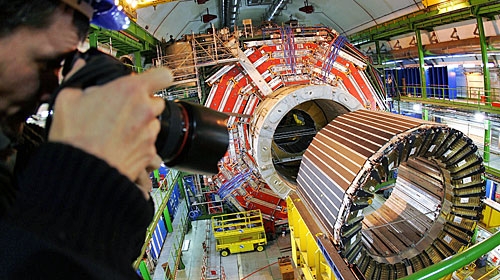
The construction of the LHC is nearing completion, exciting or worrying? (AP)

I’ve heard some crazy talk in my time, but the fear surrounding the Large Hadron Collider (LHC) at CERN has really surprised me. On writing a story last month that a guy in Hawaii (with a scant background in physics) was trying to pass a lawsuit to put a stop to the construction of the LHC, I realised the pressures physicists at the cutting edge of science are under. Physicists the world over have defended the science behind the LHC, and although some of the products from high energy particle collisions are as yet unknown, there is an infinitesimal chance that a black hole will swallow Earth… (I actually want a black hole to be created, the scientific implications will be revolutionary.)
Continue reading “LHC Worries are Based on Fear of the Unknown, not Science”

Human Space Exploration: Essential for our Survival

The International Space Station (NASA)

So what is the point of exploring space anyway? We have famine, disease and disaster here down on Earth, why the hell should we direct funds toward manned exploration of the Solar System and beyond? The answer is far from simple, but my personal answer is: to explore the undiscovered
Continue reading “Human Space Exploration: Essential for our Survival”

Carnival of Space #49 @WillGator.com

It’s that time of the week again, when all the space blogs get together for one almighty shindig, discussing the news, views and opinions on the blogosphere. It’s the Carnival of Space!

This week’s edition is hosted by fellow Englishman Will Gator, science writer for the BBC Sky at Night magazine. The stories are wide-ranging and diverse, and my contributions includes how Wolf-Raynet stars may be gamma ray bursts precursors (with a little help from their neutron star buddies) and I discuss some of the implications behind setting up a distributed Internet on future Mars colonies.

Thanks Will!

Daily Roundup: Space Station Dumps its Refuse and Three Black Holes Collide

Progress 28 module drops to Earth. Credit: NASA

In a quiet event, with no ceremony or sending off party, the Russian Progress 28 supply module was released from the International Space Station on Monday to fall to Earth as a fireball. On board, all the waste and unwanted equipment from the stations astronauts. The Progress module was launched in January to deliver food, water and other supplies, and with its usefulness at an end, the charred remains of the spaceship now sit at the bottom of the Pacific Ocean… Such a sad story for poor old Progress 28…
Continue reading “Daily Roundup: Space Station Dumps its Refuse and Three Black Holes Collide”

Will the First Mars Settlements have Internet Access?

A map on terrestrial internet. Credit: Lanet-vi program of I. Alvarez-Hamelin et al.

Imagine that you have just set up camp on Mars. Everything is up and running. You and your team have not only survived the journey from Earth, you’ve also made it through fiery re-entry and landed within a metre of your planned location. Success! So you crack open a miniature bottle of vintage whisky bottled in the year 2000 and share a sip with your companions. You want to tell the world, you want to check in with your family to say that you are “OK”.

It would be very poor if you were restricted to relaying a message though mission controllers. Simply “phoning home” for a chat wouldn’t be possible (the lag time between sentences would be at least 16 minutes). Could there be a way of sending emails? Possibly; voice messages will be fine too. But could our explorers set up a website or some “Mars blog” to document their travels? This could obviously be done remotely, with a terrestrial website, but there are strong arguments for a distributed Internet service on the Red Planet too. Can a “MarsNet” or “RedNet” be integrated with Earth’s Internet, establishing an “Interplanetary Internet”?
Continue reading “Will the First Mars Settlements have Internet Access?”

How Big is the Biggest Star in the Universe?

A comparison between the Sun and a hypermassive star. Credit: NASA

So how big is it? According to Fraser at the Universe Today, the largest known star is VY Canis Majoris. This is a massive star, otherwise known as a red hypergiant star and this one sits in the constellation Canis Major, about 5000 light years from Earth. Apparently it is more than 2100 times the size of our Sun, a monster! This star is so big that light takes more than eight hours to cross its circumference. In fact, this star, if placed in the centre of the Solar System, it would reach as far as the orbit of Saturn.

Although VY Canis Majoris is big, it isn’t as big as the biggest star could be. If it was cooler, a similar star could reach over 2600 times the size of our Sun…

Could a Wolf-Rayet Star Generate a Gamma Ray Burst?

Gamma ray bursts (GRBs) are the most energetic events to be seen in the observable universe. On March 19th, a record breaking GRB was observed in the constellation of Boötes by NASA’s Swift Observatory and ground based telescope arrays (i.e. the Polish “Pie of the Sky” GRB detector). This was an explosion unparalleled with anything we have ever seen. Not only was it the brightest GRB, it was the most distant GRB – this explosion occurred 7.5 billion years ago (it was therefore located 7.5 billion light years away). Taking measurements of the spectrum of light from these events not only helps us understand what causes such a massive detonation, but also reveals the nature of the Universe when it was half the age it is now.

In a new publication headed by the University of Utrecht, in The Netherlands, the highly dynamic and self-destructive Wolf-Rayet star has been singled out as a possible GRB progenitor after some complex tidal interactions with a binary partner, spinning-up the star until it collapses and unleashes vast amounts of energy into space…
Continue reading “Could a Wolf-Rayet Star Generate a Gamma Ray Burst?”

Carnival of Space #48

This weeks edition of the Carnival of Space is being housed over at the Next Big Future by futurist Brian Wang. Check out his site, you’ll find many ideas on the future of space technology, nanotechnology, anything to do with advanced concepts and the future. Great stuff.

I entered one article this week, a short discussion about the recent sunspot activity and the implications of the overlap of Solar Cycle 23 and 24… There’s more where that came from…

Astroengine.com Roundup and Opinion

It’s been a while since I last posted as I’ve been flying from the US to the UK and have only just gotten my office up and running. That’s not to say I haven’t been writing. On the Universe Today, I’ve posted quite a few articles ranging from quite an elaborate April Fools story (but not quite as elaborate as Virgin and Google’s Virgle prank), to a black hole hiding in the middle of Omega Centauri, to rocks rolling around on Mars… here’s a round up of the most interesting…
Continue reading “Astroengine.com Roundup and Opinion”

Upgrade to WordPress 2.5

Keeping up to date with the upgrades, astroengine.com has been successfully upgraded to version 2.5. Apparently v2.5 has been in the making for six months, and I must say, everyone has done a great job. The Administration section is especially nice. Let’s see if the upgrade converts into an increase in speed…

Ouch, a few plugins are now dead, but I’ll be sure to find replacements. Feel free to point out any problems with the site as you go, sending a message to ijo@astroengine.com.

More to come…