National Geographic Feature: “Star Struck” by Ken Croswell

An all-sky image of the Milky Way (Serge Brunier/NASA)

As promised, here’s an excerpt from astronomer Ken Croswell’s “Star Struck,” a National Geographic featured article from the December 2010 edition that takes us on a fascinating tour of the Milky Way.

Croswell discusses recent discoveries of hypervelocity stars, why planets are rare in the outermost reaches of our galaxy and the black hole hiding inside the galactic core. The Astroengine article “Life is Grim on the Galactic Rim” gets a mention as Croswell describes metal-poor stars and why life might be unlikely in those systems.

From “Star Struck”:

It’s hard to be modest when you live in the Milky Way. Our galaxy is far larger, brighter, and more massive than most other galaxies. From end to end, the Milky Way’s starry disk, observable with the naked eye and through optical telescopes, spans 120,000 light-years. Encircling it is another disk, composed mostly of hydrogen gas, detectable by radio telescopes. And engulfing all that our telescopes can see is an enormous halo of dark matter that they can’t. While it emits no light, this dark matter far outweighs the Milky Way’s hundreds of billions of stars, giving the galaxy a total mass one to two trillion times that of the sun. Indeed, our galaxy is so huge that dozens of lesser galaxies scamper about it, like moons orbiting a giant planet.

Read the rest of “Star Struck” by Ken Croswell in the December edition of National Geographic.

In addition to the article, National Geographic has a beautiful extended Milky Way gallery that’s well worth a look.
Astroengine Gets Quoted in National Geographic

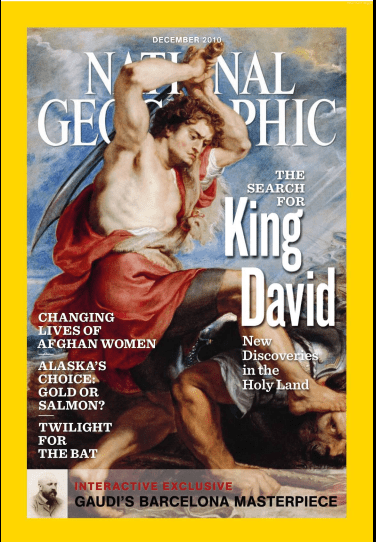
The December 2010 edition of National Geographic

A couple of months ago I was contacted by National Geographic magazine notifying me that one of their writers had quoted me in an article for their December issue. Pretty cool, I thought. But then I forgot all about it.

Then, I received a note from the ever watchful Bill Hudson (@2012hoax) telling me Astroengine had been printed on page 99. I quickly scurried over to the National Geographic website to find, sure enough, I was there too: on page 3 of the online article “Star Struck.”

The following morning, I received a complementary copy of the December edition so I could see Astroengine in print for the first time.

National Geographic’s special feature takes a fascinating tour of the Milky Way and when discussing metal-poor stars in the outermost reaches of our galaxy, the article quotes the title of the Astroengine post “Life is Grim on the Galactic Rim.” Obviously they like my rhyming skills.

Thank you National Geographic!

I’ve been told I can write a blog with an excerpt from the superb article written by Ken Croswell, so that’ll be coming right up!

I think I need to blog more…

Dead On Arrival: Necropanspermia Spawned Life on Earth?

Are those Martian fossils in meteorite ALH84001? (NASA)

Panspermia” is a hypothesis that life is transferred from planet-to-planet and star system-to-star system through some interplanetary or interstellar means.

But for panspermia to work, this life needs to be sufficiently protected — and, um, kept alive — from the worst the universe can throw at it (such as radiation, cold and vacuum). Alas, when considering interstellar hops, the timescales are likely too long (i.e. millions of years) and said life will be dead on arrival.

We know that Earth Brand™ life is a pretty hardy thing. After all, we’ve tortured terrestrial microbes and mosquito larvae in the vacuum of space to see if they’d pop. Sure enough, when brought back to terra firma the various creatures wriggled and squirmed as if nothing had happened. But these experiments in orbit were carried out over the course of months or years. While this might be suitable for interplanetary transfers, it would take millions of years for an extraterrestrial interloper to traverse even a modest interstellar gap.

Any hitchhikers that were alive on a stellar wind-blown particle will be toast (or, more accurately: freeze-dried, pulverized, mashed-up, DNA-shredded mess) on reaching their exotic destination eons later.

What good are tiny alien fossils when the panspermia model is supposed to seed other worlds with life… that’s actually alive?

Enter a new incarnation of pansermia: “Necropanspermia.”

Conceived by Paul Wesson, of Herzberg Institute of Astrophysics in Canada, necropanspermia is the transfer of the information of life to new worlds, wriggling extraterrestrial bacterium not required.

Assuming alien microbial life has made the trip across interstellar space, died and then fossilized, Wesson reckons the information contained within the long-dead microbe could be used as some kind of template by a hospitable world to use and grow new life. (It’s not quite zombie science, but it’s hard not to say “reanimated alien corpse.”)

Wesson even goes so far to suggest ET’s microbial remains can be “resurrected.”

“Resurrection may, however, be possible.” Wesson concludes in his Space Science Reviews paper. “Certain micro-organisms possess remarkably effective enzyme systems that can repair a multitude of strand breaks.”

Hypothesizing about various forms of panspermia may seem more like a philosophical argument, but Wesson suggests that we might be able to find evidence for necropanspermia if we collect some dust samples from the outermost reaches of the solar system, far enough away from Earth’s biological pollution.

Alas, as the Hayabusa asteroid mission has proven, capturing dust from anywhere in space isn’t easy.

Read more about necropanspermia in my Discovery News article “Life on Earth Spawned by Dead Alien Microbes?