When an Astrophysicist Needs a Star Map

Stars of the Northern Hemisphere, Ashland Astronomy Studio

Imagine the scene: I’m having a romantic walk on a clear night with my wife along the beach. We see a brief flash of light and Deb says, “Hey, a meteor!” I then proceed to tell her that most meteors are actually no bigger than a grain of sand and they originate from comets, even though she already knew that. Feeling quite chuffed with myself that I was able to describe a nugget of atmospheric dynamics in 2 minutes, Deb then points up again and says, “There’s Orion. What constellation is that one?”

“Um. I have no idea,” I reply, feeling less smug. “I know how those things work, but I don’t know what they look like.”

I don’t own a telescope (yet) and I only took one course in university on practical astronomy, everything else was astrophysics. So the sad thing is that I know how stars work — from the nuclear fusion in their core to coronal dynamics (the latter of which I did my PhD in) — but if anyone asked me to point out a constellation or the location of a star… I wouldn’t have a clue.

Sure, there are the old favorites, like Orion, the Big Dipper (or Plough) and bright Polaris, but my expertise in night sky viewing is pretty limited. Although I’d usually refer any astronomy-related questions to BBC astronomy presenter (and Discovery News writer) Mark Thompson, I’d love to learn more. So, firstly, I needed a star chart.

Luckily, a few weeks ago, I received a random email from Erik Anderson from Ashland Astronomy Studio asking whether I’d like a copy of his company’s new star map poster. Being eager to boost my pitiful knowledge of the constellations, I jumped at the chance. Soon after, my poster arrived through the post.

Now this is where things got really cool. Although Erik had titled his email to me “Star Map with Exoplanet Hosts,” I’d forgotten about the “exoplanet” part. On the clear, yet detailed Ashland star map, all the major constellations and stars are plotted, along with the time of the year (in the Northern Hemisphere) they can be seen. But also, there’s a symbol representing the hundreds of stars that are known to have exoplanetary systems orbiting.

Over the last couple of weeks, I’ve been referring to my newly-framed star map, and can now confidently point into the sky, not only identifying the constellations but also some stars that possess exoplanets. Only last night, I pointed up in the general vicinity of the star 61 Virginis (near the blue giant Spica) and said, “That star has 3 worlds orbiting it.”

I’m not sure if Deb was overly impressed with my exoplanet knowledge, but I was happy to be smug again.

Although it’s only a very small part of an astronomer’s tool kit, a star map is essential. Although you can get apps for your iPhone, you can’t beat a poster that isn’t only functional, but also looks very attractive on your office wall.

The very cool Ashland Astronomy Studio Star Map can be purchased from Amazon.
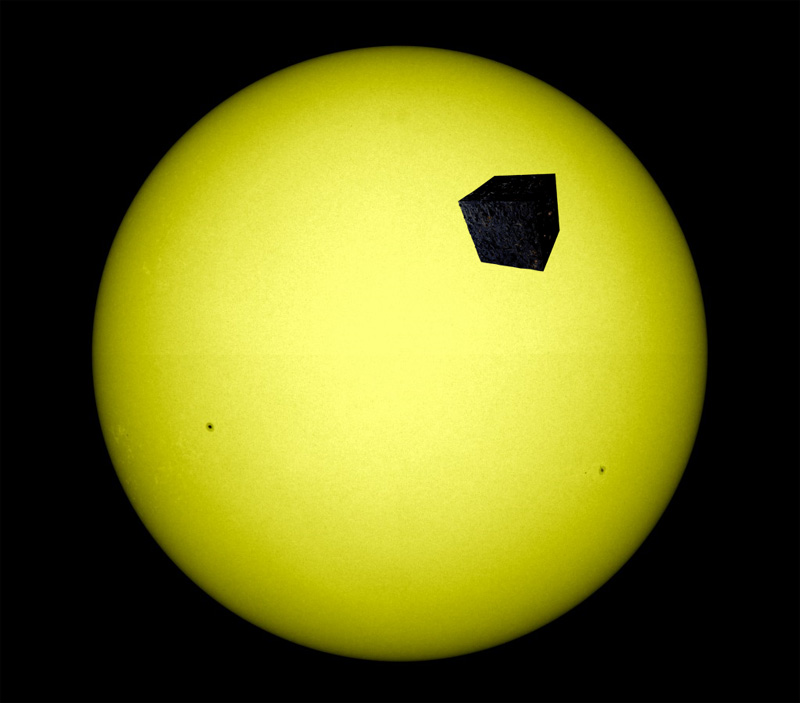
Could Kepler Detect Borg Cubes? Why Not.

That's no sunspot.
"That's no sunspot."

Assuming Star Trek‘s Borg Collective went into overdrive and decided to build a huge cube a few thousand miles wide, then yes, the exoplanet-hunting Kepler space telescope should be able to spot it. But how could Kepler distinguish a cube from a nice spherical exoplanet?

With the help of Ray Villard over at Discovery News, he did some digging and found a paper dating back to 2005 — long before Kepler was launched. However, researcher Luc Arnold, of the Observatoire de Haute-Provence in Paris, did have the space telescope in mind when he studied what it would take to distinguish different hypothetical shapes as they passed in front of his theoretical stars.

The big assumption when looking for exoplanets that drift between distant stars and the Earth — events known as “transits” — is that the only shape these detectable exoplanets come in are spheres. Obvious really.

As a world passes in front of its parent star, a circular shadow will form. However, from Earth, we’d detect a slight dimming of the star’s “light curve” during the transit, allowing astronomers to deduce the exoplanet’s orbital period and size.

The transit method has been used to confirm the presence of hundreds of exoplanets so far, and Kepler has found over 1,200 additional exoplanet candidates. But say if astronomers paid closer attention to the shape of the received light curve; spherical objects have a distinct signature, but say if something looked different in the transiting “planet’s” light curve? Well, it could mean that something non-spherical has passed in front of a star. And what does that mean? Well, that would be a pretty convincing argument for the presence of a huge planet-sized artificial structure orbiting another star. Artifical structure = super-advanced alien civilization.

Arnold tested his theory that all manner of shapes could be detected by Kepler, assuming the transiting structure was on the scale of a few thousand miles wide. In this case, Arnold was testing his hypothesis to see whether we could detect an advanced civilization’s “shadow play.” Perhaps, rather than beaming messages by radio waves, an advanced civilization might want to signal their presence — SETI style — by blocking their sun’s light with vast sheets of lightweight material. As the shape passes in front of the star, the slight dimming of starlight would reveal an artificial presence in orbit.

By putting a series of these shapes into orbit, the aliens could create a kind of interstellar Morse code.

Of course, this is a rather “out there” idea, but I find it fascinating that Kepler could detect an alien artifact orbiting a star tens or hundreds of light-years away. Although this research is only considering orbital “billboards,” I quite like the idea that Kepler might also be able to detect a large structure like… I don’t know… a big Borg mothership. Having advanced warning of the presence of an aggressive alien race sitting on our cosmic doorstep — especially ones of the variety that like to assimilate — would be pretty handy.

Publication: Transit Lightcurve Signatures of Artificial Objects, L. Arnold, 2005. arXiv:astro-ph/0503580v1