Lucky sod: Major Tim Peake, British astronaut (BNSC)
Really, we are. But for the love of god old chap, make sure the first 2015 space station cargo run is packed to the brim with tea bags!
Ever since I heard the first UK government-funded astronaut was being trained to join the European Space Agency in 2009, I nearly wet myself. You see, when you’re a kid growing up in the UK, you can say: “I want to be a fireman,” “I want to be a policeman,” or “I want to be a doctor,” (I said the latter, which, as it turned out, wasn’t too far off.) You can’t say, for example: “I want to be an astronaut!” — to do that you’d have to emigrate, something my mum would never have endorsed to a starry-eyed 10-year-old.
Ever since Margaret Thatcher’s government deemed human spaceflight too expensive for our little island nation to shoulder in the 1980s, we Brits have been relegated to spectators in the human spaceflight arena (robotic spaceflight, however, is a whole different matter). But now, that’s beginning to change with the announcement that Major Tim Peake has been selected as a 2015 space station crew member.
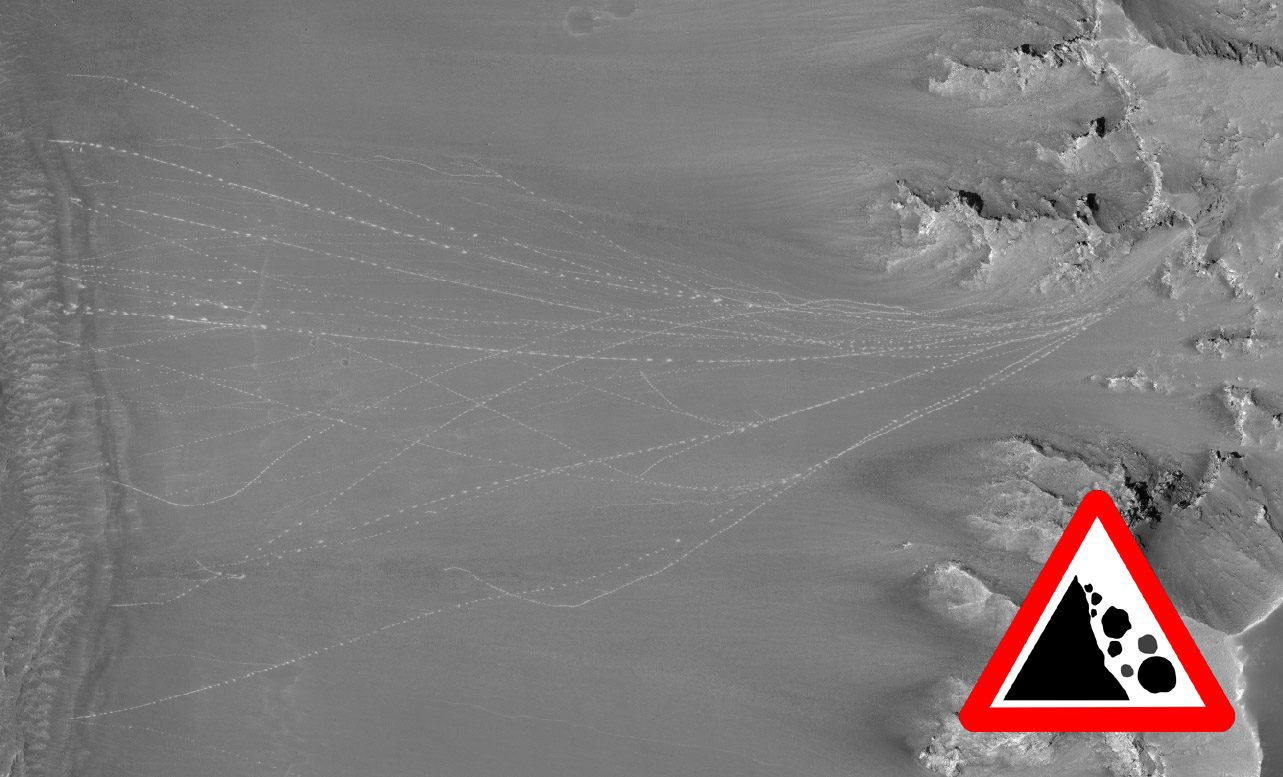
Trails of Mars rocks that have rolled down the slope of a crater rim as imaged by the HiRISE camera. Credit: NASA/JPL/Univ. of Arizona.
It’s always fascinating to see evidence of active geological processes on Mars. And with the help of the armada of robots in orbit and roving the Red Planet, there are plenty of opportunities to see the planet in action.
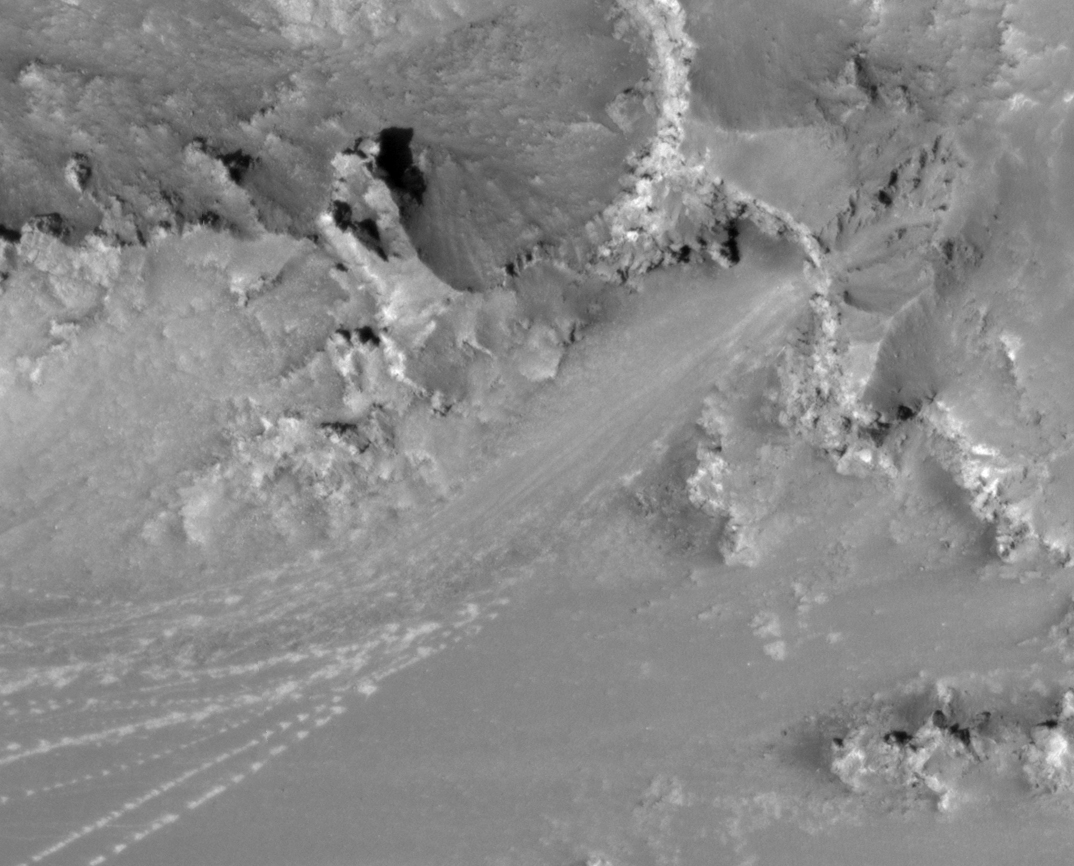
Take this recent image from the High-Resolution Imaging Science Experiment (HiRISE) camera aboard NASA’s Mars Reconnaissance Orbiter (MRO) for example. In this striking scene — which is a little over one kilometer wide — the bright trails of rocks that have rolled down a sloping crater rim after being dislodged from the top are visible from space. The rocks have obviously bounced on their way, leaving dotted impressions as they rolled. Some have reared in wide arcs, following the topography of the landscape. Others have hit other rocks on their way down, dislodging them, creating secondary cascades of smaller boulders.
“The many boulder tracks in this image all seem to emanate from a small alcove near the rim of the crater,” describes HiRISE Targeting Specialist Nicole Baugh. “They spread out downslope and finally terminate near the crater floor. A high-contrast stretch of the area where the tracks stop shows lots of boulders, some still at the ends of the tracks.”
A rough estimate from the high-resolution imagery suggests some of these Mars boulders are over a meter wide. Future Mars astronauts beware: don’t camp out at the bottom of Martian hills! There’s no vegetation to hold big rocks in place or slow their speed. As previous observations of Mars “avalanches” suggest, weathering through the expansion of water ice (frost action) and/or rapid vaporization of carbon dioxide ice likely trigger pretty extreme downfalls of debris. It would be a bummer to travel all the way to Mars, survive the ravages of solar radiation, a daring descent and landing only to get flattened by a wayward chunk of rock when you set up camp.
I’ve always had a special joy for surveying HiRISE observations; it’s a very privileged window to this alien landscape that, in actuality, has many similar geological processes we find on Earth. And so here we have a collection of boulders that, somehow, became dislodged and stormed down from the rim of a crater. If we saw such an event in person, we might note the unnatural bounce these boulders have in the roughly one-third Earth gravity. But we’d also have to find shelter fast, as just like rolling boulders on Earth, those things will flatten you.


 astroengine.com