The Shuttle Could Fly Beyond 2010

Could the Shuttle be revived until 2015? (NASA)

Whether you are surprised by this news or not, it is a big development for the future of NASA. An internal email within the space agency has instructed staff to begin preliminary planning for a feasibility study into extending the life of the Space Shuttle fleet until 2015. This isn’t a one year extension, this isn’t just one extra flight, this is a full five year extension beyond the scheduled decommissioning date set by NASA.

This email, although downplayed by NASA sources, appears to show a U-turn in the political climate behind the agency’s closed doors. So what prompted the decision to commence a feasibility study? Could the Shuttle be safely flown after 2010?
Continue reading “The Shuttle Could Fly Beyond 2010”

US Practices Retroactive Computer Protection: NASA Hacker to be Extradited

Gary McKinnon being interviewed via phone by Jerry Pippin (jerrypippin.com)

Gary McKinnon, a British computer analyst, has failed in his appeal against extradition to the US. McKinnon is accused of accessing 97 US military and NASA computers during his search for information about a possible US government conspiracy to cover up the existence of UFOs. According to the Glasgow-born 42 year old, the computers he accessed were totally unprotected and surprisingly easy to hack. However, the US government says his actions were malicious and the biggest breach of US government computers of all time. McKinnon’s activities allowed him access to 16 NASA computers between 2001 and 2002.

For the record, it is my opinion that McKinon is the victim of his own curiosity. He most certainly is not an organized terrorist wanting to bring down the US government. What’s more the UK has tough laws that he can be prosecuted by, so why is he being extradited to a country where he has never set foot before? Having followed this unfolding story for some years, I feel compelled to mention it on Astroengine.com. This man should not be extradited. The apparent ease at which this individual walked into NASA networks is astonishing; it’s not McKinon that needs to be taken to court, it’s NASA’s Internet security experts who need to be taken to task…
Continue reading “US Practices Retroactive Computer Protection: NASA Hacker to be Extradited”

Phoenix Welcomes in Sol 90 and Mars Winter

Phoenix sees the Sun dip below the horizon for the first time in 90 sols. It's going to get pretty cold here on in... (NASA/JPL/UA)
Phoenix sees the Sun dip below the horizon for the first time in 90 sols. It's going to get pretty cold out there... (NASA/JPL/UA)

This stunning image was taken by Phoenix on the 90th sol (Mars day) – or August 25th here on Earth – of its mission to the Red Planet. Until now the Sun has remained in the sky continuously due to the Mars Arctic summer, perfect for the landers solar panels to receive 24-hour solar energy. Sol 90 marks colder days and less sunlight for Phoenix as we push into Mars winter…
Continue reading “Phoenix Welcomes in Sol 90 and Mars Winter”

Computer Worm Infects International Space Station

The ISS crew are currently trying to purge on board computers of the W32.Gammima.AG worm (NASA)

International Space Station (ISS) software security has been brought into question after on board systems were infected by a computer virus earlier this month. This is possibly the first time that a computer in space has played host to a malicious piece of software code, intended to seek out installed online gaming software and then transmit sensitive information it to an attacker. Although the virus in question, known as the W32.Gammima.AG worm, is pretty harmless (after all, I don’t think the astronauts on board play many online games), the infection comes as a surprise. Why hasn’t the ISS got sufficient anti-virus software installed? How did this security breech pass unnoticed until now? The space station may have narrowly dodged the bullet on this one, as if the worm was a little more virulent, there aren’t many network managers between here and low Earth orbit to find a quick solution to the problem…
Continue reading “Computer Worm Infects International Space Station”

GOCE Will be the Coolest Satellite to Orbit Earth, Ever

Solar panels have never looked so good. GOCE is the Porsche of orbital engineering (GOCE/ESA)

The European Space Agency is set to launch the Gravity field and steady-state Ocean Circulation Explorer (GOCE) Star Destroyer satellite on September 10th. This advanced mission will be the most sophisticated piece of kit ever to orbit the Earth, investigating the Earth’s gravitational field. It will perform a highly accurate mapping campaign, producing a high resolution reference shape of the geoid (i.e. the shape of our planet). The mission will be unprecedented, but that’s not the reason why I’m drawing attention to it…

Only last week I remarked on the coolness of the 2013 Mars rover mission in the shape of the dazzling Pasteur Rover (set to drill two-metres into Mars), and today with the announcement of the launch GOCE, it looks like ESA has done it again. They’ve encased their state-of-the-art instrumentation inside something that belongs in a science fiction movie, more reminiscent of the Imperial Star Destroyer from Star Wars than a tin box satellite…
Continue reading “GOCE Will be the Coolest Satellite to Orbit Earth, Ever”

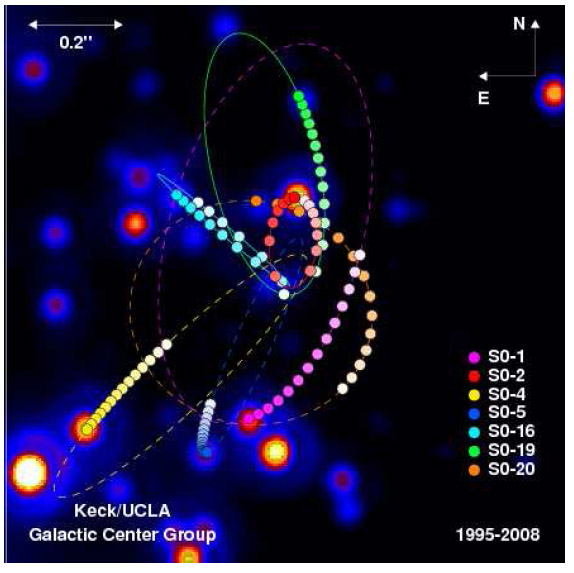
Meet Sagittarius A*, Our Very Own Supermassive Black Hole

Yearly location of stars within 0.2 parsecs from Sagittarius A* orbiting the common, compact radio source (A. Ghez)

We are told there is a supermassive black hole living in the centre of our galaxy. Apparently, supermassive black holes can be found in the centre of most galactic nuclei, and all the stars within the surrounding galactic disk will orbit around it. But how do we know there is a huge black hole in the centre of the Milky Way? What evidence is there? It turns out there is quite a lot, actually.

In a recent review of the subject, the radio emissions observed since the 1950’s are examined. However, probably the most striking piece of evidence is the figure to the left. Of course, we know black holes exert a massive gravitational pull on local space, and by observing the centre of our galaxy, we find there is a huge gravitational influence over a compact cluster of stars, all orbiting a common point, reaching orbital velocities of 5000 km/s…
Continue reading “Meet Sagittarius A*, Our Very Own Supermassive Black Hole”

The NASA Rocket Failure – Routine Access to Space Still Not Available, But We’re Getting Closer

Moment of detonation: the ATK ALV X-1 rocket and $17 million NASA payload scrubbed in an instant (Explorer Fish)

Early yesterday morning an Alliant Techsystems (ATK) ALV X-1 rocket launched from NASA’s launch facility at Wallops Island, VA. However, only 27 seconds and 11,000 feet into the flight, a launch anomaly prompted the range safety officer to hit the self-destruct button. According to sources, the ALV X-1 was a new type of launch vehicle costing $17 million (including NASA payload).

The ALV X-1 rocket is a sub-orbital design, otherwise more commonly known as a sounding rocket. Intended to carry instrumentation into the atmosphere, rather than into orbit, the ALV X-1 would complete a parabolic flight path, delivering the payload at a predetermined altitude to carry out experiments and parachute to Earth. At 5am Friday morning, this obviously didn’t happen.

It would seem that regardless of whether spaceflight is initiated by private enterprise, established space agency or Middle Eastern government, the challenges are the same, nobody has risk-free, routine access into space…
Continue reading “The NASA Rocket Failure – Routine Access to Space Still Not Available, But We’re Getting Closer”

Why Can’t we see the Oort Cloud?

Hubble Space Telescope observation of Polaris – looking through the Oort Cloud, but not resolving any comets (Hubble)

The Oort Cloud is a mysterious entity. Located on the outskirts of the Solar System, this hypothetical region is probably the source of the long-period comets that occasionally pass through the inner planets’ orbits. The strange thing about these comets is that they have orbits inclined at pretty much any angle from the ecliptic which suggests their source isn’t a belt confined to the ecliptic plane (like the asteroid belt or Kuiper belt). Therefore, their proposed source is a cloud, acting like a shell, surrounding the Solar System.

OK, so we think the Oort Cloud is out there, and there is a lot of evidence supporting this, but why can’t we see the Oort Cloud objects? After all, the Hubble Space Telescope routinely images deep space objects like stars, galaxies and clusters, why can’t we use it to see embryonic comets within our own stellar neighbourhood?
Continue reading “Why Can’t we see the Oort Cloud?”

Carnival of Space Week 68 – Crowlspace

Schematic showing Sagittarius A crossing the beam of Indlebe on 28 July 2008 (Stuart MacPherson)

For this week’s outing into the wild world of space blogging Carnival style, we dock at Crowlspace.com for a superb mix of space news, views and opinions. It’s entitled “…star travel won’t be easy,” and they’re not kidding! It seems this week has focused around the conventional, and sci-fi modes of transportation (although the question of energy in either case will be the limiting factor). For my part, I submitted my opinions about the recent misinterpretation of a radio signal from the centre of our galaxy. No, it isn’t aliens, it’s totally natural, I promise

Breaking News: We Have Sunspots, First for Over a Month

New sunspots observed on Aug. 21st (© Pavol Rapavy)

Just as we were getting concerned that the Sun may be facing an extended solar minimum, amateur astronomers, in the last few hours, have observed a new sunspot pair appearing around the Sun’s south-eastern limb. They are young, emergent spots, gradually getting larger. It will be interesting to see how they evolve. The observation above was taken by Pavol Rapavy in Rimavska Sobota, Slovakia, and now we have detailed images of the region by a British astronomer too (sounds like the Sun might be making an appearance for the UK summer at last!)…
Continue reading “Breaking News: We Have Sunspots, First for Over a Month”