In my capacity as Mars Foundation Communications Officer, I was asked to approach one of the mission scientists working with The Compact Reconnaissance Imaging Spectrometer for Mars (CRISM) instrument on board the Mars Reconnaissance Orbiter (MRO). The Foundation has an acute interest in CRISM as its main task is to look for water (past and present) and certain minerals on the Martian surface. We are currently investigating Mars settlement designs, so any indication about the location of these quantities will be of huge interest to us (especially as our “Hillside Settlement” will require colonists to use local materials when and where possible). In an enlightening interview, SETI Institute principal investigator Dr Adrian Brown detailed some of the important discoveries to come out of CRISM and how it may be of use to future colonists… Continue reading “Interview: Dr Adrian Brown, Mars Reconnaissance Orbiter Scientist”
One year on, the Carnival of Space has gone from strength to strength. After astroengine hosted the Carnival last week, I realized just how many diverse space blogs there were out there. I counted 30+ entries; trying to organize that huge number of blogs, whilst doing them all justice, is a hard task. This week it seems everyone has been typing hard and finding their best stories for the Anniversary Edition hosted where the Carnival was born one year ago. Week 52 has a science fiction theme, which has given me the perfect opportunity to display a picture of my favourite sci-fi program of all time: Babylon 5. Check out the Why Homeschool blog with Henry Cate for this weeks massive collection of space news from around the web.
For me, the most incredible story was the colliding black hole research to come out of the Max Planck Institute. They have observed a black hole being “kicked out” of its host galaxy during a galactic merger event. Two supermassive black holes collided, causing a huge recoil, ejecting a black hole of several hundred million solar masses into intergalactic space. Stunning science.
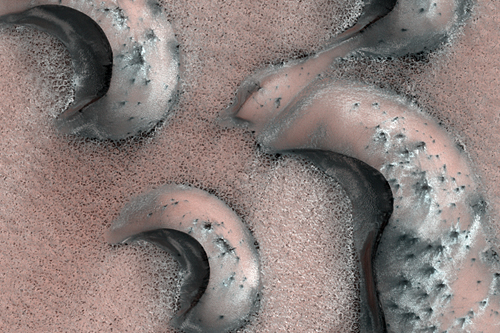
Martian sand dunes, shaped like terrestrial barchan dunes (HiRISE/NASA/UA)
The sand dunes on the surface of Mars closely resemble their terrestrial cousins, only bigger. Formed from wind-driven sand and dust, the Martian versions can grow ten-times bigger than any dunes we have on Earth. The High Resolution Imaging Science Experiment (HiRISE) on board NASA’s Mars Reconnaissance Orbiter (MRO) has been taking shots of these distinctive shapes, and although there are examples all over the planet, they seem to have the same characteristics no matter where they form or how they swarm. Now researchers are investigating how these Mars dunes grow and why they are so large…
On the 11th April, I reported on some new HiRISE images of barchan sand dunes that appeared to form on the Red Planet. In this particular case, a flat-topped mountain (or mesa) was being ravaged by the Martian wind, sweeping fine grains of sand and dust downstream. What formed in the mesa’s wake turned out to be quite impressive. Long strands of sand banks, stretching hundreds of miles beyond the mesa mixed with swarms of similarly-shaped dunes. What struck me were the impressive similarities with Earth-based sand dunes we find on our beaches and deserts.
Since this initial report, I have found HiRISE to be quite a prolific dune-seeker. On April 16th, HiRISE released more images of sand dunes in the northern polar regions of Mars, some heavily eroded (pictured below), and others tightly packed and clumsily shaped. I was intrigued. As you may have noticed from some of the Mars stories I cover, I like to see terrestrial processes happening on the surface of Mars. Seeing an impressive Mars avalanche, or a simple rock rolling down a hill, I love it. I think it gives us a special connection with an alien world when we can see processes we commonly associate with Earth happening on an eroding Mars.
The dissappearing dunes at northern latitudes (NASA/JPL/UA)
So what processes are behind these giant Mars dunes? It might seem obvious (wind blowing sand ain’t that hard to understand after all), but researchers at the Federal University of Ceará in Fortaleza, Brazil have been modelling the effects that the tenuous Mars atmosphere and weak gravity have on sand dune construction. Murilo Almeida and his team have found that when blown around on the surface of Mars, grains of sand “bounce” much higher than their terrestrial counterparts. In fact, they bounce 100 times higher and further. They are also blown 10 times faster. This has the effect of producing a series of sand dunes with very long wavelengths.
This also has a knock-on effect as a possible mechanism that drives the savage dust storms in the thin atmosphere. As there is more bouncing action in Martian grains of sand than here on Earth, more dust particles are thrown aloft and suspended in the air.
Even during solar minimum, the Sun can be surprisingly dynamic. We are currently observing a sunspot-less solar disk, but on Saturday the Solar and Heliospheric Observatory (SOHO) observed a noteworthy X-ray flare. It was a B3.8 flare, producing a coronal mass ejection (CME), sending vast quantities of hot plasma into interplanetary space. Admittedly, it is strange to witness CMEs of this size at this time in the solar cycle, but what is even weirder is that the flare was produced by a region devoid of sunspot activity (see image). SOHO captured the CME event with its LASCO instrument and the two-probe Solar Terrestrial Relations Observatory (STEREO) captured an incredible “solar tsunami” (or Sun Quake) as the flare caused the Sun’s surface to ripple. And all this without an intense magnetic field and sunspot pair… Continue reading “Solar Flare, CME and Tsunami Generated by a “Blank Sun””
Also, my recent Soyuz Hard Landing article got picked up by Slashdot and appears to be getting a lot of attention. I hope to write a summary article about the “ballistic re-entry” of the Russian Soyuz descent module on astroengine.com soon, but for now, check it out on the Universe Today…
Hello and welcome to the 51st edition of the Carnival of Space! My name is Ian O’Neill, UK solar physicist and writer for the Universe Today. I am honoured to be hosting the Carnival, so thank you Fraser for letting me loose on seven days-worth of excellent space related news from the growing blogosphere. Astroengine is my online home, delving into the inner workings of the cosmos, so it’s good to freshen the site up with news from a superb cross-section of space blogs.
There is a huge breadth of topics this week with no particular trend, but as Earth Day was on April 22nd, I’ll kick off with the some of the stories a little closer to home (and then end up somewhere in the proximity of the Big Bang, 13.7 billion years ago). As said by the great Yuri Gagarin, “I see Earth! It is so beautiful!” I begin with our Blue Planet… Continue reading “Carnival of Space Week 51”
When you stop to think about it, sending transmissions via radio into space in the hope to contact aliens is a bit silly. The intention behind the 16 transmission we have directed into space is to a) make contact with extraterrestrials, b) advertise our presence in the cosmos, and c) tell ET something useful about mankind. We know we are leaking transmissions into space all the time (i.e. radio and TV), but we assume they don’t travel that far or are too weak for aliens to detect. But wait one second… We are constantly blasting radar into space, tracking near earth asteroids; will aliens pick up those transmissions? Well, these radar transmissions have covered 2000 times more sky than radio and last 500 times longer. And since the 1960’s we’ve sent 1400 radar transmissions into space. So, what’s the verdict? Aliens are one million times more likely to receive the tracking signal from NEO tracking radar than radar intended for aliens… Continue reading “Aliens More Likely to Pick Up Our NEO Radar Transmissions than Radio”




 astroengine.com

