Occasionally, out of the CGI’d dust of orgasmic fight sequences of Transformers 2 and the predicted lack of plot in the forthcoming 2012, the movie industry churns up a gem of a sci-fi flick.
I suspect Moon is one of those rare movies (I am still trying to find time to get my bum down the cinema to watch it) that combines plot, effects and scientific accuracy (just about) to arrive at a genuinely good film.
And then there’s District 9, due for release in August. At first look of the trailer, you’ll see why I’m getting a little excited:
I was expecting the same old aliens invade, world on fire, Will Smith punches alien, USA saves the world storyline at first, but if you read the IMDB plot summary (spoilers!), you’ll be pleasantly surprised.
Damn, I have to share the plot… stop reading now if you want to be totally vague about the story of District 9.
That's what those posters are all about! The movie viral campaign from District 9.
[Micro-spoiler below]
Basically, rather than invading Earth, these alien dudes have landed on our planet seeking refuge after their home world died. Their spaceship arrives over South Africa and thirty years later, these once-advanced alien beings have been turned into social outcasts, restricted to an alien slum called District 9. People have lost patience with looking after these creatures, but agencies hold onto these aliens against their will to learn about their technologies. Then, it would appear the aliens start to fight back…
It’s set in a gritty Johannesburg location, the CGI looks subtle, plus Peter Jackson (Lord of the Rings director, say no more) is involved, so there’s some hope this might be a unique and thrilling sci-fi. I get the feeling there is a lot of play on alien rights, the welfare of ET integrated in society (or not), with a healthy dose of alien-racism (alienation?) thrown in.
Us humans will be the bad guys! Awesome! Filthy aliens…
We’re currently having loads of fun over at Discovery Space, celebrating mankind’s biggest space achievement: when Apollo 11 landed on the moon 40 years ago. On July 20th 1969, Neil Armstrong and Buzz Aldrin made history while Michael Collins orbited overhead. This was a key moment in space exploration that was followed by another 5 lunar landings until 1972. Unfortunately, that was it and the Apollo Program was gradually wound down…
However, the current plan is to get astronauts back to the moon by 2020, but how are we going to do it? Actually, the answer is far from clear-cut, and although NASA is pushing ahead with the development of Constellation, outspoken space advocates, such as Buzz Aldrin, are presenting some alternatives.
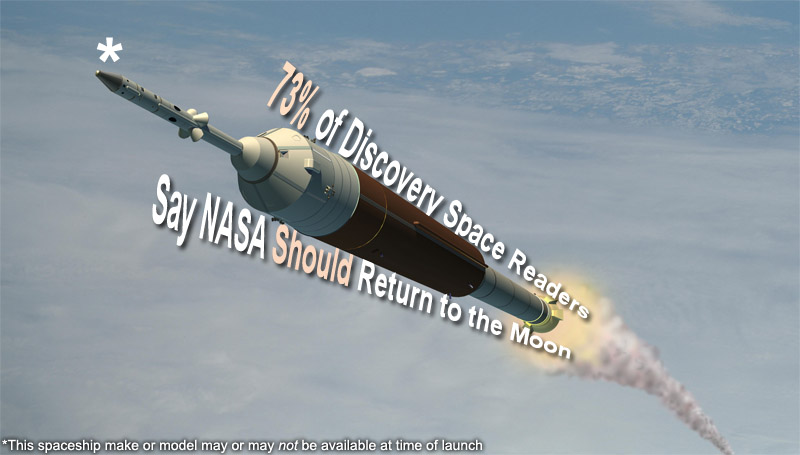
But in an interesting twist, after carrying out a two-week poll on Space Disco, I found that general opinion is stacked firmly in favour of a NASA return mission to the moon…
We did it 40 years ago, what’s the point in retracing our steps when we could just mount a manned mission to Mars? Ian O’Neill discusses the pros and cons about NASA’s future exploration plans. Including results from the Discovery Space reader poll.
NASA has a backup plan to launch crew and cargo to the moon, reduce the gap between shuttle retirement and a replacement ship’s debut, and save taxpayers billions of dollars.
NASA will offer reporters an unprecedented chance to conduct interviews with scientists inside the lab that stores moon rocks Apollo astronauts collected during their six missions on July 2.
Did you know the Apollo 17 astronauts had to fix their lunar buggy with duct tape? Or that the Saturn V carrying Apollo 12 was struck by lightning 37 seconds after lift off? We investigate the little-known facts about the Apollo missions.
It may be our natural satellite, easily observable in the night sky, but the moon still hides many secrets. Explore the lunar surface with us as we investigate some of the moon’s best kept secrets.
We are told that one of the key reasons to set up a lunar base is to mine the moon for its abundance of natural resources, but is this realistic? In some ways yes, but there’s a lot of economics and politics to wade through first.
Many in-space activities could be automated, negating the need for a human presence. However, taking astronauts out of the space exploration loop is as attractive as it is unpalatable. Is the astronaut surplus to requirements?
Fortunately I’ve been hard-wired to Twitter today, so I’ve spotted some awesome links pop up from my ace tweeters. But I wasn’t prepared for the awesomeness that was encapsulated in @jimmynewland tweet titled, “2012: All the Disaster Pr0n you can take!”
To be honest, I was expecting the movie trailer for the John Cussak disaster flick “2012” (coming to a deafening surround sound theatre near you), but no… this is better… far better. Take a look, it gets funnier the more you watch it:
Basically, it looks like Emmerich’s wet dream, probably an opportunity he’s been waiting for all his career. If you thought The Day After Tomorrow was an Earth-crunching death-fest, think again, this movie has rolling buildings, flying Bentleys, flying giraffes, spaceships, exploding cities, exploding fireballs, exploding… rocks… Hell, where’s the nukes! We need nukes! I hope Emmerich remembered the nukes.
Every so often I feel a film is just being marketed poorly. This is often laziness and misdirection on their part. Occasionally it is arrogance when they think there is more to their film than is actually there. So, in my own arrogance, I try to help them along. Last year I felt “Hulk” needed some help. Today my mission is one that blends swimmingly with my own love of Disaster. Please enjoy this special holiday treat that I made just for you.
Dean is referring to 2012, and watching it, I can’t help but be entertained and enthusiastic for the movie. He’s done a great re-edit. It now has the 1970’s classic disaster movie atmosphere of Towering Inferno with the cutting edge Big Flaming Balls Of Fire™ we are now accustomed to in modern Hollywood.
It’s not going to be a good film, films kinda need plots. Perhaps the experienced cast might be able to pull it out of the frenzy of tsunamis, burning cities and crying children, but I’m not going for the plot, I’m going for the CGI… and the science errors, of course.
Alternative title: “Jumping to Conclusions and Bullshit”
Crop circles are amazing. They are, quite literally, works of art. And like all other known forms of art, they are constructed by people with time on their hands. No UFOs have been braiding our crops, no aliens have been playing let’s-confuse-the-stoopid-humans-with-this-cryptic-message-we-travelled-hundreds-of-light-years-to-deliver. Crop circles are made by hoaxers and enthusiasts.
So yesterday, I read a terribly fascinating, yet terribly painful article that seamlessly combines three disparate facts to arrive at a terribly flawed conclusion: a coronal mass ejection (CME) will hit us on July 7th, possibly causing global damage, according to a crop circle prediction.
This may seem a little shocking, considering this equivalent of a micro-doomsday is only two days from now, but the “Exopolotics Examiner” Dr. Michael Salla discusses it with great excitement:
The Alert is for Sunspot 1024 which suddenly appeared on July 3 and 4 […] It typically takes CMEs, traveling at around a million miles per hour, three to four days to reach the Earth. So if Sunspot 1024 does generate CMEs towards the Earth, they would arrive right on the predicted date of July 7.
Apparently, we now have an infallible space weather prediction method. Sunspot 1024 could generate a CME directed toward Earth, therefore fulfilling the prediction that we are going to get hit by a CME in two days. Amazing right? Obviously Salla is referring to the work of a solar physicist, with a new hi-tech computer simulation, or with access to cutting-edge observational data. Wow, it looks like we have found the Holy Grail of sunspot characterization methods!
(Guess again)
Actually, the July 7th prediction is purely based on crop circles at Milk Hill, in Wiltshire, UK. How do we know these flattened fields of corn predict a CME? Actually, they don’t. Even the crop circle experts make no convincing connection with crop circles and the Sun, apart from pointing out that the patterns resemble an orrery — but even if it is an orrery, the corn has been flattened by a team of hoaxers, they could make it mean anything. (I’m still waiting for a massive Micky Mouse crop circle.)
Although I find all this highly entertaining, the thing that made me laugh the most was the point that the Milk Hill patterns were made in “3 Phases.” However, looking at the incredibly beautiful design of that thing, it’s little wonder the aliens had to build the design in shifts. After all, extraterrestrials need tea-breaks too… perhaps their little feet got tired stomping all that corn… or perhaps it was constructed by slacking crop circle hoaxers who couldn’t get it all done in one night?
My money is on the latter.
So, there is a dubious link between the crop circle and the Sun (apart from ‘it faces that way,’ directly along the tractor tracks… hmm, interesting), what could Salla be talking about? Oh that’s it! The Earth’s magnetosphere has a hole in it! Hell, dig your lead-lined bomb shelters now!
Now this is one point I’m actually a little annoyed about. Apparently Dr. Salla is also qualified in solar-terrestrial physics, as he seems to dredge up some pretty compelling science recently published by NASA. Salla says:
Importantly, scientists will be able to directly study the impacts of large amounts of solar plasma penetrating a breach in the magnetosphere first reported by NASA scientists in December 2008 […] If the interpretations of crop circle researchers are correct, then we will shortly directly observe the impact of solar energy from CMEs passing through the magnetosphere breach. –Dr Salla (emphasis not added by me, used for dramatic effect I suspect).
Now this is good stuff, perhaps this guy is on to something. In summary:
The Milk Hill crop circle predicts a solar storm on July 7th (but it’s not very clear where in the corn this is printed).
An active sunspot has appeared at a high latitude on the solar surface (this is true, although only B Class solar flares have been detected… not in Earth-killing leagues I’m afraid).
This sunspot could generate an Earth-directed CME (this is true, again, but the odds are pretty damn low).
The CME will hit us on July 7th (read #3).
Now that NASA has detected a hole in our magnetosphere, deadly solar particles could penetrate our atmosphere!
In other words, Salla has strung together some dubious “signs” from a crop circle, tied it into this new sunspot, gotten all excited that it could generate some pretty feeble CMEs, somehow assumed they will be Earth-directed and then chucked in a very incorrect opinion as to what this “hole in the magnetosphere” means.
Although the magnetospheric breach is certainly an amazing discovery — made by the Time History of Events and Macroscale Interactions during Substorms (THEMIS) satellites in 2008 — I think Salla misses the point. The magnetospheric breach hasn’t just appeared, it wasn’t caused by human activity (like the hole in the ozone layer, which I think he thinks this is), it’s always been there in some way, shape or form.
NASA’s five THEMIS spacecraft have discovered a breach in Earth’s magnetic field ten times larger than anything previously thought to exist. Solar wind can flow in through the opening to “load up” the magnetosphere for powerful geomagnetic storms. But the breach itself is not the biggest surprise. Researchers are even more amazed at the strange and unexpected way it forms, overturning long-held ideas of space physics. —NASA release.
Obviously overcome with the NASA terminology “giant breach,” Salla assumes this is a new hole in the magntosphere leaving us open to the ravages of the Sun. Actually it doesn’t, it’s simply an observation of a previously unknown piece of magnetospheric dynamics. Yes, the breach is linked with solar storms and the aurora, but there’s every likelihood this phenomenon has always existed, even when the Earth’s magnetic field was battered by X-class solar flares and jumbo CME’s during the last solar maximum (are we still here? Yes, I think we are). To think we are going to even notice a make-believe low-energy CME produced by a feeble region of the Sun generating B-class solar flares is laughable.
So the physics is flawed, the prediction is totally far-fetched, and apparently you need a PhD in exopolitics to understand how crop circles come into it. It’s just a fear-mongering article that is becoming all too common on the Examiner these days.
No, this is another huge FAIL for the Examiner… where are all the Skeptical, Science and Common Sense Examiners?
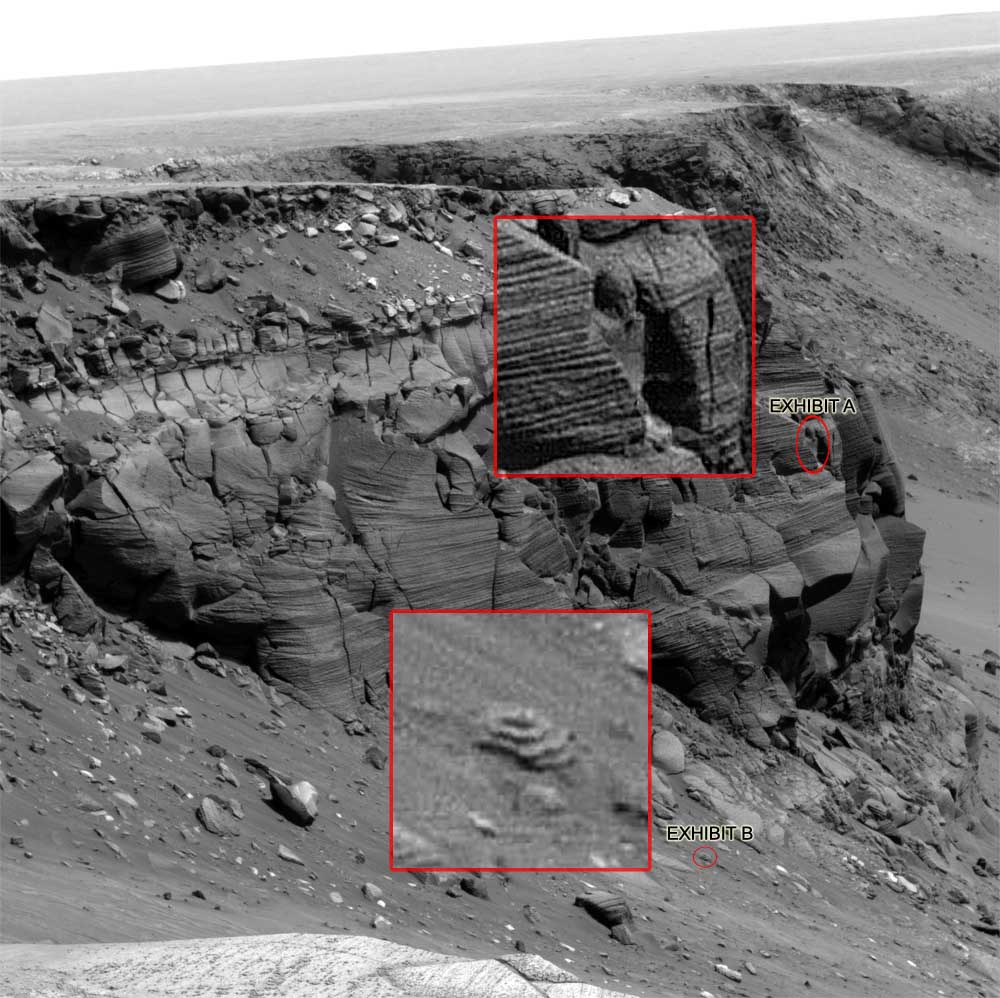
I’ve always loved these Victoria images; you can easily see layering in the exposed rock and boulders strewn below. In fact, this could be a black and white picture of the Utah desert, or a wide angle view of the Grand Canyon. But no, this is Mars; lifeless Mars.
Or is it?
One version of the Opportunity image can be found on a conspiracy website, where a ‘study’ has been carried out. And guess what they found?
Oh yes, apparently a Martian civilization worshiped the pharaohs of ancient Egypt, carving a statue more commonly associated with pyramids into the crater wall (“Exhibit A” in the image above). Also, there’s a curiously shaped multi-layer disk on the ground — obviously some kind of alien artifact (“Exhibit B”).
Please.
Normally I’d ignore something like this, but I thought I’d have a little fun one evening (because my evenings simply aren’t exciting enough, it seems). Inspired by Phil Plait’s visions of Miss Piggy in a Mars mesa last week, I wanted to test myself and go on a pareidolia hunt of my own, armed with the Victoria crater pic, my imagination and questionable eyesight.
The human brain is a strange old thing at times, creating recognizable features out of random, inanimate objects, and that is exactly what some people use as “proof” of their nutty theory or visions of the second coming. People see Jesus in burnt toast, Michael Jackson in cloud formations and, in this case, ancient Egyptian statues carved into crater rims on Mars.
So have a look at this, I impressed myself (note the outstanding use of Photoshop): Mars faces:
What I discovered in this single NASA Mars image:
A: Exhibit A – the Egyptian statue.
B: Exhibit B – some other artifact.
C: Admiral "It’s a trap!" Ackbar from Star Wars: The Empire Strikes Back.
D: Audry II, the blood-drinking plant from Little Shop of Horrors.
E: Jabba the Hutt, or an angry toad.
F: A gorilla’s head (kinda).
G: Can’t remember what I saw in this… but it’s kinda alien looking… right?
H: Insane-looking face. Could be the Mad Hatter?
I: Weird-looking Picasso face.
J: The alien from Predator.
K: Human head.
L: Another Egyptian statue, head part.
M: Humanoid skull!
I’ve even got a full-resolution version in case you can’t see the fruits of my imagination (all 4MB of it). But who cares if you can’t see Jabba, Ackbar, skulls or statues? That’s not the point; most conspiracy sites skew the facts to convince the reader to believe their false claims anyway. Hmmm… I’m quite good at this, perhaps I should start my own ‘Mars Faces’ conspiracy, only including characters from Star Wars… hmmm.
I’m personally most impressed with the “humanoid skull” (M), “Admiral Ackbar” (C) and the “insane face” (H). Obviously the ancient Martian civilization were a part of the Empire (not so far, far away), carried out sacrifices on humanoids (bones now littering the plains), worshipped Egyptian kings and had killer rock sculpting skills. Obviously.
16.5 light years away, a revolution in sci-fi television programming is about to explode to life… Yes, it really is that exciting. Almost like a tsunami approaching a peaceful shore, island inhabitants totally unaware of its impending arrival, the triple star system of 40 Eridani is about to be bathed in a very special terrestrial signal…
So why am I getting so excited for this random star system? Well, 15 years ago, the awesome five-season show Babylon 5 aired in the US and the UK. For me, B5 formed a watershed of my love for sci-fi. In fact, you could say I was a teenage Babylonoholic, I couldn’t get enough of it.
As we transmit electromagnetic signals over the airwaves for our television viewing pleasure, we’ve also been leaking it into space. As the signal travels at the speed of light, the maximum distance our TV signal would have travelled is about 80 light years (we started leaking in the 1930’s). By that reasoning, our TV shows should have reached Aldebaran by now.
Unfortunately, the aliens of Aldebaran have a rather limited choice of TV shows… at the moment they’re probably putting up with Nazi Germany’s propaganda broadcasts (like in Jodie Foster’s Contact). Things are far more exciting in 40 Eridani… they’re about to get flooded by the first season of Babylon 5! Sure, there’s lots of other things to watch in the expanse of 80 light years, but if I had to choose, I’d be prepping my TV aerial and stocking the fridge in time for 5 years of awesome sci-fi on a world orbiting one of the three 40 Eridani stars…
In The Future™, when mankind is Sufficiently Advanced®, nations, companies and entrepreneurs will be shuttling huge cargo spaceships to and from the asteroid belt. Asteroid mining is going to be the first REAL gold rush, “thars gold in them thar rocks!” But not only gold, we’ll be able to consume asteroids of all their constituents; platinum, iridium and silicon (silicon?). Global economies will be flooded with a new-found wealth being fed by the new Solar System’s bounty. Times will be good, after all, this is The Future™.
Although asteroid mining looks good on paper, once you do a little bit of adding up, you suddenly realize it’s actually one hell of an undertaking. Looking at the economics of asteroid mining is especially daunting, and believe me, my co-author Greg Fish has done the number crunching.
When Greg and I started out researching our book, Astroeconomics: Making Money from the Vacuum of Space, we initially made the assumption that the key way to make vast wads of cash in space is from asteroid mining. This assumption was purely based on… well, an assumption. A quick glance on the various space advocacy websites will demonstrate just how accepted asteroid mining is as a future industry. After all, science fiction has been telling us this for years. Given a sufficiently advanced technology, we’ll be able to build a spaceship, with a mining platform, send it to the asteroid belt (obviously a very short distance), fill up the cargo hold with ore (or, if we are that advanced, refined precious metals) and be back on Earth by a week next Friday.
However, when we looked at the situation, we decided to focus on the economics of the beast (in all honesty, Greg did the calculations, I can barely balance my own books, let alone the books of an entire space-faring industry).
Naturally, we assume it’s going to be businesses (not governments) wanting to mine asteroids, and we assume mining/spaceflight technologies that could possibly be available within the next few decades (and no, we didn’t consider nanotech; I’m thinking rock-eating nanobots wont be available in stores for a long while yet). We also assumed these space mining companies will want to make a profit (we might be wrong). Unfortunately, asteroid mining doesn’t make an awful lot of sense from a business perspective. The risk is too high, the overheads are whopping, and the payback — while impressive — won’t pay the bills. And then there’s nasties like space pirates and industrial accidents to consider, adding to the ‘risk’ factor.
All in all, it’s not a very attractive business proposition to build a mining fleet and send it on an interplanetary joyride; most businesses would rather set up a mining installation in the middle of Antarctica. But we’re not pouring cold water on the whole venture either, we’ve worked out a few ways future businesses can actually turn asteroid mining into an industry.
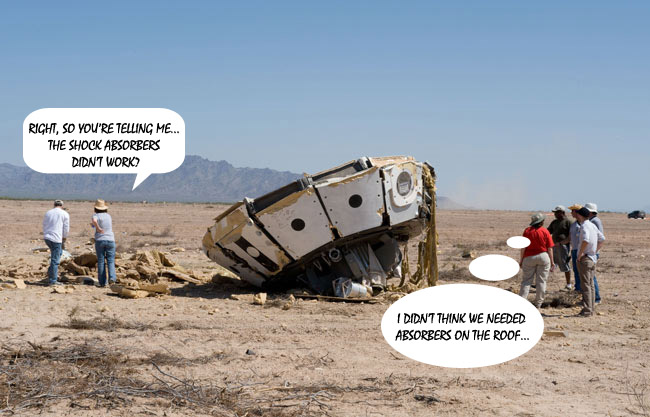
Although there are doubts about Constellation, and NASA recently announced a “plan B” launch option for a return trip to the Moon, Orion development continues as planned. Next up is the development of the Orion shock absorbers, intended to take the sting out of the return capsule’s landing.
Tests are currently being carried out at the Landing and Impact Research Facility in NASA’s Langley Research Center on the seat pallet that will protect the Orion astronauts’ from the shock of touch-down. It is hoped Orion will be a land-anywhere capsule, including land and water. In fact, I am a little bit excited about the planned landing spot in the Pacific Ocean, not far from Catalina Island, off the Los Angeles coastline. That’s just down the road and a small swim from me!
To test the pallet and its “energy-absorbing struts,” the 20,000-pound test article is dropped 18 feet onto a crushable honeycomb material designed to simulate different landing surfaces. —Aviation Week
The seat shock absorbers won’t only be used for landing, it is hoped they will mitigate much of the launch vibration effects caused by the Ares I crew launch vehicle. These tests are a result of studies of how much vibration crew members can take before it becomes difficult to read instrumentation displays and react to situations during launch.
Wow! I thought the single image of the volcanic eruption (plus shock wave) was cool, but after seeing the complete series of images put together in this animation, I’m literally blown away. Thank you Richard Drumm for sharing the video on Twitter — now this is one YouTube video that needs to be shown off.
The 29 photos in this animation were taken by space station astronauts as they passed over Russia’s Sarychev Peak volcano in the Kuril Islands.
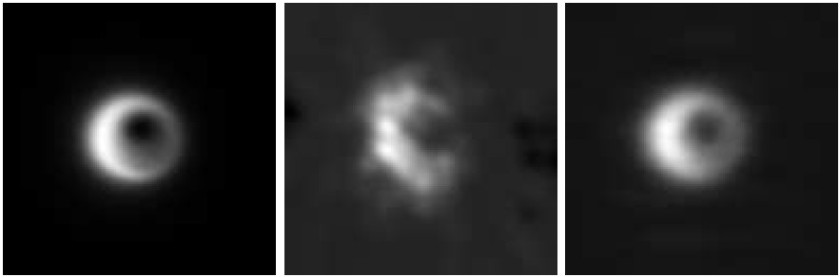
A modelled black hole shadow (left) and two simulated observations using a 7-telescope and 13-telescope array (Fish & Doeleman)
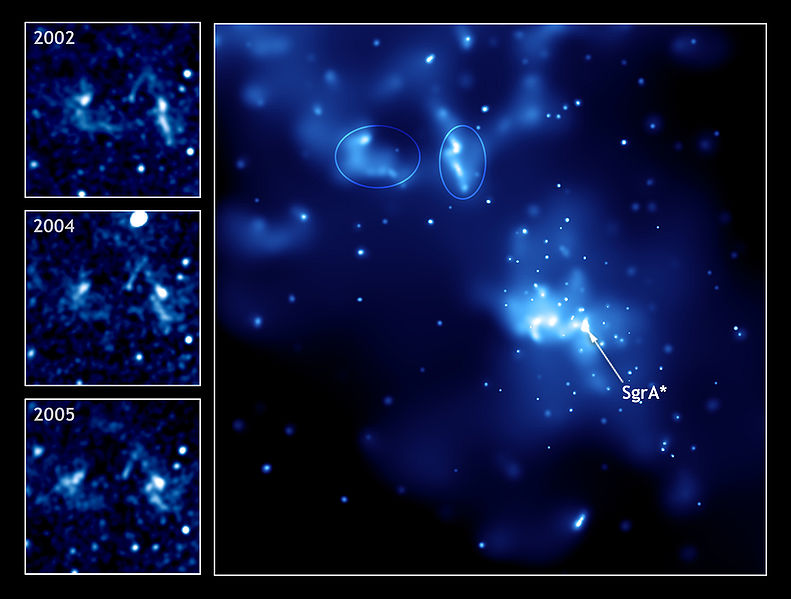
All the evidence suggests there is a supermassive black hole lurking in the centre of our galaxy. We’ve known as much for quite some time, but it wasn’t until recently that we’ve been able to confirm it. As it turns out, most galactic nuclei are predicted to contain supermassive black holes in their cores.
The Milky Way’s supermassive black hole is called Sagittarius A*, a well-known compact radio source used by radio astronomers as an instrumental calibration target. The black hole driving this emission has been calculated to weigh in at a whopping 4×10⁶ solar masses.
So, we’re certain Sgr A* is a supermassive black hole, how can we use it?
Using our Sun as an example, stellar physicists use the Sun as an up-close laboratory so they can better understand stars located many light years away. It is an up-close star that we can study in great detail, gleaning all kinds of information, helping us learn more about how stars work in general.
What if Sgr A* could be used in a similar way, not in the study of stellar physics, but in the pursuit to understand the dynamics of black holes throughout the Universe?
This is exactly the question Vincent Fish and Sheperd Doeleman from the MIT Haystack Observatory ponder in a recent publication. The researchers make an important point early in their paper:
Due to its proximity at ~ 8 kpc [26,000 ly], Sgr A* has the largest apparent event horizon of any known black hole candidate.
The centre of our galaxy as imaged by Spitzer (NASA)
In other words, the supermassive black hole in the centre of the galaxy is the largest observable black hole in the sky. As Sgr A* is so massive, its event horizon is therefore bigger, providing a sizeable target for Earth-based observatories to resolve.
Although the black hole is quite a distance from us, the size of its event horizon more than makes up for its location, it even trumps closer, less massive stellar black holes. Sgr A* could therefore be our own personal black hole laboratory that we can study from Earth.
But there’s a catch: How do you directly observe a black hole that’s 26,000 light years away? Firstly, you need an array of telescopes, and the array of telescopes need to have very large baselines (i.e. the ‘scopes need to be spread apart as wide as possible). This means you would need an international array of collaborating observatories to make this happen.
The authors model some possible results using many observatories as part of a long baseline interferometry (VLBI) campaign. As Sgr A*’s emissions peak in the millimetre wavelengths, a VLBI system observing in millimetre wavelengths could spot a resolved black hole shadow in the heart of Sg. A*. They also say that existing millimetre observations of Sgr A* show emission emanating from a compact region offset from the centre of the black hole, indicating there is some kind of structure surrounding the black hole.
The results of their models are striking. As can be seen in the three images at the top of this post, a definite black hole shadow could be observed with just 7 observatories working together. With 13 observatories, the resolution improves vastly.
Could we be on the verge of tracking real-time flaring events occurring near the black hole? Perhaps we’ll soon be able to observe the rotation of the supermassive black hole as well as accretion disk dynamics. If this is the case, we may be able to also witness the extreme relativistic effects predicted to be acting on the volume of space surrounding Sgr A*.
The best news is that technological advancements are already in progress, possibly heralding the start of the construction of the world’s first “Event Horizon Telescope.”
Source: Observing a Black Hole Event Horizon: (Sub)Millimeter VLBI of Sgr A*, Vincent L. Fish, Sheperd S. Doeleman, 2009. arXiv:0906.4040v1 [astro-ph.GA]







 astroengine.com