When I said this on Twitter today, it struck up a lot of support. It actually came out as a throwaway comment in Wednesday’s Astroengine Live when I was having a rant about the misconception that space exploration is a luxury and not a necessity. If I was debating this now, I’d probably be somewhere between “necessity” and “luxury”. On the one hand it would be nice to have a very wealthy space agency, carrying out unimaginable science throughout the Solar System, colonies on the Moon and Mars, mining asteroids and setting up an interplanetary transportation system. On the other hand, none of these things will be possible unless there is huge (global) public support and political will… Continue reading “Space Exploration Isn’t an Economic Stimulus. It’s a Humanity Stimulus”
SpaceX Falcon 9 on the launchpad at Cape Canaveral (SpaceX)
On Feb. 24, 2009, a quarter of a billion dollars fell into the Antarctic Ocean.
NASA’s recently completed Orbiting Carbon Observatory (OCO), failed 12 and a half minutes into flight when its upper rocket stage didn’t separate.
The $270 million satellite never made it into space. It did make quite a splash though, filmed for the world to see.
In today’s economic climate, NASA does not need failures like OCO. On Feb. 26, the Obama administration allocated $18.7 billion to NASA in the 2010 budget. “Although that is only half a percent of the total U.S. budget,” says aerospace analyst and founder of the blog spacepolitics.com Dr. Jeff Foust, “to a person like you or me, it’s a lot of money to spend on an agency with problems.” Continue reading “No Bucks for NASA Without Buck Rogers”
In the 17th Century, Johannes Kepler defined the laws of planetary motion around our star. Now the Kepler space telescope will define the motion of alien worlds around distant stars. Go find us some exoplanets!
I saw this image on The Write Stuff blog at the Orlando Sentinel, and I had to share. It is the moment of ignition of the Delta II rocket from Space Launch Complex-17B at Cape Canaveral Air Force Station, just before lift-off of NASA’s Kepler mission.
Left: The first ever rocket launch from Cape Canaveral, Bumper 2 (based on the V-2 weapon design), was in July 1950. Right: The Kepler space telescope launches onboard a Delta II rocket from Cape Canaveral, March 2009 (NASA)
Kepler, the exoplanet-hunting space telescope, successfully launched from Cape Canaveral Air Force Station on top of a Delta II rocket at 10:49 pm EST. In a word: awesome. Unfortunately I missed lift off, but it was good to watch NASA TV as the flames from the first stage receded into the black. Obviously today’s event will come as a huge relief to NASA having lost the Orbital Carbon Observatory (OCO) last month when the Taurus XL upper stage fairing failed to separate, locking the satellite in a doomed sub-orbital trajectory, crashing into the Antarctic Ocean.
The highest any rocket had gone before: A 1947 US V-2 rocket, with nose cone camera, captures the limb of the Earth (NASA)
On checking out the NASA homepage, the headline news was obviously about Kepler, but underneath was a fascinating image (left). From the NASA Image of the Day, there’s a vintage piece of spaceflight history. Two images, one facing north, the other south, shows the first view from an altitude of over 100 miles (160 km). The pictures were taken by a camera in the nose cone of an experimental V-2 rocket launched by the US on March 7th, 1947. The V-2 technology, as used by Nazi Germany in World War II, had been captured after the war and developed by US scientists. In this case, the V-2 nose cone housed a camera, rather than an explosive warhead, to carry out the first high altitude atmospheric observations.
The camera returned a series of images to the Earth, and these striking panoramas were constructed, covering a million square miles of our planet’s surface. This was the first time a rocket had been used for rudimentary space science; before this time, rockets only had military applications.
62 years later, almost to the day, a Delta II carries one of the most ambitious NASA projects into orbit, to begin another peaceful application, not studying the atmosphere of our own planet, but to search for other Earths orbiting distant stars.
Forget Bush’s “Vision For Space Exploration”, is it about time for some common sense?
When NASA had purpose: Buzz Aldrin on the Moon (NASA)
Just in case you were wondering about what NASA is supposed to be doing, you’re not alone. On Monday, Buzz Aldrin, Feng Hsu and Ken Cox submitted a scathing draft letter proposing a radical change to ex-President Bush’s 2004 Vision for Space Exploration, stating that “post-Apollo NASA” has become a “visionless jobs-providing enterprise that achieves little or nothing,” in the field of re-usable, affordable or safe space transportation. The authors also call into question that logic of returning to the lunar surface. Tough words, but are they right?
As it turns out, only yesterday (Wednesday) the word from the White House was that the US will still be returning to the Moon in 2020, regardless of the short-falls of Bush’s 2004 Vision… Continue reading “One Giant Leap… into Obscurity? Not Quite”
The fairing of the Taurus XL rocket upper stage failed to separate correctly in this morning's OCO launch (Vandenberg Air Force Base/NASA)
In the early hours of this morning at 1:55am PST, a carbon dioxide monitoring mission was launched from Vandenberg Air Force Base in California. NASA’s Orbiting Carbon Observatory (OCO) was being carried into a 700 km polar orbit by a Taurus XL rocket. Unfortunately, 12 minutes and 30 seconds into the flight, the rocket upper stage suffered an anomaly, and the fairing failed to separate. Although it appears the rocket attained the desired altitude The vehicle did not attain the desired altitude and the $270 million satellite was doomed, trapped inside the the nose cone. The upper stage fairing was protecting the OCO as it ascended through the atmosphere; once in space it should have separated, peeled off and dropped away. That didn’t happen. Continue reading “Not Just a Satellite: NASA’s Orbiting Carbon Observatory Fails (Update)”
According to results from a Russian biology experiment on the International Space Station (ISS), a mosquito has survived the rigours of space for 18 months. However, this little winged insect didn’t do it inside the comfort of the ISS, he did it outside, in a small can.
The mosquito study is intended to see how the insect copes with being exposed to damaging cosmic rays and the extreme variations in temperature, in the build-up to a possible Russian manned mission to Mars. According to a Russian media source, the future Mars cosmonauts are already training for the mission in a forest outside Moscow… Continue reading “Mosquito Survives in Space for 18 Months”
“The United States is not developing space weapons and could not afford to do so even if it wanted to” said an official with the Pentagon last Thursday. Space weapons have always been a bit of a hush-hush topic, and it looks like the trend hasn’t been broken with this recent announcement. The real issue surrounding the announcement is what the Pentagon’s ideas of “space weapons” are.
“The United States is not developing space weapons and could not afford to do so even if it wanted to,” said an official with the Pentagon last Thursday. Space weapons have always been a bit of a hush-hush topic, and it looks like the trend hasn’t been broken with this recent announcement. The real issue surrounding this announcement is what the Pentagon’s ideas of “space weapons” are… Continue reading “Pentagon Denies Space Weapons”
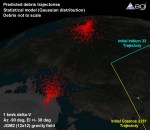
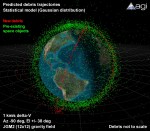
Less than a day after news of the unprecedented in-orbit collision between the active Iridium communications and defunct Russian satellites, the software company AGI has already carried out an analysis of the event. A detailed animation has been released depicting the velocity, angle of impact and statistical distribution of debris. Although the CGI is missing (I would have liked to have seen at least an explosion, shockwave and shards of twisted smoking metal. Come on guys, have a little fun!), it is a great visual aid for us to get a grip of what happened up there. To be honest I’m still blown away that this happened at all. There might be a lot of junk up there, but the statistical likelihood of this happening is still low.
On Tuesday, at approximately 5pm GMT, two satellites made history. They became the first artificial satellites ever to collide accidentally in low-Earth orbit. The event happened between a defunct Russian satellite (Cosmos 2251, launched in 1993) and an active commercial Iridium communications satellite (Iridium 33, launched in 1997), destroying the pair. Now there’s a mess up there, pieces of debris threatening other satellites, possibly even the International Space Station… Continue reading “It’s Not One-Way Traffic: Satellites Collide at 790 km”




 astroengine.com