This is hardly surprising if we consider that the lifespan of Spirit should have been 3 months, the fact that it has lasted 69 months (so far) is nothing short of miraculous. In rover-mission-lifetime years, doesn’t that make Spirit and her twin sister Opportunity 1380 years old? (I decided that a “lifetime” is 60 years, in case you were wondering.) Perhaps that’s not how it works, but for NASA to build a robot that has lived 23 times longer than the mission specified is pretty damn impressive. No wonder Spirit is losing her memory. I’m surprised she hasn’t lost the will to live.
Spirit has lost the use of one of her wheels and remains stuck in the sand… so she is showing her age. But still, 23× longer than planned? When I’m 1380 years old, I hope I’m only suffering amnesia every now and again.
“25 billion of your biggest bombs please. I’ll pay credit, thanks!”
"I love the smell of venting volatiles in the morning..."
The Pluto debate frustrates me, as you may have noticed. It’s not that I have particularly strong views about whether it should be called a planet or a dwarf planet or a plutoid or pygmy planetoid, it’s that I really don’t care; I actually see Pluto’s “demotion” as exciting progress in the field of Solar System science rather than any derogatory gesture aimed at Pluto. Pluto is still Pluto; it hasn’t been knocked out of orbit, it hasn’t even been “bombed” (unlike our poor old Moon), it’s just being filed under a different category.
A King Amongst Dwarfs
In my opinion, calling Pluto a “planet” was unworkable, especially after a bigger dwarf planet was discovered in 2005 by a team of astronomers led by Dr. Mike Brown. This dwarf planet was named Eris (or 136199 Eris) and at first it seemed like we had gained a tenth planet.
The “ten planets” thing was short lived, however. In recognition that Eris probably represented the beginning of a spate of discoveries of welterweight worlds, the International Astronomical Union (IAU) took a vote in 2006 and decided to redefine what constitutes a planet. Pluto was in the firing line, became a rounding error and was dropped from the planetary club.
Kicked out and nowhere to go.
But it wasn’t all bad for the little guy. Pluto was designated king of all “plutoids” (trans-Neptunian dwarf planets) in 2008, meaning another three dwarf planets now orbited the Sun with this designation (Eris, Haumea, and Makemake in addition to Pluto).
Just so my opinion is known, I don’t care what Pluto is called. If NASA decided to explode Pluto as part of a Kuiper belt clearing project, then yes, I might be a bit annoyed; I’d even start a blog titled “Save Pluto.” But calling Pluto a dwarf planet (or the rather cute plutino) really doesn’t bother me.
I haven’t really thought much about this statement until, today, @PlutoKiller himself (Mike Brown) tweeted, “Seriously, what just happened? The entire discussion is on placing explosives in the solar system. Pluto has not even been mentioned.” I then fired off a reply saying something about building a New Horizons 2 and packing it with plutonium to which @PlutoKiller said, Evil Santa-style: “Just in time for Xmas.”
And then the penny dropped.
Kuiper Belt Cruelness
To be honest, I’m astonished I haven’t thought of this before. Looking at Mike’s Twitter feed should have been enough inspiration, but until I wondered down the bombing Pluto => plutonium enrichment => lets fly a shedload of plutonium to Pluto path, that I asked the question: How much energy is needed to completely destroy Pluto?
Now we’re talking! Time for some Kuiper belt mayhem!
It might seem quiet now...
I’m not talking about simply bombing Pluto and making a big crater, I’m not even talking about fire bombing all the volatiles out of its frozen surface, I want to remove Pluto from existence. Why do I want to do this? Well, for fun, and because @PlutoKiller himself said so. And it’s Halloween, so why not?
Now, energy is energy and mass is mass, let’s give Pluto the same treatment. Using the following equation (known henceforth as the “Plutoid Killing Equation”, or simply PluKE), we can find out how much energy we need to erase Pluto:
This equation is the total gravitational binding energy of a sphere of mass, M and radius, R. G is the Gravitational Constant. For Pluto, a sphere, its vital statistics are:
MPluto = 1.305 × 10²² kg
RPluto = 1.153 × 10⁶ m
and
G = 6.673 × 10⁻¹¹ m3 kg-1 s-2
Plugging the numbers into PluKE, we can derive the total energy required to kill Pluto, literally:
EPluto(dead) = 5.914×1027 Joules
Oops, who put those WMDs there?
But what does this number mean? This is the bare minimum energy required to match the gravitational binding energy of Pluto. If you want to rip the dwarf planet apart (plus pyrotechnics and speeding debris), you’ll need a lot more energy. However, nearly 6×1027 Joules (that’s a 6 followed by 27 zeros) delivered into Pluto in one second should give the little world a very bad day.
Tsar Very Much
But how can we “deliver” this vast quantity of energy in one second? I suspect that any super-advanced civilization hell-bent of wiping out planets will have a better idea of this than me, but using weapons that are available to modern man might be a good place to start. Forget the uber-powerful death ray emitted by the Death Star, that’s sci-fi. It may not be sci-fact, but how about sending some nuclear bombs to the Kuiper belt?
How many bombs will we need? Ten? Ten dozen? A thousand?
The most powerful nuclear weapon tested was the Soviet 58 MT Tsar Bomba in 1961. So if we know how much energy is released by one of those beasts, we should be able to work out how many we’ll need to send to the unsuspecting Pluto.
1 MT = 1 megaton of TNT = 4.184×10¹⁵ Joules
therefore, a single Tsar Bomba has the potential to release an energy of:
We needed 6×1027 Joules to wipe out Pluto, obviously the 2.4×10¹⁷ Joules a single bomb can deliver is woefully short of our goal. So how many Tsar Bomba weapons do we need?
(6×1027 Joules) / (2.4×10¹⁷ Joules) = 2.5×10¹⁰
We need to build 25,000,000,000 nuclear bombs. 25 billion. Ouch.
Obviously, looking at this estimation, it is impossible to destroy a dwarf planet as puny as Pluto using the most powerful weapon known to man. Also, it’s worth keeping in mind that this is the bare minimum of energy that needs to be applied to Pluto to match its gravitational binding energy, so to destroy it, you’ll need a lot more bombs.
There’s also the question of how to distribute the weapons. Would you put them all in one place? Distribute them all around the globe? Perhaps burrow into the centre of the body? I suppose putting all the bombs in one place might be impressive, kicking a chunk of plutoid into space.
Now I must report these findings to @PlutoKiller himself, I fear he won’t be happy with the outcome of my calculations…
Although I’ve been neck-deep in Ares I-X launch news today, I’ve had some time to see what else has been going on in the Universe. I really hope I’ll find the time to get to this stack of blog post ideas over the weekend, one of them is a particular peach.
But before I turn in for the night, an interesting little debate has been sparked over at Keith Cowing’s NASA Watch. Keith, the ever watchful eye over all things NASA, somehow stumbled across the NASA 360 blog and pointed out that the agency might be trying too hard to be “hip.”
I think that one of the hardest things NASA has to do is to communicate their incredible science to the general public — no one said outreach was easy. Every day I am challenged with this issue on Discovery News. On the one hand I want to talk about the quantum effects of Hawking Radiation at the event horizon of a black hole, but on the other, I have to realize that most of my audience didn’t take Advanced Quantum Mechanics at school.
Realizing how to approach an audience with science is a bit like approaching a crème brûlée with a blowtorch; you have to do it slowly, with enough distance between the caramelizing sugar (audience) and the flame (science). You get too close and the mix gets burned (confused), get too far away and the mix is undercooked (bored).
This by no means is equivalent to “dumbing down,” it’s simply a method to find analogies and examples that can connect the mind-bending science with a tangible reality (like comparing the curvature of space-time with the curvature of a rubber sheet when a heavy ball is placed on top of it). If you start over-simplifying the science, you end up sounding like a tool and your audience thinks you’re lame/boring/condescending.
If analogies and examples aren’t forthcoming, try humour. One example of this is “5 Frightening (But True) Space Stories,” a guest blog post for Space Disco Robert Lamb posted today. Robert is an expert at blending science and humour. So much so, this blog post teaches some spaceflight history without you even realizing it.
So, back to NASA Watch and the comments about the NASA 360 blog post written by presenter Jonny Alonso:
I am certainly all for trying to connect to a broader audience but this NASA 360 post by Johnny Alonso (the MTVish on-air host) is just silly with its attempt at teen Twitter and SMS lingo i.e. “hai guyz” and “that would totally suck. lol”, “it was hawt :)” and “These cats Mike and Barry”. –Keith Cowing, NASA Watch
Running the risk of sounding a little long in the tooth, Keith is obviously a little riled about the standard of writing on this particular post. At first, I was mildly amused, but the more I looked at it, the more I realized NASA’s outreach style might be flawed. Using text-speak to convey his work presenting for NASA makes Alonso sound limited (which I’m sure he’s not, although I haven’t seen him in action, so I might be wrong), but worst of all it knocks the credibility of NASA outreach.
This might be one form of communication, but there must be some kind of editorial control? Are there standards? Granted, I think the content produced by NASA online is second to none, which is probably why NASA 360 is standing out like a sore thumb. Also, this blog post is the personal angle written by an enthusiastic young guy in a conversational, loose tone who probably has a lot of fans.
Perhaps I’m just old fashioned in agreeing with Keith, but “outreach” doesn’t mean NASA should be publishing blogs like this to try to appeal to a younger/trendy audience. As sad as it may be, if the younger generation isn’t interested in NASA, I doubt a presenter saying “hai” all the time is going to change that.
What do you think? Am I being picky? Is this just a symptom of what we can expect from blogs in the future?
You could say it’s been an eventful day… but you’d be understating the importance of the last 24 hours. We saw the first test launch of the Constellation Program, and it was a success (despite being delayed by a day). Although it’s going to be a while until NASA processes all the data gathered from the launch, I watched that elegant white rocket take to the skies above Kennedy Space Center and thought “I can see astronauts travelling on that thing.”
Alas, this thought may be fleeting as the Constellation Program is underfunded and lacking direction. However, there’s a lot to be said for seeing the Ares I test vehicle soar 28 miles into the atmosphere. Could this “proof of concept” sway funding decisions in NASA’s favour?
I couldn’t even guess right now.
So, for now, let’s enjoy the Ares I-X launch and congratulate NASA on a job well done. The US space agency has done mankind proud. Again.
Forget the supposed “Mayan Prophecy” of doomsday in 2012, the Mayan civilization never (ever!) predicted that the world was going to end on Dec. 21st 2012. Really, no ancient Maya elder ever said anything about doom. Also, no Mayan descendent believes that their ancestors foretold doom (and in fact, they’re getting rather pissed off at the insinuation).
Are you seeing a pattern yet? Please say you are.
In short, the world isn’t going to end in 2012, it is simply the end date of the Mayan calendar. There is nothing scary, spooky, weird or ominous about that despite what the doomsayers keep telling us. As I talked about in a previous article, 21/12/2012 is going to be a poignant reminder that the Mayan Long Count calendar represents the last breath of an ancient civilization.
And to be honest, who needs doomsday theories when the history of the Mayan culture is so fascinating anyway. I’m totally blown away by this video:
However, the timing of this news report is no coincidence. Can you guess why?
Hint: in about three weeks time, a fun little movie called 2012 is going to be released. It might have a terrible plot, it might even be over-hyped, but I wager that the 2012 movie will be a blockbuster. Blockbusters = audience. So, why do you think this mother of all coincidences just happened? Why would CNN decide to run this news report now? Do you think it might be the same reason why every media outlet will be pulling apart every aspect of 2012 for most of November?
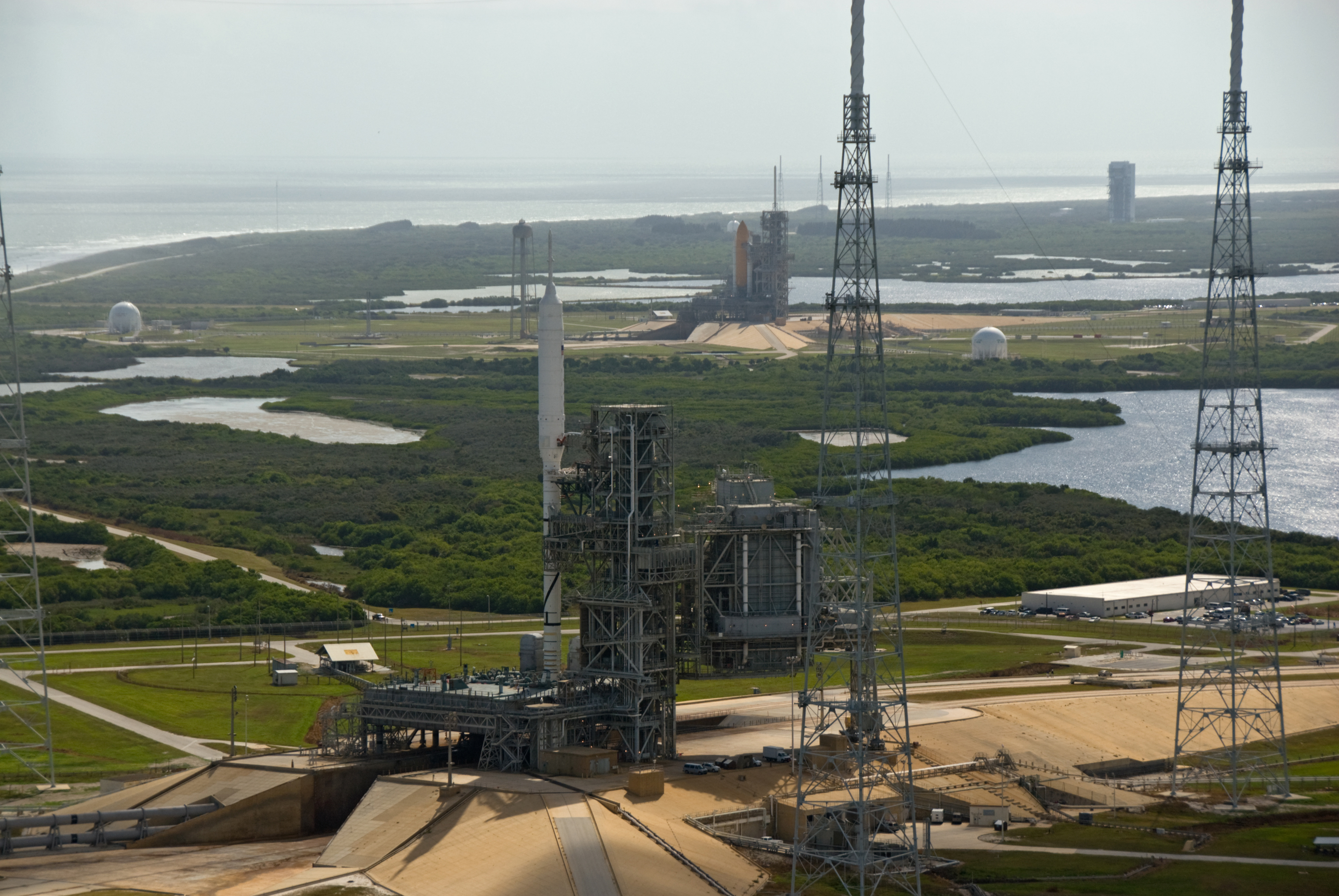
The Ares I-X and space shuttle Atlantis, ready to launch (NASA)
This is possibly the most confusing image I have seen since I started writing about human space flight. In the foreground, we have the brand new Ares I crew launch test vehicle for the Constellation Program (a.k.a. the Ares I-X), and in the background we have space shuttle Atlantis awaiting its scheduled Nov. 16th STS-129 launch. Is this going to be a historic scene of the past and future generations of U.S. manned space flight? Or is this going to be an example of how to waste a lot of money very quickly in one launch?
The world should be bubbling over with excitement that we are about to see a brand new launch system take to the skies on Tuesday at 8am EDT (albeit on a suborbital path) but it’s not, as hanging over the Constellation Program is the decision to come from the White House after the Augustine Commission report was released on Thursday. No one expected good news for the Ares I rocket, and nothing much has changed. NASA is developing the wrong rocket for the wrong destination (i.e. the Moon).
On the one hand, I want to see the Constellation Program become the trailblazer of manned spaceflight, but on the other hand I’m concerned that the program is too flawed and too expensive (pretty much in agreement with the Commission). Perhaps a cheaper, more efficient alternative can be implemented to solve our current space exploration woes? NASA definitely needs the support of commercial spaceflight, perhaps a focus on stimulating the commercial sector should take an even higher priority than space station resupply contracts?
There are arguments for and against Constellation, and I haven’t worked out where I stand yet. However, I totally support Norm Augustine’s comments that NASA shouldn’t be “running a trucking service” in low-Earth orbit. That job should be left to commercial spaceflight companies. NASA should be pushing into new frontiers with the most technologically advanced spaceship they can develop.
So, back to this photo. Never before has the term “bitter sweet” been so applicable. I just hope we see a perfect launch on Tuesday, but it may well be the only flight of Constellation (so be sure to wake up early, just in case).
Despite the fact the UK is effectively frozen out of participating in any kind of human spaceflight activity (we can blame Maggie Thatcher for that particular stroke of genius when she masterminded the 1986 Outer Space Act), it would appear Will Whitehorn, president of Virgin Galactic, has been meeting with the UK’s science minister Lord Drayson to investigate the possibility of establishing a spaceport at Lossiemouth RAF airbase in Scotland.
Central to Galactic’s argument for the Lossiemouth airbase is the fact that the fledgling space tourism business could directly account for 2,000 new jobs in the area. The space industry already supports 68,000 jobs in the UK and contributes £2.4bn to the gross domestic product, so the spaceport would only increase investment and interest in national space endeavours.
This move is supported by Andy Green, chief exec of the software company Logica who is chairing the “Space Innovation and Growth Team” due to report to Drayson in January on ways to stimulate the British space industry. Only a few days ago, Green wrote to Drayson, pushing for a UK space agency and a national space program.
The space sector has grown 9% a year over the past decade, more than three times faster than the economy as a whole. –Jenny Davey, TimesOnline.co.uk
If this plan bares fruit for Richard Branson’s spaceflight dreams, Lossiemouth could become the third international location for Virgin Galactic’s WhiteKnightTwo/SpaceShipTwo combo to take off from. Currently, the New Mexico spaceport is under construction and Branson also plans to fly fee-paying tourists (at $200,000 a pop) through the aurora from Kiruna, Sweden.
Let’s face it, us soft and squidgy humans don’t react particularly well to radiation, the vacuum of space or hypervelocity meteoroids. This being the case, how do we ever hope to settle on other worlds, particularly worlds with dust for a backyard and a sky flooded in radiation from the Solar System’s biggest nuclear reactor (the Sun)? To put it mildly, it’s not going to be easy. In fact, exploring and settling on other celestial bodies will the the biggest challenge us terrestrials will face in the next century.
So we start thinking locally, we start thinking “familiar”; where could we build a habitat that’s a stone’s throw from Earth, where we can do a full-scale practical test of our colonizing skills but be only a couple of days from home?
The Moon is that world and we are currently stumbling our way toward that goal. In fact, it is (currently) one of NASA’s main priorities, to get man back to the Moon by 2020 (although the Augustine Commission report was released today and presents many more options for the future of NASA). Once we do eventually get back to the Moon, our lunar explorers will use man made habitats, but what about longer, more permanent settlements?
We’re going deeper underground
In-situ mining of materials for building habitats and using the landscape to protect settlers isn’t a new idea, but we are beginning to acquire better observations of the Earth’s only natural satellite. And now, observations from the Japanese Kaguya spacecraft (that was deliberately crashed into the lunar surface in June) have been used to scout out a possible location for a future permanent habitat.
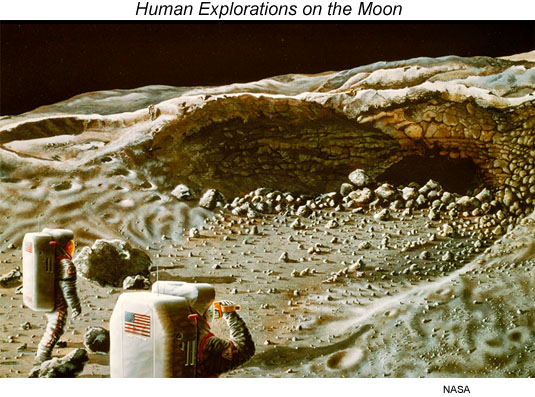
Cavemen 2.0 (NASA)
It may be hard to believe, but the Moon was once a very hot body, where molten rock began to cool shortly after formation. This molten rock eventually solidified, but in doing so, lava burrowed out long channels known as sinuous rilles. These rilles are a sure sign that lava once flowed there. However, scientists have known for some time that beneath these rilles, lava tubes may also hide. The lava tubes formed when the remaining molten rock flowed away, leaving an encrusted layer of rock surrounding a closed network of tunnels.
A lava tube with a view
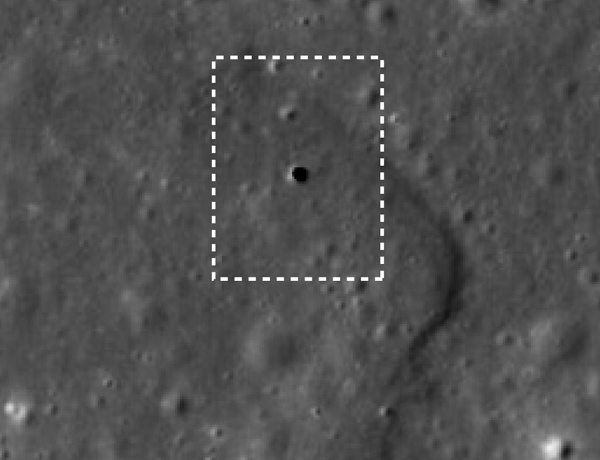
However, this is the first time a hole in the roof of one of these lava tubes has been found. This hole, for obvious reasons, has been dubbed “a skylight,” and Junichi Haruyama and the SELENE/Kaguya team have been working hard to seek out such features. Their hard work has just paid off.
“This is the first time that anybody’s actually identified a skylight in a possible [lunar] lava tube,” said Carolyn van der Bogert, a co-investigator on the team from University of Münster in Germany, of the discovery in a region of the Moon’s near side in Marius Hills.
The skylight measures 65 metres wide and it is thought to extend 80 metres deep. The hole is right in the middle of a rille, indicative of the presence of a lava tube 370 metres across. It is currently unknown whether the skylight allows access to the lava tube (access may be blocked by rubble or solidified magma), but there is the tantalizing possibility that this hole could be used by astronauts to access an underground cave.
Anti-radiation living
“Basalt is an extremely good material for radiation protection. It’s free real estate ready to be exploited and modified for human use,” said Penny Boston of the New Mexico Institute of Mining and Technology in Socorro. It’s not exactly a leap of the imagination that locations like the Marius Hills skylight could become very valuable regions when space agencies and potential lunar companies need a permanent foothold on the Moon.
Until we are able to set foot back on the Moon’s surface, we must rely on robotic explorers to do the reconnaissance work (indeed, that is the main priority for NASA’s Lunar Reconnaissance Orbiter, a satellite capable of snapping images 10× sharper than this Kaguya picture), but the fact remains, features like this are very appealing to help protect us humans from the ravages of space.
Bored of the Moon? Set up home in a Martian divot!
*Technically, it would be a “condo“; anyone living in the lava tube would own the space inside, they wouldn’t own the lava tube itself. We all know that no one can “own” the Moon don’t we? You can throw away that “Congratulations! You’re Now The Proud Owner Of One Acre Of Lunar Real Estate!” certificate, it’s about as valid as those “I Need Your Bank Account Details To Deposit $1 Million” Nigerian royalty emails.
(Note the clever use of CAPS and excessive exclamation marks in the title. It speaks volumes.)
I guess this confirms I was wrong. Consider this an apology to all the crackpots, doomsayers, cranks and Walter Wagner. I’m sorry I got it all… so… wrong.
While out on the town in London, Bad Astronomer Phil Plait pulled Prof. Brian Cox out of a pub and subjected him to some intense interrogation. Obviously caught with his guard down, Cox folded under the pressure and briefly told the world what we can expect when the Large Hadron Collider (LHC) recommences experiments in November. Wow, just… wow.
This made me giggle. Looks like TAM London was a tonne of fun, hopefully next time I can go.
The Ares I-X rollout from the Kennedy Space Center's Vehicle Assembly Building (from NASA TV)
The Ares I-X rollout began a little after 1:30 am EDT on Tuesday morning at Kennedy Space Center as planned. NASA TV was running the event live, and it was great to see the long, slender test rocket slowly edge along the crawlerway to begin its overnight journey to launchpad 39B.
Despite the pessimism surrounding the Constellation Program, I for one am very excited to see the Ares I-X blast off. It will be a sight to remember.








 astroengine.com