Chandrayaan-1 Didn’t Fail. It Fried

chandrayaan

As we all know by now, India’s first mission to the Moon (Chandrayaan-1) lost contact with mission control over a week ago. Very quickly, the Indian Space Research Organization (ISRO) declared that the mission was unrecoverable, and after a 10-month stint, it was curtains for India’s début lunar jaunt.

Oh well, these things happen in space.

But not everyone sees it that way. Almost immediately, the media started calling Chandrayaan-1 a “failure.” The ISRO issued press releases saying that 95% of the mission objectives had been completed, so it couldn’t be considered a “failure.”

During the Al Jazeera Inside Story show I was invited to appear on shortly after contact was lost with the satellite, I mentioned that it isn’t easy to put stuff into space. Although the ISRO has been operational for the best part of 40 years, getting a probe to the moon, dropping an impactor onto the surface and surviving for 10 months wasn’t an easy thing to do by any means. How could the mission possibly be a failure? More of a partial success.

Some questions will obviously hover over the reasons for the mishap, but it doesn’t seem to be holding India back as they prepare Chandrayaan-2.

So what did happen? It would appear that some more details are surfacing about the satellite’s demise. The Indian press are pointing to a decision by the ISRO to increase the orbit of Chandrayaan-1 from 100km to 200km in May this year for scientific reasons. In actuality, the radiation shielding installed on the craft was insufficient, forcing mission control to increase the orbit away from the Moon.

And now it looks like the same problem — lack of decent radiation shielding — fried the communication computers on board the satellite, probably the root cause of the blackout. In any case, international specialists will meet in Bangalore today to shed some light on why Chandrayaan-1 disappeared and to evaluate its performance.
Mount Placid

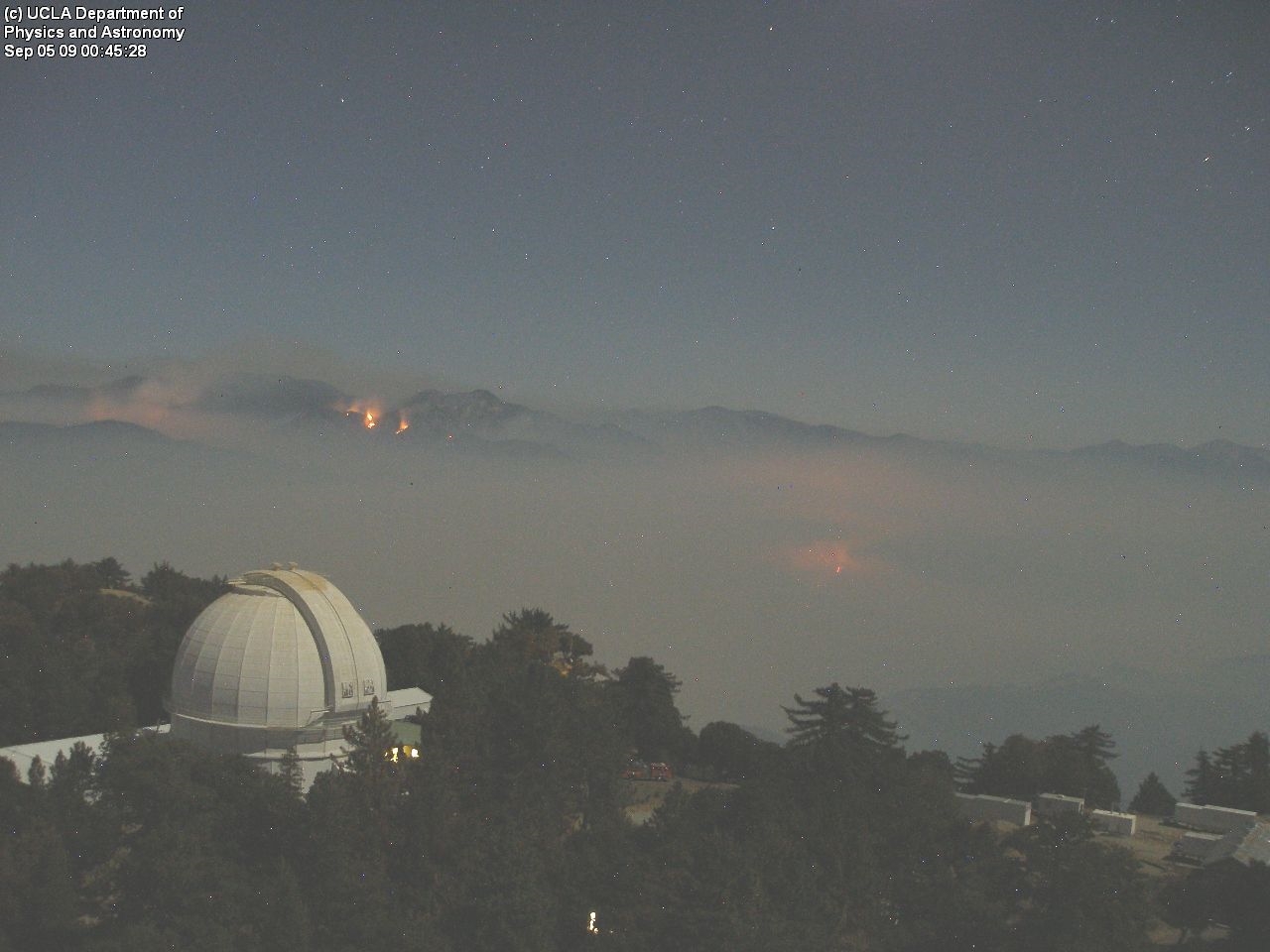
The view from Mt. Wilson Towercam, facing east (UCLA)

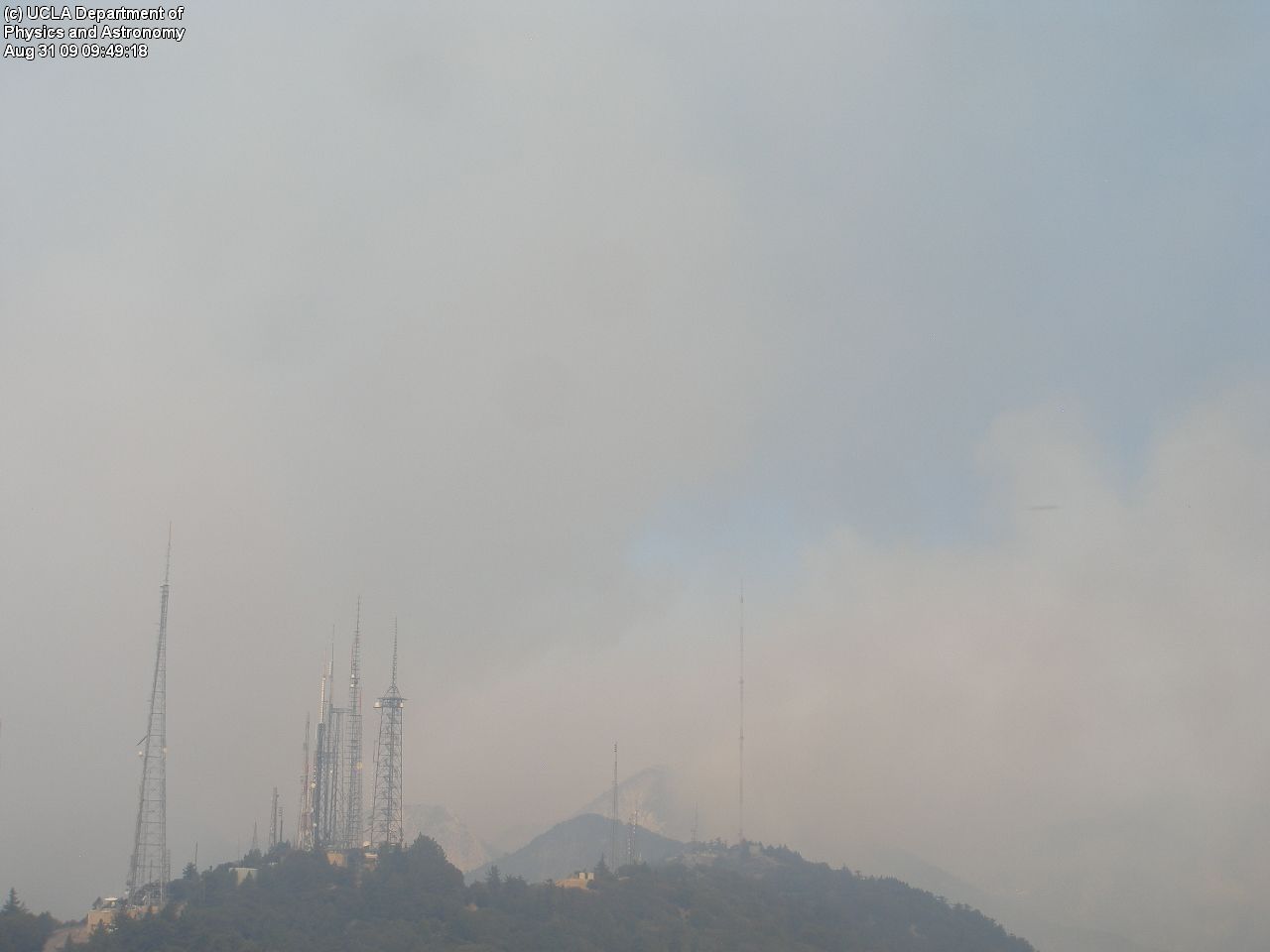
So, the observatory Towercam is back online, and the summit of Mount Wilson is looking decidedly un-charred and… peaceful. This means the fire crews did an outstanding job of removing vegetation and the aerial water attack obviously paid off. The Hooker Telescope dome is also looking fine.

But it’s the scene to the east of Mt. Wilson (the Towercam has been turned around), showing fires burning in the valley and in the hills (the nearest fires still burn in the West Fork of the San Gabriel River Canyon near Shortcut Saddle), that reminds us that the fire fight is far from over, and the fire men and women are putting their lives on the line day and night.

But for now, the historic Mt. Wilson Observatory is safe, and the lesser-known Stony Ridge Observatory is apparently intact…

Station Fire Now Threatens Stony Ridge Observatory

sro2

Over these last few days, the Internet was abuzz with news about the Station Fire threatening the world-famous Mount Wilson Observatory. In case you don’t know what the observatory is famous for, Edwin Hubble used the 100″ Hooker Telescope to deduce that the Universe is expanding. So, yes, it’s an important site that needed to be defended for as long as was physically possible. Also, an array of telecommunications towers share the Mt. Wilson summit, so there was a lot at stake.

So far so good. The Station Fire is gradually coming under control, even though it still spreads east through the San Gabriel Mountains (and I can still smell smoke through my open office window). We’re not out of the woods, but at least the observatory is safe for now and fire crews are making great headway.

But hold on. What about Stony Ridge Observatory?

Stony Ridge Observatory?

Stony Ridge Observatory

Yes, there’s another observatory at stake. Not as famous as Mt. Wilson, but Stony Ridge is in jeopardy, if not more so. Stony Ridge is currently inside the Station Fire perimeter, five miles north of Mt. Wilson, and nobody knows if it’s been hit by the fires.

Stony Ridge Observatory is a single 30-inch Newtonian-Cassegrain telescope housed inside a dome. It is a site that was built and is maintained by amateur astronomers, and back in 1963, it was the 8th biggest telescope in California. Currently, the observatory is used for outreach activities and follow-up observation campaigns. It’s also accredited with a number of asteroid discoveries.

Unfortunately, Stony Ridge probably won’t see the aerial fire fighting we saw at Mt. Wilson. Ground crews have made attempts to approach the site, but access to the observatory was blocked by mountain debris on the road. In short, there is no word about the status of the observatory and there are no plans to mount a huge fire fighting effort.

When housing, communication masts and larger observatories are threatened by fire, resources are committed, but for an observatory the size of Stony Ridge, it’s the sad case of waiting for the fire to burn its course and then assess the damage after the fact.

For Stony Ridge Observatory fire updates, see the temporary fire updates page.

Source: Sky & Telescope via @buffalodavid.

Chandrayaan-1 is Lost, Astroengine Appears on Al Jazeera

As far as blogging about space news goes, this is most definitely the pinnacle of my writing career. After hearing the frustrating news that the Indian Space and Research Organization (ISRO) had lost touch with their Chandrayaan-1 lunar mission, I, of course, felt compelled to blog about it.

Not 24 hours later, I receive an email from the producer of an Al Jazeera news show called Inside Story asking me if I’d be interested in sharing my views about Chandrayaan-1 on the show early Monday morning. Hell yes!

So I spent the rest of Sunday cramming the (very interesting) history of the Indian space program, along with some of the specifics of Chandrayaan-1. By Monday, I was ready to go.

The filming for the show started at 7:05am in a studio in Culver City and lasted about 25 minutes. And it was a lot of fun! Check out the video above, I think the Inside Story production is highly professional, with a very BBC feel to it. I’m very happy to have been asked for my opinion live on air, on the international stage.

Although my brain wasn’t functioning particularly fast at such an early hour, I think it went well, and I eventually got my points across…

Wildfire? Volcano? Warzone? Hell? All of the above?

wildfires

I think this timelapse video pretty much puts the Station Fire into perspective. The fire has so far destroyed over 120,000 acres of land, gutted dozens of homes and taken the lives of two fire fighters. Although it would appear fire crews are slowly getting a handle on the blaze (it was around 20% contained at time of writing), should there be a change in weather, the fires could flare up once more, but there are hopes that humidity should continue to rise through the night.

Also, it would appear the earlier fires spotted on the summit of Mount Wilson were primarily controlled backfires (i.e. small fires started deliberately by the fire service to burn off brush, thereby removing fuel for an uncontrolled fire). Now, an airborne assault has begun, water and fire retardant being dropped to slow the advance of the Station Fire around the mountain leading to the observatory. And now, the word is that fire crews seem to be winning the fight to save the Mount Wilson Observatory (thank you @palomarskies for the update!).

So, for now, I’ll leave you with this phenomenal HD timelapse video of the Station Fire created by willieworks. The view is of the mountains to the north of LA, from Mulholland Drive, above Universal Studios. It’s a scene that really does belong in the movies. What a sight.

Fires Hit Summit of Mount Wilson [Update]

mt-wilson-fire2

Update (14:07 PDT): Mount Wilson’s server has now gone offline it seems. The webpage with fire updates stopped functioning a little before 14:00 PDT and the Towercam is no longer sending images to the mirror website. The last image was taken at 13:49 PDT. Although we were warned this may happen due to power outages to the observatory, this is the first time it’s been offline since the start of the fires.

13:25 PDT: In a bad turn of events, the Station Fire reached the summit of Mount Wilson, coming within feet of the observatory buildings. It seems possible that this fire may be due to secondary effects from the Station Fire (i.e. airborne embers). Watch the unfolding events via the KTLA helicopter.

The 150ft Solar Tower and the 100″ Hooker Observatory are both under siege from the smoke and fire. Fortunately, the fires aren’t as active as they have been, possibly due to increased humidity in the region, but this is obviously a concern. However, fire crews appear to be controlling the blaze so far. According to @CalFireNews, fire crews are in the area protecting the structures:

*Station IC* There are between 5-8 Engines providing Structure protection for Mount Wilson. — CalFireNews

In case you cannot access the Solar Tower’s Towercam, check the mirror site.

My thoughts are with the fire crews bravely fighting the fires around the observatory.

Updates pending…

Fire Fighters Step Down From Mt. Wilson, But Flare-ups Still Threaten Observatory [Update]

A morning view from Mt. Wilson Observatory. Lots of smoke, but the fires seem to have calmed (©UCLA)

Update (Aug. 31st, 15:00 PDT): The situation has taken a turn for the worse it appears. Ground crews have been pulled off Mt. Wilson and the fire is approaching the observatory rapidly. The fire will now be fought from the air. The Towercam is no longer accessible (although it is probably overloaded with traffic):

Monday, 31 Aug 09, 2:46 pm PDT – CHARA Array operator PJ Goldfinger reported that at about 2:00 pm she monitored an LA County Sheriffs Department transmission advising a pullout from Red Box, the major staging area near the mountain. I just spoke with Sherry Roman, Public Affairs Officer of the Angeles National Forest. She could give no updates as to the status of the fire in the Mount Wilson vicinity except that the USFS still considers that passage of fire across Mount Wilson is imminent and will be fought aerially rather than with ground personnel. Once the fire is through the area, they can assess the damage by air after the event before they can send in ground personnel. She also confirmed what PJ’s monitoring implied, that firefighters have been removed from Red Box.

This roller coaster has taken a dip downward. Mt. Wilson Observatory.

August 31st, 10:00 PDT: Well, last night was a rather dramatic night for the Mount Wilson Observatory. During the seemingly relentless charge of flames pushing dangerously close to the summit, news came in that it was very likely the Station Fire would arrive at the observatory some time last night. However, due to the brave efforts of fire crews who camped out on Mt. Wilson through the night, the observatory and telecommunication masts look like they’ve been saved, for now.

At this point, I don’t think [the observatory] suffered any serious damage. We’ll probably get some flare-ups or threatening flame activity, but we don’t think it’s going to be a major problem,” Inspector Edward Osorio of the Los Angeles County Fire Department said this morning.

Aggressive brush clearance and fire retardant appear to have helped, slowing the advance of the flames. However, the observatory and critical communications equipment are not out of the woods quite yet. The threat of flare-ups could still pose an issue. Another cause for concern is the fact that fire crews have been ordered away from the observatory earlier this morning, possibly to relocate north of the fire, the direction it appears to be heading.

Monday, 31 Aug 09, 7:50 am PDT – At 6:25 this morning, fire crews were instructed to withdraw from Mount Wilson. Larry Webster and Dave Jurasevich left the mountain with them. I have just spoken with Larry and Dave when they reached the bottom of the Angeles Crest Hwy in La Canada, and they report minimal fire activity in the immediate vicinity of Mount Wilson. It is not clear why the withdrawal decision was made nor whether or not the fire crews will return. Those fire fighters joined other crews deployed at the Red Box turnoff to Mount Wilson, five miles from the Observatory. So, they are still within close proximity for redeployment. Thus, the good news is that the fire in the Observatory’s vicinity seems to have diminished. The bad news is that there are no fire fighters presently on the scene.Mt. Wilson Observatory.

The Station Fire has claimed the lives of two fire fighters and caused nearly $8 million of damage. The fire is now 85,000 acres in size and continuing to spread in hot, dry conditions. Here in the San Fernando Valley, west of the Station Fire, the air is full with the smell of smoke and numerous poor air quality warnings have been issued.

Source: LA Times, Mt. Wilson

Fire Fighters Will Defend Mount Wilson Observatory Overnight [Update]

The view looking west from Mt. Wilson Observatory at 8:17pm PST (Aug. 30th)

Update: Monday, August 31st, 05:45 PDT: In the early hours of Monday morning, it would appear the situation atop Mt. Wilson remains the same. The Towercam is showing smoke and fires to the West of the summit, but there is no further breaking news from the Observatory:

Monday, 31 Aug 09, 4:50 am PDT – No reports from the mountain yet this morning. Towercam shows new fire encroachment. The Inciweb update is eight hours old – 42,500 acres, 2,575 personnel – and two fire fighters lost.Mt. Wilson Observatory

Sunday, August 30th, 20:30 PDT: According to the Mt. Wilson Observatory fire updates, fire crews have decided to remain at the summit of Mt. Wilson to fight the Station Fire blaze overnight. There were concerns this evening that the conditions would be too treacherous for the fire fighters to remain behind, but it would appear this has changed.

Sunday, 30 Aug 09, 8:07 pm PDT – A critical aspect to the survivability of the Observatory should the fire sweep across it is whether or not fire fighters will be on site during such an event. The U.S. Forest Service continually assesses the danger to fire fighters in any scenario and will withdraw fire crews in situations that are particularly precarious. Such an evaluation took place on Mount Wilson in the last half hour with the decision for the fire crews to remain in place tonight. That’s very good news.Mt. Wilson Observatory

But the fire continues and Mike Brown, an astronomer who lives near (but doesn’t work at) Mt. Wilson, tweeted his eye witness account of his view of the fire: “Holy smokes; massive glowing plume tonight just west of Mt. Wilson is scarier than last nights 50 ft flames. #stationfire.”

Unfortunately, in another location, two fire fighters have tragically lost their lives fighting a blaze in Acton. According to reports from @CalFireNews and the LA Times the fire fighters were involved in an accident where their vehicle apparently rolled over a mountainside. The accident happened during a period of intense fire fighting.

This is a horrific reminder that hundreds of brave men and women are currently out there battling against hellish heat and poisonous air. My thoughts are with the lost fire fighters families and the fire fighters that continue to push on through the night atop Mt. Wilson and the areas hit hard by the Station Fire.

Updates pending…

“Station Fire” Could Damage Mount Wilson Observatory [Update]

The Mount Wilson Observatory webcam, looking west. City lights to the left is the approximate location of Burbank (©UCLA)
The Mount Wilson Observatory webcam, looking west. City lights to the left is the approximate location of Burbank (image corrected for contrast. ©UCLA)

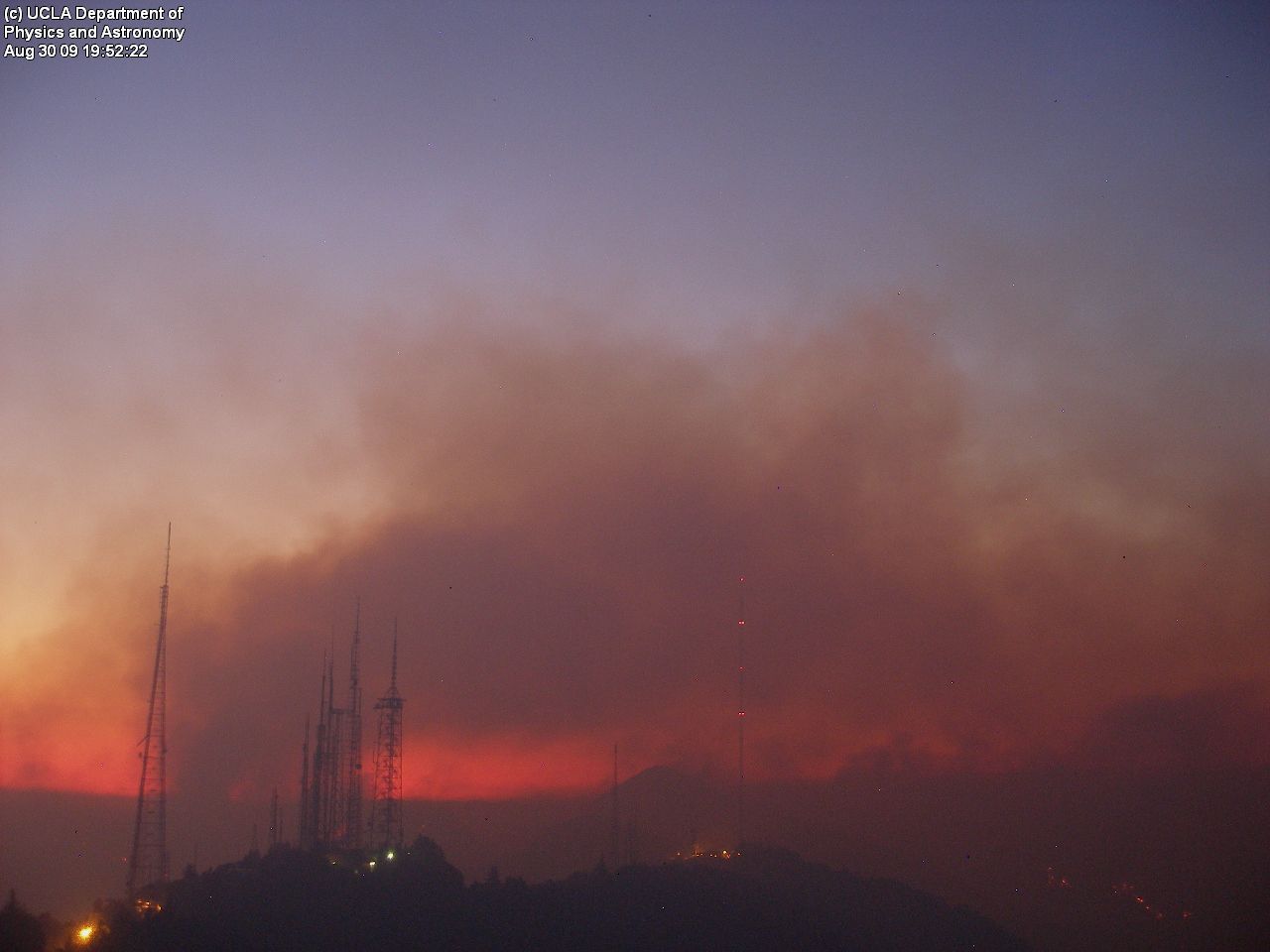
August 29th: As the fires rage in Southern California, the “Station Fire” continues to burn unnervingly close to the famous Mount Wilson Observatory, about 50 miles east from my location. The above image was captured at 8:29pm (PST) tonight from the observatory’s 150-foot Solar Tower webcam (called the “Towercam”), and it’s pretty obvious how close the fire is.

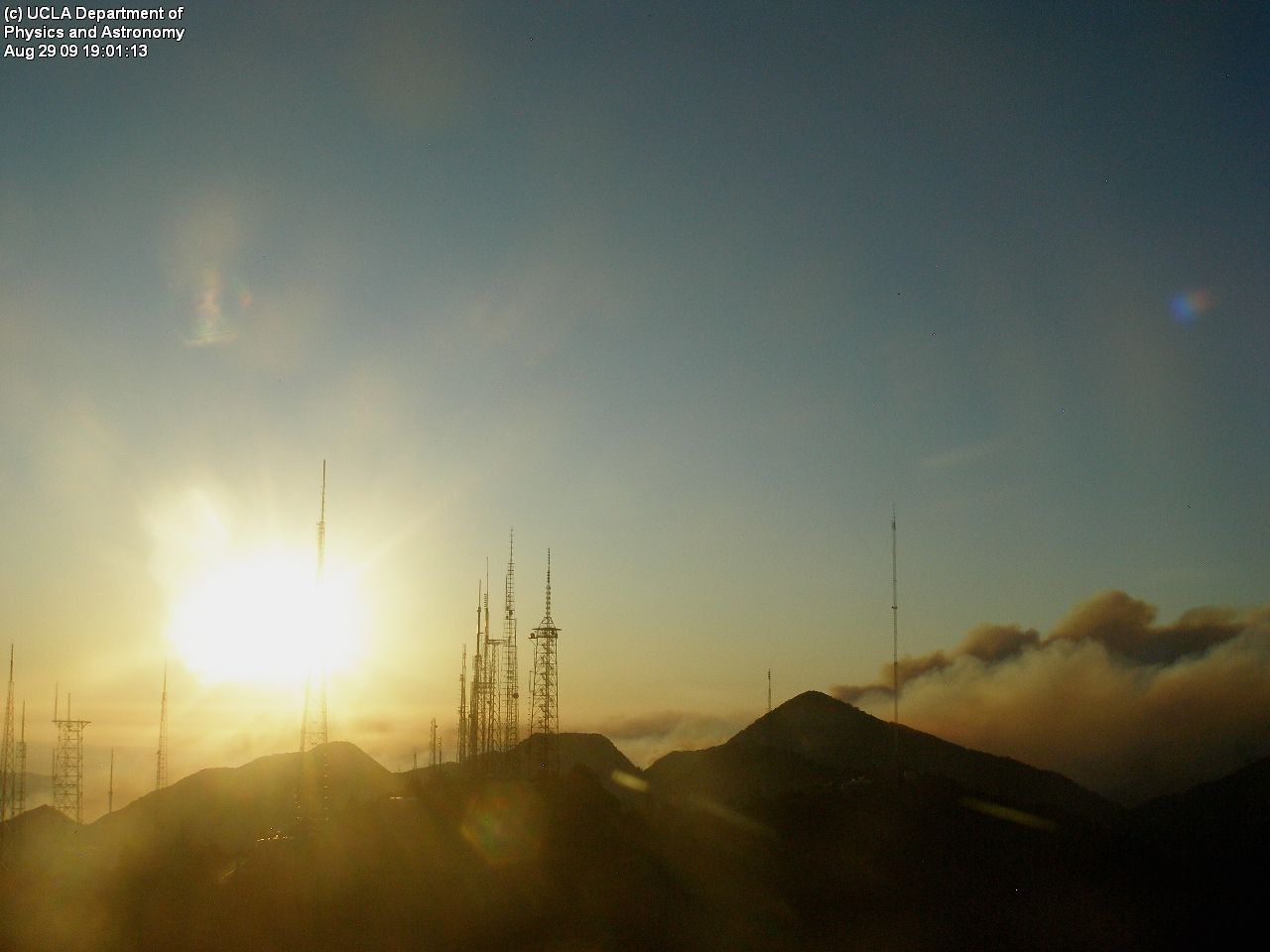
Mount Wilson at sunset earlier today (©UCLA)

Mount Wilson isn’t just important for the observatory, it is also home to telecommunication masts that are a lifeline for emergency services.

If Mount Wilson goes out, this news conference is done, because we won’t have any telecommunications,” Deputy Los Angeles County Fire Chief Jim Powers said in a press conference this morning.

Update (August 30th, 19:40 PST): Things are looking a little grim for Mt. Wilson. A couple of hours ago, the LA Times reported that the Station Fire was expected to reach the summit of Mt. Wilson in 2-4 hours. The worst news is, that due to a lack of escape routes at the observatory, fire crews will have to abandon the site should the fire get too close.

It’s a serious situation,” said Bob Shindelar, operations branch director of California Incident Management Team 5. “Is the observatory going to make it? We’re doing everything in our power. But I wouldn’t be surprised if it is impacted by fire today or tomorrow.”

The view from Mt. Wilson, facing west at 19:52 PST (Aug. 30th)

At 17:42 PST, the fire was within 2 miles of the summit and closing. Fire crews have been working on removing brush from the observatory buildings, structures that cover many acres.

I was driving through Woodland Hills today, and the view from here was ominous. The smoke is thick, and a huge cumulus cloud was rising high in the atmosphere. At one point, the scene looked like a volcano from a distance.

Reports from the observatory itself however remain a little more upbeat than the LA Times with this update on their website:

The LA Times has released this article in the last hour. Our reports on site are not presently so dire, but the “fog of war” certainly exists in a situation like this. Every preparation is being made for this scenario, and it may indeed yet happen. I remain optimistic for now.

Lets hope the spreading fire slows before it reaches the observatory and telecommunication masts…

Updates pending…

Thanks to Mike Brown (@plutokiller) for the link to the Towercam.

Lost In Space: India’s Chandrayaan-1 Moon Mission Goes Silent

A miniature replica of the Chandrayaan-1 spacecraft (V. Ganesan/The Hindu)

Just as one mission begins (Discovery’s STS-128), another ends. Unfortunately, only 10 months after launch, the Indian Space Research Organization’s (ISRO) lunar satellite Chandrayaan-1 has mysteriously ceased communication with mission control. ISRO officials have declared that the mission has ended, 14 months earlier than planned.

On Saturday, at 1:30am local time, the ISRO lost communications, and according to a spokesman, the agency is no longer in control of the spacecraft. Chandrayaan-1 data was being received by a monitoring unit in the southern city of Bangalore. There is currently no explanation for the failure.

The mission had completed 3,400 orbits of the Moon and everything seemed to be operational for the next few thousand orbits. The ambitious mission was launched by the fledgling space agency to allow India to stake a claim over lunar exploration with the future hope of exploiting the Moon’s natural resources (such as the abundance of uranium). This mission put India into a very exclusive club of only five international space agencies that had sent missions to the Moon before (NASA, JAXA, ESA, ROSCOSMOS and the CNSA).

This isn’t the first problem the satellite had suffered, however. In May, the probe lost a critical instrument called a star sensor, and then in July, the craft overheated. Fortunately, further damage to the rest of the satellite was averted by ground controllers.

Despite the obviously upsetting news about the loss of the $80 million piece of ISRO hardware, officials are surprisingly upbeat about the whole thing.

The mission is definitely over. We have lost contact with the spacecraft,” Project Director M. Annadurai said. “It [Chandrayaan-1] has done its job technically… 100 per cent. Scientifically also, it has done almost 90-95 percent of its job.”

Personally, I think the ISRO did a superb job at developing Chandrayaan-1 mission, and simply getting the thing into lunar orbit is an incredible feat. Another aspect I was impressed with was the ground controllers’ ability to deal with problems in-flight and fix them accordingly. This can only help to strengthen India’s ability when launching future missions to the Moon.

Sources: The Hindu, New York Times