For this week’s push into the blogospheric cosmos, we swing by Jon Voisey’s space blog The Angry Astronomer. I’m not too sure what he’s so angry about – possibly those pesky student loans he’s got to pay back… sorry Jon, after two years of graduating from my postgrad studies, I don’t have a research job and I haven’t even thought about paying back any of my loans! Ahh the life of a scientist… As always, a great mix of space news and views from around the world, and for my part I entered an article about recoiling supermassive black holes – now that is something I’d love to see…
Mystery mounds - we know it's a mystery, but please give us a clue? (HiRISE/NASA)
The High Resolution Imaging Science Experiment (HiRISE) on board the Mars Reconnaissance Orbiter is a stunning piece of kit. It is generating a vast quantity of images, all lovingly displayed on the HiRISE and other NASA websites. New views of the Mars landscape appear almost daily, with technical information on the projected scene, a polished display image, raw files and a little bit of text telling us what we are looking at. So far so good. That was until recently… Generally speaking, articles with compelling images do rather well online, plus I’m a big believer in “a picture speaks a thousand words,” so I jumped on the chance of running an article about some mysterious shapes that have recently been seen on the planet. Obviously the writer of the HiRISE image was of the same mind by letting the picture do the talking and… well, forgetting to mention where these mysterious features were located…. a mystery indeed… Continue reading “And This Mysterious Mound is Where?”
High-spatial and temporal resolution view from the Hinode SOT G-band filter (NASA)
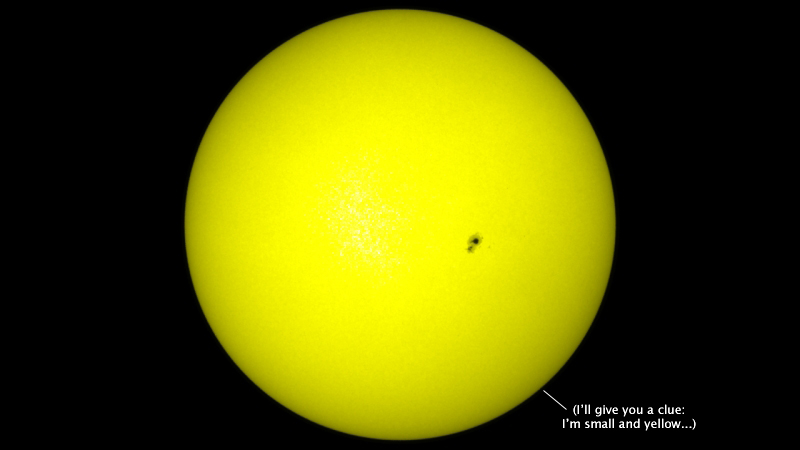
Our Sun is often called an “average” or “unremarkable” star. This is a little unfair, after all this unremarkable specimen is responsible for generating all the energy for all the planets in the Solar System and it has nurtured life on Earth for the past four billion years. We are also very lucky in that the Sun (or “Sol”) is comparatively stable with a periodic cycle. What’s more, it is alone, with no binary partner complicating matters. We live in a very privileged corner of the Milky Way, within the “Goldilocks Zone” (i.e. “just right” for life – as we know it – to thrive) from Sol, where there is a unique and delicate relationship between our star, the Earth and interplanetary space. This is all great, but in the star club, how does Sol measure up? Is it really just an average, boring star?
I noticed in the comments of my article Observing an Evaporating Extrasolar Planet that some readers were discussing the classification of our Sun. This was in response to the subject of the exoplanet called HD 209458b orbiting the yellow dwarf star HD 209458 in the constellation of Pegasus. I happened to point out that HD 209458 was “…not too dissimilar to our Sun (with 1.1 solar masses, 1.2 solar radii and a surface temperature of 6000 K),” but also highlighted that HD 209458 was a yellow dwarf star. To be honest, I didn’t think about the connection until Jerry Martin asked why our Sun is never referred to as a yellow dwarf star? Helpfully, Dave Finton posted a link to Wikipedia that discusses this topic. For the full wiki treatment, have a look at Wikipedia:G V star, otherwise read on…
The Hertsprung-Russell diagram – stars plotted by their absolute magnitude, luminosity, classification, and effective temperature.
In the Hertzsprung-Russell Diagram, all known stars fall into one of six broad classifications depending on their luminosity and surface temperature. Observed stars can either be classed as (from big to small) a super-giant, bright giant, giant, sub-giant, main sequence or white dwarf. Within those classifications are spectral sub-classes from “O” (surface temperature of 30,000K), “B”, “A”, “F”, “G”, “K” to “M” (at 3,000K). However, for the sake of keeping this article on-topic, we’ll focus on our star, Sol (which is Latin for Sun).
Granted, our Sun has a surface temperature of around 6,000K, giving it a spectral classification of “G”. On the luminocity scale, our Sun scores a “V”. So, the Earth orbits a “G V star” which is otherwise known as a Yellow Dwarf star (although their actual colour ranges from white to slightly-yellow). Why is Sol considered to be “average”? That’s because in the Hertzsprung-Russell Diagram, yellow dwarfs can be found right smack-bang in the centre of the chart, half-way down the Main Sequence. Using this chart gives an idea about where our star came from and where it is going. For the moment, it is a hydrogen-burning star, converting 600 million tonnes of hydrogen into helium per second. This “hydrogen burning phase” generally lasts for about 10 billion years (Sol is about half-way through this phase) until all the hydrogen fuel is exhausted. When this happens, a yellow dwarf will puff up into a Red Giant, eventually shedding its outer layer, producing a planetary nebula. Eventually, the core will cool and compress into a long-living white dwarf star.
So, to answer the question, the Sun is a yellow dwarf star… and it certainly is notunremarkable…
The physics behind the warp drive (Richard Obousy and Gerald Cleaver)
In science fiction, the “warp drive” helps Captain Kirk, Jean-Luc Picard, Commander Janeway and Benjamin Sisko potter around space with ease. Without warp speed, TV episodes of Star Trek would stretch into months and seasons would last decades. Alas, even science fiction succumbs to the laws of relativity: Nothing, not even light (or a Klingon) can travel faster than the speed of light. As I researched for a recent Universe Today article, the space between the stars is prohibitively large, even the nearest star is over 4 light years away (Proxima Centauri), so how could it be possible for USS Enterprise to flit from one star system to the next without putting a dent in Einstein’s theory of relativity? The answer comes if we realise that although light speed is a physical limit on how fast things can travel through space-time, there is no limit on how fast space-time can travel if it is warped. Suddenly we have a theoretically possible means of travelling between the stars by altering the fabric of the Universe in a warp “bubble”… Continue reading “Could Warp Drive Become a Reality?”
I don’t suppose he can get it right all the time. Recently, Buzz Aldrin, second man on the Moon and huge space development advocate, has been very vocal with his views about NASA and the agency’s position in the space exploration pecking order. Good man, the world needs more people like him willing to encourage a more positive attitude toward space. But today, I read that the NASA legend has dropped a clanger. Fair play, he’s entitled to his views, but for once (and hopefully the only time) I will say “Buzz, you are totally, and unequivocally wrong.” So what did he say? Science fiction makes space science reality look boring. Continue reading “Bad Move Buzz, Science Fiction DOES NOT Make Space Boring”
The newest version of WordPress was released today with loads of new features (including the long overdue wordcounter! I’m easy to please…). Most of the upgrades will make life a bit easier for me when posting new articles on Astroengine, so hopefully that will be reflected in the quality of my writing. If you want to learn more about WordPress and why this upgrade is pretty awesome, check out the online video from the developers of WordPress Version 2.6 (a.k.a. “Tyner,” after jazz pianist McCoy Tyner)…
Astrophysicists love to simulate huge collisions, and they don’t get much bigger than this. From the discoverers of the first ever observed black hole collision back in April, new observational characteristics have been researched and Max Planck astrophysicists believe that after two supermassive black holes (SMBHs) have collided, they recoil and drag flaring stars with them. By looking out for anomalous X-ray flares in intergalactic space, or off-galactic nuclei locations, repelled black holes may be spotted powering their way into deep space at velocities of up to 4000 kms-1… Continue reading “Recoiling Supermassive Black Holes and Stellar Flares”
OK, so if you’re an exoplanet hunter, which stars would you focus your attention on? Would you look at bright blue young stars? Or would you look at dim, long-lived red stars? If you think about it, trying to see a small exoplanet eclipse (or transit) a very bright star would be very hard, the luminosity would overwhelm any attempt at seeing a tiny planet pass in front of the star. On the other hand, observing a planet transiting a dimmer stellar object, like a red dwarf star, any transit of even the smallest planet will create a substantial decrease in luminosity. What’s more, ground-based observatories can do the work rather than depending on expensive space-based telescopes… Continue reading “Observing Red Dwarf Stars May Reveal Habitable “Super-Earths” Sooner”
We had a great time discussing everything from Planet X, UFOs, space travel, Mars colonization and space weather! Be sure to check out his show, it makes for entertaining and educational listening.
I have been invited back onto Colin Knight’s Terra Chat show over at Blog Talk Radio tonight to discuss some follow-up topics to the Planet X doomsday scenario plus some cool stuff about space travel and Mars settlement planning. I had a great time on last month’s show (which aired on June 8th and is available for playback), and I’m sure tonight will be just as compelling. So, from 7pm Pacific Time (10pm Eastern Time), you can catch the live broadcast over at Terra Chat.




 astroengine.com