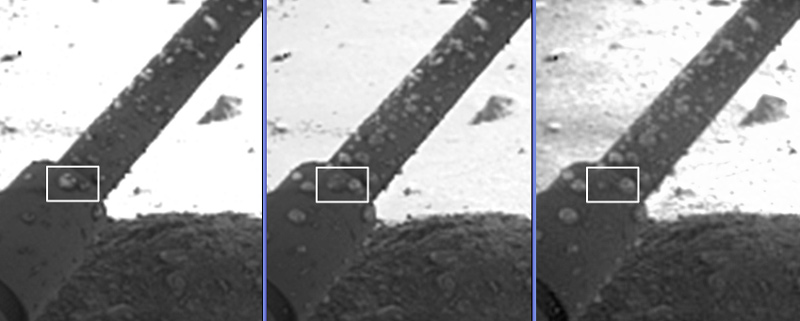
Water droplets appear to be growing on Phoenix’s leg shortly after landing on Mars (NASA)
NASA scientists are currently trying to understand a set of images taken by the Phoenix Mars Lander shortly after it landed on the Red Planet in May 2008. The images in question show one of the robot’s legs covered in what appears to be droplets of liquid water. The droplets remain on the lander for some time, appearing to get larger and changing shape.
By now, we know that liquid water (apparently) hasn’t existed on the Martian surface for hundreds of millions of years; the atmosphere is currently too thin and too cold to support liquid water. However, the confirmed presence of perchlorate in the regolith may provide an important clue as to what might be going on… Continue reading “Liquid Water on Mars?”
$2.2 billion eggs. One basket. The MSL Skycrane lowers the 850kg rover to the Martian surface (NASA)
Don’t get me wrong, I am incredibly excited about any planetary mission, no matter how much it costs. However, there is something about the Mars Science Laboratory (MSL) that makes me uneasy. The project may be delayed (the MSL is scheduled for a 2011 launch) and it may be costing more than NASA projected, but it’s not these factors I’m worried about.
The MSL is built on a “bigger and better” mentality; it dwarfs both of the Mars Exploration Rovers Spirit and Opportunity, plus it is packing a rather impressive suite of 10 complex scientific instruments to carry out an unprecedented campaign in the Martian dirt. Oh, and did I mention it will be powered by radioisotope thermoelectric generators (RTGs), a complete departure from the tried and tested solar panelled rovers? Oh hold on, as the MSL weighs nearly a tonne, a brand new method of landing the thing is required (simply parachuting, air bag bouncing or rocket thruster powered landings are now passé). The “Skycrane” that looks like one of those hoverboards from Back to the Future II has been invented to gently lower the MSL (pictured above).
Still, I’m not too concerned, NASA has proven itself countless times at overcoming technological challenges. That’s why NASA is there, to research and develop new technologies and science. But what if the MSL has gone too far? What if the technology is too untried and untested? Unfortunately, it looks like the recent turn of events have taken even the MSL program manager by surprise… Continue reading “The MSL is Too Expensive? Who Cares! We’re Searching For Life!”
On Mars, there are no car washes, no windscreen wipers, no rain, no fans... you get the picture. (NASA)
By far the biggest difficulty for robotic operations on the Martian surface are Sun-blocking dust storms. Not only do red-tinted dust clouds block the Sun from penetrating the atmosphere, the dust grains fall on solar panels, creating a layer of dusty sunscreen, reducing the amount of light falling on the photovoltaic cells. This is a special problem for long-term missions on the Red Planet. The rovers Spirit and Opportunity have been pottering around in the Martian regolith for over five years, mission planners had little idea their tough explorers would live much beyond their designed 3 month lifespan; long-term accumulation of dust was of no concern… until now. Continue reading “A Windy Day on Mars Gives Spirit an Energy Boost”
Could a NASA manned mission to Mars really stimulate the economy? (Mars Society/Ian O'Neill)
When times get tough, the world needs visionaries.
Visionaries find solutions, they invent systems and invoke change. One such figure in current events with a weight of 300 million people on his shoulders, is the new US President Barack Obama. His entire political campaign is based on bringing change to the USA (and the world), making him the most prominent political figure out there. Is he a visionary? Some would argue that he is, others would say that history will decide that point. I’m on the fence as to whether Obama will find historic solutions to these seemingly insurmountable global crises. But the thing I admire about the new US President is that he is a strong leader, and sometimes, that is all a country needs to pull itself from the precipice and back to prosperity.
So, the Obama-backed $800+ billion economic stimulus package is currently pumping through the system to eventually be divvied up and sent to areas of the economy that need to be reinvigorated. In principal, it’s a good idea. But what if it fails? Unfortunately there’s an awful lot more riding on Obama’s shoulders than 300 million hopes; $800 billion of their taxes will be keeping the new President awake until the early hours. If this all goes right, Barack Obama will go down as one of history’s visionaries; if it all goes wrong… well, let’s just not go there for the time being…
There will be critics of any economic bailout, and others who think there are better options. Robert Zubrin, founder and President of the Mars Society, has come forward with his suggestions to aid economic recovery… Continue reading “Can a Mission to Mars Stimulate the Economy?”
The distribution of atmospheric methane originating from three principal regions on the Martian surface (NASA)
Today, NASA held a press conference detailing some significant discoveries from observations made of the Martian atmosphere. Using NASA’s Infrared Telescope Facility and Keck Telescope, scientists from the University of Hawaii and NASA were able to deduce the spectroscopic fingerprint of methane. Although scientists have known for a long time that methane exists in the Martian atmosphere, the big news is that there is lots of it, it appears to be constantly replenished and it is a huge indicator of biological processes under the surface.
The Mars Reconnaissance Orbiter's HiRISE instrument spots the dead Phoenix Lander on December 21st (NASA/HiRISE)
NASA lost contact with the Phoenix Mars Lander at the start of November 2008, as its batteries were drained and sunlight began to dwindle. With no sunlight came no charge for the batteries from Phoenix’s solar panels, and the robot’s fate was sealed: a sun-deprived coma. A dust storm hastened the lander’s fate, but it certainly wasn’t premature. The Phoenix mission was intended to last three months, but in the same vein as the Mars Exploration Rovers, Phoenix’s mission was extended. In the high latitude location of the Martian Arctic, a dark winter was fast approaching, so Phoenix didn’t have the luxury of time and it transmitted its last broken signal before the cold set in, sapping the last volt of electricity from its circuits…
Although there was some excitement about the possibility of reviving the lander next summer, it is highly unlikely Phoenix will be in an operational state, even if it did have an abundant source of light to heat up its solar panels once more. No, Phoenix is dead.
However, that doesn’t mean the orbiting satellites won’t be looking out for it. So long as there is a little bit of light bouncing off the frosted Martian surface, the Mars Reconnaissance Orbiter can image Phoenix, keeping track of the encroaching ice around its location. The HiRISE team seem to be assembling a series of images throughout the change in seasons at the landing site, so it will be interesting to see the full set…
DEM images of Columbia Hills on Mars (USGS/HiRISE)
If there’s one instrument that should get the Mars Orbiting Science Award of 2008 it’s the High Resolution Imaging Science Experiment (HiRISE). Flying on board NASA’s Mars Reconnaissance Orbiter (MRO), HiRISE has been taking some astonishing imagery of the Martian surface since 2006. In fact, the HiRISE image gallery has become the staple of my high resolution Mars photo collection, and the studies being carried out by this fantastic instrument have formed the basis of many articles.
However, the most useful images to come from HiRISE are also the rarest. Digital Elevation Models (DEMs) come from the use of stereo image pairs (more commonly seen in anaglyphs generated by the HiRISE team to give the viewer a 3D impression of the Martian landscape). In the case of DEMs, some pretty neat science can be done, generating images of the Red Planet’s terrain in unrivalled precision. Seeing the Victoria Crater DEM is a particular joy… Continue reading “HiRISE Mars Digital Elevation Models: Difficult to Build, Easy on the Eye”
One of the overriding features in the Martian atmosphere is the troublesome dust storm. Sometimes, these storms can last months and can span the entire planet. As testified by the solar panels on rovers Spirit and Opportunity, dust storms block sunlight from passing through the atmosphere and can deposit a thick red layer over the robots, amplifying the dust storm’s damaging effects.
In the stunning image above, the Mars Reconnaissance Orbiter (MRO) captured the dust being blown up from the Red Planet’s surface. In short, this is the source of a growing dust storm from a canyon system, injecting a huge amount of material into the skies… Continue reading “MRO Spots Mars Dust Storm in the Making”
The Mars Science Laboratory (MSL) project is failing. But it is not suffering from technical failure en-route to the Red Planet, it hasn’t gotten itself stuck in a Martian sand-trap, it hasn’t even fallen foul of the “Galactic Ghoul”; the MSL is suffering from an overlooked space exploration hazard: bad management. According to today’s (not unexpected) NASA announcement, the MSL will not be launched until 2011.
I had a very bad feeling about today’s press conference, and it looks like my fears were justified. Due to technical difficulties, the launch of the MSL is being delayed by two years, as the overrun will ensure the mission misses the next Mars launch window. So I have to ask: why is an over-budget, behind schedule, poorly managed mission being allowed to sap the budgets of other NASA programs when the solution is so obvious? Continue reading “The Cancer Spreads: Mars Science Laboratory Delayed Until 2011”



 astroengine.com