Coolest White Dwarf Is a Glimpse of What Happens Long After Our Sun Dies

All good things come to a cold and dusty end.

[NASA’s Goddard Space Flight Center/Scott Wiessinger]

“So, what do you think happens after you die?”

The question was more of an accusation. The lady asking was sitting across from me at a Christmas dinner a friend of mine was hosting and the previous query was one about my religion. She wasn’t impressed by my response.

Granted, it probably wasn’t the ideal setting to say that I was an atheist, but I wasn’t going to lie either.

“Um, well…” I remember feeling vulnerable when I responded, especially as I’d only just met half the dozen people in the room, including the lady opposite, but I remember thinking: stick with what you know, Ian. So, I continued: “When I’m dead, all the elements from my body will remain on Earth,” — I didn’t want to go into much detail about my real plan of having my remains blended up into a jar and then launched into space (more on that in a future post, possibly) — “and those elements will get cycled through the biosphere through various biological, chemical and physical processes for billions of years. Eventually, however, all good things must come to an end and the sun will run out of fuel, ballooning into a huge red giant star, leaving what is known as a white dwarf in its wake.” (By her glazed look, I could tell she regretted asking, but I continued.) “If, and it’s a big IF, the Earth survives this phase of stellar death, our planet might be hurled out of the solar system. Or, and this is my favorite scenario,” — I’d hit my stride and everyone else seemed to be entertained — “it might careen inward, toward the now tiny white dwarf sun, where Earth will be ripped to sheds under powerful tidal forces, sending all the rocks, dust, and the elements that used to be my body, raining down onto the white dwarf.”

This is an abridged version. I also went into some white dwarf science, why planetary nebulae are cool, and how our sun as a white dwarf would stand as a monument to the once great solar system that will be gone five billion years from now. The recycled elements from my long-gone body could eventually rain down onto the atmosphere of a newborn white dwarf star — pretty cool if you ask me. This might be more of a cautionary tail about inviting an atheist astrophysicist to religious celebrations, but I feel my tabletop TED talk was good value for money. And besides, by turning that inevitable “what religion are you?” question into a scientific one, I hadn’t gotten bogged down with justifying why I’m an atheist — a conversation that, in my experience, never works out well over dinner.

So, why am I remembering that fun evening many years ago? Well, today, there’s some cool white dwarf news. And I love white dwarf news, especially if it’s about dusty white dwarfs. Because dusty white dwarfs are a reminder that nothing lasts forever, not even our beautiful 5-billion-year-old solar system.

One Cool Dwarf

A citizen scientist working on the NASA-led “Backyard Worlds: Planet 9” project has discovered the coldest and oldest white dwarf ever found. The project’s aim is to seek out as-yet-to-be-discovered worlds beyond the orbit of Neptune (re: “Planet Nine” and beyond). Through the analysis of infrared data collected by NASA’s Wide-field Infrared Survey Explorer, or WISE (inspired by data from the European Gaia mission), Melina Thévenot was looking for local brown dwarfs — failed stars that lack the mass to sustain nuclear fusion in their cores, but pump out enough infrared radiation to be detected. In the observations, Thévenot spied what she thought was bad data, but with the help of WISE, she found not a nearby brown dwarf, but a white dwarf that was brighter and further away. After sharing her discovery with the Backyard Worlds team, astronomers at the W. M. Keck Observatory confirmed that not only was that white dwarf lowest temperature specimen yet found, it was also very dusty. In fact, it’s thought that the white dwarf, designated LSPM J0207+3331, has multiple dusty rings. Its discovery, however, is something of a conundrum and the researchers think it may challenge planetary models.

“This white dwarf is so old that whatever process is feeding material into its rings must operate on billion-year timescales,” said astronomer John Debes, at the Space Telescope Science Institute in Baltimore, in a NASA statement. “Most of the models scientists have created to explain rings around white dwarfs only work well up to around 100 million years, so this star is really challenging our assumptions of how planetary systems evolve.”

Interesting side note: It was Debes who first got me excited about dusty white dwarfs when I met him at the 2009 American Astronomical Society (AAS) meeting in Long Beach, Calif. You can read my enthusiastic Universe Today article I wrote on the topic here.

After deducing the tiny Earth-sized star’s cool temperature — 10,500 degrees Fahrenheit (5,800 degrees Celsius) — the researchers estimate that the white dwarf is approximately 3-billion years old. The infrared signal suggests a copious quantity of dust is present, which is a bit weird. As I alluded to in my tabletop TED talk, after a sun-like star runs out of fuel and puffs up into a red giant, it will leave a shiny white dwarf surrounded by a planetary nebula in its wake. Should any mangled planet, asteroid or comet that survived the red giant phase stray too close to that white dwarf, it’ll get shredded. So, it’s poignant when astronomers find dusty white dwarfs; it means those star systems used to have some kind of planetary system, but the white dwarf is in the process of destroying it. That is the inevitable demise of our solar system in 5 billion years time. But to find a 3-billion-year-old specimen with a ring system doesn’t make a whole lot of sense — the white dwarf had plenty of time to consume all that dusty debris by now, a process, according to Debes, that should only take 100 million years to complete.

Debes, who led the study published in The Astrophysical Journal on Feb. 19, and his team, including discoverer and co-author Thévenot, has some idea as to what might be going on, but more research is needed. One hypothesis is that J0207’s dusty ring is composed of multiple rings with two distinct components, one thin ring just at the edge of where the star is breaking up a belt of asteroids and a wider ring closer to the white dwarf. It’s hoped that follow-up observations by the next generation of space telescopes, such as NASA’s James Webb Space Telescope (JWST), will be able to deduce what those rings are made of, thus helping astronomers understand the evolution of these ancient star systems.

Besides being the ultimate way to gain perspective on our tiny existence (and an excellent topic for an awkward dinner conversation), this research underpins a powerful way in which citizen scientists are shaping space science, particularly projects that require many human brains to process vast datasets.

“That is a really motivating aspect of the search,” said Thévenot, who is one of more than 150,000 volunteers who works on Backyard Worlds. “The researchers will move their telescopes to look at worlds you have discovered. What I especially enjoy, though, is the interaction with the awesome research team. Everyone is very kind, and they are always trying to make the best out of our discoveries.”

Home Is Where the Mars Rover Is

Now that Opportunity’s mission is complete, many wistfully lament about “bringing our robot home.” There’s just one problem: it’s already home.

A rendering of Opportunity on Mars [NASA/JPL-Caltech]

I am fascinated with how we anthropomorphize robots, particularly space robots. We call them “brave,” “pioneers” and even give them genders — usually a “she.” We get emotional when they reach the end of their missions, saying they’ve “died” or, as I like to say, “gone to Silicon Heaven.” But these robots are, for all intents and purposes, tools. Sure, they expand the reach of our senses, allowing us to see strange new worlds and parts of the universe where humans fear to tread, but they’re an assembly of electronics, metal, plastic, sensors, transmitters, wheels and solar panels. They don’t have emotions. They don’t breathe. They don’t philosophize about the incredible feats of exploration they are undertaking. They don’t have genders.

Still, we fall in love. When watching Curiosity land on Mars from NASA’s Jet Propulsion Laboratory, I teared up, full of joy that the six-wheeled hulk of a rover — that I’d met personally in JPL’s clean room a couple of years before — had safely landed on the Red Planet. After watching NASA’s InSight lander touch down on Elysium Planitia, again via JPL’s media room last year, there it was again, I was in love. I’m already anthropomorphizing the heck out of that mission, seeing InSight’s landing as another “heartbeat” on Mars. When the European Rosetta mission found Philae lying on its side like a discarded child’s toy on the surface of comet 67P/Churyumov–Gerasimenko, I jumped up from my desk with joy. When Cassini’s mission at Saturn ended in 2017, I was miserable. When the Chinese rover Yutu rolled off its lander in 2014, I realized I was cheering the robot on. When Spirit got stuck in a sand trap in Gusev Crater, I set up a Google alert for any and all news on the recovery efforts.

These emotions aren’t just for the exciting science and engineering strides humanity makes, there’s a certain inspirational character that each robot brings. Undoubtedly, this character naturally emerges from the wonderful scientists and engineers who design and build these amazing machines, and the social media managers who often “speak” for their robots in first person. But if you strip away the science, the technology and the people who build them, we still personalize our beloved robots, giving them their own character and creating a cartoon personality. I believe that’s a beautiful trait in the human condition (except a few flawed cultural and stereotypical missteps) and can be used to great effect to captivate the general public with the science that these robots do.

Opportunity’s landing site inside Eagle crater [NASA/JPL-Caltech]

So there’s no great surprise about the outpouring of emotion for last week’s announcement that NASA called off the communications efforts with Mars Exploration Rover Opportunity. This kick-ass robot traveled 28 miles and lasted nearly 15 years, until a global dust storm in early 2018 starved it of sunlight. It landed on Mars way back in 2004, with its twin, Spirit, beginning its Martian reign with a hole-in-one, literally — after bouncing and rolling across the regolith after its entry and descent, encased inside a genius airbag system, it plopped inside the tiny Eagle crater. We’ve collectively lived through Opportunity’s adventures and the groundbreaking science it has done. There’s a huge number of terrific robot obituaries out there, so I won’t duplicate those efforts here. There is, however, a recurring sentiment that is somewhat misplaced, though entirely innocent.

Opportunity — like Spirit and all the Mars rovers and landers that have come and gone — died at home.

This may sound like an odd statement, but there seems to be this fascination with “returning” our space robots to Earth. I’ve seen cartoons of the Dr Who traveling through time to “rescue” Opportunity. People have argued for the case of future Mars astronauts returning these artifacts to terrestrial museums. There’s that touching XKCD cartoon of Spirit being “stranded” on Mars after NASA declared it lost in 2010, that is being resurfaced for Opportunity. We want our dusty Mars rover back!

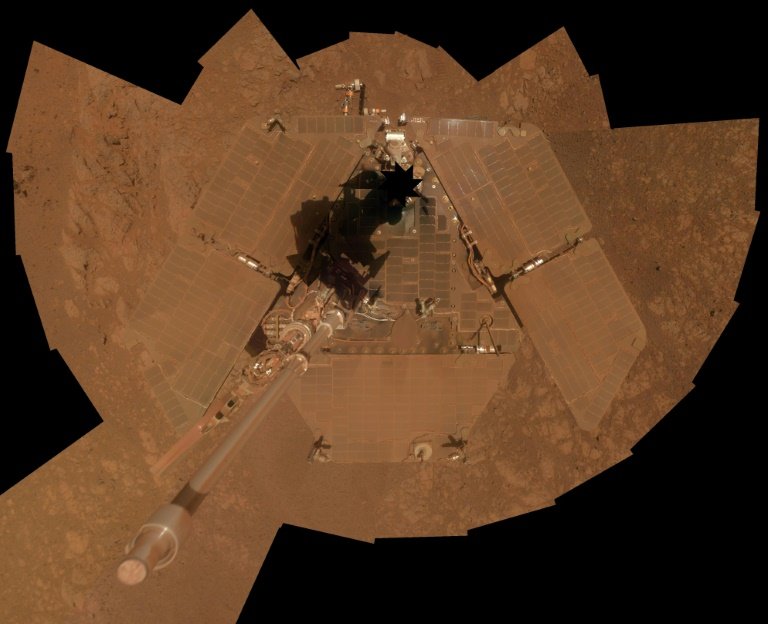
Dusty rover [NASA/JPL-Caltech]

It’s understandable, that rover has been continuously exploring Mars for a decade and a half, many of its fans, including myself, could check in on Opportunity’s adventures daily, browsing the latest batch of raw images that were uploaded to the NASA servers. We love that thing. In the tradition of military service members who die abroad, we go to great efforts to bring their bodies home so they can repatriated; we want to repatriate our science service member back to Earth.

But Opportunity is a robot that was designed for Mars. Every single design consideration took the Martian environment into account. The Red Planet’s gravity is roughly 1/3rd that of Earth, so the weight on its actuators and chassis are 2/3rds less than what they’d experience on our planet. Its motors are too under powered to reliably drive the robot forward on Earth. On Mars, they’re perfect. Granted, the mass of the Mars Exploration Rovers (approximately 185 kg) are a lot less than their supersized cousin, Curiosity (899 kg), but if Opportunity and Spirit had a 90-day mission exploring the dunes of the Californian Mojave Desert, I’m betting they wouldn’t get very far; they would be under-powered and grind to a halt. They’d also likely overheat as they were designed to withstand the incredibly low temperatures on the Martian surface.

The robots we send to Mars are undeniably Martian. If we’re going to anthropomorphize these beautiful machines, let’s think about what they’d want. I’m guessing they’d want to stay on that dusty terrain and not return to the alien place where they were constructed. And, in doing so, they become the first generation of archaeological sites on the Red Planet that, one day, the first biological Martians will visit.

A Martian’s shadow [NASA/JPL-Caltech]

My Struggle With Math, Why It Matters, and Why It Really Doesn’t

“You know what it means? You’re an artist, not a physicist.”

Twenty years later, those words still haunt me.

I was actually a bit surprised to remember this quote, but after a conversation with astrophysicist, science communicator and Twitter buddy Sophia Gad-Nasr, who was commenting on a tweet from @dsxnchezz, I found myself emotionally thinking back to a personal struggle I wanted to share.

The tweet:

The story:

A Long Time Ago In a University Far, Far Away

[Photo by Johannes Plenio from Pexels]

My first semester of studying physics at university was unexpectedly (though, in hindsight, not so surprisingly) rough: I had to confront a demon that I’d spent years running away from. You see, I’m bad at math (or, as we Brits like to call it, “maths”), to the point where I used to be convinced that I wouldn’t progress anywhere in physics. Mental arithmetic is very difficult, calculus is hell, I’m no fan of trig, and I have to spend an extra minute double checking my additions (employing the use of all my available digits). Usually, this would be a minor annoyance, but in the winter of 1999, it became an obvious gaping wound in my abilities as a wannabe astrophysicist. Throw this on top of my history of anxiety, rather than confronting the issue, I’d bury it. If I didn’t think about it, where’s the worry? Unfortunately, I had to think about it.

All the way through my GCSEs and A Levels (the qualifications that you’d take at school before going to university in the late 90’s in the UK) I was a decent student. I was never late with coursework, never skipped class and always tried my best. I was extremely lucky to have very supportive parents and very privileged to live 15 minutes from what I consider to be the best comprehensive (re: state-funded) school in my hometown of Bristol. While not a “straight A” student, I certainly performed well and, during my A Levels I was able to pick up a pleasing A, B and C, for Technology, Physics, and Geography, respectively, nabbing the exact number of UCAS points I needed to secure a place at my first choice university on the beautiful west coast of Wales — The University of Wales, Aberystwyth.

I was riding high and the future was bright. But I always had this baggage buried deep in the back of my brain: I’m bad at math.

If you’ve been through the UK route to university physics, you’ll notice a big, red, flashing neon sign of a problem with my choice of A Levels: 

🚨 THERE’S NO MATHEMATICS 🚨

This fact wasn’t lost on the university representatives at the various higher-education fairs I’d attended from 1996 to 1998. A physics rep from one of the more “prestigious” universities had the biggest assholey reaction when I said that, yes! it is true that I’m not studying mathematics at A Level: “You can forget doing physics, then,” he scoffed, before chuckling about it to his buddy. Yep, chuckled. His disdain for the gall a math-anemic student had to approach him to inquire about their astrophysics course was too much for his stupendous brain to bear, it seemed. Fortunately, he was an outlier, the majority of other reps were generally kind, supportive and helpful, but it gave me pause. Was I under-qualified? Was my inability to grasp mathematics going to be a real problem for my dream of studying black holes, galaxies, alien worlds and the Big Bang?

Screw those guys, I thought. Fortunately the detractors at that phase of my education were rare and, though they did nothing to boost my confidence in math, they didn’t dull my excitement for studying physics university. Besides, I’d nailed my grades! Onward to Aberystwyth!

***Aside: Before I continue, I need to emphasize that all my (many) years at university were amazing. To have the wonderful good fortune to live and study in arguably one of the most beautiful places in the world was humbling. As a university town, Aber couldn’t have been a better choice. I made a diverse group of lifelong friends, got a wonderful education, somehow managed to spend a semester in the Arctic studying the aurora, grew as a person, lost an appendix, and developed an appreciation for the Welsh language, all while enjoying the highest density (at the time) of pubs per capita. I only have fond memories of the physics department and all the members of staff and fellow students. The following is more of a conversation about the culture in higher education and how certain assumptions can damage the confidence of students, possibly creating an intellectual barrier for their progression, inspired by the above conversation with Sophia.***

So, with my A Levels behind me, I was ready for university. I was 18 and excited to get the introductory physics courses out of the way so I could dive into the wonders of the cosmos. Ha! Sorry, I couldn’t write that with a straight face; I was excited the meet girls and have a great time playing pub golf and partying until 5am. But once the alcohol haze had lifted after Freshers Week, reality struck. Because I didn’t have a mathematics A Level, I had to take an introductory math course “to get me up to speed” with the mathematical tools I’d need to complete my undergraduate degree. This wasn’t an unfair ask and I had little problem with tackling it. The university had a system in place that made an honest and clear effort to make sure no student was left behind. In some ways, the fact that I had to confront my math angst head-on was reassuring. After all, how the heck could I navigate a career in physics while avoiding math at all costs? Spoiler: I couldn’t and I didn’t want to. It was a fresh start, a ripping of the Band Aid, an anxiety detox. I was ready. Hit me!

To say I enjoyed these early math lectures would be a lie, but I did get a sense of satisfaction from taking them. The lecturers were generally good and delivered a well-organized curriculum. Alongside the intro math, I was doing all the other stuff my colleagues were doing, except for the theoretical classes that left smudges of squiggled chalked integrals and partial differential equations on the blackboard in the lecture theater when my introductory class started. In these early days of my university career, those squiggles may as well have been Egyptian hieroglyphics. But, gradually, like a sapling unfurling from the dirt, I was developing my own way of dealing with math: repetition. I was making progress and I could imagine that, one day, I’d be like my physics friends who could stand up in front of a lecture hall, drawing squiggles with my piece of chalk and explaining why Fourier transforms are so great. Although much of my learning was done parrot fashion, without a lot of comprehension about what I was doing at the time, I was able to, at worst, wing it.

So far, so good, right?

The Pen Game

The whole point of this story is leading to one, singular — nay, pivotal — moment in a cramped office of my first-year supervisor. Every week, small groups of us had meetings with our allocated lecturer-supervisors. My supervisor (who will remain unnamed because he’s not really the point of this story, though he did get under my skin), an older, well-respected professor with thick-rimmed glasses and eccentric humor, really didn’t want to be there. And nor did I. Each week, he’d try to get the most entertainment out of his supervised students, including me and three others who were suffering from the same no-math affliction. These meetings were supposed to be for us to have a space to discuss our math-related struggles and progress, with no fear of embarrassment.

To pass the time, and enforce his own quirky way of teaching, the professor would have this recurring game where he’d drop a bunch of pens on his desk and ask us what number it represents. It was maddening, didn’t make sense and he’d always make us feel shitty for making a blind guess. What’s more, we didn’t get the point, was this a profound lesson in math? Philosophy? Counting the seconds until all the pens had stopped rolling? I took a flier: as the pens landed, some would cross another on the desk, coming to a stop, so I counted the number of crossed pens and shouted “Two!”

Without hesitation, he replied, “No! Wrong! You’re wrong!” And so he’d drop the pens again and ask the same silly question, “What number?”

Obvious eccentricities to one side, the good professor was pissing me off. And I suppose that was the point. So, the following week I went into that office and paid attention to everything. I made a note of the time, the air temperature, the number of other items on his desk… and then I saw it. The four of us sat down and the professor grabbed his usual pens and dropped them on the desk. Without waiting for him to say a word, I blurted “FIVE!”

He looked at my smiling face and nodded. Fireworks erupted in my brain, I’d passed his stupid test. My three colleagues looked at me in astonishment. “Let’s do it again,”—he dropped the pens a second time—”how many?”

“Eight!” I felt like I’d won the professor’s admiration and approval. I might be bad at math, but damn I’m good at this game. He smiled and nodded again. He asked me to tell everyone how I did it. Feeling cocky, I just said, “look at his fingers.” Every time he dropped the pens, he’d lean on the desk, extending a different number of fingers after each drop. All I was doing was counting his goddamn fingers!

And now for the lesson of this stupid game, words that I’ve never forgotten.

“Whenever I’ve played this game,” he started, “it’s always artists who guess it correctly, physicists focus too much on the pens. You know what it means? You’re an artist, not a physicist.” He pointed at me, no longer smiling.

Besides my confusion that it was apparently a bad thing to correctly find a solution to this stupid game, why was I being branded an “artist”? There is nothing wrong with being an artist, or so I thought, but I had chosen a career path to become a physicist. What’s more, I was in a class specifically focused on supporting students who lacked the math qualifications to do physics. It seemed like a teaching self-own. Over the years, I assumed it was his way to motivate me to work harder at math—yes! Reverse psychology! Shame me into doing better! But, nah, the opposite happened.

Impostor syndrome is something, I’ve recently realized, that goes hand-in-hand with my anxiety, so to get verbal confirmation of my personal doubt was like a punch to the gut. I was ready to quit; who was I fooling? I was out of my depth. My excitement for physics fell off a cliff and, with the endorsement of an authority figure who, for whatever reason wanted to make his students feel shitty, had rubber-stamped my self-doubt.

A Better Way

I didn’t quit, but if it wasn’t for the social group that I had, I might have. My challenge with math wasn’t the only mountain I was climbing at the time. Like most undergrad students at university, simply navigating life was hard. But I was lucky, I had a girlfriend and a solid group of friends, a supportive family and a love for the student life. However, drop-out rates in physics are high, or they were 20 years ago, and what was becoming abundantly clear was this arrogant assumption that to be good at physics, I had to be good at math.

After the Pen Game, I became acutely aware of the teaching practices of my lecturers. Lessons would begin with innocuous, throw-away statements like (I paraphrase), “you all know this already,” “you hibernated through school/lived under a rock if you don’t know this,” “let’s skip these steps, if you don’t get it, read a book,” and, my personal favorite, “don’t come crying to me if/when you fail.” Back then, those statements weren’t strange, they were simply educators—many of whom didn’t really want to be teaching, they had research grants to apply for—trying to be witty or, under pressure to deliver their class, they really wanted to make sure they could fit in the entire syllabus in the allotted time. I felt even more precarious when my introductory math courses finished and I should have been “up to speed” with the mathematical tools for a bright physics future. Alas, though I was undoubtedly better at math, my confidence had ebbed to zero.

Fortunately, my want to continue living the university life outweighed my anxieties and I learned to live with it. I didn’t ask for help (in hindsight, I should have), and math just became my dirty secret. It was a specter that followed me around the campus. That said, I was good at physics; I had a great conceptual grasp of all the topics and meandered my way through the math. But the real turning point for me happened when studying the final semester of my Masters year in the high-Arctic, on the Norwegian archipelago of Svalbard. The EU-funded exchange program (Reason 1,324 why I have very strong feelings against Brexit; I took for granted the research and study programs that the UK could seamlessly participate in and I’m devastated that the next generation of students/researchers may not have the same, broad opportunities), that gave me the chance to experience real research on the aurora and other space weather phenomena in this incredible part of the world, made me think of math differently. I’d found my passion—the sun-Earth interaction—and suddenly, I realized math wasn’t the barrier. It was my anxiety and fear. I’d built mathematics up into this impenetrable barrier rather than viewing it as the tool that builds physics theory. Long story short, I had to literally travel to the ends of the Earth (well, the top of the Earth) for me to realize that, ya know, math ain’t that bad.

I went on to do a Ph.D in solar physics—specifically coronal loops, an origin of space weather—and, during a random research trip to Hawaii to work with colleagues who were based in Honolulu, I met my wife. So, I have no regrets and, as I type this from my computer at home in Los Angeles, I remember my struggle with math with fondness, oddly enough. And I have no problems using all my available digits to do basic arithmetic. I even do it in public.

We live at a time where science is regularly overlooked and often derided (re: climate change deniers, anti-vaxxers, flat-earthers etc.) and we need all the most talented critical thinkers to take on careers in science, technology, engineering, art, and mathematics (STEAM) in order to confront some of the biggest challenges facing our planet. So, educators of all levels, never make assumptions of the abilities of your students; just a throwaway comment like “I’m sure you already know this…” can boost needless anxiety in learning.

And, whatever you do, never play the Pen Game.

Faint Fossil Found in Solar System’s Suburbs

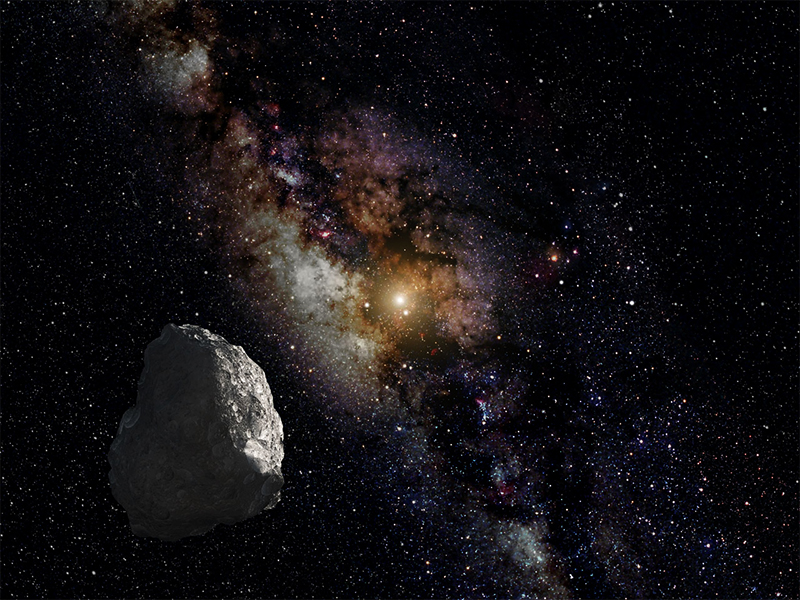
A tiny rock has been detected in the Kuiper belt, which may not seem like such a big deal, but how it was found is.

[NASA, ESA, and G. Bacon (STScI)]

We think we have a pretty good handle on how planets form. After the birth of a star, big enough clumps of dust and rock in the disk of leftover debris begin to accrete mass until they turn into spheres under the pull of their own gravity, jostling around, pushing smaller protoplanets out of the way and being shoved aside by, or smashing, into larger ones. Whatever planets survive this messy process end up becoming a solar system. We’ve seen this around other stars and aside from a few interesting twists on this model, we think we know what’s going on pretty well by now.

But there was one piece missing. The math says that to start the planet building process, you need a kind of planetary seed between one and ten kilometers wide. Since we happen to live in a solar system, we should be able to look outwards, towards the Kuiper Belt, which we think is made primarily from the leftovers of planetary formation, and see these protoplanetary fossils drifting across the sky. However, the process has proven to be rather tricky. These rocks are very faint and rather small compared to everything else we can usually see, so looking for them is kind of like trying to spot a grain of dust in a room illuminated only by moonlight, which is why we have so much trouble finding them.

Or at least we did until now, when a 1.3 kilometer Kuiper Belt Object, or KBO was spotted by a simple setup and commercially available cameras as it eclipsed background stars. While that might not sound like much right now, it’s actually an extremely important finding. First, it tells us how to find tiny KBOs so we can take a proper survey of protoplanetary leftovers. Secondly, it shows that we’re correct in our solar system formation model and demonstrated that predicted artifacts of baby planets that never quite made it do exist. The next part will be to try and detect more of these little planet seedlings to figure out how efficient the formation process is, and see what we can learn from that.

As noted, these finds don’t just apply to our own solar system, but to pretty much every planet in the universe. Just consider that mighty gas giants with swirling storms that could swallow Earth whole, exotic icy dwarfs with percolating cryovolcanoes and towering peaks dusted with reddish organic molecules, and tropical worlds with deep oceans teeming with life — which might even be home to an alien civilization living through its heyday — all started out as these little rocks lucky enough to clump together for a few hundred million years, find a stable orbit, and cool down enough to become a cosmic petri dish. They might not be impressive or exciting on their own, but that doesn’t mean they aren’t profoundly important.

Reference: Arimatsu, K., et. al., (2019) A kilometre-sized Kuiper belt object discovered by stellar occultation using amateur telescopes, Nature Astronomy Letters, DOI: 10.1038/s41550-018-0685-8

[This article originally appeared on World of Weird Things]