“Astronaut needed for experimental flight to Titan…”

The Reliant Robin Space Shuttle from the BBC's Top Gear.
A better chance of making it to Saturn: The Reliant Robin Space Shuttle from the BBCs Top Gear.

An ad on Craigslist has just appeared: Astronaut Needed (Northern Alberta). Sign me up!

Oh, hold on…

Astronaut needed for experimental flight to Titan. I have been working on this project now for near 40 years and am afraid I’m no longer fit enough to go. My secret space craft is the result of my professional experience and imagination while serving the U.S. military in advanced aeronautics as a scientist. The craft harnesses a revolutionary propulsion system and its fuselage is fabricated with the most advanced material. While considerably safe, I am certain you will make it safely to Titan but there will not be enough fuel to get home. This is for someone unique that has always wanted to see the universe first-hand and has perhaps a terminal view on life here at home. Here’s your shot at romantic history.” —Mad Rocket Scientist from Canada (emphasis added by me).

I was almost convinced I had a stab at flying to the Saturnian moon. What put me off? The fact that there won’t be enough fuel to get me back to Earth? Or was it the fact that I’m not stark raving mad? Nope, it turns out I’m too tall. “[The applicant] must be no taller than 5’10 and relatively slim.” Curses.

Thank goodness the spaceship is “…is largely cpu controlled,” I was getting worried that this ad was sounding a little too reckless…

Wow.

Thanks to @absolutspacegrl for the heads up!

Did NASA “Bomb” the Moon? Kinda

NASA possesses Weapons of Moon Destruction, obviously.

There’s been a lot of criticism concerning the media’s ability to report science recently. After all, what is “good” science reporting? The tabloid press is well known for hyping up scientific endeavour, and although some news outlets deliberately fill their columns with hyperbole, it doesn’t necessarily mean the science is being misrepresented, it just means the column in question is making a mountain out of a molehill.

Take Friday morning’s NASA LCROSS impact with the Moon. Those of us that were following the action on the various news outlets and online feeds were astonished by the sheer amount of fear, misinformation, disinformation and general weirdness that was being banded about. To be honest, I was shocked.

[I actually have a theory about one of the reasons why LCROSS was a particular target for many conspiracy wingnuts and doomsday woo, but I’ll save that for another article I’ll be writing shortly.]

Although a lot of the stuff was total silliness (i.e. the Moon feels pain, LCROSS might knock the Moon off it’s axis, many moonpeople might die etc. etc.), many worried individuals were concerned by the reports from the mainstream press. Let’s have a look at one of the claims being disseminated by a wide variety of news outlets in the run-up to, and the days following, LCROSS: The Moon was being “bombed” by NASA.

Did NASA “bomb” the Moon or not?

A huge number of people have a problem with the word “bomb” when connected with the LCROSS mission (I’m not fond of the description either). Could this one word be indicative of bad journalism? For the scientifically-minded, “bomb” doesn’t sound very scientific and would rather use “impactor.” For the non-specialist, “bomb” conjures thoughts of war, violence and Al Qaeda.

Is it just creative writing? Is it an inaccurate term? Is it wrong? First off, let’s look at the definition of “a bomb.”

bomb. n. An explosive weapon detonated by impact, proximity to an object, a timing mechanism, or other means.

The LCROSS Centaur was certainly not manufactured as a conventional weapon (as in, it didn’t carry explosives and couldn’t “detonate”), but just by its mass, could it cause an explosion like a bomb? In the case of the above definition, I’m referring to the “or other means” part.

Energy is energy

The Centaur was empty of propellent when it was sent careening toward the lunar south pole, but it still had a mass of 2366 kg (the size of an SUV). At the time of impact, it was travelling at a velocity of 2.5 km/s (2500 m/s). From this information alone, we can calculate the kinetic energy of Centaur at the moment it slammed into the lunar surface.

Ekinetic = 1/2 mv2 = 1/2 × 2366 (kg) × 25002 (m/s) = 7.4×10⁹ Joules

This is the total energy the Centaur had when it was speeding toward the Moon, and according to basic physics energy is always conserved. So, when the Centaur ate Moon dust, where did this energy go?

We know energy wasn’t lost through the production of sound waves, as there’s no atmosphere on the Moon — In space, no one can hear your rocket go *bang* (although seismic waves would have been generated, propagating through the Moon’s surface). Also, lots of chunks of rock (from the surface) and shards of metal (from the Centaur) would have been ejected from the crater, each piece carrying a little piece of that kinetic energy away from the impact (much like very high-energy shrapnel). A lot of rock was displaced too, creating a crater 20 meters in diameter and 3 meters deep. Much of the kinetic energy will have also been converted to heat and light (the “flash” of the impact was captured by the LCROSS infrared camera).

What with all this heat, light and shrapnel, the Centaur impact sure is sounding like an exploding bomb. If you convert the 7.4×10⁹ Joules into units more synonymous with weaponry, we find that the energy released during the Centaur impact was the equivalent of 1.8 tonnes of TNT exploding. That’s the size of a small bunker-busting bomb.

What’s more, kinetic weapons are a well-known method to take out orbiting satellites, so this concept isn’t a new one.

As much as it pains me, using an inflammatory statement like “NASA Bombed The Moon” is a correct analysis of the effects of the Centaur dead-weight hitting the Moon. However, the press milked “the Moon bombing” way beyond what I’d consider to be reasonable, taking full advantage of the violent connotations associated with this incredible NASA mission to probe for water on the Moon.

I think that people are apprehensive about it because it seems violent or crude, but it’s very economical.” –Tony Colaprete, principal investigator for LCROSS (Feb. 2008)

What REALLY Happened to the LCROSS Centaur?

<conspiracy mode>

In the early hours of Friday morning at 4:31am, the spent Centaur rocket from the NASA LCROSS mission slammed into the surface of the south pole of the moon. What was the point in that?

Well, NASA was hoping that the tumbling chunk of metal the size of a small bus would kick up a huge plume of dust. Following 4 minutes behind was the shepherding LCROSS spacecraft, also on a kamikaze dive, hoping to drop through the plume, sensitive instruments ready to analyse the dust for water.

I know what you’re thinking: what right does NASA have to BOMB the Moon? They have NO RIGHT AT ALL!!

It turns out that they are actually waging a top secret war against the population of peaceful extraterrestrials that live on the far side of the Moon. This “experiment” was in fact a reckless attack against a superior alien civilization, intended to strike fear into the hearts of the aliens.

If you were to believe the NASA promo video of the event, this should have been spectacular, vast quantities of lunar regolith blasting into space… it should have been akin to the biggest Fourth of July firework detonating. This “shock and awe” tactic is typical of the US space agency. The huge mass of the Centaur (a little under 2400kg), combined with its break-neck speed (1.5 miles per second) should have unleashed the equivalent energy of a tonne of TNT exploding. However, what NASA didn’t tell us was that Centaur was also carrying plutonium, so the explosion should have been a LOT bigger, easily visible to the naked eye.

But what did we see? Nothing. What did NASA see? Nothing. So what happened? Well, the answer to that is a little more compelling than what NASA is telling us.

Yes, they can show us images of a meagre “flash” as the Centaur hit inside a lunar crater, but I don’t think Centaur hit the Moon at all… the Centaur rocket was swallowed by the Moon.

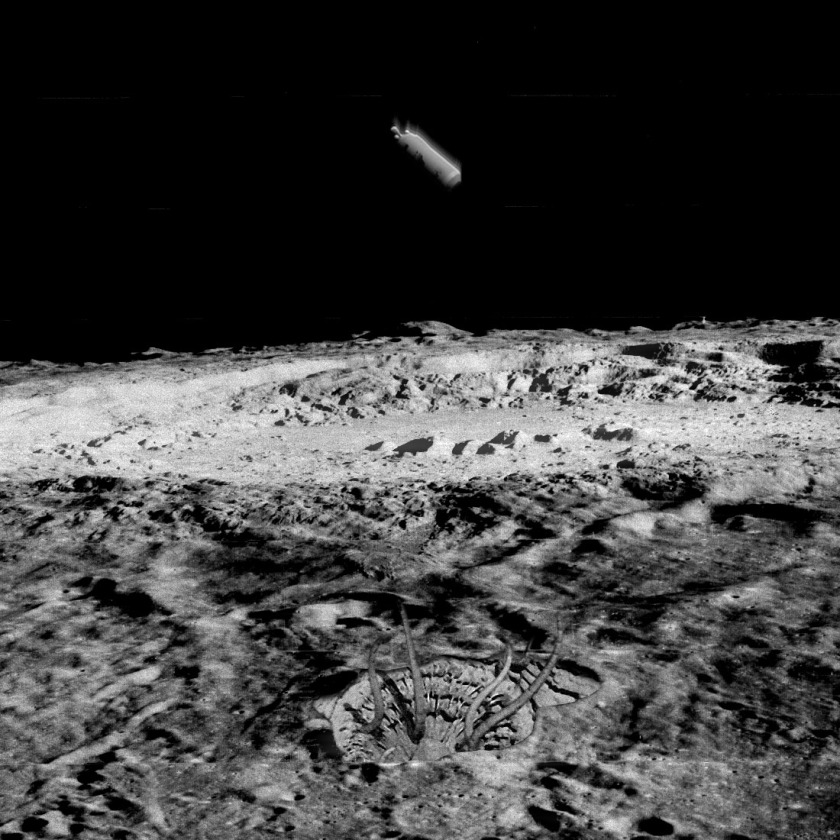
Don’t believe me? Moments before impact, NASA’s lunar satellite — the Lunar Reconnaissance Orbiter (LRO) — was approaching the location and it took this photo. What you see here will shock you. It will astound you. And what’s more, it’s REAL.

Aliens DO live on the Moon, and they were prepared for the NASA bombing…

lcross-conspiracy

</conspiracy mode>

I’m sorry, I couldn’t resist. In the run-up to the LCROSS impact, the sheer amount of crazy conspiracy theories hit fever-pitch (I blogged about it on Space Disco 2 hours before impact). Some of my favourite theories involved alien civilizations on the lunar surface, plutonium on LCROSS (to destroy the Moon), the “fact” that it was all just a publicity stunt and the LCROSS mission didn’t exist at all… and the strange theory that the Moon feels pain.

Yawn.

A polite message to the conspiracy theorists: Come on people, stop making stuff up and understand the real science. You might find reality more interesting than your twisted fantasies.

Image: The Sarlacc pit monster from Star Wars, Copernicus lunar crater and the LCROSS Centaur rocket. Photoshopping: Me.

Oops… I really geeked out this time, didn’t I.

Mars Crater’s Cracked Frosting

Subliming ice from the crater's edge (NASA/JPL/University of Arizona)
Subliming ice from the crater edge (NASA/JPL/University of Arizona)

This image looks like the frosted top of an over-baked muffin, but it’s actually the side of a crater on Mars covered with ice. Taken by NASA’s Mars Reconnaissance Orbiter (MRO) High Resolution Imaging Science Experiment (HiRISE) over the Martian south pole, this example demonstrates an active process of weathering acting on the red landscape. According to the HiRISE site, the ice layer is approximately 3 km thick.

In regions situated closer to the equator, craters aren’t open to erosion by ice (not surface ice in any case), but in polar regions it’s a different story. Due to the Martian thin and cold atmosphere, water ice rarely melts into a liquid; it bypasses the liquid phase and turns straight into a gas. This process is known as sublimation. There are terrestrial examples of sublimation too, including frozen carbon dioxide (or “dry ice”) which sublimes at room temperature, generating a carbon dioxide vapour.

For this particular crater, it is obvious where there is a higher rate of sublimation than others. As the Sun illuminates the crater edge from the bottom right, the rim of the crater receives the most sunlight, heating up the darker regolith and causing more ice loss. The large cracked-like structure within the crater is most likely a combination of darker material under the ice receiving preferential heating and shrinkage of the subliming ice pack.

This seasonal freezing of water vapour and sublimation of water ice erodes the sides of these polar craters, wearing them down season after season.

I never tire of seeing HiRISE images of the Red Planet, especially when they include active atmospheric processes that continue to shape the landscape of this alien world.

Source: HiRISE

@Astroengine Got CNN’d (and other epic things)

cnn-banner

I’ve been pondering a word that could describe today.

I drew a blank.

It’s a very hard day to sum up in one word. In fact, this entire week has been something of a unique one. From a space point of view, it’s been busy, largely due to the endless supply of space science research spewing from the American Astronomical Society’s Division of Planetary Sciences meeting in Puerto Rico.

However, last night (and early this morning) is what topped it all off. The NASA LCROSS mission slammed into the lunar south pole at 4:31am (PDT) and I was there tweeting away, keeping abreast of all the juicy LCROSS news. That was until Time Warner Cable decided to pull the plug on my internet connection 10 minutes before the main event (I’m certain they did it deliberately, it’s the only explanation). Panic-stricken — and really peeved that I’d spent the whole night excited to see the glorious end to this Moon mission, only to be foiled by my ISP — I checked the TV, and it was working, plus a local channel was covering the event. Phew.

As it turned out, there wasn’t much to see. Oh well.

Anyway, on waking up this morning, I was shocked to find my inbox was stuffed full of Twitter follow messages and notes of congratulations from my team at Discovery News. CNN had picked me, with four heavy-hitters on Twitter as their #FollowFriday. But it wasn’t an ordinary #FollowFriday, the guys at CNN Technology posted this #FollowFriday on their site!

Editor’s note: In this new weekly feature, we highlight five recommended Twitter feeds about a hot topic in the news. Today’s list focuses on space-related tweets and NASA’s plan to crash two spacecraft on the moon Friday in a search for water in lunar soil.CNN Tech

So despite my internet woes, CNN had chosen me (@astroengine) with @BadAstronomer, @Astro_Mike, @LCROSS_NASA and @NASA_AMES. So I was in the company of an entire NASA facility (Ames), a NASA mission that had just hours before slammed into the Moon (LCROSS), the first astronaut to tweet from space (Mike Massimino) and the one, and only, Phil “The Bad Astronomer” Plait.

Wow.

They also added this very flattering description of @astroengine:

4. astroengine — Astroengine is the Twitter name of Ian O’Neill, a British-born physicist with a long resume and a healthy sense of humor. It’s also the name of his blog, which gathers articles and posts on such light-reading topics as quantum mechanics, solar physics, relativity, cosmology, space flight science and “some of the more bizarre theories that drive our universe.”

Number of followers: more than 1,700

Sample tweet: “Europa, Jupiter’s Moon, Could Support Complex Life http://bit.ly/3n6iKL (I, for one, welcome our alien Jellyfish Overlords)”

So, I’d like to take this opportunity to say “hello” to my hundreds of new followers!

And did I think of a word that describes today? Actually, I think I just did:

Epic.

The White House Astronomy Night: Change, Delivered

In agreement with Phil Plait, this video made me smile too. A lot.

President Obama (now a Nobel Peace Prize recipient) hosted an astronomical party on the White House lawn on October 7th for an audience of 150 middle school students from the Washington area and some guests of honour (including Charlie Bolden, NASA Administrator and Buzz Aldrin, Apollo legend). It looked like a really exciting event for all the school kids involved.

This was my favourite bit:

So, there are a lot of mysteries left, and there are a lot of problems for you students to solve, and I want to be a president who makes sure you have the teachers and the tools that you need to solve them. That’s why we’re working to reinvigorate math and science in your schools and attract new and qualified science teachers in your classrooms, some with lifetimes of experience […] That’s how we’ll move American students to the top of the pack in math and in science over the next decade to guarantee that America will lead the world in discovery in this new century.” –President Barack Obama, Oct. 3rd.

Was there ever an astronomy party on the White House lawn during the previous administration?

Whatever Happened to Hyper-Velocity Star HD 271791?

One scenario: Exploding star flings binary parter away at high velocity (Max Planck Institute for Astrophysics)

HC 271791 is a star with a problem, it’s moving so fast through our galaxy that it will eventually escape from the Milky Way all together. However, there is a growing question mark hanging over the reasons as to why HD 271791 is travelling faster than the galactic escape velocity.

So-called hyper-velocity stars were first predicted to exist back in 1988 when astrophysicist Jack Hills at Los Alamos National Laboratories pondered what would happen if a binary star system should stray too close to the supermassive black hole lurking in the galactic nucleus. Hills calculated that should one of the stars get swallowed by the black hole, the binary partner would be instantly released from the gravitational bind, flinging it away from the black hole.

This would be analogous to a hammer thrower spinning around, accelerating the ball of the hammer rapidly in a circle around his body. When the thrower releases the hammer at just the right moment, the weight is launched into the air, travelling tens of meters across the stadium. The faster the hammer thrower spins the ball, the greater the rotational velocity; when he releases the hammer, rotational velocity is converted to translational velocity, launching the ball away from him. Gold medals all ’round.

So, considering Hills’ model, when one of the stars are lost through black hole death, the other star is launched, hammer-style, at high velocity away from the galactic core. The fast rotational velocity is converted into a hyper-velocity star blasting through interstellar (and eventually intergalactic) space.

Hills actually took his theory and instructed the astronomical community to keep an eye open for speeding stellar objects, and sure enough they were out there. HD 271791 is one of these stars, travelling at a whopping 2.2 million kilometres per hour, a speed far in excess of the galactic escape velocity.

However, the 11 solar mass star didn’t originate from the Milky Way’s supermassive black hole (inside the radio source Sgr. A*), it was propelled from the outermost edge of the galactic disk. There is absolutely no evidence of a supermassive black hole out there, so what could have accelerated HD 271791 to such a high velocity? After all, stars aren’t exactly easy objects to throw around.

If HD 271791 used to be part of a binary pair, its partner would have had to suddenly disappear, releasing its gravitational grip rapidly. One idea is that HD 271791’s sibling exploded as a supernova. This should have provided the sudden loss in a gravitational field — the rapidly expanding supernova plasma will have dispersed the gravitational influence of the star.

However, according to Vasilii Gvaramadze at Moscow State University, the supernova theory may not be sound either; by his calculations a binary pair simply cannot produce such a large velocity. Gvaramadze thinks that a far more complex interaction between two binary pairs (four stars total) or one binary pair and another single star some 300 solar masses. Somehow, this “strong dynamical encounter” caused HD 271791 to be catapulted out of the system, propelling it at a galactic escape velocity.

Although this complex slingshot theory sounds pretty interesting, the supernova theory still sounds like the most plausible answer. But how could a sufficient rotational velocity be attained? As Gvaramadze points out, even an extreme rapidly orbiting binary pair cannot produce a star speeding at 530-920km/s.

This is in contrast to research carried out by scientists at the Max Planck Institute for Astrophysics and the University of Erlangen-Nuremberg. In a January 2009 press release, Maria Fernanda Nieva points out that this hyper-velocity star possesses the chemical fingerprint of having been in the locality of a supernova explosion. This leads Nieva to conclude that HD 271791 was ejected after its binary partner exploded. What’s more, a Wolf-Rayet may have been the culprit.

Up to now such a scenario has been dismissed for hyper-velocity stars, because the supernova precursor usually is a super-giant star and any companion has to be at large distance in order to orbit the star. Hence the orbital velocities are fairly modest. The most massive stars in the Galaxy, however, end their lives as quite compact so-called Wolf-Rayet stars rather than as super-giants. The compactness of the primary leaves room for a companion to move rapidly on a close orbit of about 1 day-period. When the Wolf-Rayet-star exploded its companion HD 271791 was released at very high speed. In addition, HD 271791 made use of the Milky Way rotation to finally achieve escape velocity. —Maria Fernanda Nieva

Even though Gvaramadze’s stellar pinball theory sounds pretty compelling, the fact that HD 271791 contains a hint of supernova remnant in its atmosphere, the supernova-triggered event sounds more likely. But there is the fact that just because this 11 solar mass star was near a supernova some time in its past, it certainly doesn’t indicate that a supernova was the cause of it’s high speed.

For now I suppose, the jury is still out…

Publication: On the origin of the hypervelocity runaway star HD271791, V.V.Gvaramadze, 2009. arXiv:0909.4928v1 [astro-ph.SR]

Original source: arXiv blog

The UK’s Brain Drain (been there, done that)

Professor-Stephen-Hawking-001

Back in 2006, I remember sitting in my local UK Job Centre finding out how I could claim for unemployment benefits.

I can see it now, the moment I explained to my liaison officer that I had been looking for work but received little interest. She looked at me and said, candidly, “Have you thought about not mentioning you have a PhD? It might help.” She smiled.

What? I now need to hide my qualifications if I want to get a job? Isn’t that a little counter-intuitive? Actually, as it turned out, she was right. Many of the jobs I had applied for didn’t require a postdoc to do them; why would a company hire me when they can hire a younger postgrad with lower salary expectations?

Up until that moment, I was still hopeful that I might be able to land an academic position; possibly back in my coronal physics roots, but funding was tight, and I hadn’t done enough networking during my PhD to find a position (I had been too busy scoping out the parties and free booze at the conference dinners).

So there I was, with all the qualifications in the world with no career prospects and a liaison officer who deemed it necessary to advise me to forget the last four years of my academic career. It was a low point in my life, especially as only a few months earlier I had been enjoying one of the highest points in my life: graduating as a doctor in Solar Physics.

Fortunately for me, I had another option. My girlfriend (now lovely wife) was living in the US, and although searching for a job in the UK was a priority for us (we were planning on living in the UK at the time), I knew I could try my luck in the US as well. So after a few months of searching, I cancelled my Job Centre subscription and moved to the other side of the Atlantic.

I had just become a part of the UK’s “brain drain” statistic. I had qualifications, but I was in a weird grey area where companies thought I was over-qualified and funds were in short supply for me to return to academic research.

A lot has happened since those uncertain postdoc times, and although I tried (and failed) to pick up my academic career in solar physics in the US (it turns out that even the sunny state of California suffers from a lack of solar physics funding), the job climate was different. Suddenly, having a PhD was a good thing and the world was my oyster again.

To cut a long story short, I’m happily married, we own five rabbits (don’t ask), we live just north or Los Angeles and I have a dream job with Discovery Channel, as a space producer for Discovery News.

Although I’d like to think that if I was currently living in the UK, I might have landed an equivalent career, I somehow doubt I would be as happy as I am right now with how my academic qualifications helped me get to where I am today.

Why am I bringing this up now? Having just read about Stephen Hawking stepping down as Lucasian professor of Mathematics at Cambridge University and the Guardian’s report about the risk of losing British thinkers overseas, I wonder if employment opportunities have improved since 2006. What’s most worrying is that there appears to be this emphasis on making money as quickly as possible, rather than pursuing academic subjects. However, in my experience, having a PhD doesn’t mean you can even land a job in industry, you might be over-qualified.

Giving up on that tradition of deep intellectual discovery in favour of immediate economic benefit is a huge mistake. You lose the gem of creative, insightful, long-term thinking. That is what Britain has done so spectacularly in the past, and to give that up is a tragedy.” —Neil Turok

A special thanks to Brian Cox, who tweeted the inspiration to this post.

Triton’s Ice Won’t Mix

Triton_sm

Triton, Neptune’s largest moon, hasn’t been studied in detail since Voyager 2 did a flyby in 1989. That was until a team headed by Will Grundy, a Lowell Observatory planetary scientist, did a 10-year study into the distribution of the moon’s ices.

Soon to be published in the journal Icarus, the team has found that concentrations of nitrogen and carbon monoxide mix together and form a covering of ice on the Neptune-facing side of Triton. This is in contrast to the methane content of the atmosphere. For some reason, methane is concentrated on the non-facing Neptune hemisphere of the moon. It appears that methane doesn’t like to mix with the other volatile ices.

This is in stark contrast to the non-volatile ices, such as water and carbon dioxide. Both appear to have a homogeneous distribution, regardless of phase or geographical location.

These are incredible observations of a moon that was once a Kuiper Belt Object. However, the infrared analysis carried out on Triton could be a test-run before observations are carried out on other, more exotic, targets.

This type of long-term, detailed analysis would be equally valuable for small icy planets like Pluto, Eris, and Makemake, all of which are similar to Triton in having volatile ices like methane and nitrogen on their surfaces,” said Grundy. “We have been monitoring Pluto’s spectrum in parallel with that of Triton, but Eris and Makemake are quite a bit fainter. It is hard to get time on large telescopes to monitor them year after year. We expect that Lowell Observatory’s Discovery Channel Telescope will play a valuable role in this type of research when it comes on line.”

Source: Space Disco, Discovery Channel (yeah, I’m referencing myself), Lowell Observatory

2012 Movie TV Teaser Trailer Micro-Review

2012

For context, you might want to read Want a Little Doom for Supper? first.

Give me some DOOM!

As scheduled, the extra-special 2012 teaser trailer appeared on the TV. Mildly excited, I flicked between the channels in the hope of catching a glimpse of what lies in store for November cinema screens. I tried to keep up the typing in real time… alas, it was too hard, the doom was moving too fast for my fingers, but this is what I remember…

We start off with John Cusack’s panic-stricken face warning his family on the phone while driving a stretch limo (stretch limo?) through LA streets, “When they tell you not to panic, that’s when you RUN!!!” Poetry.

Then a scene that can only be described as hilarious silly gratuitous insane the most over-powering CGI I have ever had the pleasure of seeing.

It was basically the Planes, Trains and Automobiles version of doomsday. Just without the trains. Add a crying child.

High-speed car sequences, palm trees snapping, ground cracking, houses folding… ooh look out for the obligatory exploding petrol tanker!!!! [extra !!! for effect] Then, buildings fall to the ground, people dying everywhere… but Cusack, plus brood, fly through the surprisingly uncongested LA streets at hyperspeed! Oh crap! Look out for the– PHEW! The car jumped through (jumped through!!) a disintegrating building (disintegrating building!!!), popping out the other end unscathed.

There’s more!

The Huge Massive CrackTM advances through California, with Cusack and co.’s car always in front of the impending doom that’s unfolding behind them.

Oh! There’s a plane! We’re now on an airfield… it’s okay, the family have an escape route! They fly off, Huge Massive CrackTM ripping through the asphalt as the pilot accelerates into the air. Buildings crashing down, toppling sideways (sideways!!!), crying child looks out the window, people are being squashed by cars down there!! That’s not for young eyes goddammit! They keep flying– NOOO!! More collapsing buildings!! Fly under them!!! YESSS!!! That pilot just flew UNDER a sideways collapsing building. Los Angeles is toast, looks more like the Grand Canyon than a city.

I’m tired… that was intense. Totally silly, too. Did it make me want to see the movie more? Not really, looks like it’s going to be very basic disaster pr0n, as predicted, with a very loose plot. Ah well.

Disclaimer: This in no way, shape or form indicates that I now think something is going to happen in 2012. All of the above is based on a trailer for a movie. A movie people! The theories about doomsday in 2012 are still nonsense. If you don’t believe me, have a read.

Image: Still from the awesome 2012 parody video 2012: It’s a Disaster!!! by Garrison Dean (io9)