Planet X Does Not Exist

Planet X really doesn't exist...
Planet X really doesn’t exist…

(Update: “2012: No Planet X” hit the front page of Digg.com this morning. It doesn’t appear to have the accelerated popularity of the first “No Doomsday in 2012”, but the response is still fantastic. Thanks to everybody for your support. Join the fun over at Digg!)

After some questions about the specific theories surrounding the end of the Earth in 2012, I decided to investigate the strange and mysterious “Planet X” (or “Nibiru”) in todays posting on the Universe Today. Primarily this was out of curiosity, after all, there are hundreds (if not thousands) of websites devoted to the coming of this massive planet in, you guessed it, 2012. What is it with this date? It seems that every doomsday theory has come together for a huge party in four years time. So, you can probably guess from my tone, I’m a little skeptical. To cut a long story short, I am sick and tired with seeing unfounded “scientific” (borderline psudoscientific) theories of a planet that doesn’t exist, purely to scare people into buying an aspiring best selling novel about “How to Survive the Planet X Flypast”. My argument differs quite a lot to the Planet X supporter’s argument; I back my points up with scientific evidence.

Check out “2012: No Planet X” over at the Universe Today and see what you think…

Carnival of Space Week 55 @Catholic Sensibility

Saturn (NASA)

This week’s outing to all things spacey is being hosted over at Catholic Sensibility.

Our blogger Neil presents a great and informative edition this week, with a space habitation (or space real estate) theme. I put my 2c-worth into the ring with my adventures in Cornwall last week. Visiting the Eden Project near St. Austell really did spike my interest into how the superb geodesic domes could be used for future Mars colonies. Check out all the posts from the space blogosphere to find out more!

No Mayan Prophecy Doomsday in 2012 (Sorry)

A Mayan pyramid, but did the Mayans really forecast doomsday?

(Update: It seems people agree with my 2012 article and it hit the front page of Digg just before 1am (GMT) on Wednesday. Join the fun!)

The Mayan Prophecy seems to predict the end of the world, or at least a large potion of humans on Earth. As a race we appear to have side-stepped many previous doomsday events in the past (how can you forget the crazed predictions of the Y2K bug), so what makes December 21st 2012 so special? Why is it going to be this date that will kill us all off? Actually, and I doubt this will surprise all the level-headed thinkers out there, there is very little evidence that anything will happen on that date. I can’t really talk for the predictions that there will be nuclear Armageddon, a plague outbreak or an ultra-credit crunch, but as far as any astro-threats are concerned, I have good news (we’re in the clear)…
Continue reading “No Mayan Prophecy Doomsday in 2012 (Sorry)”

The Eden Project and Mars Settlement

The Eden Project, nr. St Austell (©Ian O'Neill)

On our travels last week, we decided to stop off at the Eden Project down near St. Austell in Cornwall for a few hours. It’s been one of those places I’ve always wanted to visit, especially since my involvement with the Mars Foundation. Well known in the UK for its “Biomes” – huge geodesic domes composed of hexagonal cushions of flexible but durable plastic – the project supports a huge number of plants and animals from around the globe. So, apart from looking pretty cool, why have I decided to mention it on astroengine? Well, Eden hasn’t only inspired environmentalists, it could aid the future design and implementation of structures beyond Earth…
Continue reading “The Eden Project and Mars Settlement”

Carnival of Space Week 54 @Altair VI

The Carnival at Altair IV

This week’s Carnival of Space was held over at Altair VI, David S. F. Portree’s space blog. It is a superb read at the best of times and he’s done a wonderful job with the 54th edition. I entered a small article about the recent observations of the STEREO solar observatory with a nice little video of evolving coronal loops (how I miss studying those things). The scope and quality of all the stories from the space blogosphere are top drawer (as it is every week), from Fermi’s Paradox to the Phoenix Mars mission, we have it all, so be sure to check it out!

Astroengine is Back and Refreshed After a Week’s Break

The Eden Project, Cornwall, UK - Inside the Mediterranean biome

After a week on the Lizard in Cornwall, I’m back from an inspiring trip. It was great to spend some quality time with Mum and Colette and a great opportunity to take in the stunning sights of this wonderful part of the world. Naturally I spent some time finding any chance to research some stories for astroengine and managed to wander around the Goonhilly Earth Station. There is a great article to be written about this historic location, so I’ll be getting onto that soon. Also, as we’d never been, we spent today at the Eden Project near St. Austall. There are some parallels with my work with the Mars Foundation, so expect an article about this superb project too (with some interesting applications to Mars colonization)…

For now, sleep!

Daily Roundup: From Pancake Stars to Suspended Animation for Astronauts

As I’m going to be away for a week, Astroengine is going to be quiet for seven days. I’m heading down to Cornwall, UK where I hope to go to Goonhilly Earth Station (on the Lizard) to try to get some more information on its shutdown. Last year I was shocked to hear that the station and its operations were being moved to the South East, so the majority of the satellite dishes will be dismantled. This is such a shame; those dishes are synonymous with the Cornish countryside. When they’re gone it will be like a good old English cream tea, but without the scone… but hey, everything changes, but I want some answers, so I intend to get some!

So, to keep you occupied, I’ll give a rundown of my picks of the stories I’ve done for the Universe Today in the past few days…
Continue reading “Daily Roundup: From Pancake Stars to Suspended Animation for Astronauts”

Carnival of Space Week 53 @Space Cynics

Google Earth - a story from Orbiting Frog

It’s that time of the week again, when all the space enthusiasts get together for one big party. This week, the Carnival is being held over at the Space Cynics. They may be a cynical bunch, but they’ve put on one great, enthusiastic gathering. Like a huge art gallery, they’ve looked at the artistic merit of each entry and turned it into something beautiful…

My entry (filed under “Audio Gallery”), was the great interview I had with Dr Adrian Brown, CRISM scientist and SETI Institute member. It was aimed toward the Mars Foundation, so there were lots of fun Mars settlement ideas. Have a look at the Mars Foundation for the full interview, or here for a summary

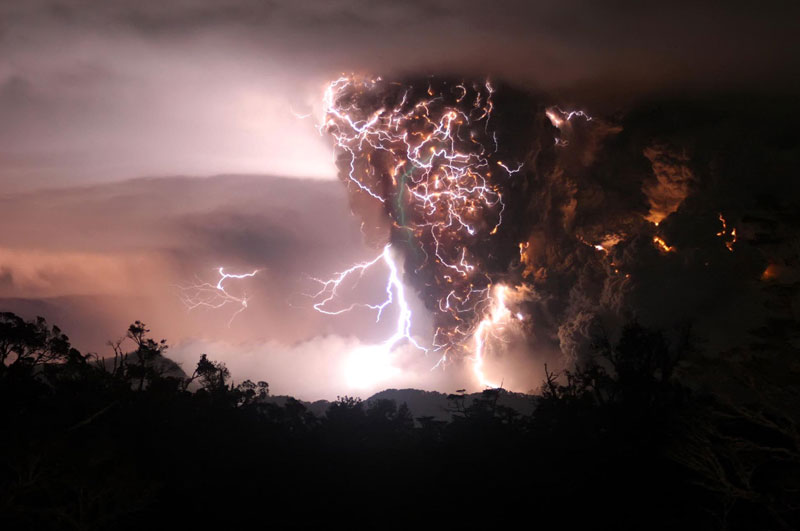
Chile Chaiten Volcano Erupts Generating a Spectacular Lightning Storm

Chaiten Volcano, southern Chile, erupts generating an intense electrical storm (UPI)

This is quite possibly the most stunning photograph I have seen for a long, long time. In Chile, a volcano has erupted, blasting huge quantities of ash and gas into the atmosphere. As the plume of ejected material rose through the cooler atmosphere, electric charge was built up through electron exchange between plume and surrounding air. The resulting electrical storm produced some terrifyingly beautiful images. Thank goodness I spotted the lead on this story, from a tabloid newspaper in Bristol’s city centre…

It’s one of those iconic media images, something so unworldly and terrifying that it takes some time to understand the scale of what you’re seeing. Sitting outside a pub in glorious (and rare) UK sunlight, flicking through the Daily Mail, I stumbled across page 20 of the tabloid (dated May 7th). A double-page spread of a scene that was more reminiscent of an apocalyptic movie. My first thought was that it was some sort of nuclear explosion, but then, on reading the text I realized it was in fact a huge plume of ash and smoke being blasted from the Chilean volcano that had erupted last Friday. But something was strange about the image. A vast quantity of electrical discharge could be seen, lightning strikes threading through the plume and more lightning bolts being emitted by the surrounding cloud cover. I knew this was something special, so I checked to see if the newspaper ran a story online too.

Fortunately they did, and no one else seemed to be following it out of the mainstream UK media. I’ve actually been trying to find a way of including the Chaiten Volcano event in the Universe Today for the last few days, but apart from doing a minor story of an International Space Station snapshot from orbit, I couldn’t find much bulk for the report. The Daily Mail ran some stunning images of the event, but it was the volcano triggered lightning that got me interested. Have a look at the story I ran on the Universe Today (it’s proving to be pretty popular…).

As far as I can see, the violent lightning storm would have been caused by the rapid updraught of hot ash. Friction between the hot cloud and cool surrounding atmosphere would have created a vast charge generator, sparking to life as electrical discharge.

Chaiten Volcano, lightning strikes from atmospheric cloud cover (UPI)

Source: Daily Mail newspaper

Dynamic Coronal Loops as seen by STEREO (Video)

The STEREO (Behind) view of three loop systems moving into view (NASA)
What with all the surprise activity of the Sun at solar minimum of late, I’ve found myself looking around the solar observation sites an awful lot more than I used to. During all the commotion back in 2003 when the Sun was blasting out record breaking X-ray flares one after another, I really didn’t think I could be surprised with anything else the Sun would do. That was until, very much unannounced, three sunspots rotated into view, blasting another X-ray flare into space… at solar minimum. The strange thing was, that these sunspots weren’t even from this solar cycle, they were from the previous one that ended some time around December 2007! And now we get a stunning, detailed view of more unexpected solar activity from the Solar Terrestrial Relations Observatory (STEREO), a hi-res video of dynamic coronal loops…
Continue reading “Dynamic Coronal Loops as seen by STEREO (Video)”