Scientists Create Synthetic Life… Now What?

You talk about synthetic life like it's a bad thing - Tricia Helfer in BSG

Say if you’re in space, searching for life, what do you look for? That’s simple. You look for something that resembles life on Earth; whether that be single-celled amoeba or a Star Trek-style humanoid with a lumpy head and webbed feet.

That’s life we know and understand (with some sci-fi comedy thrown in). What if there are some other unimaginable creatures that may not fit into our understanding of How Things Work™? This is a very real problem NASA has been faced with ever since the agency started sending probes to Mars and spacecraft beyond the Solar System itself. Deep space missions (like the Voyager and Pioneer probes) have intelligent life forms in mind (i.e. ones that can read, hear and interpret the Leonardo da Vinci Vitruvian Man; so it would be nice if ET also has an appreciation for fine art), but our intrepid Mars rovers and landers that have been pestering the Red Planet since the 1960s are looking for the basic building blocks of life, plus evidence of past or present life. So far, there’s been a lot of rocks turned over, yet no sign of extraterrestrial life.

Therefore, scientists at a very early stage defined “life” as a self-sustaining chemical system capable of Darwinian evolution so we can focus on finding life we know and understand. To boost this understanding a little further, wouldn’t it be great if we could create our own evolving soup of chemicals?

Now, it seems, this has become a reality. Scientists in a Florida lab have created a beaker filled with synthetic life
Continue reading “Scientists Create Synthetic Life… Now What?”

Here’s One We Didn’t Discover Earlier

The 1998 archive Hubble image of HR 8799 after image analysis - one of the star's exoplanets have been resolved (NASA/HST)
The 1998 archive Hubble image of HR 8799 after image analysis - one of the star's exoplanets have been resolved (D. Lafrenière et al., ApJ Letters)

What’s just as exciting as directly imaging an exoplanet in a new observing campaign? To discover an exoplanet in an old observing campaign.

Like so many significant astronomical discoveries, archival images of the cosmos provide a valuable tool to astronomers. On its most basic level, astronomers can compare new images with images taken by the same (or different) observatory months, years or decades ago. This method can lead to the discovery of planets, asteroids and comets (when comparing two pictures of the night sky, a celestial object appears to move relative to the background stars). However, a new technique to analyse archived Hubble data in the search for exoplanets, has just revealed one of three known exoplanets orbiting the star HR 8699. The image in question was captured in 1998, when astronomers thought HR 8799 was an exoplanet-less star
Continue reading “Here’s One We Didn’t Discover Earlier”

China Really Didn’t Fake It (Part Deux)

Left: The reflection in Zhai's visor shows a three-row array attached to the spacecraft. Right: The reflection from Zhai's wrist mirror shows the same array, only closer. They are not studio lights (CCTV)

Remember all that conspiracy theory nonsense that was kicked up after the Chinese space walk last year? It would appear that people are still pointing fingers, accusing the Chinese space agency of being very handy with water tanks and computer animation, simulating Zhai Zhigang dangling above the (fake)Earth as he waves his flag in (fake)space. This is even after thorough analysis by the likes of professional sceptic* Phil Plait and myself (proto-professional sceptic), where the conclusion was reached that… um… China did indeed do the EVA. I’d also argue it would probably be even more difficult to pull off a stunt like the conspiracy being proposed than to get into space in the first place!

Anyhow, why am I repeating a chewed shoe of a conspiracy theory when we already know China successfully carried out a successful spacewalk on September 27th, 2008? An eagle-eyed reader of Astroengine has come forward with some additional evidence supporting one of my arguments against one of the conspiracy claims. Always nice to back up arguments with proof isn’t it?

*Yep, that is the proper spelling before you send me a message telling me otherwise. UK = “sceptic”, US = “skeptic”. So there.
Continue reading “China Really Didn’t Fake It (Part Deux)”

One Giant Leap… into Obscurity? Not Quite

Forget Bush’s “Vision For Space Exploration”, is it about time for some common sense?

When NASA had purpose: Buzz Aldrin on the Moon (NASA)

Just in case you were wondering about what NASA is supposed to be doing, you’re not alone. On Monday, Buzz Aldrin, Feng Hsu and Ken Cox submitted a scathing draft letter proposing a radical change to ex-President Bush’s 2004 Vision for Space Exploration, stating that “post-Apollo NASA” has become a “visionless jobs-providing enterprise that achieves little or nothing,” in the field of re-usable, affordable or safe space transportation. The authors also call into question that logic of returning to the lunar surface. Tough words, but are they right?

As it turns out, only yesterday (Wednesday) the word from the White House was that the US will still be returning to the Moon in 2020, regardless of the short-falls of Bush’s 2004 Vision
Continue reading “One Giant Leap… into Obscurity? Not Quite”

Not Just a Satellite: NASA’s Orbiting Carbon Observatory Fails (Update)

The fairing of the Taurus XL rocket upper stage failed to separate correctly, in this morning's OCO launch (Vandenberg Air Force Base/NASA)
The fairing of the Taurus XL rocket upper stage failed to separate correctly in this morning's OCO launch (Vandenberg Air Force Base/NASA)

In the early hours of this morning at 1:55am PST, a carbon dioxide monitoring mission was launched from Vandenberg Air Force Base in California. NASA’s Orbiting Carbon Observatory (OCO) was being carried into a 700 km polar orbit by a Taurus XL rocket. Unfortunately, 12 minutes and 30 seconds into the flight, the rocket upper stage suffered an anomaly, and the fairing failed to separate. Although it appears the rocket attained the desired altitude The vehicle did not attain the desired altitude and the $270 million satellite was doomed, trapped inside the the nose cone. The upper stage fairing was protecting the OCO as it ascended through the atmosphere; once in space it should have separated, peeled off and dropped away. That didn’t happen.
Continue reading “Not Just a Satellite: NASA’s Orbiting Carbon Observatory Fails (Update)”

Mosquito Survives in Space for 18 Months

Mosquitos: Tougher than they look

According to results from a Russian biology experiment on the International Space Station (ISS), a mosquito has survived the rigours of space for 18 months. However, this little winged insect didn’t do it inside the comfort of the ISS, he did it outside, in a small can.

The experiment was carried out by the same Russian-Japanese collaboration that brought us Space Beer from space-grown barley (I think you know my feelings about that endeavour), to study the effects of microgravity on various organisms and plants. However, in this case, our little mosquito drew the short straw and was attached to the outside of the station.

The mosquito study is intended to see how the insect copes with being exposed to damaging cosmic rays and the extreme variations in temperature, in the build-up to a possible Russian manned mission to Mars. According to a Russian media source, the future Mars cosmonauts are already training for the mission in a forest outside Moscow
Continue reading “Mosquito Survives in Space for 18 Months”

Pentagon Denies Space Weapons

“The United States is not developing space weapons and could not afford to do so even if it wanted to” said an official with the Pentagon last Thursday. Space weapons have always been a bit of a hush-hush topic, and it looks like the trend hasn’t been broken with this recent announcement. The real issue surrounding the announcement is what the Pentagon’s ideas of “space weapons” are.

Guest article by John Nestler (website: Space Marauder)

space_weapons

The United States is not developing space weapons and could not afford to do so even if it wanted to,” said an official with the Pentagon last Thursday. Space weapons have always been a bit of a hush-hush topic, and it looks like the trend hasn’t been broken with this recent announcement. The real issue surrounding this announcement is what the Pentagon’s ideas of “space weapons” are…
Continue reading “Pentagon Denies Space Weapons”

How Do You Spot Science Abuse in the Social Media Soup?

Heads should be held in shame...

You know the drill, we’ve all been there.

There you are, minding your own business, participating in the Web 2.0 phenomenon, scanning through the webpages on one of the countless social media sites. And then you see them, like coffee stains on your white upholstery, pages that seem a little out of place. One entry tells you that the world is coming to an end. Another tells you that the Illuminati have built a base on Pluto (with the obligatory IT’S A PLANET!!! comment underneath). Oh, and there’s another, claiming that a comet, twice the size of Jupiter is actually Planet X… and it’s coming right for us!

Of course, our common-sense neurons usually kick in, telling us that the author of the article is either a) nuts, b) an idiot, c) flying at half-mast or d) a troll. In which case, we are able to flex our social media muscles by burying, down-thumbing, down-arrowing, reporting or ignoring the offender.

There we go, social media in practice. One BIG victory for online democracy!

However, sometimes it’s not that simple. What if the author seems to be bona fide? What if the author is a so called “expert”? Say if the article uses some real science to explain their hopelessly flawed theory?

I may have been trawling around the dregs of the doomsday theory ilk for the past year, but the following list applies to pretty much any daft conspiracy theory or outrageous science claim, intended to misinform, scare or cause an online headache as you voyage through the increasingly accessible social media…
Continue reading “How Do You Spot Science Abuse in the Social Media Soup?”

Liquid Water on Mars?

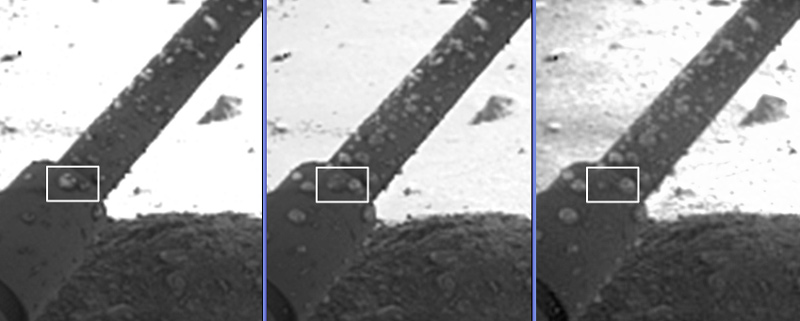
Water droplets appear to be growing on Phoenix's leg shortly after landing on Mars (NASA)
Water droplets appear to be growing on Phoenix’s leg shortly after landing on Mars (NASA)

NASA scientists are currently trying to understand a set of images taken by the Phoenix Mars Lander shortly after it landed on the Red Planet in May 2008. The images in question show one of the robot’s legs covered in what appears to be droplets of liquid water. The droplets remain on the lander for some time, appearing to get larger and changing shape.

By now, we know that liquid water (apparently) hasn’t existed on the Martian surface for hundreds of millions of years; the atmosphere is currently too thin and too cold to support liquid water. However, the confirmed presence of perchlorate in the regolith may provide an important clue as to what might be going on…
Continue reading “Liquid Water on Mars?”

Bad Astronomy Scoops Time “25 Best Blogs 2009” Award

Bad Astronomy - One of Time's top 25 blogs of 2009

It is always fantastic to hear blog has been recognised by the mainstream media, but when a site from the space blogosphere is recognized by Time.com as one of 25 best blogs of 2009, that’s a big deal. Phil Plait’s Bad Astronomy is officially up there with other blog monsters such as the Huffington Post, BoingBoing and Mashable (although few would argue against Bad Astronomy being the biggest space/astronomy/sceptical blogs out there).

So here is Phil, stepping up to the podium to accept his award:

They seemed to like the idea of a skeptical blog, which is probably what I like most about what they wrote. It’s very gratifying indeed to know that people out there appreciate a reality-based opinion. One of my overarching goals is to avoid dogma and bias and use only factual evidence on which to base my opinions. I know some people will disagree with this, but in general I think that’s because they don’t like the conclusions I reach. But I have found over the years that the hardest thing to accept as a skeptic is that the Universe doesn’t care what you think is true, it only cares about what is true.

There’s a big difference, sometimes.

–Phil Plait, Bad Astronomy (Feb. 17th, 2009)

Congratulations Phil! Your blend of healthy scepticism, astronomy, science and humour continues to inspire and motivate the rest of the science blogging world, this award recognizes Bad Astronomy as being one of the few “standard candles” cutting through the noise that is the Internet.