Oh dear. Just when I was actually beginning to care about the cast of Defying Gravity, it was cancelled half-way through the first season. I was a little annoyed about this as #DefyingGravity on Twitter was fast becoming a weekly ritual; a group of us die-hard sci-fi viewers scoffing at the science atrocities the ABC show was inflicting on us. In fact, the bad science, when coupled with a spaceship full of horny crew mates (a.k.a. friends with benefits… why not?) almost made it compelling viewing (almost).
Apart from hammering home the inevitability of astronauts having sex in space, I almost stood up and cheered when, in the last episode (called “Love, Honor, Obey“), the cast did a great job at explaining the quantum physics thought experiment, Schrödinger’s cat. As the crew was stuck inside a shielded compartment to protect themselves against an impending solar flare (it turned out to be a false alarm), mission control had no way to communicate with the crew. Steve Wassenfelder, the out-of-shape physicist, likened the crew to Schrödinger’s cat; to mission control, as they had no way of knowing whether they were alive or dead, the crew were in fact alive and dead. Clever.
The show also handled the solar flare event pretty well, although they avoided a lot of the details (but kept it within the realms of possibility, as opposed to some movies I won’t mention).
Then, after some fractal tomato plants (I didn’t say all the science was kosher), the crew opened mysterious Pod 4 to see…
…I don’t know what they saw as that was the cliff-hanger of the last episode. I’m sure I’ll end up watching it on Hulu.com, but I don’t think it will be the same without mocking it live on Twitter with the #DefyingGravity contributors (you know who you are).
Then, as quickly as Defying Gravity dropped off our screens, another compelling sci-fi series appears on ABC featuring a competent-looking cast (led by Joseph Fiennes and John Cho). It’s called FlashForward, and after only the first episode, I’m hooked. It’s actually the same feeling I had when I watched the very first episode of Heroes.
In FlashForward, we start off in Los Angeles, looking into several people’s lives, when suddenly the entire planet blacks out for 2mins 17seconds. During that time, everyone has a vision of 6 months into the future.
The series is based on the 1999 novel Flashforward by Canadian science fiction writer Robert J. Sawyer, and the premise is pure sci-fi joy. In fact, I was lucky enough to be sent a behind the scenes video by Times.com science comedian Brian Malow (be warned, there’s a fairly huge spoiler, but it’s an awesome spoiler that will get you nodding with joy… but you’ve been warned):
Robert J. Sawyer calls himself a “hard science fiction writer,” so it will be very interesting to see how the show deals with the speculative quantum-conciousness link. Still, it has to be better than that silly mag grav idea in Defying Gravity.
In other news: The lovely Eliza Dushku will live-tweet during the season 2 premier of Dollhouse (on FOX) if she gathers 100,000 Twitter followers before it airs… in 20 minutes on the West Coast. She’s only on about 92,000 at the moment, so it’s not looking likely. Still, I’ll be watching!
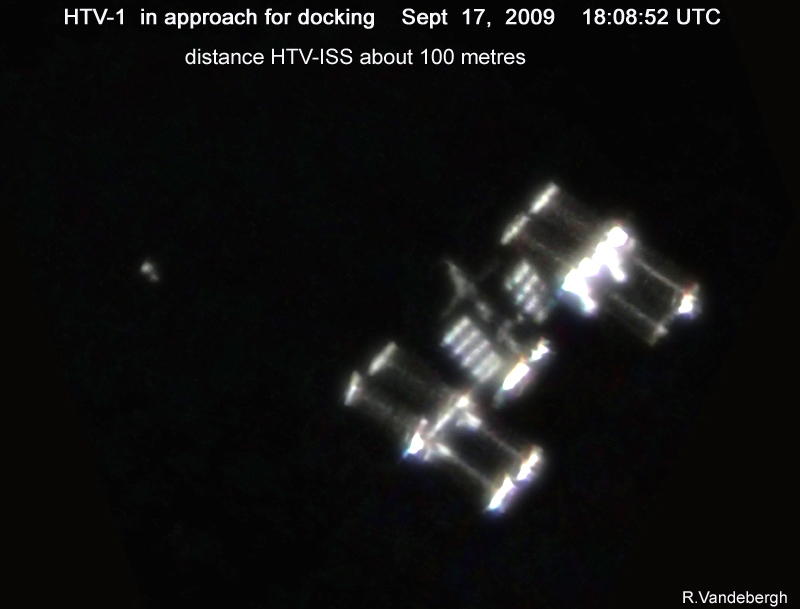
I first came across Ralf Vandebergh’s outstanding astrophotography when I was inquiring about a “mystery” object that appeared to be stalking the International Space Station (ISS) in July. As it turned out, it wasn’t a UFO, it was in fact a Russian Progress re-supply space vehicle testing out a new automated docking procedure with the orbiting outpost. Vandebergh managed to image the ISS and Progress vehicle with amazing clarity from his home in Wittem, the Netherlands.
Today, he’s done it again, only this time his target was the first flight of the robotic Japanese H-II Transfer Vehicle, HTV-1.
On day 3 of the mission (Sept. 13th) to supply the ISS with over 4 tonnes of food, water, fuel and equipment, Vandebergh captured this incredibly detailed picture of the vehicle, speeding overhead at an altitude of just under 300km (pictured top). He also took a shot of the HTV-1 as it was approaching the ISS on Sept. 17th (right).
I’m totally in awe of these shots, and there’s a lot more where this came from. In Vandebergh’s gallery there are pictures of spacewalking astronauts, shuttle cockpits and amazingly detailed portraits of the ISS… all taken with a camera, through a telescope, on terra firma. Enjoy.
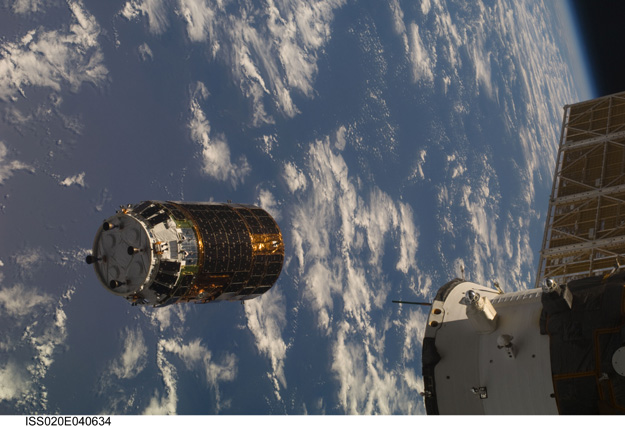
For reference, here’s a shot of the HTV-1 from the ISS shortly before docking:
The HTV-1 approaches the space station on Sept. 17th (NASA)
The space station as reflected in John “Danny” Olivas’ spacesuit visor on September 3, 2009 (NASA)
When I came across this image in NASA’s Human Space Flight gallery, I stopped. I was looking for the “perfect” shuttle image during the STS-128 mission to the International Space Station earlier this month, but I got sucked into browsing through the hundreds of EVA photographs NASA has stockpiled in their archives.
This particular scene was taken by NASA astronaut John “Danny” Olivas when he was out on a spacewalk installing a new Ammonia Tank Assembly. The EVA was over six hours long and Olivas was able to do some digital photography in that time. This picture shows his spacesuit helmet visor, with a reflection of the camera at arms length below.
Also visible in the reflections in the visor are various components of the station and European Space Agency astronaut Christer Fuglesang, mission specialist, anchored to a Canadarm2 mobile foot restraint. —NASA
The reflection captures so much detail. The curvature of the Earth can be seen in the distance, with space station solar arrays jutting in front. Even the two docked Soyuz vehicles (TMA-14 and TMA-15) are in shot. To top it all off, ESA astronaut Fuglesang is dangling in the vacuum of space attached to a robotic arm.
Today is H.G. Wells’ birthday! And I must admit, the Google logo is pretty cool. A UFO and a couple of tripods (with more in the distance) rampaging through the sleepy rural village of Horsell in Surrey is depicted. This relates to last week’s Google Doodle of crop circles and tweeted map reference to the same village near the town of Woking where H.G. Wells lived and wrote the famous War of the Worlds novel.
In my first post about the doodle, I followed the trail as far as H.G. Wells’ birthday, although last week it wasn’t Wells’ birthday. But the clues were there for something to happen today and it has. Even the logo’s filename is unambiguous: “hgwells09.gif”
So no puzzle this time, just a celebration of a legendary writer who imagined the first ever sci-fi Martian invasion in Surrey. If there’s a deeper puzzle behind this doodle, I don’t see it.
A screenshot of the 1982 colour version of the arcade game (via klov.com)
Thanks to an eagle eyed Astroengine.com reader, we may have an answer to the current Google doodle conundrum. Having spent a lot of last night following the mystery trail from crop circles, to Woking, to War of the Worlds, to H. G. Wells… I was stuck. The only thing that made this time of the year special was the fact that it’s H. G. Wells’ 143rd birthday on Monday.
However, in keeping with Google’s previous tribute to the classic computer game Zero Wing, could this new puzzle relate to another game? StockbrdigeT thinks this might be the case:
Today’s clue is co-ordinates that only have significance in their relation to War of the Worlds. Today is also what appears to be the 30th anniversary of the release of the War of the World Arcade game (the original monochrome version, not the 1983 color version).
The War of the Worlds is an arcade game based on the H. G. Wells novel The War of the Worlds. There were two versions of this game, identical in gameplay but differing in graphics. The first version was released by Cinematronics in 1979, and featured black and white vector graphics. A color version was later made in 1982.
The War of the Worlds arcade game, developed by the pioneering company Cinematronics, was one of the first games to use vector graphics (the very first Cinematronics game to use vector graphics was Space Wars, released in 1977).
So, what has this got to do with the Google doodle? Remember I was trying to find an explanation for the missing “l”? In actuality, the “l” in “Google” isn’t missing (as pointed out by another commenter, jurl), it’s there, but it’s in the process of being drawn by the little combine harvester in the crop.
I think that the Google logo is a celebration of one of the first uses of vector graphics in computer games — the “l” represents a vector being drawn by graphics software (i.e. the combine harvester).
So, the best I can do is the doodle is a celebration of:
H. G. Wells’ birthday on September 21st.
the 30th anniversary of the release of the War of the Worlds arcade game.
the first uses of vector graphics in computer games.
OK, so now I’m hooked. This evening, the Google logo changed into a doodle of a crop circle (above). This may seem a little innocuous, after all, Google is always jazzing up their logo with celebratory bits of art. But what did this resemble?
For starters, this isn’t the first time this has happened. A couple of weeks ago, another mini brain-teaser was posted with a flying saucer “beaming up” one of the “o”s in Google. CNET blogger Chris Matyszczyk managed to follow the clues and deduced that the missing “o” could be found in the numerical clue of one of @Google’s tweets. The numbers related to letters in the alphabet and spelled out, “All your O are belong to us.” This was in reference to the classic game Zero Wing (creator of the now famous gamer war cry “All your base are belong to us). It was the computer game’s 20th anniversary.
The logo was explained, the missing “o” was explained and it all related to an event (i.e. the Zero Wing anniversary).
So now we are presented with another conundrum. What does it mean? We have crop circles (linking to the search query “crop circles“, thanks @astrobio74 for pointing that out), a missing “l” in “Google” this time…. and a tweet from @Google with the map co-ordinates: 51.327629, -0.5616088.
Typing the longitude and latitude into Google Maps takes us to a location in Woking, Surrey, UK. The exact address is on Woodham Road in a village/town called Horsell.
Doing a search for the exact address and digging around the houses turned up precious little, until I typed in “Horsell” into Google. In the results is Horsell’s Wikipedia page. Horsell was made famous as being the place where Martians invaded in H. G. Wells’ classic sci-fi novel, War of the Worlds.
Much of the The War of the Worlds takes place around Woking and nearby suburbs. The initial landing site of the Martian invasion force, Horsell Common, was an open area close to Wells’ home. In the preface to the Atlantic edition of the novel, he wrote of his pleasure in riding a bicycle around the area, and imagining the destruction of cottages and houses he saw, by the Martian heat-ray or the red weed.
Great, so I’m almost 100% certain this little Google treasure hunt is pointing to War of the Worlds in some way. But why would Google pick today to do this?
A little more digging into H. G. Wells himself points to a possible answer (although I’m not totally convinced this is the sole reason). Next Monday marks the 143rd birthday of H. G. Wells (on 21 September, 1866). 143 years doesn’t strike me as a significant number, but the trail seems to lead here.
I’m now trying to work out where the “l” in “Google” fits into all this…
Wikus (Sharlto Copley) on the run from the MNU (WingNut Films).
Astroengine District 9 Review.
I managed to watch District 9 last night, and it was awesome. I may as well tell you my conclusion up-front, just in case you don’t want to read on, because I’m not going to be able to avoid mentioning some spoilers. So, if you haven’t already done so, get down the theatre now to watch a unique and enthralling sci-fi docu-action-thriller (but beware, there’s lots of exploding heads and alien gore, so go easy on the popcorn and fizzy drinks).
Generally, it looks like District 9 has received good reviews and a robust nod from the science fiction community, and now I’m going to weigh in with a review from Astroengine.com.
First and foremost, I think D9 surpassed pretty much all of my expectations, which is rare for Hollywood produce these days. It was little surprise then, that this movie wasn’t of the Hollywood brand, it came from the genius mind of the South Africa-born director Neill Blomkamp and Peter Jackson‘s production company Wingnut Films. The whole thing was shot in the gritty South African city of Johannesburg.
Setting the scene
The face of a “prawn.” Kinda cute in a squiddy way.
An alien spaceship breaks down on Earth and comes to a stop over Johannesburg. After several weeks of not seeing any sign of life, the authorities decide to cut their way into the ship. They find hundreds of thousands of malnourished insect-like, human-sized aliens inside. Humans do the right thing by setting up a makeshift shelter in Johannesburg, called District 9 (it is of no coincidence that there’s a similarity with the real events in District Six during the 1966 apartheid government rule). So far, so good.
After a couple of decades of living in the D9 shanty town, the local human populous is getting fed up with their alien neighbours (they derogatively call “prawns”). As it turns out, these aliens don’t appear to be very smart and they are certainly not organized. They have no leader and they are thought to be the “workers” of their alien race. They are far from being the sophisticated invasion party one would expect a technologically advanced race to be like.
Alien underdogs
This is the coolest thing about this movie; the aliens are cast as the unfortunate underdogs that are being forced to stay on Earth by their human captors. Why? Technology, of course.
A military organization called Multinational United (MNU) is put in charge of moving the million-plus alien beings to a new concentration camp housing facility 200 miles away. The whole operation is led by a bumbling MNU field operative called Wikus van der Merwe (played by Sharlto Copley). Wikus is your standard trying-way-too-hard-to-please-and-failing guy with a loving wife (who can somehow see past his many social flaws) and tough father-in-law (who is the head of MNU and responsible for giving Wikus this “big break”). Wikus is almost like a South African hybrid of Steve Carrel, Steve Coogan and Simon Pegg.
Serving alien evictions. Not as easy as it sounds (that sounded easy?!)
There are some fantastic moments when an overly confident Wikus knocks on doors serving eviction notices to the aliens. It is an awkward, yet captivating scenario. The MNU, an organization that obviously has absolute power over the situation, has decided to make the eviction of the aliens seem “legal” by getting them to sign (or “scrawl”) their signature on a small piece of paper. Naturally, the aliens aren’t too happy about all this and Wikus is met with a variety of responses (one where the alien slaps the paper out of his hand and storms off — Wikus triumphantly points out that a tentacle hit the paper, it is therefore signed). Another funny legality is that the aliens have been given human names (such as “Christopher Johnson”) to make their very existence bona fide.
In the first third of the film there are several reminders that the MNU isn’t a tolerant organization. If the armed units are faced with any resistance, they kill on-site. However, they are faced with an impoverished, desparate alien populous that will do anything for a tin of cat food. They are more concerned about chewing on car tires than being shot at. The cat food actually becomes a commodity in District 9, a currency the local Nigerian gangs use to trade for weapons. There is also a hilarious reference to “inter-species prostitution.”
Human-prawn hybrid?
The movie starts off in hand-held documentary style (not in an annoying Blair Witch Project way), following Wikus on his alien eviction adventures, but the atmosphere of the story changes after he accidentally sprays himself in the face with a black fluid in an unidentified cylinder. There is then an altercation with one of “Christopher Johnson’s” friends who tries to distract attention away from the shack that contained Wikus was sprayed in.
Cue alien death, execution style, by the bald-headed bad-ass special unit military guy.
A dodgy stomach and a broken arm later, Wikus is stuck in a situation he can’t get out of. You remember that spray? It turns out that it’s not only a special, highly refined spaceship fuel, it’s also a way to really mess up your day if you breathe it in. Wikus has started to change into an alien.
This is probably one of the weaker parts of the story. How a nasal spray is going to tinker with your genetics in such a way that will turn you into a human-alien hybrid, I don’t know, but District 9 didn’t start with a claim that it was going to be totally scientifically accurate. Somehow Wikus’ left hand also turns into a clawed alien appendage. I’ll turn a blind eye to the fudged human-alien biology lesson.
Guards outside the grim District 9
So we’re locked in a race against time as MNU agents track down and capture Wikus as Wikus becomes more and more prawn-like. From being a flawed MNU officer, he has now become the most valuable human on the planet; he is the only one capable of operating the alien technology (their weapons only react to alien biology).
Prawn purée
During the period when Wikus has been captured and is being experimented on, the MNU shows itself for what it really is; a weapon research facility with little regard for human life, let alone alien life. In one particularly tough scene, Wikus has to fire an assortment of alien weaponry at animal carcasses against his will…
[If you told me before watching District 9 that I would feel shocked by the death of a CGI’d alien being, I’d assume I would have been drinking heavily beforehand. But no, I hadn’t had a beer (although the Pepsi was quite syrupy).]
…At this point, a live alien is dragged out with an X painted on its torso. When stood, shivering at the end of the shooting range, Wikus is ordered to shoot the alien. He refuses, crying. You see that Wikus does have a certain degree of respect for the aliens and he is certainly adverse to killing them. Unfortunately, tied in place, and alien weapon pushed in this hand, he’s forced to fire the gun at the frightened “prawn,” who explodes in a bloody mess.
It’s pretty grizzly and also a little upsetting. I think this is the moment in the movie that you know you are dealing with a different kind of sci-fi storyline and Blomkamp does an amazing job to shock, but not to go over the top.
Agony and terror
Christopher Johnson looks out of the prison van after being captured.
Also, you realize Sharlto Copley’s acting ability is nothing short of outstanding. Before the weapon testing scene, there’s a fair amount of humour angled at his character, afterwards you can feel his agony and terror.
Needless to say, Wikus escapes and runs to the only place he can find refuge: District 9. Fortunately, we are allowed a little time to recuperate after the MNU experiments as Wikus turns into a convict running through his own city.
After a period of making friends with the smart “Christopher Johnson” and little (and quite cute) pint-sized alien son, Wikus and “Christopher” work out they need each other to find a solution to the problems they are facing. “Christopher” needs to retrieve the mysterious cylinder from the MNU HQ to make the command ship (hidden under District 9) function, and Wikus needs alien technology from the mothership hovering overhead to stop him from going 100% prawn.
And so begins an orgy of human-popping. In the best human-alien buddy pairing since Han Solo and Chewbacca, Wikus and “Christopher” assault the MNU HQ with the best alien guns Wikus could steal from those Nigerian “inter-species prostitution” gangs (with a fetish for drinking alien blood and collecting alien junk they can’t use). Of course, now that Wikus can operate these guns, he can have some fun.
A clip from District 9: Wikus uses an alien weapon for the first time (language NSFW):
Many reviews of District 9 are critical of the amount of action in the rest of the film, but I thought it was pretty cool. Science-lite, but it sure was a tour de force of movie action imagination. My particular favourite was Wikus’ energy-lightning-bolt gun that had no difficulty in snuffing out MNU personnel in a cloud of blood vapour.
A few gun battles later, and we return to District 9, plus fuel cylinder. Quite a lot happens, but to cut a long story short… there were a lot of explosions. I don’t want to give away the ending, but it was fairly routine, with a couple of minor plot twists. When I say routine, I don’t mean it was boring, the movie simply went its course without too many surprises. Well, there might have been one or two…
Of all the amazing things I plan to look at through my future telescope (yes, I’m still saving), this event didn’t even cross my mind. Not surprising really, it’s probably never been observed before: Io’s whole shadow transiting across the large Jovian moon, Ganymede.
But on August 16th, that changed when Christopher Go from Cebu, Philippines used his 11-inch Celestron telescope to capture the sequence of events as Io passed in front of the Sun, casting a near-perfect shadow on the large moon of Ganymede. If you were standing on Ganymede’s surface, looking at the Sun, you would have seen an Io solar eclipse.
My favourite thing about this animation is that both moons are very detailed, even at this resolution. You can see mottled shades on Ganymede, and I think the spin of Io may even have been captured.
A wonderful testament to Christopher Go’s astronomy skills and a fantastic example of how advanced our amateur astronomical equipment is becoming…
UPDATE: It turns out that little Io is getting its own back for last July’s eclipse by Ganymede, plunging the smaller moon into darkness. In the following video by OccultDave on YouTube, over a period of about 16 minutes, Io (the dot to the far-right) dims dramatically as Ganymede (the dot in the middle, next to the bright disk of Jupiter) blocks the sunlight:
Yesterday, NASA announced exciting news about a discovery made by a NASA mission that did a cosmic dance with comet Wild 2 back in 2004.The Stardust mission managed to scoop an amino acid called glycine from the comets dusty tail, thereby proving it’s not just asteroids that contain this critical ingredient for life.
“It’s not a particularly unexpected discovery that glycine is in a comet — we’ve found amino acids in meteorites before — but it does show that comets are another way that amino acids could have come to Earth,” lead researcher Jamie Elsila, with NASA’s Goddard Space Flight Center, told Irene Klotz from Discovery News.
Elsila and colleagues are responsible for developing a technique to extract and study the deposits of glycine from the aluminium foil that lined the probe’s collection plates. They confirmed the glycine was in fact of extraterrestrial origin (rather than contamination here on Earth), as the carbon atoms in the glycine molecules had an extra neutron in the nucleus. This means the glycine was formed in space.
“We see in this comet that amino acids were forming at the earliest time in our solar system,” Mike Zolensky, a comet dust researcher from NASA’s Johnson Space Center in Houston, said.
Zolensky suspects that heat from the radioactive decay of short-lived particles melted a piece of comet ice laced with organic compounds and water. This may have allowed the cosmic amino acid to form.
Now that an amino acid has been scraped off the collection plate of the Stardust mission, it would appear the building blocks for life are widely available throughout the Solar System (assuming comet Wild 2 isn’t a special case). Asteroids contain amino acids, as do meteorites, now it looks as if comets carry the building blocks for life too. This means early-Earth certainly had plenty of opportunities to acquire extra-terrestrial sources of amino acids…
The event horizon of a black hole is the point of no return. If anything, even light, strays within the bounds of this gravitational trap, it will never escape. The event horizon is what makes a black hole black.
But say if there was a way to remove the event horizon, leaving just the black hole’s singularity to be “seen” by the rest of the universe? What if there is a special condition that would allow this infinitely small, yet massive point to become naked?
Generally physicists agree that this is a physical impossibility, but the mathematics says otherwise; a naked singularity could be possible.
Previously on Astroengine, one “special condition” was investigated when an extreme black hole collision was simulated by a Caltech researcher. In this case, the black hole pair was smashed together, head-on, at a velocity close to the speed of light. The gravitational waves travelling away from the collision were then modelled and characterized. It turns out that after this insanely energetic impact, 14% of the total mass was converted into gravitational wave energy and both black holes merged as one.
While this might not be very realistic, it proved to be a very useful diagnostic tool to understand the conditions after the collision of two black holes. As an interesting observation, the Caltech researchers found that although the collision was extreme, and there was a huge amount of mass-energy conversion going on (plus, I’d imagine, a rather big explosion), neither black hole lost their event horizons.
Case closed, wouldn’t you think?
Actually, another theory as to how a black hole could be stripped naked has been knocking around for some time; what if you added mass to a black hole spinning at its maximum possible rate? Could the black hole be disrupted enough to shed its event horizon?
It turns out there’s a natural braking system that prevents this from happening. As soon as mass is dropped into the black hole, it is flung out of the event horizon by the black hole’s huge centrifugal force, preventing it from coming close to the singularity.
However, Ted Jacobson and Thomas Sotiriou at the University of Maryland at College Park have now improved upon this idea, sending mass in the same direction as the spinning black hole. Only this time, the black hole isn’t spinning at its fastest possible rate, the simulation lets the orbiting matter fall into the event horizon, speeding up its spin. The result? It appears to disrupt the black hole enough to strip away the event horizon, exposing the singularity.
The most interesting thing to come of this research is that swirling matter is falling into black holes all over the universe, speeding up their spin. Jacobson and Sotiriou may have stumbled on a viable mechanism that actually allows naked singularities in the cosmos. Unless nature has found another way to prevent the cosmic censorship hypothesis from being violated that is…










 astroengine.com