If I Was A TV-Loving Alien, I’d Live In 40 Eridani

tv-shows

16.5 light years away, a revolution in sci-fi television programming is about to explode to life… Yes, it really is that exciting. Almost like a tsunami approaching a peaceful shore, island inhabitants totally unaware of its impending arrival, the triple star system of 40 Eridani is about to be bathed in a very special terrestrial signal…

So why am I getting so excited for this random star system? Well, 15 years ago, the awesome five-season show Babylon 5 aired in the US and the UK. For me, B5 formed a watershed of my love for sci-fi. In fact, you could say I was a teenage Babylonoholic, I couldn’t get enough of it.

Today, I see the superb graphic on Obtuse Goose (after being pointed to Phil’s Bad Astronomy post by Greg “Weird Things” Fish), showing the local star systems to the Solar System and what they are watching.

Watching? Yes.

As we transmit electromagnetic signals over the airwaves for our television viewing pleasure, we’ve also been leaking it into space. As the signal travels at the speed of light, the maximum distance our TV signal would have travelled is about 80 light years (we started leaking in the 1930’s). By that reasoning, our TV shows should have reached Aldebaran by now.

Unfortunately, the aliens of Aldebaran have a rather limited choice of TV shows… at the moment they’re probably putting up with Nazi Germany’s propaganda broadcasts (like in Jodie Foster’s Contact). Things are far more exciting in 40 Eridani… they’re about to get flooded by the first season of Babylon 5! Sure, there’s lots of other things to watch in the expanse of 80 light years, but if I had to choose, I’d be prepping my TV aerial and stocking the fridge in time for 5 years of awesome sci-fi on a world orbiting one of the three 40 Eridani stars…

Source: Obtuse Goose, via Bad Astronomy, via Greg.

Russian Saraychev Peak Eruption Video Glory

Wow! I thought the single image of the volcanic eruption (plus shock wave) was cool, but after seeing the complete series of images put together in this animation, I’m literally blown away. Thank you Richard Drumm for sharing the video on Twitter — now this is one YouTube video that needs to be shown off.

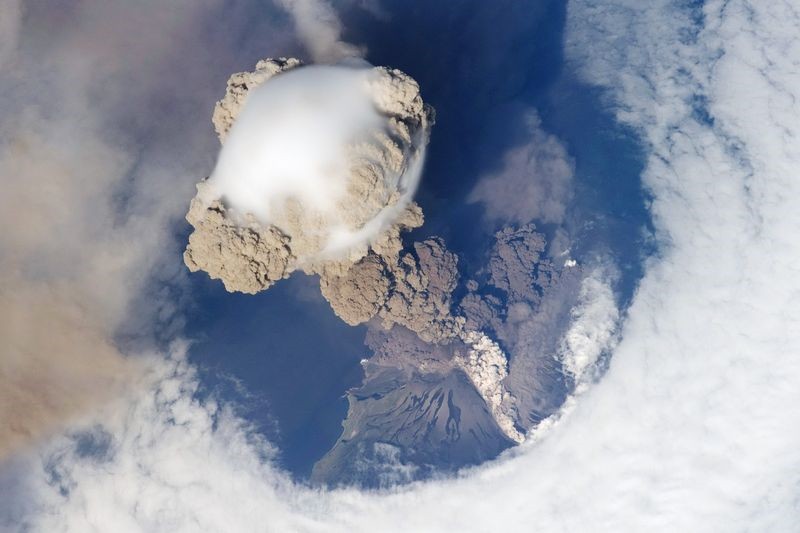
The 29 photos in this animation were taken by space station astronauts as they passed over Russia’s Sarychev Peak volcano in the Kuril Islands.

For more information, check out my previous Astroengine post

A Shocking Volcanic Plume

volcano_shock

When I first saw this image, I didn’t think too much of it. After all, this isn’t the first time I’ve seen a volcanic plume racing through the atmosphere. However, this picture is awesome on so many levels.

First, as part of NASA’s Earth Observatory program, an astronaut in the International Space Station was fortunate to get the timing just right to witness Russia’s Sarychev Peak volcano in the Kuril Islands explode, blasting a huge plume of ash and smoke high into the atmosphere. Second, the conditions on the ground must have been very still, allowing such a huge vertical structure to reach so high. And thirdly, the image captures two amazing features: a condensing cloud of vapour at its peak (the white, smooth cloud) and a shock wave that pushed all the surrounding cloud away from the eruption.

Wow.

For more on this stunning event, check out Michael Reilly’s great article over at Discovery’s Earth Pub.

Warp Drives and… Black Holes?

black-hole-aurora

Why do all roads seem to lead to black holes? Man made black holes are supposedly going to be produced by the Large Hadron Collider, swallowing Earth (or, at least, a large fraction of Europe), so it seems only logical that something like a warp drive — a technology of the uber-future requiring uber-energies — would also generate a black hole, right?

Yes, we are talking about a vastly theoretical technology, but according to Italian researchers, the spaceship propulsion device popularized by Star Trek could have grave consequences for Planet Earth.

Over the past week, I’ve been deep inside the science behind faster-than-light-speed propulsion and time travel as a part of the Discovery Space Wide Angle: Surfing Spacetime, and I feel well versed in the astounding physics that could make warp speed a possibility in the future. All this started when interviewing one of the leading authorities on warp drive propulsion, Dr Richard Obousy, who is not only upbeat about the possibilities of the futuristic warpship, he’s done the math to prove that a sufficiently advanced civilization could “surf” on a spacetime wave.

However, there’s a catch. Well, two.

Firstly, we need to develop an understanding for dark energy. And second, we need a gargantuan energy source.

Dark energy is a cosmological theory that explains the continued expansion of the universe. This energy pervades all of the cosmos, explaining everything from the grouping of galactic clusters to the faster-than-light-speed inflationary period immediately after the Big Bang. There’s a lot of indirect observation of dark energy and its effects on spacetime. It’s out there, but it’s a tough proposition to think we might be able to harness it someday. But then again, we said that about electricity once, who knows what technological revolutions await us in the decades and centuries ahead.

Assuming we find a way of harnessing dark energy, how can we use it? This is where visionary physicists like Dr Obousy come in. Skipping over the superstring small-print of extra-dimensional theory, we basically need a huge amount of energy to manipulate the universal dark energy, thereby shrinking and expanding vanishingly small dimensions beyond our three dimensional universe.

So how much energy is needed warp spacetime, allowing a futuristic spaceship to zip through space? “Some back of the envelope calculations I performed last year indicated approximately the mass energy contained within the planet Jupiter,” Richard told me.

This sounds like a lot of energy! However, there’s a trend, the rest mass energy of Jupiter is actually an improvement on previous warp drive calculations. “The very early warp drive calculations indicated that one would need more mass energy than was available within the entire universe… that’s TRILLIONS of Jupiters!

This improvement is down to recent developments in superstring theory and quantum dynamics. It would appear that the energy requirements for a warp drive improves with developments in physics. If this trend continues, we may find other energy saving ways to make a warpship a reality.

However, there are some practical issues putting the breaks on travelling at warp speed. Only recently, I reported on a study focusing on quantum fluctuations as the warp “bubble” (containing our warpship) blasts through the light speed barrier: the occupants could get roasted by Hawking Radiation.

Today, another problem has surfaced from the extreme warp equations: black holes (who would have guessed?). Italian physicist Stefano Finazzi of Italy’s International School for Advanced Studies has crunched the numbers and wondered about what would happen when the energy runs out. It’s all very well generating a Jupiter’s rest mass-worth of energy, but how will it be sustained by the warp drive? What will happen when all the energy is depleted?

Eventually the energy would run out. The [warp] bubble would rupture, with catastrophic effects. Inside the bubble the temperature would rise to about 1032 degrees Kelvin, destroying almost anything on the bubble.Eric Bland, Discovery News

It gets better, Finazzi also predicts a fair amount of doom outside the warp bubble, too. “We know that the warp drive will be destabilized,” he added. “But we do not know if it will in the end explode or collapse to a black hole.”

Don’t go running out of gas any where near Earth is all I say

Although these implications of doom and gloom should have given Jean Luc Picard a panic attack whenever he said “engage!” or “make it so Number One…”, we have to remind ourselves warp drive propulsion isn’t even close to being a reality. Dr Obousy and warp scientists before him are only just beginning to assemble a theoretical framework around the sci-fi notion of warping spacetime, so to already be predicting warp speed fail seems a little premature in my opinion.

In response to the Hawking Radiation problem, Dr Obousy pointed out that if we get to the point of generating vast quantities of energy, harnessing the spacetime warping power of dark energy, we should be able to at least have a stab at finding solutions to these potential warp drive problems.

Objections are good, but usually we find smart ways of circumventing problems. Humans are good at that,” he said.

I agree.

Thunder Cloud vs. Volcanic Plume; Light Show Ensues

stephen-omeara1

I know I only recently posted a lightning picture, but when I saw this shot, I had to post it. During an eruption of Rabaul volcano in Papua, New Guinea, Stephen O’Meara saw a stunning display in the angry skies.

“A storm cloud approached the volcano’s 2 km plume, and lightning began to arc between the two,” O’Meara said in the SpaceWeather.com article.

These events aren’t uncommon in the air surrounding hot, rising plumes of gas and ash, but some of the recent photography of such events are astounding.

A Lightning Bolt Hits Water, So Close You Can See Its Streamers

A bolt of lightning, 40 metres away (©Francis Schaefers and Daniel Burger)

It’s pictures like these that make me a) want to do more photography, b) feel more in awe of nature than I already am, and c) wonder how the photographer didn’t pack up his gear and run away screaming. But thank goodness the talented storm chasers didn’t run away, they actually witnessed a very rare event, up close.

This astounding image was shot by photographers Francis Schaefers and Daniel Burger when they were chasing a thunderstorm along a beach in Vlissingen, the Netherlands. Chasing a storm along a beach. The best bit of the SpaceWeather.com article comes right at the end, where it says that Schaefers and Burger took a series of shots from “underneath a balcony where they figured the lightning wouldn’t reach.”

Let me emphasise that last bit: underneath a balcony.

Balls of steel comes to mind. For me, nothing less than a reinforced bunker surrounded by lightning rods will do.

Related Lightning Articles:

Anyway, back to why this image is so fantastic. When lightning strikes the ground, if you are able to get the timing perfect, you might be able to capture ‘upward streamers’ rising from the ground to meet the leading edge of the bolt, as NASA lightning expert Richard Blakeslee explains:

Streamers reach upward from the water.

In a typical cloud-to-ground lightning strike, as the leader approaches the ground, the large electric field at the leader tip induces these upward propagating streamers. The first one that connects to the downward propagating leader initiates the bright return stroke that we see with our eye. Upward streamers are often observed on photographs of lightning hitting the ground.”

It’s hard to imagine if this streamer phenomenon has been observed to reach out from water before, but this Dutch example must be very rare. It’s hard enough to photograph lightning streamers on solid ground, let alone on the surface of a body of water.

In case you weren’t already amazed, check out this shot. It’s called The Cruise You Don’t Want to Take for very obvious reasons:

The storm, plus cruise, ship off the coast of Vlissingen, the Netherlands (©Francis Schaefers and Daniel Burger)

Source: SpaceWeather.com

Astroengine Featured on CNET

cnet

In an article written by Don Reisinger for CNET News, Astroengine.com was selected as one of the “18 cool sites and apps that teach you about space.”

This is awesome as one of my main effort on Astroengine is to not only promote space news, opinion, skepticism and logical thinking, I also hope the site serves as an educational medium, so readers can understand the science that hides beneath the headlines. “Outreach” is a lot more than a group of scientists trying to work out how best to promote their work to the world; it’s a way of communicating advanced scientific theories to an audience who don’t necessarily have a specialized knowledge of the subject matter. Even though I have an education in a small aspect of astrophysics, it is often hard to understand the next big discovery in cosmology (don’t get me started on quantum dynamics, that stuff is insane!), so the more explaining the better in my books.

Also, to add to the coolness, by virtue of alphabetical luck, Astroengine.com takes the #2 slot in the top 18 space websites. And to top the whole thing off, Don Reisinger’s article hit the front page of Digg.com this morning. Needless to say, Astroengine was busier than Grand Central Station on a Friday evening this afternoon (thank goodness I have a brand new server to deal with demand)!

Thank you Don, I really appreciate the mention and the really cool review!

For more, check out “18 cool sites and apps that teach you about space” on CNET.com »

A Hole In Arizona

©Stan Gaz

This picture was posted by Phil Plait and I was mesmerized. Stan Gaz, the photographer of Meteor Crater in Arizona, will be laying on an exhibition in New York from April 30th to June 6th. If this is anything to go by, it’s an event you can’t afford to miss out on… if you’re in or near New York that is. As I am quite literally on the other side of the country, I’ll miss it, but here’s more info if you are more fortunate.

Star Formation: The Game

starformation

Dave Mosher, I’m pointing my finger at you for this late night effort! Usually I stay up late to write articles, but for the last 30 minutes I’ve been playing this game after Dave sent a message on Twitter saying he had been playing a “simple” and “addictive” star formation game. No kidding! I shouldn’t have even clicked the link. But like a caffeine-infused moth to a super-shiny flame, off I went for some simple star-creation fun.

It looks like the Star Formation game is part of Discover Magazine’s featured article about the mysteries of star birth (it’s a great read, check it out). The game is simple, yet captivating (despite a few minor bugs). You play the role of supernova progenitor, dropping some massive star fury on an unsuspecting nebulous cloud of hydrogen. According to the game developers, the situation is physically accurate, it is just up to you to create the perfect conditions for stars to form in the dense cloud. It would appear the lectures I attended on star formation paid off, as I speak I’m on top of the leaderboard with a whopping 21122 points (see the screengrab above, I saved it posterity, I doubt I’ll be at #1 for much longer).

I’m all for games with an educational element, and I can’t think of a better way to spend an evening (well, I can, but if you’re stuck in the office, this is a great alternative to work). I’m off to create some more stars, check out Discover so you can do the same (just you try to knock me from the #1 slot!).

Astroengine.com Now Featured in Alltop.com!

Astroengine.com is now listed in the Alltop web directory! This ranks in the upper echelons of “coolness” as Astroengine now features alongside space news behemoths such as the Universe Today, Bad Astronomy, Space.com, Discovery, New Scientist, Space.com, Space Examiner and loads more besides!

From the Alltop homepage: Alltop is an “online magazine rack” of popular topics. We update the stories every hour. Pick a topic by searching, news category, or name, and we’ll deliver it to you 24 x 7. All the topics, all the time.

Be sure to check out Alltop.com, I’ve used it a lot. I like the format as you can access all your favourite space and science news websites on one page and organize it as you see fit. I suppose it’s like an RSS feed reader, only easier. That seems to be the trend of social media these days, speed and ease of use… perhaps I need to start cutting back on some of my gadgets