Social Media Aggregates Space News For Breakfast

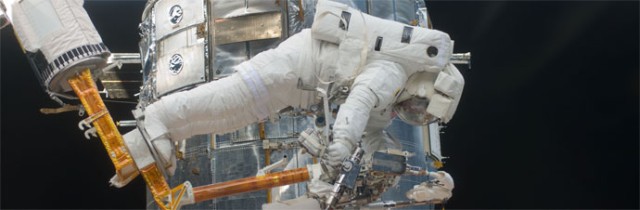
Getting the full experience: Twitter provided a ring-side seat during today's Hubble servicing spacewalk (NASA).

Earlier today, 500 people meandered through Astroengine.com, and I was a little confused as to where they came from. I checked the social bookmarking sites, but this particular page wasn’t listed. Normally, an excess collection of visitors will appear from the aether after quasi-randomly plopping onto my server from StumbleUpon, or blasting my bandwidth during a Digg surge, but this traffic was different. The visitors found my website after clicking a link on a new website called A Portal To The Universe. I knew the site existed, but I hadn’t had the time to check it out. But it is awesome.

Astroengine’s regular readers will know that I have a fascination with the movers and shakers in the world of social media, and I have found various ways to use it for my evil intelligence gathering methods. Also, I’ve met some fantastic people along the way and made very good friends. This time last year, if someone said, “Ian, you will make real friendships online in 12 months,” I would have thought, a) OMG, I’ll be more of a geek than I am now! or b) that is the saddest thing I’ve heard in my life, I never want to see this laptop again.

But then, the web mist cleared, and I saw the light (with a little help from my good friend Avi). Social media isn’t about connecting with a bunch of strangers who have little care for who you are or what you do, it’s about forming social links with like-minded people who have a genuine interest in what you have to say. It’s not quantity (@aplusk-style; why would you want the responsibility of entertaining over a million followers on Twitter anyway?), it’s quality that counts.

Before I realized it, I was collaborating, communicating and collecting space news from real people with real science to distribute. I was tweeting, digging, stumbling, reddit-ting, mixxing and generally socializing my heart out. Along the way, certain platforms fell by the wayside, and now I’m currently enjoying Twitter (more than I should), StumbleUpon and pretty much all the Google applications. Facebook has been steady and so has Digg (for better or worse).

Information reloaded

Building a community is the mainstay of social media, but what do you do if you have too much information flooding your bookmarks? You might use an RSS feed aggrigator, or you might filter your Twitter messages, but wouldn’t it be great if you had a website that helped you find the specific information you are looking for, and helped you find other like-minded people in an ocean of chatter?

But now it would appear space news is welcoming social media with open arms. Two exciting projects have appeared online, using the best information gathering techniques on Web 2.0. Finally, it would appear space science is getting the attention it deserves.

Portal to the Universe

port_uni

In celebration of the International Year of Astronomy 2009 (IYA 2009), the Portal to the Universe was launched at the European Week of Astronomy and Space Science (JENAM 2009), that took place at the University of Hertfordshire, UK, in April.

It is a fantastic news platform with featured news from a range of blogs and news sources. Real-time data is also available from many missions with a wealth of socially generated topics. In the spirit of social media, the Portal grabs community-based space news, displaying all the relevant news to the astronomy and space community. An amazing resource I have been using since it was launched.

Keeping up-to-date with cutting-edge astronomy and space science breakthroughs has just become that much easier, thanks to the Portal To The Universe, the latest Cornerstone project of the International Year of Astronomy 2009 (IYA2009). As a high-tech website embracing Web 2.0 technologies, the Portal To The Universe aims to become a one-stop-shop for astronomy news.Portal to the Universe

AstroSpaceNow

astrospace

This website actually came as a surprise to me. Ricardo J. Tohmé, founder of AstroSpaceNow, contacted me on Twitter and mentioned they were starting up a social astronomy blog. Fortunately, I went to the site to check it out and was impressed with the design of the “coming soon” page. Feeling I’d be left out if I didn’t, I signed myself up for the newsletter and forgot about it.

Then, as promised, a week later, the site went live.

Looking at the pages of AstroSpaceNow, there is a very real Twitter/microblogging feel, and at first, I was a little cautious. There has been a massive surge of the bold-colour/bold-type websites over the last few months, so I didn’t want this to be just another Twitter aggregator with a space twist.

As it turns out, AstroSpaceNow is tremendously powerful. It uses the power and speed of Twitter to keep up to date with key space-related Twitter accounts. Each account is tagged and colour-coded so you can quickly scan through the lists. Each Twitter stream is categorized and the site refreshes every five minutes.

So, if you want to find out what the space news buzz is all about right now, and find the interesting people who are buzzing, this is the site for you. It’s another fantastic resource for space bloggers, as one glance at the pages of AstroSpaceNow and you know exactly what is going on.

A Calculated Love Story: Me and My Casio fx-82D

I call her Casio, Casio fx-82D.

Sitting here at my laptop, like I do most of the time, I see the same stuff on my desk day and night. Occasionally I clean it, but most of the time it’s a mess of the highest order.

If I walked away from my desk, I probably wouldn’t remember what I have on it. I suppose it’s one of those “I remember it like the back of my hand” moments, when you really have no clue what the back of your hand actually looks like. It’s familiar, why would your brain need to remember it anyway?

So, the other day I gave this some serious thought: What item do I have in my life that I, a) can’t live without, b) I take totally for granted and c) I’ve had for a long time.

First thought was my Swiss Army knife. I’ve had that for many years, I take it for granted, but I could live without it. Second thought was my wallet; I take it for granted, but I’ve only had it for a couple of years and, to be honest, I leave it at home most of the time, stashing cash and credit cards into my back pocket. What about my laptop? Nope, I never take it for granted (after seeing the death of many a good computer). My cellphone? Nope, I get through so many phones it’s not funny.

So what else is there? Could I really coast around life without that vital item? Is there anything that fulfils a), b) and c)?

She's been a patient friend

Then I saw it.

The one thing that has sat on my desk for nearly two decades, ready for action, always reliable, necessary, but woefully taken for granted. My Casio fx-82D (FRACTION no less), my first, and only, scientific calculator…

I’m going to start this story with an interesting fact. To my recollection, I’ve only replaced the battery twice. I received my fx-82D some time between 1989 and 1992 for a birthday from my parents, and being a budding scientist I was overwhelmed (it is a scientific calculator after all). So nearly two decades later, to remember replacing the battery twice is astounding.

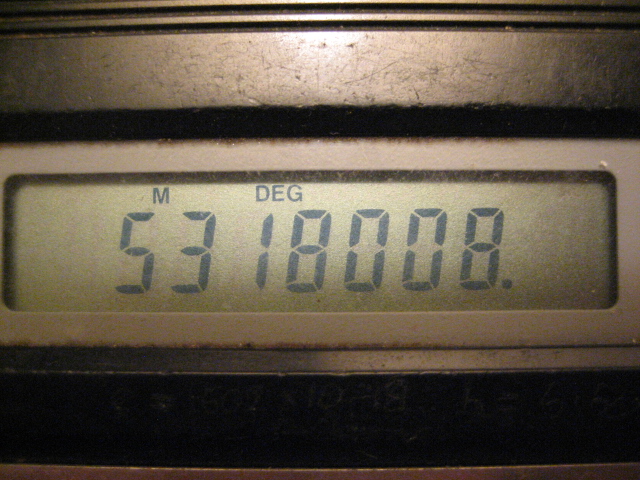
The first thing I ever typed into my Casio. Probably the last thing I typed in too.

It’s not as if I haven’t used it very much either. Not only do I have a problem with numbers, mental arithmetic comes hard, so I have to use trusty old Casio for pretty much everything.

I remember calculating my shopping budget in 1998 during my first week at university; I remember using it to calculate the number of holes there were in the ceiling tile above my head during a particularly boring religious education class in school (I remember being amazed that there were 40×64 = 2560 holes); then there’s the countless exams, thousands of hours sitting in the library studying for finals (instinctively I just used Casio to quickly calculate how many hours there were in a year, just in case the “thousands” of hours in the library didn’t sound reasonable) and huge amounts of time debugging calculations in thousands of lines of code during my PhD.

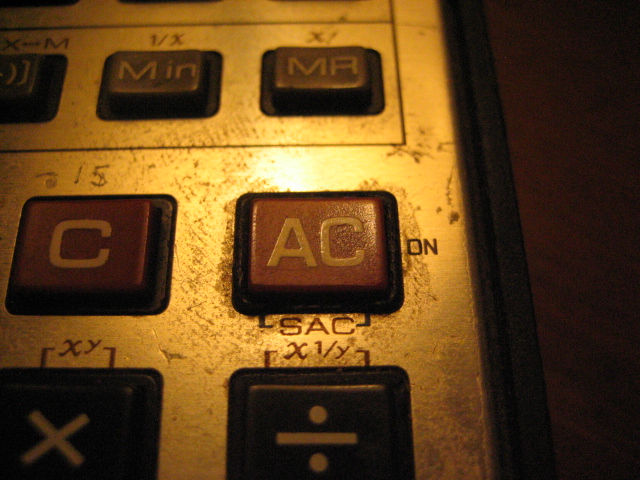
The fingerprints of ancient calculations

I may have achieved a lot in my academic life, but a huge portion of my success is down to the countless key strokes on my fx-82D.

She’s also been my partner in crime on a few occasions.

Did I really just say “she”?

There’s a funny story from my days in college when I was studying for my A Level in physics. For some strange reason, I couldn’t remember unit prefixes (such as the value of nano, micro and pico)…

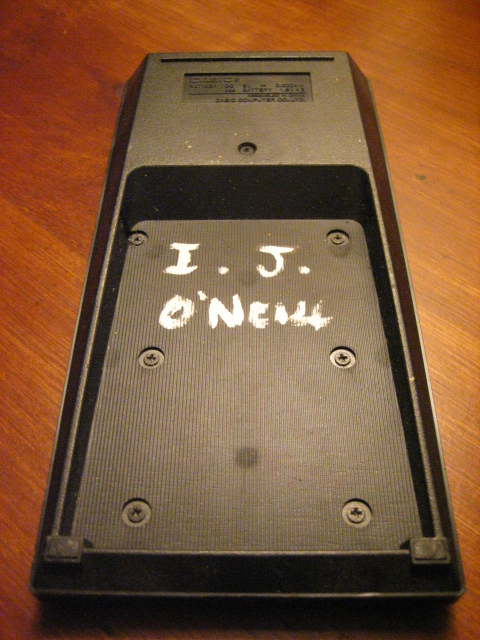
In my defence, the bulky “graphical” calculators that were popping up in school pencil cases that my classmates were using had functions that could automatically abbreviate the exponential number into a unit. So I didn’t feel so bad scoring a mini conversion chart into the aluminium casing with my compass in the front of the calculator. To this day, you can read:

m-3 μ-6 η-9 ρ-12 f-15

She even has her rear tattooed with my name. Dedicated.

It almost looks like mini hieroglyphics. In truth, I don’t think I ever had to use it in an exam situation, but at least I know it’s there, just in case.

All in all my Casio fx-82D FRACTION has been my constant, reassuring mass of two-decade-old microchips, printed circuit boards and basic liquid crystal display. She’s developed with my in my personal mathematical development and calculated everything from shopping lists to complex partial differential equations. She’s shared my voyage of calculating the density of pubs per person in my university town, to arriving at a solution for the final temperature state of my simulated quiescent coronal loops just before I handed in my PhD thesis for review.

If the last two decades are anything to go by, I wonder just how much longer I’ll be using this calculator. Is it the item I hand down to my grandkids? Or, like the Hubble Space Telescope, eventually need too much refurbishment to continue being of much use and then decommissioned?

Did I really just compare my Casio to Hubble?

Long may she continue being that one item I can’t live without, I take for granted and long may she continue to calculate equations no matter how complex or routine.

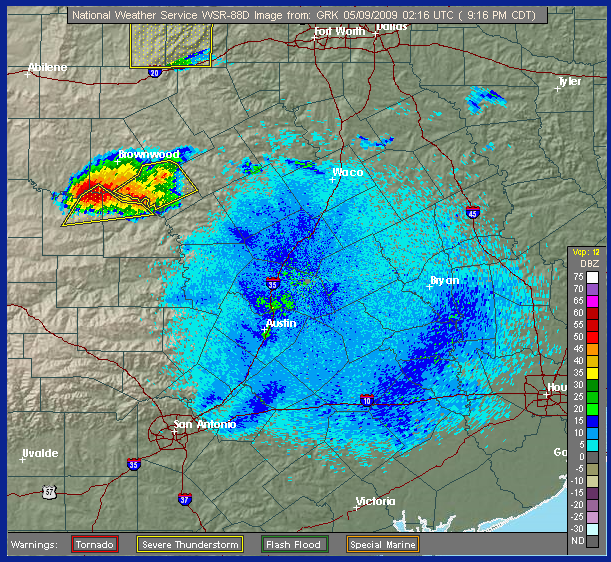
See that Red Splodge? That’s Where Captain Jack Is

jack_tornado

Captain Jack at Badlands Radio (formerly Paranormal Radio) has been evacuated from the WPRT studios in Central Texas as tornadoes are sweeping through the area. His show is being covered by me until he can return, so be sure to tune in to find out more!

Last thing I heard was that Jack was in Brownwood (in what appears to be some pretty terrible conditions, looking at the radar picture above), attempting to return to the studio…

Listen to Badlands Radio NOW »

UPDATE: After 5 hours on the air, I get news from Jack that he and Selene are doing fine and returning to the studios. Be sure to check out the Badlands Radio for Jack’s eyewitness account of the tornado that caused so many problems in Central Texas.

Astroengine Live Bonus Show, Today at 4pm PST/7pm EST

You may have noticed I’ve been a little quiet on the airwaves these last couple of weeks. This doesn’t mean all the space news of the world has slowed, or I’ve been any less active article writing, it’s just that life seems to happen during my regular Wednesday slot and I have to keep cancelling!

But not today, I’ll be on the air at 4pm PST/7pm EST for an extra special show, just before Captain Jack hits the mic in his brand new and shiny Badlands Radio (formally known as Paranormal Radio).

For more information about how you can listen in to today’s Astroengine Live, go to the Astroengine Live section of Astroengine.com »

Colbert: Entomologists Succeed Where NASA Failed, Introducing The Agaporomorphus Colberti

Agaporomorphus colberti, a diving beetle from Venezuela (Kelly Miller and Quentin Wheeler)

You remember last month’s fuss over a certain component of the International Space Station, don’t you? You know, the NASA node-naming competition that a certain US comedian managed to dominate, ultimately winning the popular vote to name the node after himself? Come on, you must remember? The vote that NASA ultimately decided wasn’t very suitable and went with “Tranquillity” instead? Ah yes, that competition!

Although Stephen Colbert, presenter and award-winning comedian on “The Colbert Report”, was denied having Node 3, NASA did recognise his efforts and named the brand new microgravity treadmill after him. The Combined Operational Load Bearing External Resistance Treadmill (or COLBERT), is not only to remember Stephen’s landslide public vote, it is also a marvel in acronym construction.

Although space scientists are not so keen on naming components of the space station after Colbert, zoologists don’t have the same concerns about naming something after a living person. Two entomologists, Quentin Wheeler at Arizona State University and Kelly Miller at the University of New Mexico, have named a Venezuelan diving beetle after him, the mighty Agaporomorphus colberti. This is in honour of Colbert’s 45th birthday on May 13th.

Although it is great to be named after a small creature that enjoys paddling in the depths of South American ponds, I wonder if it’s any match for being named after an orbiting running machine for astronauts? After reading the honours list in the beetle world, I think I’d still prefer to have the unique privilage of astronauts saying, “I’m off to the COLBERT to stave off any muscle wastage…”

The pair have named beetles to honor the late rock ‘n’ roll legend Roy Orbison and his widow Barbara (Orectochilus orbisonorum); for fictional “Star Wars” character Darth Vader (Agathidium vaderi); and for former President George W. Bush, former Vice President Dick Cheney, and former Secretary of Defense Donald Rumsfeld (Agathidium bushi, A. cheneyi and A. rumsfeldi).

Agathidium vaderi? No way! Can I get one as a pet?

Still, good for Wheeler and Kelly. They’ve drummed up some interest in diving beetles and created some popular media attention for their area of science.

What does this have to do with space? Not a lot, just thought Agaporomorphus colberti sounded cool.

Source: Physorg.com

Chances of the World Being Destroyed by the LHC is 50:50. Yes, Walter Wagner Is Back!

It’s one of those occasions when you’re not sure whether you should laugh… or hold back your giggling because you realise you’re witnessing some very well produced train-wreck TV.

Oh yes, it can mean only one thing, Walter Wagner is back! But this time, the media came prepared.

They made fun of him.

Yes, it was the Jon Stewart Show, and yes it was satire, but this time the joke was on the crackpot notion that the Large Hadron Collider (LHC) could actually cause harm to the world.

The subject of the LHC drove me insane last year (it also annoyed some very high profile physicists); it became almost impossible to report on the research CERN scientists were hoping to carry out, as every day Wagner (with his ‘lawsuit’ craziness) or Rossler (with his ‘infringement of human rights’ nonsense) would pop up, forcing any decent physics article into a defence of the LHC. Needless to say, this annoyed many physicists involved in the LHC, but excited media doomsday headlines into a frenzy of doomsday crackpottery.

Now, Wagner has been caught out and been made a fool of. Although I hate to see anyone in this situation, in this case, I think it is needed. Wagner only has himself to blame. He started these doomsday theories, now it’s up to mainstream comedy shows to debunk his authority on the subject.

Hold on, did he ever have an authority over physics? Oh yes, that’s right. No, he didn’t. He used the media as a tool to gain attention.

On the other hand, physicist Prof. John Ellis is an authority on physics… in fact, he’s the authority on LHC physics. I think I’d put my trust in an evil genius with a PhD and decades of experience, rather than the Caped Wagner Crusader any day.

For more on the subject, check out Ethan’s Starts With A Bang, he has more patience than me and delves into the subject a bit more »

Here’s more LHC goodness if you’re hungry for more »

Source: Gia via Twitter

Slow News Day: Alien Skull On Mars

PD*28522608

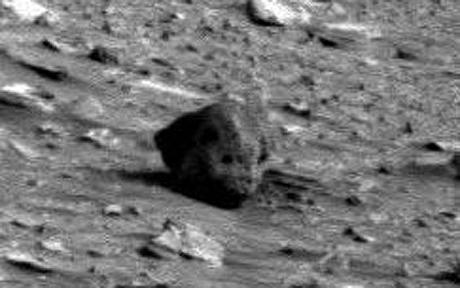
This just came in from the Telegraph, apparently Mars Exploration Rover Spirit has spotted a random skull on the Martian surface. This is obviously the only interpretation… as we know what an alien looks like, don’t we? Big head, big eyes, pasty grey skin. Something like this? Or, more likely, like this? Or this? Wow, it could be any one of them.

However, it’s not quite that exciting.

It’s a rock, as you may have already guessed. And no, the Telegraph isn’t taking it seriously either. (Although The Sun’s microreport could be taken either way.)

Although the newspaper’s article resembles a badly conditioned April Fools gag, there is one glaring error, well two actually. No, three.

Firstly, Spirit is not a camera – it’s a whole robot with a camera attached (called the Panoramic Camera, or Pancam for short). If it was just a camera, could you imagine the movie location costs?

Second, I’m not sure why this was filed in “Science News”. It obviously needs to be filed under “It’s a Slow News Day, We’ll Report Anything”.

And thirdly, I seriously doubt this image got “space-gazers talking”. When I last looked at one of Opportunity’s panoramic shots, I could see all kinds of strange things in the Mars dirt. If I was a conspiracy theorist, I’d love poking around the shapes and shadows, thinking I could see skulls, flying hubcaps and mysterious plant-like features. But I’m not a conspiracy theorist, I’m a “space-gazer”, but I’m not “talking”.

As it’s late, I’ve given up trying to find the source of the article (no links – come on Telegraph, if you’re gonna play blogging for the day, at least reference your lead!). Apparently some “UFO hunters” were being serious, but then joking, about this rock that looks like a skull. So, what the Telegraph is really trying to tell us is:

A stone. On Mars. Might look like a skull. Doesn’t really. Even ufologists don’t take it seriously. So it’s not really news. Move along.

I’m not suggesting the Telegraph isn’t a good newspaper, on the contrary, but really, what’s the point?

Why did I even bother to report on this? Oh yeah: It’s a stone that looks like a bunny skull. Now try explaining how a rabbit got up there…

Astroengine Featured on CNET

cnet

In an article written by Don Reisinger for CNET News, Astroengine.com was selected as one of the “18 cool sites and apps that teach you about space.”

This is awesome as one of my main effort on Astroengine is to not only promote space news, opinion, skepticism and logical thinking, I also hope the site serves as an educational medium, so readers can understand the science that hides beneath the headlines. “Outreach” is a lot more than a group of scientists trying to work out how best to promote their work to the world; it’s a way of communicating advanced scientific theories to an audience who don’t necessarily have a specialized knowledge of the subject matter. Even though I have an education in a small aspect of astrophysics, it is often hard to understand the next big discovery in cosmology (don’t get me started on quantum dynamics, that stuff is insane!), so the more explaining the better in my books.

Also, to add to the coolness, by virtue of alphabetical luck, Astroengine.com takes the #2 slot in the top 18 space websites. And to top the whole thing off, Don Reisinger’s article hit the front page of Digg.com this morning. Needless to say, Astroengine was busier than Grand Central Station on a Friday evening this afternoon (thank goodness I have a brand new server to deal with demand)!

Thank you Don, I really appreciate the mention and the really cool review!

For more, check out “18 cool sites and apps that teach you about space” on CNET.com »

A Hole In Arizona

©Stan Gaz

This picture was posted by Phil Plait and I was mesmerized. Stan Gaz, the photographer of Meteor Crater in Arizona, will be laying on an exhibition in New York from April 30th to June 6th. If this is anything to go by, it’s an event you can’t afford to miss out on… if you’re in or near New York that is. As I am quite literally on the other side of the country, I’ll miss it, but here’s more info if you are more fortunate.