For a rare glimpse into the inner workings of a conspiracy theorist’s brain, check out this hilarious explanation of the super-duper-hyper-speed-top-secret-military-drone that was captured in this video of an Iranian missile test on October 8th. There’s some spooky music added to the edited FOX News coverage to get you in the mood:
So do you see what the conspiracy is? Something really fast shot through the clouds just after Iran launched their Shahab-3 rocket. Obviously there is something weird about that, right?
“One theory is that it’s a secret American drone. At any time there are prototype aircraft and drones being operated that won’t be shown in public for years.
“Stealth aircraft flew for many years before their existence was acknowledged.
“But the speed and acceleration seems phenomenal. I’m not convinced we’ve got anything capable of such manoeuvres.”
Oh come on Nick, you can’t fool us! You know it’s not a classified military aircraft don’t you. In your expert opinion, you’re “not convinced we’ve got anything capable of such manoeuvres.” Don’t leave us hanging, just say it. We won’t judge you. Much.
Obviously leaning toward the extraterrestrial argument, Pope — who was once a UFO advisor to the British Ministry of Defence — appears to have numbed all the reasoning functions of his brain. He’s taken one look at the video footage — probably with an amazed look on his face, mouth open wide — and when asked by reporters what he saw, he responds with a smug look of knowing. There be aliens in them clouds.
As you might have guessed from the video, it’s certainly not a UFO. Hell, it’s not even a flying object. It’s a shadow. For observers in the space community who see rocket launches all the time, shadows of rocket smoke trails often fall on clouds. In the case of the Iranian missile launch (which, in actuality, is the real concern in this footage), the sunlight is coming from the right of the picture. As the missile passes through the altitude at which the Sun lines up with the cloud, a shadow dissects the cloud. It really is that simple. Any confusion about the altitude of the cloud is down to the angle of the camera view and the opacity of the cloud.
For his continuing UFO studies, I think Pope should be doing more research on how to recognize shadows rather than letting his imagination run rampant. However, it is interesting to see how the brain of a prominent ufologist works; zero skeptical thought, oodles of imagination and conspiracy theories behind every cloud.
An ad on Craigslist has just appeared: Astronaut Needed (Northern Alberta). Sign me up!
Oh, hold on…
“Astronaut needed for experimental flight to Titan. I have been working on this project now for near 40 years and am afraid I’m no longer fit enough to go. My secret space craft is the result of my professional experience and imagination while serving the U.S. military in advanced aeronautics as a scientist. The craft harnesses a revolutionary propulsion system and its fuselage is fabricated with the most advanced material. While considerably safe, I am certain you will make it safely to Titan but there will not be enough fuel to get home. This is for someone unique that has always wanted to see the universe first-hand and has perhaps a terminal view on life here at home. Here’s your shot at romantic history.” —Mad Rocket Scientist from Canada (emphasis added by me).
I was almost convinced I had a stab at flying to the Saturnian moon. What put me off? The fact that there won’t be enough fuel to get me back to Earth? Or was it the fact that I’m not stark raving mad? Nope, it turns out I’m too tall. “[The applicant] must be no taller than 5’10 and relatively slim.” Curses.
Thank goodness the spaceship is “…is largely cpu controlled,” I was getting worried that this ad was sounding a little too reckless…
In the early hours of Friday morning at 4:31am, the spent Centaur rocket from the NASA LCROSS mission slammed into the surface of the south pole of the moon. What was the point in that?
Well, NASA was hoping that the tumbling chunk of metal the size of a small bus would kick up a huge plume of dust. Following 4 minutes behind was the shepherding LCROSS spacecraft, also on a kamikaze dive, hoping to drop through the plume, sensitive instruments ready to analyse the dust for water.
I know what you’re thinking: what right does NASA have to BOMB the Moon? They have NO RIGHT AT ALL!!
It turns out that they are actually waging a top secret war against the population of peaceful extraterrestrials that live on the far side of the Moon. This “experiment” was in fact a reckless attack against a superior alien civilization, intended to strike fear into the hearts of the aliens.
If you were to believe the NASA promo video of the event, this should have been spectacular, vast quantities of lunar regolith blasting into space… it should have been akin to the biggest Fourth of July firework detonating. This “shock and awe” tactic is typical of the US space agency. The huge mass of the Centaur (a little under 2400kg), combined with its break-neck speed (1.5 miles per second) should have unleashed the equivalent energy of a tonne of TNT exploding. However, what NASA didn’t tell us was that Centaur was also carrying plutonium, so the explosion should have been a LOT bigger, easily visible to the naked eye.
But what did we see? Nothing. What did NASA see? Nothing. So what happened? Well, the answer to that is a little more compelling than what NASA is telling us.
Yes, they can show us images of a meagre “flash” as the Centaur hit inside a lunar crater, but I don’t think Centaur hit the Moon at all… the Centaur rocket was swallowed by the Moon.
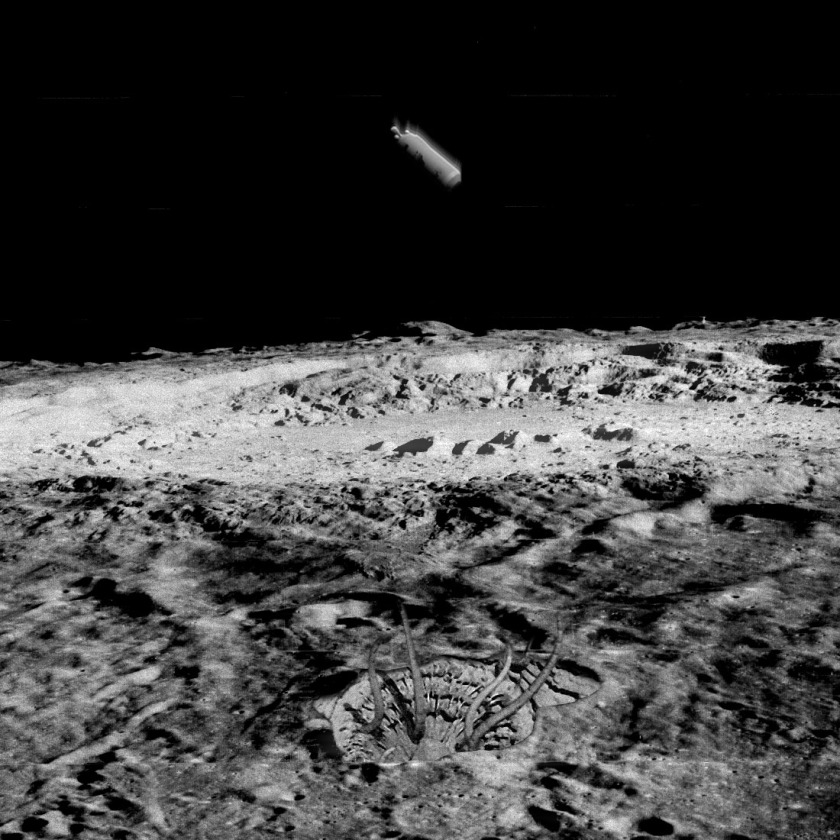
Don’t believe me? Moments before impact, NASA’s lunar satellite — the Lunar Reconnaissance Orbiter (LRO) — was approaching the location and it took this photo. What you see here will shock you. It will astound you. And what’s more, it’s REAL.
Aliens DO live on the Moon, and they were prepared for the NASA bombing…
</conspiracy mode>
I’m sorry, I couldn’t resist. In the run-up to the LCROSS impact, the sheer amount of crazy conspiracy theories hit fever-pitch (I blogged about it on Space Disco 2 hours before impact). Some of my favourite theories involved alien civilizations on the lunar surface, plutonium on LCROSS (to destroy the Moon), the “fact” that it was all just a publicity stunt and the LCROSS mission didn’t exist at all… and the strange theory that the Moon feels pain.
Yawn.
A polite message to the conspiracy theorists: Come on people, stop making stuff up and understand the real science. You might find reality more interesting than your twisted fantasies.
I’ve been pondering a word that could describe today.
I drew a blank.
It’s a very hard day to sum up in one word. In fact, this entire week has been something of a unique one. From a space point of view, it’s been busy, largely due to the endless supply of space science research spewing from the American Astronomical Society’s Division of Planetary Sciences meeting in Puerto Rico.
However, last night (and early this morning) is what topped it all off. The NASA LCROSS mission slammed into the lunar south pole at 4:31am (PDT) and I was there tweeting away, keeping abreast of all the juicy LCROSS news. That was until Time Warner Cable decided to pull the plug on my internet connection 10 minutes before the main event (I’m certain they did it deliberately, it’s the only explanation). Panic-stricken — and really peeved that I’d spent the whole night excited to see the glorious end to this Moon mission, only to be foiled by my ISP — I checked the TV, and it was working, plus a local channel was covering the event. Phew.
Anyway, on waking up this morning, I was shocked to find my inbox was stuffed full of Twitter follow messages and notes of congratulations from my team at Discovery News. CNN had picked me, with four heavy-hitters on Twitter as their #FollowFriday. But it wasn’t an ordinary #FollowFriday, the guys at CNN Technology posted this #FollowFriday on their site!
Editor’s note: In this new weekly feature, we highlight five recommended Twitter feeds about a hot topic in the news. Today’s list focuses on space-related tweets and NASA’s plan to crash two spacecraft on the moon Friday in a search for water in lunar soil. —CNN Tech
So despite my internet woes, CNN had chosen me (@astroengine) with @BadAstronomer, @Astro_Mike, @LCROSS_NASA and @NASA_AMES. So I was in the company of an entire NASA facility (Ames), a NASA mission that had just hours before slammed into the Moon (LCROSS), the first astronaut to tweet from space (Mike Massimino) and the one, and only, Phil “The Bad Astronomer” Plait.
Wow.
They also added this very flattering description of @astroengine:
4. astroengine — Astroengine is the Twitter name of Ian O’Neill, a British-born physicist with a long resume and a healthy sense of humor. It’s also the name of his blog, which gathers articles and posts on such light-reading topics as quantum mechanics, solar physics, relativity, cosmology, space flight science and “some of the more bizarre theories that drive our universe.”
Number of followers: more than 1,700
Sample tweet: “Europa, Jupiter’s Moon, Could Support Complex Life http://bit.ly/3n6iKL (I, for one, welcome our alien Jellyfish Overlords)”
So, I’d like to take this opportunity to say “hello” to my hundreds of new followers!
And did I think of a word that describes today? Actually, I think I just did:
In agreement with Phil Plait, this video made me smile too. A lot.
President Obama (now a Nobel Peace Prize recipient) hosted an astronomical party on the White House lawn on October 7th for an audience of 150 middle school students from the Washington area and some guests of honour (including Charlie Bolden, NASA Administrator and Buzz Aldrin, Apollo legend). It looked like a really exciting event for all the school kids involved.
This was my favourite bit:
“So, there are a lot of mysteries left, and there are a lot of problems for you students to solve, and I want to be a president who makes sure you have the teachers and the tools that you need to solve them. That’s why we’re working to reinvigorate math and science in your schools and attract new and qualified science teachers in your classrooms, some with lifetimes of experience […] That’s how we’ll move American students to the top of the pack in math and in science over the next decade to guarantee that America will lead the world in discovery in this new century.” –President Barack Obama, Oct. 3rd.
Was there ever an astronomy party on the White House lawn during the previous administration?
Back in 2006, I remember sitting in my local UK Job Centre finding out how I could claim for unemployment benefits.
I can see it now, the moment I explained to my liaison officer that I had been looking for work but received little interest. She looked at me and said, candidly, “Have you thought about not mentioning you have a PhD? It might help.” She smiled.
What? I now need to hide my qualifications if I want to get a job? Isn’t that a little counter-intuitive? Actually, as it turned out, she was right. Many of the jobs I had applied for didn’t require a postdoc to do them; why would a company hire me when they can hire a younger postgrad with lower salary expectations?
Up until that moment, I was still hopeful that I might be able to land an academic position; possibly back in my coronal physics roots, but funding was tight, and I hadn’t done enough networking during my PhD to find a position (I had been too busy scoping out the parties and free booze at the conference dinners).
So there I was, with all the qualifications in the world with no career prospects and a liaison officer who deemed it necessary to advise me to forget the last four years of my academic career. It was a low point in my life, especially as only a few months earlier I had been enjoying one of the highest points in my life: graduating as a doctor in Solar Physics.
Fortunately for me, I had another option. My girlfriend (now lovely wife) was living in the US, and although searching for a job in the UK was a priority for us (we were planning on living in the UK at the time), I knew I could try my luck in the US as well. So after a few months of searching, I cancelled my Job Centre subscription and moved to the other side of the Atlantic.
I had just become a part of the UK’s “brain drain” statistic. I had qualifications, but I was in a weird grey area where companies thought I was over-qualified and funds were in short supply for me to return to academic research.
A lot has happened since those uncertain postdoc times, and although I tried (and failed) to pick up my academic career in solar physics in the US (it turns out that even the sunny state of California suffers from a lack of solar physics funding), the job climate was different. Suddenly, having a PhD was a good thing and the world was my oyster again.
To cut a long story short, I’m happily married, we own five rabbits (don’t ask), we live just north or Los Angeles and I have a dream job with Discovery Channel, as a space producer for Discovery News.
Although I’d like to think that if I was currently living in the UK, I might have landed an equivalent career, I somehow doubt I would be as happy as I am right now with how my academic qualifications helped me get to where I am today.
Why am I bringing this up now? Having just read about Stephen Hawking stepping down as Lucasian professor of Mathematics at Cambridge University and the Guardian’s report about the risk of losing British thinkers overseas, I wonder if employment opportunities have improved since 2006. What’s most worrying is that there appears to be this emphasis on making money as quickly as possible, rather than pursuing academic subjects. However, in my experience, having a PhD doesn’t mean you can even land a job in industry, you might be over-qualified.
“Giving up on that tradition of deep intellectual discovery in favour of immediate economic benefit is a huge mistake. You lose the gem of creative, insightful, long-term thinking. That is what Britain has done so spectacularly in the past, and to give that up is a tragedy.” —Neil Turok
As scheduled, the extra-special 2012 teaser trailer appeared on the TV. Mildly excited, I flicked between the channels in the hope of catching a glimpse of what lies in store for November cinema screens. I tried to keep up the typing in real time… alas, it was too hard, the doom was moving too fast for my fingers, but this is what I remember…
We start off with John Cusack’s panic-stricken face warning his family on the phone while driving a stretch limo (stretch limo?) through LA streets, “When they tell you not to panic, that’s when you RUN!!!” Poetry.
Then a scene that can only be described as hilarioussillygratuitousinsane the most over-powering CGI I have ever had the pleasure of seeing.
It was basically the Planes, Trains and Automobiles version of doomsday. Just without the trains. Add a crying child.
High-speed car sequences, palm trees snapping, ground cracking, houses folding… ooh look out for the obligatory exploding petrol tanker!!!! [extra !!! for effect] Then, buildings fall to the ground, people dying everywhere… but Cusack, plus brood, fly through the surprisingly uncongested LA streets at hyperspeed! Oh crap! Look out for the– PHEW! The car jumped through (jumped through!!) a disintegrating building (disintegrating building!!!), popping out the other end unscathed.
There’s more!
The Huge Massive CrackTM advances through California, with Cusack and co.’s car always in front of the impending doom that’s unfolding behind them.
Oh! There’s a plane! We’re now on an airfield… it’s okay, the family have an escape route! They fly off, Huge Massive CrackTM ripping through the asphalt as the pilot accelerates into the air. Buildings crashing down, toppling sideways (sideways!!!), crying child looks out the window, people are being squashed by cars down there!! That’s not for young eyes goddammit! They keep flying– NOOO!! More collapsing buildings!! Fly under them!!! YESSS!!! That pilot just flew UNDER a sideways collapsing building. Los Angeles is toast, looks more like the Grand Canyon than a city.
I’m tired… that was intense. Totally silly, too. Did it make me want to see the movie more? Not really, looks like it’s going to be very basic disaster pr0n, as predicted, with a very loose plot. Ah well.
Disclaimer: This in no way, shape or form indicates that I now think something is going to happen in 2012. All of the above is based on a trailer for a movie. A movie people! The theories about doomsday in 2012 are still nonsense. If you don’t believe me, have a read.
In a discussion I seem to keep having these days when I mention that human spaceflight is actually a valuable endeavour for a nation, I’m usually met with a look of incongruity. Then the question: What has space exploration ever done for us?
I used to get a little angry about this question (of course space exploration is important!) but in actuality, I have to explain the answer because it isn’t necessarily obvious. By pushing into space, a nation can enrich its technology, improve education, boost employment in skilled areas, thereby improving the economy and generally improving a nation’s standing in the world. That’s the eco-friendly version. There are other applications such as military prowess, strategic advantage and business potential. Unfortunately, doing bold things in space requires money, and to get money you need to convince the government that it’s worth spending money on. Last time I looked, there’s no Space Race 2 going on, so we can’t rely on politics to see the necessity of space flight.
However, the US has invested billions of dollars in the exploration of space, and although NASA is a money-hungry entity, it produces results and has shaped the world as we know it. Granted, the US space agency was built on Cold War ideals and was hinged around the sole purpose of beating the Soviets to the Moon, but modern NASA is still relevant, if not more so.
Rockets and healthcare
From space, and back to Earth with a bump.
I watched a series of fascinating videos of the protests that went on in Washington D.C. on September 12th concerning President Obama’s healthcare reform plans. The Tea Party (not Twinnings, or Boston… some other tea party that didn’t have a lot of tea) exploded to life to the sound of tens of thousands of voices protesting “socialist” healthcare. Apparently, a nationalized healthcare system is a bad thing. The arguments against Obama’s plan seem rather outlandish to me, and a hardcore group of protesters (not all the protesters, just a few apparently missing a sanity gene) accused the US President of being a “communist,” “socialist,” “Marxist” and (most shockingly) a “Nazi.”
So, here we are, with a field-full of rabid protesters that have been whipped up into a frenzy by the media, special interest groups and political antagonizers. These geniuses see a nationalized healthcare system as a socialist agenda. Of course, this means communism is just down the garden path. Last time I looked, the UK wasn’t a communist state, and although the British National Health Service (NHS) isn’t perfect, it’s a damn sight better than the US health insurance insanity.
The point I’m trying to make is that tens of thousands of people descended on the US capital to protest a healthcare bill that actually seems quite sensible. Unfortunately, this huge group believe this bill is actually a government conspiracy intended to dupe the public, bankrupt the country and control the nation.
NASA losses
Now let’s wind back the clock to last year, when it was announced NASA would be shedding thousands of jobs when the space shuttle is retired. More recently, a task group was formed to discuss NASA’s options considering its budget isn’t going to grow any time soon — unfortunately, Bush’s “Vision for Space Exploration” can’t be done because the Constellation Program will cost too much. Now the Augustine Commission has set out some plans that may curtail NASA’s big projects, possibly even cancelling Constellation.
To top all this off, there is a 5-year gap (minimum) between the shuttle being retired and Constellation taking over (if that even happens), that means there will be at least 5 years the US will have without a manned launch vehicle. Yes, the US has gone through this before (between the end of the Apollo Program in 1970 and the Shuttle Program in 1982), but this time we could lose access to the space station, a $100 billion project the US is heavily invested in.
Fortunately, US companies are seeing business opportunities in space, so given enough funding, start-ups like SpaceX could start ferrying NASA astronauts into LEO sooner rather than later. There are also other nations involved in the space station and they can give us a lift into space. Unfortunately, apart from the Shuttle, there’s only one other spacecraft that’s human-rated in the world. That’s Soyuz.
Russian Roulette
Soyuz is great, it’s a sturdy vehicle and it’s received little complaint from the astronauts and cosmonauts that have been ferried around in it (well, most of the time). The Russian space agency will basically be offering NASA taxi rides into space so the US can still use the International Space Station.
The cost? $50 million per seat.
Wow, what a bargain. The space shuttle costs the best part of a billion dollars to launch every time. Compare that with $50 million, it almost seems as if this 5-year gap is a good thing. It might save NASA some money!
However, in the process of retiring the shuttle, skilled US jobs will be lost. Even the transition from the shuttle program to Constellation will cause a re-shuffle of NASA employees. Last year, Senator Bill Nelson pointed out that shedding jobs from the US space agency, only to rely on a Russian launch vehicle, will have the effect of generating jobs in Russia. This might seem like an over-exaggeration, but it may indirectly be the case.
The added concern is that the $50 million value per Soyuz seat could increase. After all, US-Russia relations aren’t exactly toasty, the Russian space agency could set its own price for taxi rides to the space station. NASA money will be spent, not on advancing US spaceflight capabilities, but on another nation’s spaceflight capabilities. Sure, NASA and Roscosmos are co-operating now, but both are government-backed entities and that co-operation could turn south during the next East-West political upset.
Conclusion
In summary, until US spaceflight companies develop human-rated space vehicles, or until the Constellation Project (or equivalent) is finished, the US will be wholly dependent on Russia for human spaceflight. NASA will be paying a premium rate for that privilege.
So when I see thousands of individuals crowding on Capitol Hill, angrily protesting about the idiotic belief that the President of the USA is on the verge of creating a communist state, I think about NASA and the fact that the US space agency has been forced to pay for seats on board a spaceship maintained by an ex-communist state the US government is having problems with.
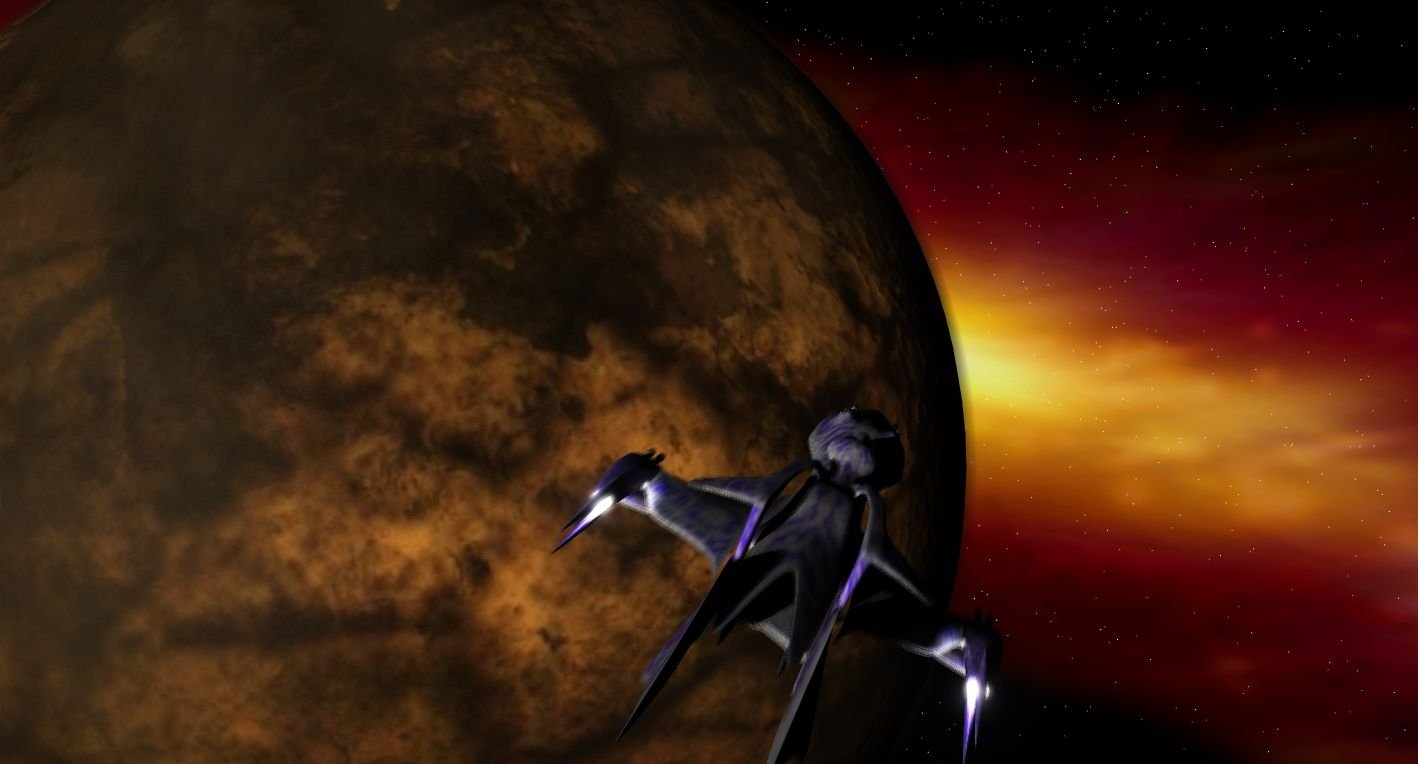
The White Star approaches the Shadow’s homeworld of Z’ha’dum on the Galactic Rim.
It would appear that scientists have confirmed that the outer edge of the Milky Way is a bad location for life to even think about existing.
This research reminded me of the “Galactic Rim” in the 90’s sci-fi TV series Babylon 5. The Rim is the mysterious region of space right at the edge of our galaxy where only the hardiest of explorers dared to venture. As explained in the season 2 episode of B5, “In the Shadow of Z’ha’dum,” Captain Sheridan (Bruce Boxleitner) discovers that his wife (when exploring The Rim) went missing on a planet called Z’ha’dum. It turns out that an angry ancient alien race — called the Shadows — lived on this mysterious world and their discovery led to them being used in all kinds of plots during the latter four seasons of this awesome sci-fi show.
However, the existence of any kind of life (let alone life as complex as the evil Shadows) in the badlands of the Milky Way is looking very unlikely.
Located some 62,000 light years from the core of our galaxy (over twice the distance of the Earth from the galactic centre), two very young star clusters in the constellation of Cassiopeia have been studied. Chikako Yasui, Naoto Kobayashi and colleagues at the University of Tokyo, Japan, found these clusters in a vast cloud of gas and dust called Digel Cloud 2. The stars inside these clusters are only half a million years old, and the majority of them should possess proto-planetary disks (which is characteristic of local star-forming regions). However, it would appear that these stars contain very little oxygen, silicon or iron (i.e. they have very low metallicity) and only 1 in 5 of the 111 baby stars analysed in both clusters have disks.
If proto-planetary disks are rare, this means there will be a rarity of planets. This is an obvious bummer for life to form. After all, Life As We Know It™ is quite attached to evolving on Earth-like planets.
So why are these young stars lacking proto-planetary disks, when local star forming regions don’t seem to have this affliction? The authors of the paper, soon to be published in the Astrophysical Journal, suggest that these stars did have disks, but some mechanism is rapidly eroding them.
The most likely scenario is that low metalicity proto-planetary disks are more susceptible to photoevaporation. Simply put, these disks evaporate when exposed to EUV and X-ray radiation from their parent stars far more rapidly than disks that are metal-rich.
Therefore, if an alien race was able to form, they’d be very rare or they’d be very different from what we’d expect “life” to be like (i.e. they thrive in low metalicity star systems). Sounds like the mysterious Shadow homeworld of Z’ha’dum would be a very rare sight on The Rim of our Milky Way after all.
Oh dear. Just when I was actually beginning to care about the cast of Defying Gravity, it was cancelled half-way through the first season. I was a little annoyed about this as #DefyingGravity on Twitter was fast becoming a weekly ritual; a group of us die-hard sci-fi viewers scoffing at the science atrocities the ABC show was inflicting on us. In fact, the bad science, when coupled with a spaceship full of horny crew mates (a.k.a. friends with benefits… why not?) almost made it compelling viewing (almost).
Apart from hammering home the inevitability of astronauts having sex in space, I almost stood up and cheered when, in the last episode (called “Love, Honor, Obey“), the cast did a great job at explaining the quantum physics thought experiment, Schrödinger’s cat. As the crew was stuck inside a shielded compartment to protect themselves against an impending solar flare (it turned out to be a false alarm), mission control had no way to communicate with the crew. Steve Wassenfelder, the out-of-shape physicist, likened the crew to Schrödinger’s cat; to mission control, as they had no way of knowing whether they were alive or dead, the crew were in fact alive and dead. Clever.
The show also handled the solar flare event pretty well, although they avoided a lot of the details (but kept it within the realms of possibility, as opposed to some movies I won’t mention).
Then, after some fractal tomato plants (I didn’t say all the science was kosher), the crew opened mysterious Pod 4 to see…
…I don’t know what they saw as that was the cliff-hanger of the last episode. I’m sure I’ll end up watching it on Hulu.com, but I don’t think it will be the same without mocking it live on Twitter with the #DefyingGravity contributors (you know who you are).
Then, as quickly as Defying Gravity dropped off our screens, another compelling sci-fi series appears on ABC featuring a competent-looking cast (led by Joseph Fiennes and John Cho). It’s called FlashForward, and after only the first episode, I’m hooked. It’s actually the same feeling I had when I watched the very first episode of Heroes.
In FlashForward, we start off in Los Angeles, looking into several people’s lives, when suddenly the entire planet blacks out for 2mins 17seconds. During that time, everyone has a vision of 6 months into the future.
The series is based on the 1999 novel Flashforward by Canadian science fiction writer Robert J. Sawyer, and the premise is pure sci-fi joy. In fact, I was lucky enough to be sent a behind the scenes video by Times.com science comedian Brian Malow (be warned, there’s a fairly huge spoiler, but it’s an awesome spoiler that will get you nodding with joy… but you’ve been warned):
Robert J. Sawyer calls himself a “hard science fiction writer,” so it will be very interesting to see how the show deals with the speculative quantum-conciousness link. Still, it has to be better than that silly mag grav idea in Defying Gravity.
In other news: The lovely Eliza Dushku will live-tweet during the season 2 premier of Dollhouse (on FOX) if she gathers 100,000 Twitter followers before it airs… in 20 minutes on the West Coast. She’s only on about 92,000 at the moment, so it’s not looking likely. Still, I’ll be watching!






 astroengine.com