The Case of the Supermassive Black Hole, the Infrared Object and Perceived Accuracy of Science

There is a trend in astronomical observations to label strange and exotic objects with superlative names. Take “supermassive” black holes for instance. Yes they are more massive than intermediate black holes, bigger than stellar black holes, and in a whole different league to theoretical micro-black holes. But is the label “supermassive” an accurate description? Is it even scientific?

After reading a very interesting article written by Michael Gmirkin on “Incorrect Assumptions in Astrophysics“, I began to relate his investigation into the use of terms to describe astronomical phenomena with very expressive names. Terms like “super-massive”, “ultra-luminous”, and “beyond-bright” are mentioned by Gmirkin, perhaps leading astronomers to incorrect conclusions. Whilst this may be perceived as an issue amongst scientists, what if the media or non-specialist individuals misinterpret the meaning of these grand statements? Could it lead to public misunderstanding of the science, possibly even causing worry when a scientist describes a particle accelerator collision as “recreating the conditions of the Big Bang”?
Continue reading “The Case of the Supermassive Black Hole, the Infrared Object and Perceived Accuracy of Science”

The Crab Pulsar is Probed By LIGO. Is it Really a Smooth Neutron Star?

The Crab Nebula contains the famous Crab Pulsar (NASA/JPL-Caltech/R. Gehrz)

Scientists working with the Laser Interferometer Gravitational-Wave Observatory (LIGO) have announced their first land-mark discovery. LIGO was built to detect gravitational waves (as predicted by Einstein’s general relativity), but this discovery is actually about not detecting gravitational waves. Hold on, what’s all the fuss about then? This sounds like a null result, and in some ways it is. But on the other hand it may be one of the most important neutron star observations ever. So what has LIGO (not) seen?
Continue reading “The Crab Pulsar is Probed By LIGO. Is it Really a Smooth Neutron Star?”

Collapsing Wolf-Rayet Stars and Inverse Compton Scattering of Stellar Photons

A Wolf-Rayet star WR124 with surrounding nebula M1-67 (NASA)

Wolf-Rayet stars are a violent and self-destructive phase of a massive star’s lifetime. This is the point at which they begin to die as a prelude to a supernova and black hole formation. Often, large nebulae can be found around these bright stellar objects (pictured), emitting strong ultraviolet radiation. As Wolf-Rayet (WR) stars continue to lose huge amounts of mass and deplete all their fuel, they become even more unstable, resulting in a huge supernova. Exploding WR stars have been linked with powerful gamma ray (γ-ray) bursts; in fact the largest, most distant GRB was observed on March 19th in the constellation of Boötes by NASA’s Swift Observatory and the Polish “Pie of the Sky” GRB detector. There is some evidence that this GRB was the result of a WR star/neutron star binary pair, but what would happen if a WR star is sitting close to an O-type star just as it explodes?

As the WR star collapses, a shock wave (containing hot, relativistic electrons) sent hurtling toward the O-type star may cause inverse Compton scattering of the stellar photon field, generating powerful, long period emissions of γ-ray radiation. New research suggests that this mechanism may explain the 1-100 GeV γ-rays observed minutes or hours after the main GRB…
Continue reading “Collapsing Wolf-Rayet Stars and Inverse Compton Scattering of Stellar Photons”

Dynamic Coronal Loops as seen by STEREO (Video)

The STEREO (Behind) view of three loop systems moving into view (NASA)
What with all the surprise activity of the Sun at solar minimum of late, I’ve found myself looking around the solar observation sites an awful lot more than I used to. During all the commotion back in 2003 when the Sun was blasting out record breaking X-ray flares one after another, I really didn’t think I could be surprised with anything else the Sun would do. That was until, very much unannounced, three sunspots rotated into view, blasting another X-ray flare into space… at solar minimum. The strange thing was, that these sunspots weren’t even from this solar cycle, they were from the previous one that ended some time around December 2007! And now we get a stunning, detailed view of more unexpected solar activity from the Solar Terrestrial Relations Observatory (STEREO), a hi-res video of dynamic coronal loops…
Continue reading “Dynamic Coronal Loops as seen by STEREO (Video)”

Solar Flare, CME and Tsunami Generated by a “Blank Sun”

The empty solar disk on April 27th - still generated an X-ray flare (SOHO)

Even during solar minimum, the Sun can be surprisingly dynamic. We are currently observing a sunspot-less solar disk, but on Saturday the Solar and Heliospheric Observatory (SOHO) observed a noteworthy X-ray flare. It was a B3.8 flare, producing a coronal mass ejection (CME), sending vast quantities of hot plasma into interplanetary space. Admittedly, it is strange to witness CMEs of this size at this time in the solar cycle, but what is even weirder is that the flare was produced by a region devoid of sunspot activity (see image). SOHO captured the CME event with its LASCO instrument and the two-probe Solar Terrestrial Relations Observatory (STEREO) captured an incredible “solar tsunami” (or Sun Quake) as the flare caused the Sun’s surface to ripple. And all this without an intense magnetic field and sunspot pair…
Continue reading “Solar Flare, CME and Tsunami Generated by a “Blank Sun””

Supermassive Black Hole Flare Lights Up Mysterious Molecular Torus

Artists impression of a light echo from the surrounding torus of a supermassive black hole (Max Planck Institute)

Theoretically, supermassive black holes that occupy the centre of galaxies (including our own) are surrounded by a vast cloud of gas. Depending on the angle you are viewing this molecular torus will obscure the supermassive black hole’s bright accretion disk. Until now, this vast doughnut of matter has never been observed, but with the help of the supermassive black hole accretion disk and a dying star, there’s a possibility that the molecular torus will not only be observed, but also mapped…
Continue reading “Supermassive Black Hole Flare Lights Up Mysterious Molecular Torus”

The Sinister Side of the Cosmos: Killer Galaxies, Cosmic Forensic Science and Deadly Radiation

The ghost of a dead dwarf galaxy hangs around the killer, spiral galaxy (R. Jay Gabany)

It’s been a busy day with a range of topics posted on the Universe Today, but all have a common thread: the universe is a deadly place for man and galaxy. For starters, research into the radiation mankind will face when settling on Mars and the Moon could prove to be one of our main challenges in space. The threat of a massive dose of radiation from a solar flare is bad enough, but the gradual damage to our cells and increased risk of cancer is a problem we need to solve, or at least manage. But that’s nothing compared with what dwarf galaxies have to put up with; their larger spiral cousins like to eat them for dinner, leaving behind galactic ghosts of the dwarfs that were…
Continue reading “The Sinister Side of the Cosmos: Killer Galaxies, Cosmic Forensic Science and Deadly Radiation”

LHC Worries are Based on Fear of the Unknown, not Science

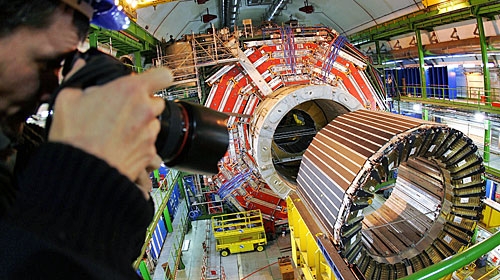
The construction of the LHC is nearing completion, exciting or worrying? (AP)

I’ve heard some crazy talk in my time, but the fear surrounding the Large Hadron Collider (LHC) at CERN has really surprised me. On writing a story last month that a guy in Hawaii (with a scant background in physics) was trying to pass a lawsuit to put a stop to the construction of the LHC, I realised the pressures physicists at the cutting edge of science are under. Physicists the world over have defended the science behind the LHC, and although some of the products from high energy particle collisions are as yet unknown, there is an infinitesimal chance that a black hole will swallow Earth… (I actually want a black hole to be created, the scientific implications will be revolutionary.)
Continue reading “LHC Worries are Based on Fear of the Unknown, not Science”

How Big is the Biggest Star in the Universe?

A comparison between the Sun and a hypermassive star. Credit: NASA

So how big is it? According to Fraser at the Universe Today, the largest known star is VY Canis Majoris. This is a massive star, otherwise known as a red hypergiant star and this one sits in the constellation Canis Major, about 5000 light years from Earth. Apparently it is more than 2100 times the size of our Sun, a monster! This star is so big that light takes more than eight hours to cross its circumference. In fact, this star, if placed in the centre of the Solar System, it would reach as far as the orbit of Saturn.

Although VY Canis Majoris is big, it isn’t as big as the biggest star could be. If it was cooler, a similar star could reach over 2600 times the size of our Sun…

Could a Wolf-Rayet Star Generate a Gamma Ray Burst?

Gamma ray bursts (GRBs) are the most energetic events to be seen in the observable universe. On March 19th, a record breaking GRB was observed in the constellation of Boötes by NASA’s Swift Observatory and ground based telescope arrays (i.e. the Polish “Pie of the Sky” GRB detector). This was an explosion unparalleled with anything we have ever seen. Not only was it the brightest GRB, it was the most distant GRB – this explosion occurred 7.5 billion years ago (it was therefore located 7.5 billion light years away). Taking measurements of the spectrum of light from these events not only helps us understand what causes such a massive detonation, but also reveals the nature of the Universe when it was half the age it is now.

In a new publication headed by the University of Utrecht, in The Netherlands, the highly dynamic and self-destructive Wolf-Rayet star has been singled out as a possible GRB progenitor after some complex tidal interactions with a binary partner, spinning-up the star until it collapses and unleashes vast amounts of energy into space…
Continue reading “Could a Wolf-Rayet Star Generate a Gamma Ray Burst?”