Life on Mars? Only in The Sun.

In its haste to become the first newspaper to print the “NASA: Evidence of Life on Mars” headline, the UK’s Sun website caused a stir last week. Not only was this headline incorrect, it was a wee bit irresponsible.

For starters, no evidence for life has been found on the Red Planet. Second, NASA has not proclaimed such a discovery. In fact, The Sun riled the U.S. space agency so much, this headline prompted NASA spokesman Dwayne Brown to issue the following statement:

“This headline is extremely misleading. This makes it sound like we announced that we found life on Mars, and that is absolutely, positively false.”

So where did it all go so wrong?

This story stems from an astrobiology conference celebrating the 50th anniversary of the search for alien life. At this conference, findings by NASA’s Mars Exploration Rover Opportunity were reviewed. One of these findings was the tantalizing discovery of sulfates by the rover in 2004. Where there’s sulfates, water once existed. Where there’s water, life might have existed.

In an exciting twist to this discovery, scientists studying sulfate deposits on Earth (known as gypsum) were asked by scientists in the Mars Program to investigate terrestrial gypsum deposits more closely. Up until now, it was thought that gypsum contained no fossils, but on closer inspection it turns out that ancient gypsum deposits from the Mediterranean Sea (dated to about 6 million years old — when the sea was actually dry) are stuffed full of microscopic fossils of algae and phytoplanktons.

So, on Mars we have sulfates. On Earth we have sulfates (gypsum) full of fossils of aquatic microscopic life. If we know the terrestrial deposits of gypsum contain fossils of basic life forms, perhaps sulfate deposits on Mars would be a good place to start looking for basic ancient extraterrestrial life.

Of course, for the tabloid newspaper, these Martian sulfate deposits became “pond scum” and therefore “evidence” for life on Mars.

In actuality, the text of The Sun article wasn’t that misleading and actually did a good job of reporting the science (apart from the “pond scum” bit). Unfortunately, the title of the article let the rest of the article down, ultimately undermining the journalists’ work.

But, coming from the same publication that printed the silly “Pictures show life on Mars” article from 2008, the “Evidence for life on Mars” headline is pretty tame.

Now, time for the same news with a more appropriate headline by Irene Klotz on Discovery News: “Earth Fossil Find May Lead to Martian Discoveries

Thanks to Astroengine.com reader Judy Mason for inspiring this post.

Mars Rover Spirit Becomes “Mars Base Spirit”

Sorry Spirit, you're not coming home (see the full xkcd comic strip).

As far as space missions go, you couldn’t find a better epic tale than that of Mars Expedition Rover Spirit. Designed to last 3 months, roved for six years; lost the use of a wheel, turned it into a nifty trench-digging tool; nearly died, came back to life; had memory problems, shrugged them off… the list could go on for ever. However, it’s now official, this is one challenge the little wheeled warrior couldn’t beat; she’s stuck in the sand and there’s nowhere to go.

Mars Rover Spirit is now “Mars Base Spirit.”

Naturally when NASA broke the news that Spirit was going to remain stuck in a hole in Gusev crater for the rest of her days, we weren’t surprised, but everyone was sad. That little robot has captivated the world with all her escapades, and although she’s a machine, we’ve all personified Spirit. She’s the little rover that could.

And she‘s a girl, obviously.

But wait! Spirit is not dead quite yet. Spirit will hopefully become a stationary science probe if she makes it through winter (but that’s a big “if”). Once the Sun dips closer to the horizon during the winter months, less sunlight will hit the rover’s solar panels. Depending on how much energy Spirit has in reserves and how much dust coats the panels (making them less efficient at collecting the dwindling light), we could be looking at the end of the mission all together. Assuming she makes it through till spring, it’s conceivable that Spirit can be used as a weather outpost and, intriguingly, a tracking beacon to measure Mars’ wobble. The tiny wobble could lead scientists to understand the interior of the planet.

“We think we can actually determine whether the core of Mars is liquid or molten,” said Cornell University’s Steve Squyres, the lead scientist of the Mars rover program. “There’s compelling evidence that Mars once had a pretty powerful internally generated magnetic field and that probably required a core of iron that was liquid.”

If Spirit can make it through the winter and help NASA understand the interior of Mars, that would be the icing on the cake. Although Spirit may not be dominating the surface of Mars like her sister rover Opportunity (who’s notched up over 12 km so far and still going strong), perhaps she can dominate the interior of Mars by remaining stationary in the sand.

Spirit Suffers Another Bout of Amnesia. Spirit Suffers Another Bout of Amnesia.

"Oh, that's a nice view, I hadn't noticed that hill before. Hey, that's a pretty-looking rock!"

NASA’s Mars Exploration Rover Spirit is suffering from amnesia, again.

This is hardly surprising if we consider that the lifespan of Spirit should have been 3 months, the fact that it has lasted 69 months (so far) is nothing short of miraculous. In rover-mission-lifetime years, doesn’t that make Spirit and her twin sister Opportunity 1380 years old? (I decided that a “lifetime” is 60 years, in case you were wondering.) Perhaps that’s not how it works, but for NASA to build a robot that has lived 23 times longer than the mission specified is pretty damn impressive. No wonder Spirit is losing her memory. I’m surprised she hasn’t lost the will to live.

Spirit has lost the use of one of her wheels and remains stuck in the sand… so she is showing her age. But still, 23× longer than planned? When I’m 1380 years old, I hope I’m only suffering amnesia every now and again.

Source: Physorg.com

Rolling (Mars) Stone

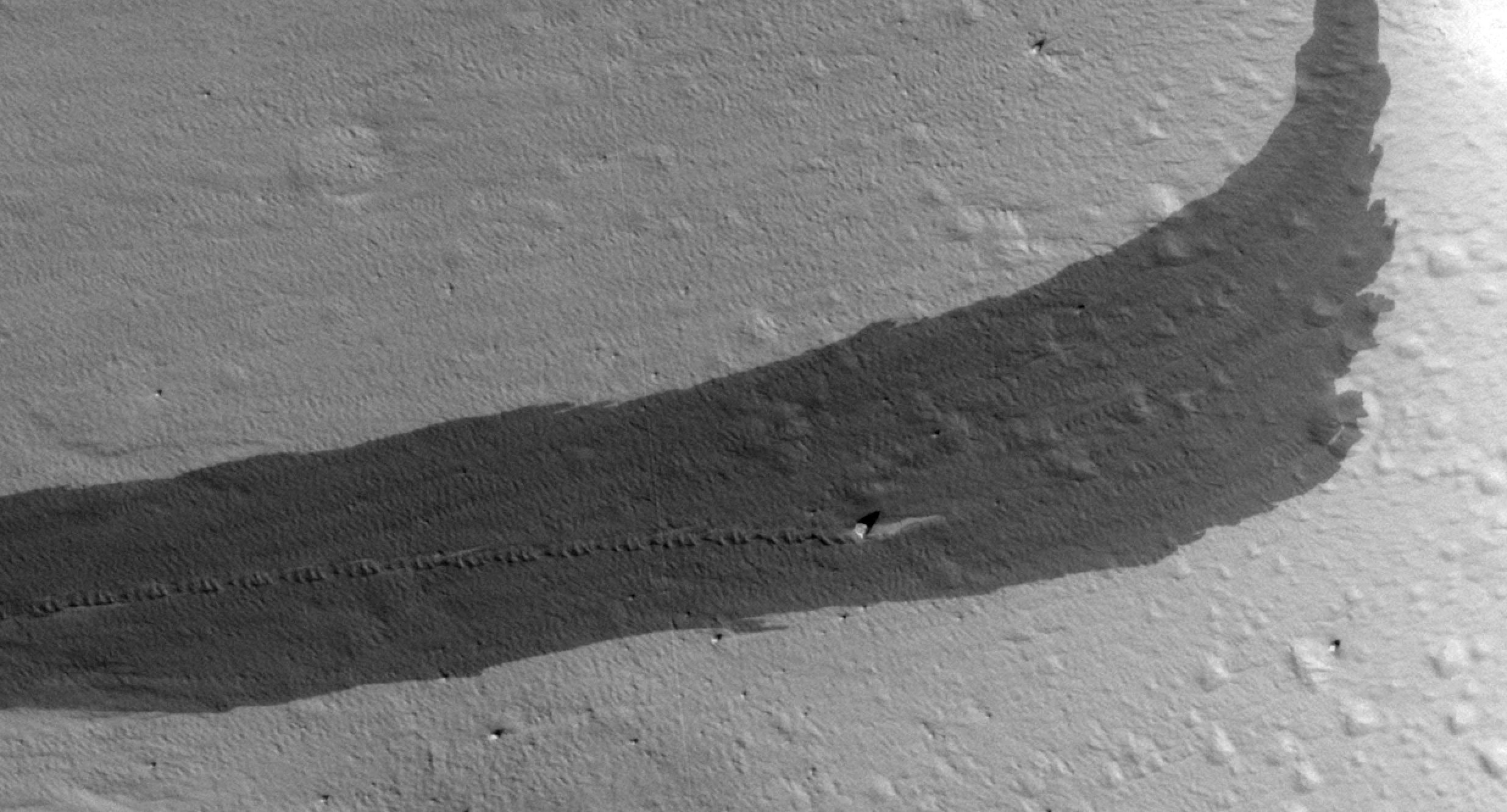
The 6 meter-wide boulder as imaged by HiRISE (to supersize the pic, click on it - 9MB)

It may only be a large rock, but images like this drive home the significance of the HiRISE instrument on board NASA’s Mars Reconnaissance Orbiter; it enables us to see recent geological activity on a planet we often view as being “dead.”

This boulder (approximately 6 meters-wide) had come to a stop at the bottom of the sloping wall of an impact crater. The path the boulder took is obvious as it left a series of prints in the Martian regolith as it bounced and rolled. The darker material that appears to have flowed around the rock is relatively fresh dry dust and sand that has also been dislodged from the top of the slope, falling as an avalanche, settling as a dark streak. As time goes on, the streak will age and blend in with the surrounding regolith.

It is suspected that seismic activity or a weather event (such as a dust devil) may have triggered the avalanche. As for the boulder, it looks like it rolled down the slope before the sand/dust avalanche, so it may have originated from the same destabilization event, or it happened earlier. As the source of the streak and boulder appear to originate from the same location, I suspect the former might be the case.

Regardless, it goes to show Mars is still active, and the MRO is in the perfect location to capture the Red Planet proving that fact.

Source: HiRISE

Mars Crater’s Cracked Frosting

Subliming ice from the crater's edge (NASA/JPL/University of Arizona)
Subliming ice from the crater edge (NASA/JPL/University of Arizona)

This image looks like the frosted top of an over-baked muffin, but it’s actually the side of a crater on Mars covered with ice. Taken by NASA’s Mars Reconnaissance Orbiter (MRO) High Resolution Imaging Science Experiment (HiRISE) over the Martian south pole, this example demonstrates an active process of weathering acting on the red landscape. According to the HiRISE site, the ice layer is approximately 3 km thick.

In regions situated closer to the equator, craters aren’t open to erosion by ice (not surface ice in any case), but in polar regions it’s a different story. Due to the Martian thin and cold atmosphere, water ice rarely melts into a liquid; it bypasses the liquid phase and turns straight into a gas. This process is known as sublimation. There are terrestrial examples of sublimation too, including frozen carbon dioxide (or “dry ice”) which sublimes at room temperature, generating a carbon dioxide vapour.

For this particular crater, it is obvious where there is a higher rate of sublimation than others. As the Sun illuminates the crater edge from the bottom right, the rim of the crater receives the most sunlight, heating up the darker regolith and causing more ice loss. The large cracked-like structure within the crater is most likely a combination of darker material under the ice receiving preferential heating and shrinkage of the subliming ice pack.

This seasonal freezing of water vapour and sublimation of water ice erodes the sides of these polar craters, wearing them down season after season.

I never tire of seeing HiRISE images of the Red Planet, especially when they include active atmospheric processes that continue to shape the landscape of this alien world.

Source: HiRISE

Opportunity Investigates Possible Martian Meteorite

opportunity_meteorite2

On its epic journey to Endeavour Crater, Mars Expedition Rover (MER) Opportunity passed a suspect looking boulder on July 18th. Dubbed “Block Island” by MER controllers, this dark rock looks very different from its surroundings, so Opportunity has been ordered to go off its planned route by 250 meters and have closer look.

Measuring approximately 0.6 meters across, the jagged specimen could be a meteorite, giving the rover a chance to carry out an in-situ analysis of its composition, determining whether or not this is indeed of extra-martian origin.

The odd-shaped and dark rock sits atop the regolith, and Opportunity will use its APXS instrument to determine its composition (NASA)

The next step is for the rover to extend its robotic arm, pressing the Alpha Particle X-Ray Spectrometer (APXS) up against the rock’s surface. The spectrometer will basically give the sample a blast of radiation, consisting of alpha particles and X-rays. The analysis of scattered alpha particles (after they have bounced off the material) will reveal the mass of the elements they collide with and the emission of X-rays will also reveal a lot about the material.

So could this be a meteorite? We’ll have to wait until the little robot has carried out its experiment… she may be getting old, but Opportunity is still carrying out some awesome science.

Source: NASA

Spirit And The Amazing Technicolour Dust Devils

spirit_dust_devils

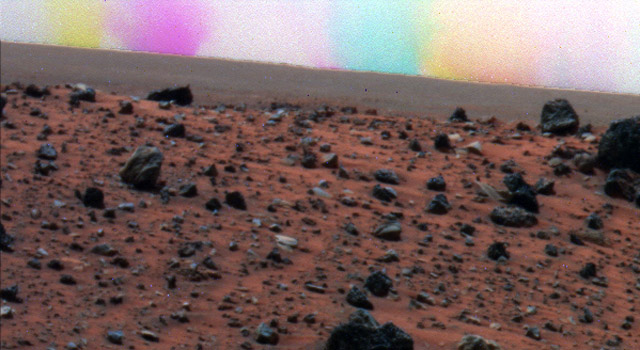
What are they? I’ve seen some odd photos from the Martian surface, but when I first saw this image, the pinks, blues and yellow smudges looked… alien. The surprise probably comes from the fact that we are so used to the rusty red pictures to come from the various rovers, landers and satellites, that any colour not a variation of red comes as a shock.

Although it looks odd, there is in fact a sensible answer to these ghostly splodges on the horizon. This photo was snapped by Mars Expedition Rover (MER) Spirit back on sol 1919 of the MER mission on May 27th, 2009.

Using its panoramic camera (Pancam), Spirit performed a number of exposures, each one using a different colour filter. With some luck during the photography session of the Martian landscape, a dust devil (a mini whirlwind) meandered through the Pancam’s field of view. In each frame taken with different filters, the only feature moving would have been the swirling dust, so that’s why it appears as a different hue than the surrounding landscape.

Dust devils occur on both Mars and on Earth when solar energy heats the surface, resulting in a layer of warm air just above the surface. Since the warmed air is less dense than the cooler atmosphere above it, it rises, making a swirling thermal plume that picks up the fine dust from the surface and carries it up into the atmosphere. This plume of dust moves with the local wind.NASA/JPL

Dust devils have provided some unexpected fun for the rovers, often tuning up unannounced. These make for interesting observations of local weather conditions, but they also provide an essential mini-undusting service for the wheeled robot’s solar panels.

And now they’ve been pictured in technicolour. How nice.

Source: NASA/JPL

I See Mars Faces… Everywhere

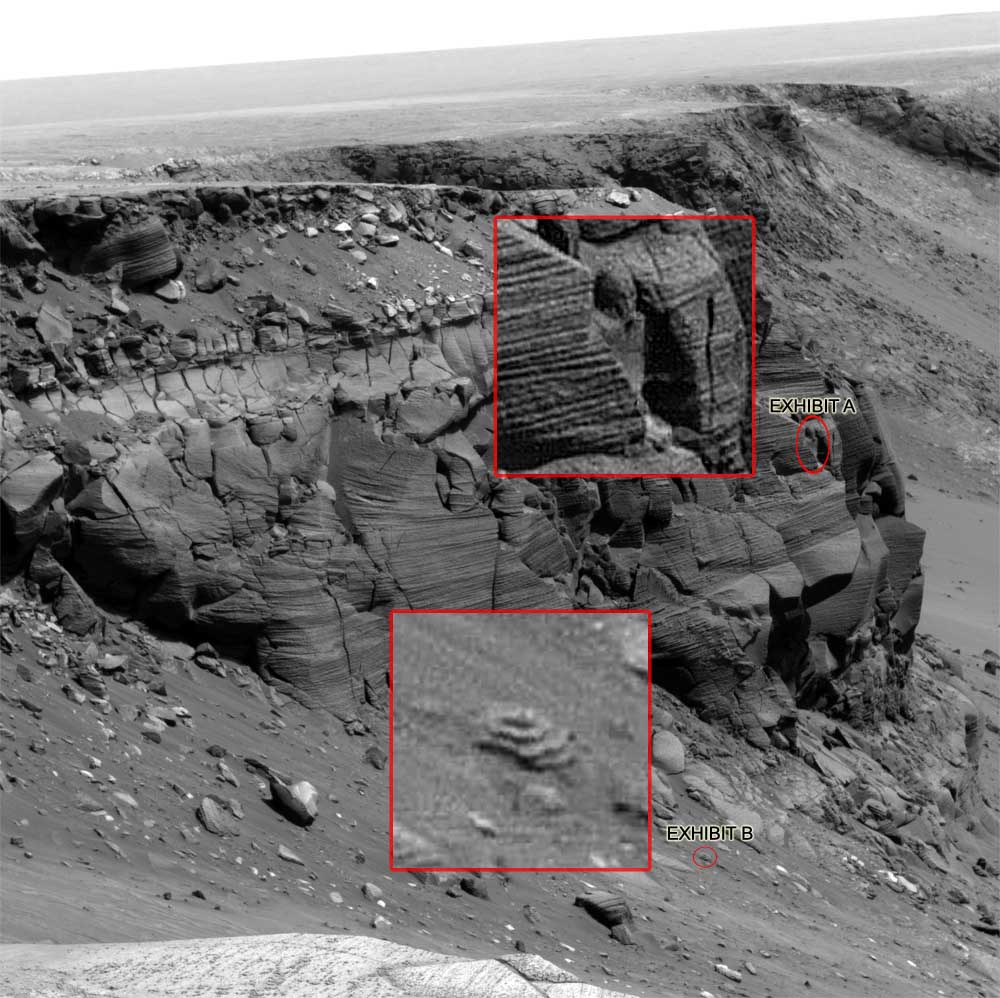
The two suspect shapes spotted by Mars conspiracy theorists. Exhibit 1: The Egyptian statue. Exhibit 2: ??

During my search for material for last week’s Wide Angle: Mars Roving on Discovery, I was looking for images snapped by the Mars Exploration Rovers (MER) Spirit and Opportunity. During my trawl around Google Images, I managed to find a high-resolution picture of the rocky outcrop on the side of Victoria Crater when Opportunity was imaging the area in 2006.

I’ve always loved these Victoria images; you can easily see layering in the exposed rock and boulders strewn below. In fact, this could be a black and white picture of the Utah desert, or a wide angle view of the Grand Canyon. But no, this is Mars; lifeless Mars.

Or is it?

One version of the Opportunity image can be found on a conspiracy website, where a ‘study’ has been carried out. And guess what they found?

Oh yes, apparently a Martian civilization worshiped the pharaohs of ancient Egypt, carving a statue more commonly associated with pyramids into the crater wall (“Exhibit A” in the image above). Also, there’s a curiously shaped multi-layer disk on the ground — obviously some kind of alien artifact (“Exhibit B”).

Please.

Normally I’d ignore something like this, but I thought I’d have a little fun one evening (because my evenings simply aren’t exciting enough, it seems). Inspired by Phil Plait’s visions of Miss Piggy in a Mars mesa last week, I wanted to test myself and go on a pareidolia hunt of my own, armed with the Victoria crater pic, my imagination and questionable eyesight.

The human brain is a strange old thing at times, creating recognizable features out of random, inanimate objects, and that is exactly what some people use as “proof” of their nutty theory or visions of the second coming. People see Jesus in burnt toast, Michael Jackson in cloud formations and, in this case, ancient Egyptian statues carved into crater rims on Mars.

So have a look at this, I impressed myself (note the outstanding use of Photoshop):

Mars faces:

What I discovered in this single NASA Mars image:

A: Exhibit A – the Egyptian statue.
B: Exhibit B – some other artifact.
C: Admiral "It’s a trap!" Ackbar from Star Wars: The Empire Strikes Back.
D: Audry II, the blood-drinking plant from Little Shop of Horrors.
E: Jabba the Hutt, or an angry toad.
F: A gorilla’s head (kinda).
G: Can’t remember what I saw in this… but it’s kinda alien looking… right?
H: Insane-looking face. Could be the Mad Hatter?
I: Weird-looking Picasso face.
J: The alien from Predator.
K: Human head.
L: Another Egyptian statue, head part.
M: Humanoid skull!

I’ve even got a full-resolution version in case you can’t see the fruits of my imagination (all 4MB of it). But who cares if you can’t see Jabba, Ackbar, skulls or statues? That’s not the point; most conspiracy sites skew the facts to convince the reader to believe their false claims anyway. Hmmm… I’m quite good at this, perhaps I should start my own ‘Mars Faces’ conspiracy, only including characters from Star Warshmmm.

I’m personally most impressed with the “humanoid skull” (M), “Admiral Ackbar” (C) and the “insane face” (H). Obviously the ancient Martian civilization were a part of the Empire (not so far, far away), carried out sacrifices on humanoids (bones now littering the plains), worshipped Egyptian kings and had killer rock sculpting skills. Obviously.

Want more Mars faces? We have some puzzles on the subject over at Discovery Space! What are the odds…

Mars Rover Spirit is Stuck in the Regolith

Spirit is stuck (NASA)

Mars Exploration Rover Spirit is in trouble again. She’s stuck.

The tenacious little robot has suffered traction problems before and has even been dragging around a broken wheel for the last three years, leaving the other five to take up the slack. Then there’s the dust storms that have hindered the life-giving solar panels ability to collect sunlight. And most recently, the on-board computers have been rebooting and Spirit’s flash memory has been forgetting to record data.

A little help here? Spirit has driven into soft ground, burying her wheels halfway. Engineers are working plans to extricate her. –A distress tweet from @MarsRovers

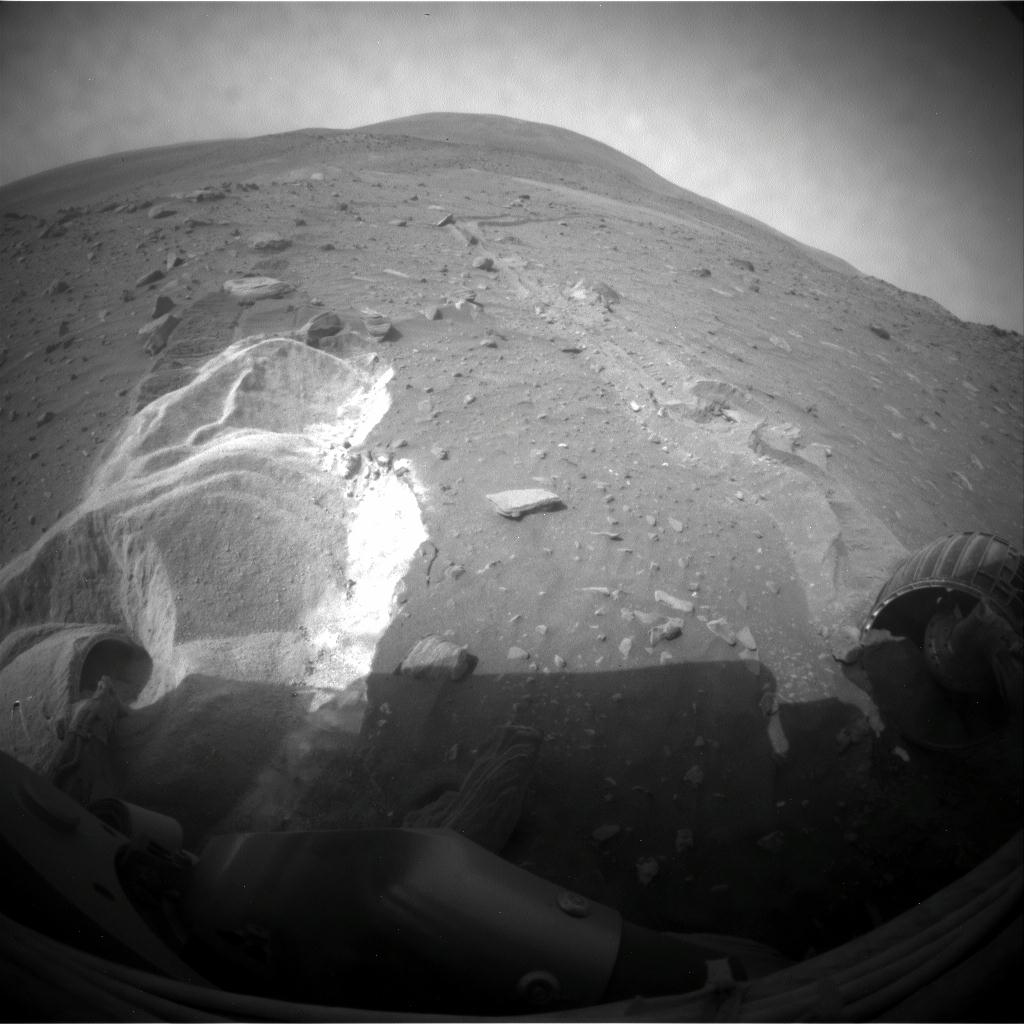
One of Spirit's buried wheels as taken by the front hazard-avoidance camera on Sol 1899, May 6th (NASA)

Now, she’s stuck in the Martian dirt after slipping backwards down a slope during a series of backward drives around a plateau called “Home Plate.”

Spirit is in a very difficult situation,” JPL project manager John Callas said. “We are proceeding methodically and cautiously. It may be weeks before we try moving Spirit again. Meanwhile, we are using Spirit’s scientific instruments to learn more about the physical properties of the soil that is giving us trouble.”

At JPL, a team have been assembled to try to find a solution to the problem with a model of the situation here on Earth. Unfortunately the wheels are stuck fast, half-buried, and scientists are increasingly worried that any attempts to free the struggling rover could make matters worse. The concern is for the chassis under the robot. Should it make contact with the rocks underneath, it would effectively beach itself, completely losing traction that could be used to free the wheels. In short, the situation is not good, but NASA is working overtime to find ways to get the rover on the road once more.

Fortunately, wind has helped the ailing rover recently, clearing excess dust off the solar panels, giving Spirit a much needed energy boost, but will it be enough to get her out of this difficult situation? If there’s a way, Spirit will find it, as let’s face it, she’s lived through a lot of hard knocks…

Source: NASA, AP