Slow News Day: Alien Skull On Mars

PD*28522608

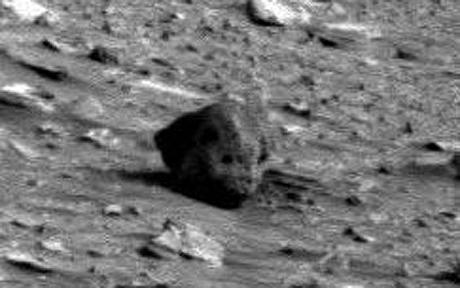
This just came in from the Telegraph, apparently Mars Exploration Rover Spirit has spotted a random skull on the Martian surface. This is obviously the only interpretation… as we know what an alien looks like, don’t we? Big head, big eyes, pasty grey skin. Something like this? Or, more likely, like this? Or this? Wow, it could be any one of them.

However, it’s not quite that exciting.

It’s a rock, as you may have already guessed. And no, the Telegraph isn’t taking it seriously either. (Although The Sun’s microreport could be taken either way.)

Although the newspaper’s article resembles a badly conditioned April Fools gag, there is one glaring error, well two actually. No, three.

Firstly, Spirit is not a camera – it’s a whole robot with a camera attached (called the Panoramic Camera, or Pancam for short). If it was just a camera, could you imagine the movie location costs?

Second, I’m not sure why this was filed in “Science News”. It obviously needs to be filed under “It’s a Slow News Day, We’ll Report Anything”.

And thirdly, I seriously doubt this image got “space-gazers talking”. When I last looked at one of Opportunity’s panoramic shots, I could see all kinds of strange things in the Mars dirt. If I was a conspiracy theorist, I’d love poking around the shapes and shadows, thinking I could see skulls, flying hubcaps and mysterious plant-like features. But I’m not a conspiracy theorist, I’m a “space-gazer”, but I’m not “talking”.

As it’s late, I’ve given up trying to find the source of the article (no links – come on Telegraph, if you’re gonna play blogging for the day, at least reference your lead!). Apparently some “UFO hunters” were being serious, but then joking, about this rock that looks like a skull. So, what the Telegraph is really trying to tell us is:

A stone. On Mars. Might look like a skull. Doesn’t really. Even ufologists don’t take it seriously. So it’s not really news. Move along.

I’m not suggesting the Telegraph isn’t a good newspaper, on the contrary, but really, what’s the point?

Why did I even bother to report on this? Oh yeah: It’s a stone that looks like a bunny skull. Now try explaining how a rabbit got up there…

Mars Chaos

Of all the places I’d want to visit on Mars, this would be high on my list. After travelling to the bottom of Hellas Planitia (for the thick atmosphere and possibly finding liquid water) and the summit of Olympus Mons (for the view), I’d be sure to have a scout around Ariadnes Colles, in the southern hemisphere (pictured above).

The Ariadnes Colles region may not be a household name, but looking at these new high resolution images coming from the Mars Express orbiter, I can’t help but be impressed…
Continue reading “Mars Chaos”

In 1911, Martians Were Building Canals

Martians Build Two Immense Canals In Two Years

On August 27th, 1911 the New York Times Sunday magazine ran an article entitled “Martians Build Two Immense Canals In Two Years”. Astronomer Percival Lowell had been studying the Red Planet and sketched what he saw, in this case, a growing complex of apparent canals on the Martian surface. There was even a nice little story that went along with this canal-building alien civilization theory. Lowell said, “The whole thing is wonderfully clear-cut,” that the Martian civilization was dying and they were building canals to reach the water ice in the Martian poles.

It turns out he was right about the water ice, but there’s no trace of this canal-building race on Mars… in fact there’s little trace of anything biological on the Red Planet. So apart from a few historic anecdotes, there’s still no life on Mars. The search continues.

Canals a thousand miles long and twenty miles wide are simply beyond our comprehension. Even though we are aware of the fact that … a rock which here weighs one hundred pounds would there only weigh thirty-eight pounds, engineering operations being in consequence less arduous than here, yet we can scarcely imagine the inhabitants of Mars capable of accomplishing this Herculean task within the short interval of two years. — Excerpt from the 1911 New York Times article.

Source: The Futility Closet (an awesome site)

Mars Can Be A Fuzzy Planet

The summit of Pavonis Mons (NASA)

This strange image was captured by the Mars Reconnaissance Orbiter’s (MRO) camera–the amazing High Resolution Imaging Science Experiment (HiRISE)–as it passed over one of the largest volcanoes in the Solar System, Pavonis Mons.

Located near the equator of Mars, atop the Tharsis bulge, Pavonis Mons is the second highest volcano after the huge Olympus Mons (towering over the Martian surface 27 km high). Pavonis Mons is still much higher than anything the Earth can muster, towering 14km into the atmosphere (compare that with the altitude of Mt. Everest’s peak height of 8.85 km).

So why is this picture so blurry? Is HiRISE suffering a malfunction? Did mission control send the wrong commands? Actually, HiRISE is working just fine. It’s the dust-covered surface that’s blurred.

As the ancient volcano is reaching so high into the Martian atmosphere, the air becomes very thin. The atmosphere was already thin; the average ground level atmospheric pressure is less than 1% of the Earth’s. At Pavonis Mons’ peak, the atmospheric pressure is ten-times thinner. Therefore any wind at these altitudes is extremely weak.

The extreme planet-wide dust storms that regularly engulf Mars dump huge quantities of dust on the top of the Martian volcanoes, but when the dust settles, there’s nothing to transport it elsewhere. Therefore, the thick layer of fine material remains where it is, tickled by the light-weight winds, rarely moving.

In the high resolution image, you can see some resolved features such as the odd impact crater and small ripples. Other than that, it’s a thick, smooth dust blanket that covers the Pavonis Mons summit, hiding any interesting geology for below, giving the impression any images of the summit are out of focus…

For more, check out The Blurry Summit of Mars’ Pavonis Mons on the Universe Today.

40% More Solar Energy For Opportunity

shadow_opportunity

Good news for Mars Exploration Rover Opportunity, a windy day on the Martian surface has cleared a layer of dust off its solar panels.

Opportunity is currently trundling across the undulating dunes of Meridiani Planum on its way to Endeavour crater, a destination it wont reach for another two years. It needs all the energy it can muster. So, like the fortuitous gust of wind that gave Spirit a 3% boost in energy in February, Opportunity has received what may appear to be a small hurricane in comparison. This gust of wind shifted so much dust caked on the rover’s solar panels, the robot has had an energy increase of 40%.

As of Sol 1850 (April 7, 2009), Opportunity’s solar array energy production has increased to 515 watt-hours. Atmospheric opacity (tau) remains elevated at around 0.95. The dust factor has improved to 0.642, meaning that 64.2 percent of sunlight hitting the solar array penetrates the layer of accumulated dust on the array. The rover is in good health with a rested actuator and extra energy.NASA Opportunity updates

Since Opportunity arrived on Mars five years ago until April 7th, the tenacious rover has travelled 15,114 meters (9.39 miles). For a mission that was only slated to last three months, that’s not a bad distance its clocked up.

Source: NASA

Return of the Bouncing Boulder: Debris After a Martian Landslide

The debris after a landslide on Mars (NASA/HiRISE/Stuart Atkinson)

Mars is far from being geologically active when compared with the Earth, but it isn’t geologically dead either. In a stunning visual study by Stuart Atkinson over at Cumbrian Sky, he has done some desktop detective work on high-resolution HiRISE images of the Martian surface and turned up some astounding images. One scene shows a huge chunk of material, slumped down a slope, but in the detail are the familiar divots etching out the tracks of bouncing boulders after being disturbed by the Martian avalanche…
Continue reading “Return of the Bouncing Boulder: Debris After a Martian Landslide”

Welcome to my Sinkhole, Premium Martian Real Estate

A sinkhole in Tractus Fossae, created by tectonic activity (HiRISE/NASA)

It might not look like much from space, but this depression in the Martian landscape might be considered to be a priceless feature when viewed by future Mars colonists.

In December 2008, the Mars Reconnaissance Orbiter (MRO) flew silently over the Tharsis bulge, the location of a series of ancient volcanoes. The High Resolution Imaging Science Experiment (HiRISE) captured what appears to be a deep hole. This kind of feature has been seen before, like a Martian pore, deep and foreboding. Usually these sinkholes aren’t as deep as they look, but they are deeper than the surrounding landscape. They are also similar to their terrestrial counterparts in that they have very steep sides (unlike the gentle, eroded slopes of crater rims) and they are caused by a lack of material below. On Earth, sinkholes often form due to water flowing beneath, removing material, causing the overlying rock/soil to slump, forming a sudden hole. In the example above, the sinkhole (or “collapse pit”) was caused by tectonic activity. In this case, it is likely that the material dropped into a void left over by magma-filled dykes (lava tubes from old volcanoes).

A stretched and image processed version of the sinkhole; the bottom of the hole is visible (HiRISE/NASA)

The result is a hole with very steep sides. It has been suggested that these sink holes may be useful to future Mars colonists, as they can use the natural feature for shelter. On Mars, humans would be subject to an increased dosage of radiation (due to the tenuous Martian atmosphere and lack of a global magnetic field), so it is preferable to find any form of natural shelter to build your habitat. The depth of this kind of sinkhole will afford some protection, and drilling into the cavern side would be even better. Perhaps even put a dome over the top? No need to build walls around your building then. Also, there’s the interesting–if a little frightening–prospect of accessing underground lava tubes. Therefore, colonists won’t need to dig very far to create a subterranean habitat with all the radiation protection they’ll ever need (the insulation would also be impressive).

Although this scenario might be a little far-fetched, and probably only suitable for an established human presence on Mars (after all, the numerous valleys would probably suffice for most permanent habitats drilled into cliff faces), it does go to show that the current missions in orbit around Mars are doing a great job at seeking out some possible housing solutions for our future Mars settlers…

Source: HiRISE, Marspedia

When Cosmic Rays Attack: The MRO in Safe Mode

mars_reconnaissance_orbiter21

I always get concerned when I hear about one of our invaluable robotic explorers switching into safe mode. This time, it is the turn of NASA’s Mars Reconnaissance Orbiter (MRO) that re-booted itself after an “event” in Mars orbit. It seems likely that a direct cosmic ray hit could be to blame…
Continue reading “When Cosmic Rays Attack: The MRO in Safe Mode”

Liquid Water on Mars?

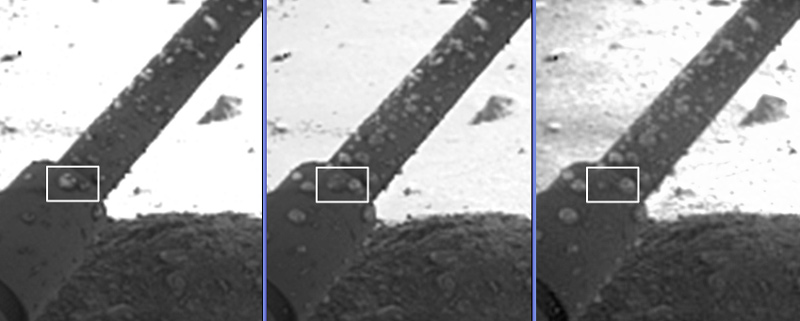
Water droplets appear to be growing on Phoenix's leg shortly after landing on Mars (NASA)
Water droplets appear to be growing on Phoenix’s leg shortly after landing on Mars (NASA)

NASA scientists are currently trying to understand a set of images taken by the Phoenix Mars Lander shortly after it landed on the Red Planet in May 2008. The images in question show one of the robot’s legs covered in what appears to be droplets of liquid water. The droplets remain on the lander for some time, appearing to get larger and changing shape.

By now, we know that liquid water (apparently) hasn’t existed on the Martian surface for hundreds of millions of years; the atmosphere is currently too thin and too cold to support liquid water. However, the confirmed presence of perchlorate in the regolith may provide an important clue as to what might be going on…
Continue reading “Liquid Water on Mars?”

The MSL is Too Expensive? Who Cares! We’re Searching For Life!

$2.2 billion eggs. One basket. The MSL "Skycrane" lowers the 850kg rover to the Martian surface (NASA)
$2.2 billion eggs. One basket. The MSL Skycrane lowers the 850kg rover to the Martian surface (NASA)

Don’t get me wrong, I am incredibly excited about any planetary mission, no matter how much it costs. However, there is something about the Mars Science Laboratory (MSL) that makes me uneasy. The project may be delayed (the MSL is scheduled for a 2011 launch) and it may be costing more than NASA projected, but it’s not these factors I’m worried about.

The MSL is built on a “bigger and better” mentality; it dwarfs both of the Mars Exploration Rovers Spirit and Opportunity, plus it is packing a rather impressive suite of 10 complex scientific instruments to carry out an unprecedented campaign in the Martian dirt. Oh, and did I mention it will be powered by radioisotope thermoelectric generators (RTGs), a complete departure from the tried and tested solar panelled rovers? Oh hold on, as the MSL weighs nearly a tonne, a brand new method of landing the thing is required (simply parachuting, air bag bouncing or rocket thruster powered landings are now passé). The “Skycrane” that looks like one of those hoverboards from Back to the Future II has been invented to gently lower the MSL (pictured above).

Still, I’m not too concerned, NASA has proven itself countless times at overcoming technological challenges. That’s why NASA is there, to research and develop new technologies and science. But what if the MSL has gone too far? What if the technology is too untried and untested? Unfortunately, it looks like the recent turn of events have taken even the MSL program manager by surprise
Continue reading “The MSL is Too Expensive? Who Cares! We’re Searching For Life!”