Ares I-X: The Beginning And The End For Constellation?

ares-1-x

The 327 ft tall Ares I-X is currently waiting inside Kennedy Space Center’s Vehicle Assembly Building for its delayed 4.2 mile rollout to the launchpad. Originally scheduled for Monday, the rollout was postponed by 24 hours when engineers spotted a nitrogen gas leak on Oct. 14th. It would appear the problem has been rectified and we can look forward to seeing the tallest rocket on the planet roll out to Pad 39B by Tuesday morning.

Unfortunately, the Ares I-X test flight is generating little excitement, even though NASA is heralding the scheduled Oct. 27th launch as “the First Flight of a New Era.” When there’s talk that the Constellation Program might be scrapped all together to allow for a cheaper alternative, there’s little wonder that even the most excited space flight enthusiasts are looking at the slender white frame of the Ares I-X thinking, will this be the only launch of the Constellation Program?

This negativity isn’t unfounded either. As we await the final report from the Augustine Commission (to be delivered to the White House later this week), one of the conclusions could be that Constellation is more hassle for NASA to complete rather than to scrap.

In this case Ares I-X will have become a very expensive firework.

Although it is unlikely the White House will decide on a course of action before Oct. 27th, I can’t help but think the outcome of Constellation would have been decided before the Ares I-X has even blasted off. No matter how well the four-stage test rocket performs during its 28 mile-high suborbital flight, the project could still be shelved.

But what if there are several options for NASA as the Commission Report summary suggests? Could the Ares I-X launch be the decision maker?

The Oct. 27th launch will be an amazing event in itself (and I’m dead excited to see that monster thunder into the skies), and unless an overlooked technical problem rears its ugly head, we’ll see the test launch of a brand new rocket system. What’s not awesome about that? If the Ares I-X blasts off perfectly, and the Ares design is proven to be free from vibrations and other design flaws, could a proof of concept sway the decision in favour of keeping Constellation in development? Possibly.

Regardless of the conclusions to come out of the Augustine Commission, the launch of Ares I-X will mark a crossroads for manned spaceflight. History will be written, but will history favour the Constellation Program? I don’t think I could place a bet either way.

Source: Orlando Sentinel
First Images of LCROSS Centaur Impact Plume Released

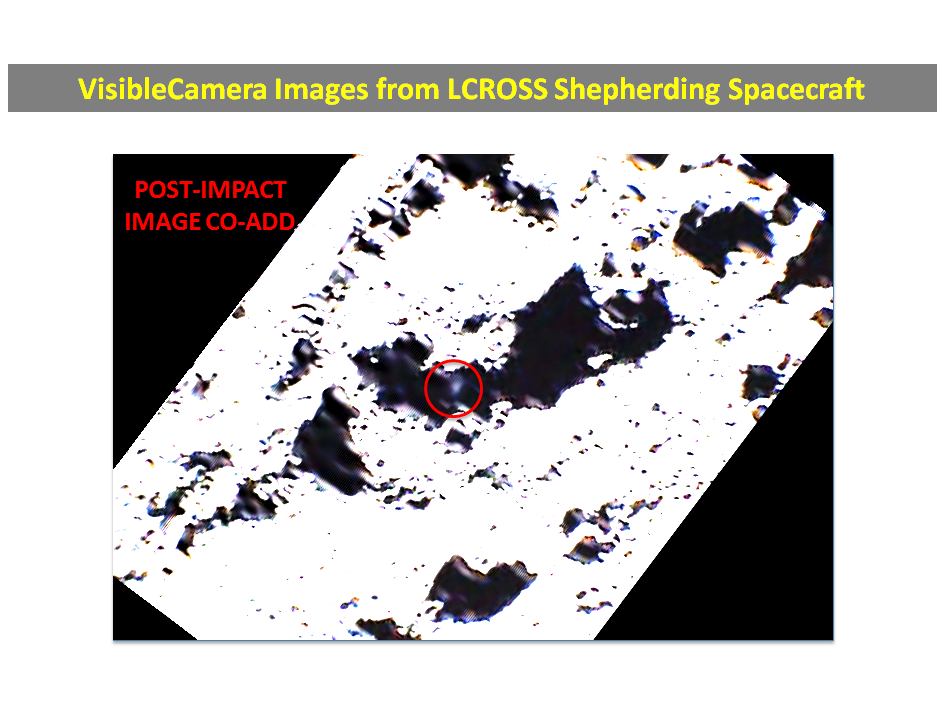
The lunar dust plume as seen 15 seconds after Centaur impact. The size of the plume was approximately 6-8 km wide at this time (NASA)

Rising a mile high and up to 5 miles wide, the impact plume of the spent Centaur rocket was observed by the NASA LCROSS shepherding probe before it travelled through the cloud of dust and crashed 4 minutes later.

The lack of an observed dust plume has been the cause of much confusion to people who watched the events unfold in the early hours of October 9th. NASA publicised the impact event as if it was going to be an explosion of dust (and possibly ice), observable from telescopes on Earth. To say the mission finale was a disappointment is an understatement.

Following the impact, NASA responded by saying that although infrared images proved the Centaur crashed on target (and a 20 meter-wide crater was created), the lack of an accompanying plume could mean that the mass hit the side of a crater (therefore blasting debris at an angle), or it hit a region devoid of dust and water ice, or the plume was simply less obvious than expected. Now that NASA has released new images of the impact, it would appear the latter may be the case; the plume was just less spectacular than the promo videos depicted.

Nine instruments on board LCROSS captured impact sequence, but until now it was unknown whether an impact plume occurred. Now NASA has confirmed that an impact flash, plume and crater were all generated.

There is a clear indication of a plume of vapor and fine debris,” said Anthony Colaprete, LCROSS principal investigator. “Within the range of model predictions we made, the ejecta brightness appears to be at the low end of our predictions and this may be a clue to the properties of the material the Centaur impacted.”

So the number-crunching continues as we wait to find out whether water was contained within that plume. However, judging by the faint cloud of ejecta, I’m thinking dreams of a H2O reservoir in Cabeus crater might be short lived.

Source: NASA, LA Times. A special thanks to @jamerz3294 for the tip!

Rolling (Mars) Stone

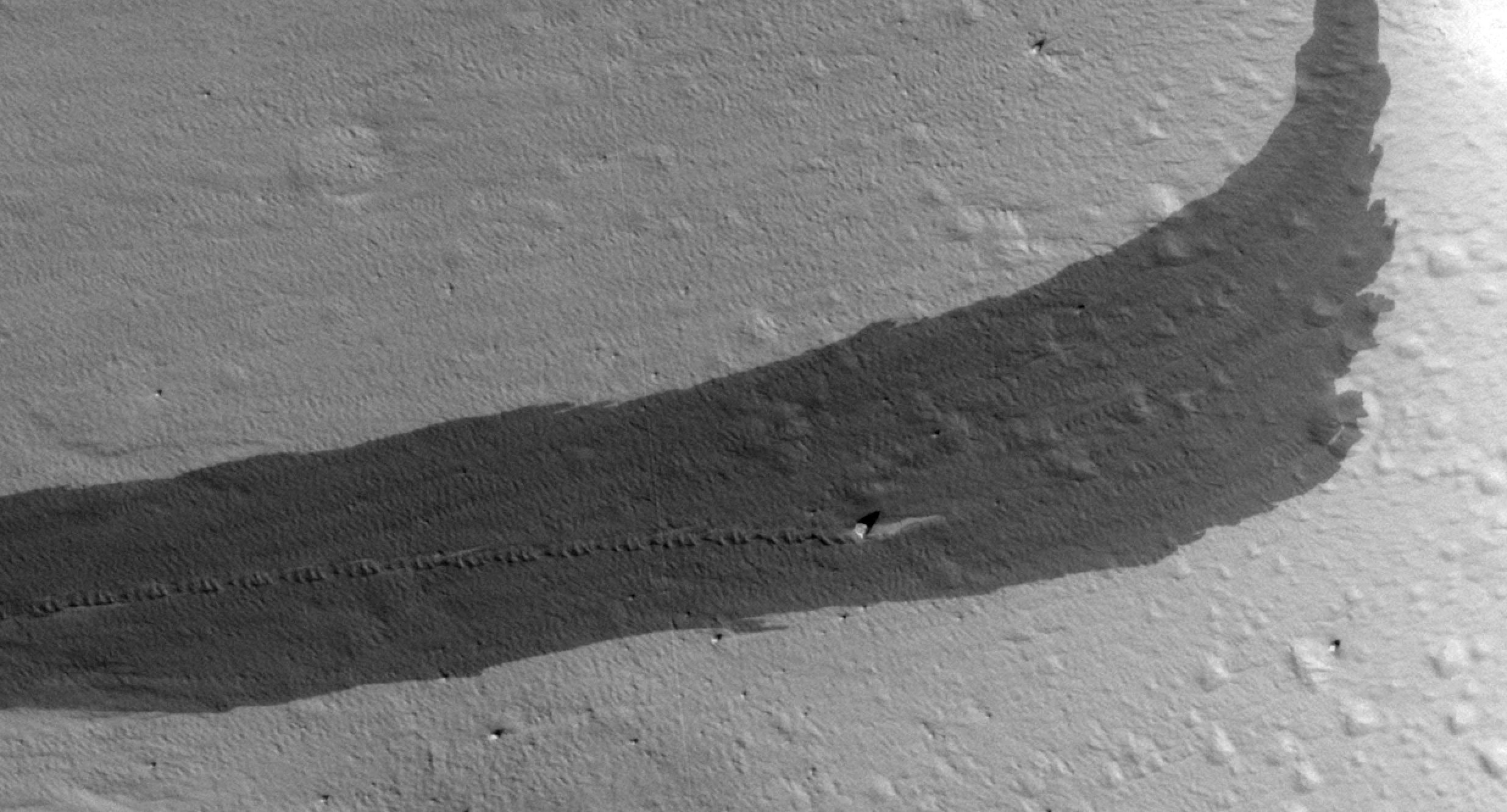
The 6 meter-wide boulder as imaged by HiRISE (to supersize the pic, click on it - 9MB)

It may only be a large rock, but images like this drive home the significance of the HiRISE instrument on board NASA’s Mars Reconnaissance Orbiter; it enables us to see recent geological activity on a planet we often view as being “dead.”

This boulder (approximately 6 meters-wide) had come to a stop at the bottom of the sloping wall of an impact crater. The path the boulder took is obvious as it left a series of prints in the Martian regolith as it bounced and rolled. The darker material that appears to have flowed around the rock is relatively fresh dry dust and sand that has also been dislodged from the top of the slope, falling as an avalanche, settling as a dark streak. As time goes on, the streak will age and blend in with the surrounding regolith.

It is suspected that seismic activity or a weather event (such as a dust devil) may have triggered the avalanche. As for the boulder, it looks like it rolled down the slope before the sand/dust avalanche, so it may have originated from the same destabilization event, or it happened earlier. As the source of the streak and boulder appear to originate from the same location, I suspect the former might be the case.

Regardless, it goes to show Mars is still active, and the MRO is in the perfect location to capture the Red Planet proving that fact.

Source: HiRISE

Late to the Doomsday Party: NASA Denounces 2012

nemesis

As we have probably all guessed by now, the Institute for Human Continuity is a viral campaign designed to generate a huge buzz around the upcoming November 13th movie called 2012.

Ever since I started writing about 2012 (way back in May 2008 with “No Doomsday in 2012“), I’ve been inundated with emails, tweets, comments, even phone calls about the 2012 doomsday phenomena. These messages have ranged from mild curiosity to outright panic. I’ve also had many crackpots trying to convince me that my scientific reasoning is not valid (which it is).

There’s also been a few bonuses, including guest appearances on the outstanding “Apocalypse” episode of Penn & Teller: Bullshit! and most recently, the upcoming Discovery Channel documentary on the same subject.

However, in the run-up to a perfectly timed movie about the “Mayan prophesy,” Sony Pictures kick-started the mother of all viral campaigns in January. The movie 2012 will be a huge event, but basing an entire marketing ploy on fear and disinformation left a lot to be desired. So for the last 10 months, I’ve been busy writing not so much about the bad science being used in these wacky 2012 theories (check out my 2008 “No Doomsday in 2012” series for the science), but about the various advertising campaigns for the movie.

However, up until this point, there’s been little official comment from NASA about all the nonsense that has been stirred up. This seems surprising as most doomsday theories involve butchered astronomical objects, surely the US space agency should take a stance on the whole matter?

Now, NASA astrobiologist Dr David Morrison has gone on the record to say the 2012 doomsday theories are bunk. It turns out that Dr Morrison has also been flooded with messages from people worried that all the hype might be real.

Interestingly, in response to accusations that Sony Pictures’ viral campaign was irresponsible, Sony’s publicity director said, “It is very clear that this site is connected to a fictional movie. This can readily be seen in the logos on the site.”

However, in January when the Institute for Human Continuity went live, indications that the site had anything to do with a fictional movie could only be found if you dug very deep into the well-polished Flash website depicting Planet X causing death and destruction on Earth. I don’t recall any logos.

In an attempt to allay any doomsday phobia in the run-up to November (and for the next 3 years), Dr Morrison has issued a nice guide about every reason why you shouldn’t be concerned about 2012 (and that it’s just a movie).

Source: Telegraph. Special thanks to Fraser Cain at the Universe Today for pointing me to David Morrison’s publication.

To A Ufologist, The Answer Is So Obvious

For a rare glimpse into the inner workings of a conspiracy theorist’s brain, check out this hilarious explanation of the super-duper-hyper-speed-top-secret-military-drone that was captured in this video of an Iranian missile test on October 8th. There’s some spooky music added to the edited FOX News coverage to get you in the mood:

So do you see what the conspiracy is? Something really fast shot through the clouds just after Iran launched their Shahab-3 rocket. Obviously there is something weird about that, right?

It’s OK, Nick Pope is on the case.

One theory is that it’s a secret American drone. At any time there are prototype aircraft and drones being operated that won’t be shown in public for years.

Stealth aircraft flew for many years before their existence was acknowledged.

But the speed and acceleration seems phenomenal. I’m not convinced we’ve got anything capable of such manoeuvres.”

Oh come on Nick, you can’t fool us! You know it’s not a classified military aircraft don’t you. In your expert opinion, you’re “not convinced we’ve got anything capable of such manoeuvres.” Don’t leave us hanging, just say it. We won’t judge you. Much.

Obviously leaning toward the extraterrestrial argument, Pope — who was once a UFO advisor to the British Ministry of Defence — appears to have numbed all the reasoning functions of his brain. He’s taken one look at the video footage — probably with an amazed look on his face, mouth open wide — and when asked by reporters what he saw, he responds with a smug look of knowing. There be aliens in them clouds.

As you might have guessed from the video, it’s certainly not a UFO. Hell, it’s not even a flying object. It’s a shadow. For observers in the space community who see rocket launches all the time, shadows of rocket smoke trails often fall on clouds. In the case of the Iranian missile launch (which, in actuality, is the real concern in this footage), the sunlight is coming from the right of the picture. As the missile passes through the altitude at which the Sun lines up with the cloud, a shadow dissects the cloud. It really is that simple. Any confusion about the altitude of the cloud is down to the angle of the camera view and the opacity of the cloud.

For his continuing UFO studies, I think Pope should be doing more research on how to recognize shadows rather than letting his imagination run rampant. However, it is interesting to see how the brain of a prominent ufologist works; zero skeptical thought, oodles of imagination and conspiracy theories behind every cloud.

“Astronaut needed for experimental flight to Titan…”

The Reliant Robin Space Shuttle from the BBC's Top Gear.
A better chance of making it to Saturn: The Reliant Robin Space Shuttle from the BBCs Top Gear.

An ad on Craigslist has just appeared: Astronaut Needed (Northern Alberta). Sign me up!

Oh, hold on…

Astronaut needed for experimental flight to Titan. I have been working on this project now for near 40 years and am afraid I’m no longer fit enough to go. My secret space craft is the result of my professional experience and imagination while serving the U.S. military in advanced aeronautics as a scientist. The craft harnesses a revolutionary propulsion system and its fuselage is fabricated with the most advanced material. While considerably safe, I am certain you will make it safely to Titan but there will not be enough fuel to get home. This is for someone unique that has always wanted to see the universe first-hand and has perhaps a terminal view on life here at home. Here’s your shot at romantic history.” —Mad Rocket Scientist from Canada (emphasis added by me).

I was almost convinced I had a stab at flying to the Saturnian moon. What put me off? The fact that there won’t be enough fuel to get me back to Earth? Or was it the fact that I’m not stark raving mad? Nope, it turns out I’m too tall. “[The applicant] must be no taller than 5’10 and relatively slim.” Curses.

Thank goodness the spaceship is “…is largely cpu controlled,” I was getting worried that this ad was sounding a little too reckless…

Wow.

Thanks to @absolutspacegrl for the heads up!

Did NASA “Bomb” the Moon? Kinda

NASA possesses Weapons of Moon Destruction, obviously.

There’s been a lot of criticism concerning the media’s ability to report science recently. After all, what is “good” science reporting? The tabloid press is well known for hyping up scientific endeavour, and although some news outlets deliberately fill their columns with hyperbole, it doesn’t necessarily mean the science is being misrepresented, it just means the column in question is making a mountain out of a molehill.

Take Friday morning’s NASA LCROSS impact with the Moon. Those of us that were following the action on the various news outlets and online feeds were astonished by the sheer amount of fear, misinformation, disinformation and general weirdness that was being banded about. To be honest, I was shocked.

[I actually have a theory about one of the reasons why LCROSS was a particular target for many conspiracy wingnuts and doomsday woo, but I’ll save that for another article I’ll be writing shortly.]

Although a lot of the stuff was total silliness (i.e. the Moon feels pain, LCROSS might knock the Moon off it’s axis, many moonpeople might die etc. etc.), many worried individuals were concerned by the reports from the mainstream press. Let’s have a look at one of the claims being disseminated by a wide variety of news outlets in the run-up to, and the days following, LCROSS: The Moon was being “bombed” by NASA.

Did NASA “bomb” the Moon or not?

A huge number of people have a problem with the word “bomb” when connected with the LCROSS mission (I’m not fond of the description either). Could this one word be indicative of bad journalism? For the scientifically-minded, “bomb” doesn’t sound very scientific and would rather use “impactor.” For the non-specialist, “bomb” conjures thoughts of war, violence and Al Qaeda.

Is it just creative writing? Is it an inaccurate term? Is it wrong? First off, let’s look at the definition of “a bomb.”

bomb. n. An explosive weapon detonated by impact, proximity to an object, a timing mechanism, or other means.

The LCROSS Centaur was certainly not manufactured as a conventional weapon (as in, it didn’t carry explosives and couldn’t “detonate”), but just by its mass, could it cause an explosion like a bomb? In the case of the above definition, I’m referring to the “or other means” part.

Energy is energy

The Centaur was empty of propellent when it was sent careening toward the lunar south pole, but it still had a mass of 2366 kg (the size of an SUV). At the time of impact, it was travelling at a velocity of 2.5 km/s (2500 m/s). From this information alone, we can calculate the kinetic energy of Centaur at the moment it slammed into the lunar surface.

Ekinetic = 1/2 mv2 = 1/2 × 2366 (kg) × 25002 (m/s) = 7.4×10⁹ Joules

This is the total energy the Centaur had when it was speeding toward the Moon, and according to basic physics energy is always conserved. So, when the Centaur ate Moon dust, where did this energy go?

We know energy wasn’t lost through the production of sound waves, as there’s no atmosphere on the Moon — In space, no one can hear your rocket go *bang* (although seismic waves would have been generated, propagating through the Moon’s surface). Also, lots of chunks of rock (from the surface) and shards of metal (from the Centaur) would have been ejected from the crater, each piece carrying a little piece of that kinetic energy away from the impact (much like very high-energy shrapnel). A lot of rock was displaced too, creating a crater 20 meters in diameter and 3 meters deep. Much of the kinetic energy will have also been converted to heat and light (the “flash” of the impact was captured by the LCROSS infrared camera).

What with all this heat, light and shrapnel, the Centaur impact sure is sounding like an exploding bomb. If you convert the 7.4×10⁹ Joules into units more synonymous with weaponry, we find that the energy released during the Centaur impact was the equivalent of 1.8 tonnes of TNT exploding. That’s the size of a small bunker-busting bomb.

What’s more, kinetic weapons are a well-known method to take out orbiting satellites, so this concept isn’t a new one.

As much as it pains me, using an inflammatory statement like “NASA Bombed The Moon” is a correct analysis of the effects of the Centaur dead-weight hitting the Moon. However, the press milked “the Moon bombing” way beyond what I’d consider to be reasonable, taking full advantage of the violent connotations associated with this incredible NASA mission to probe for water on the Moon.

I think that people are apprehensive about it because it seems violent or crude, but it’s very economical.” –Tony Colaprete, principal investigator for LCROSS (Feb. 2008)

What REALLY Happened to the LCROSS Centaur?

<conspiracy mode>

In the early hours of Friday morning at 4:31am, the spent Centaur rocket from the NASA LCROSS mission slammed into the surface of the south pole of the moon. What was the point in that?

Well, NASA was hoping that the tumbling chunk of metal the size of a small bus would kick up a huge plume of dust. Following 4 minutes behind was the shepherding LCROSS spacecraft, also on a kamikaze dive, hoping to drop through the plume, sensitive instruments ready to analyse the dust for water.

I know what you’re thinking: what right does NASA have to BOMB the Moon? They have NO RIGHT AT ALL!!

It turns out that they are actually waging a top secret war against the population of peaceful extraterrestrials that live on the far side of the Moon. This “experiment” was in fact a reckless attack against a superior alien civilization, intended to strike fear into the hearts of the aliens.

If you were to believe the NASA promo video of the event, this should have been spectacular, vast quantities of lunar regolith blasting into space… it should have been akin to the biggest Fourth of July firework detonating. This “shock and awe” tactic is typical of the US space agency. The huge mass of the Centaur (a little under 2400kg), combined with its break-neck speed (1.5 miles per second) should have unleashed the equivalent energy of a tonne of TNT exploding. However, what NASA didn’t tell us was that Centaur was also carrying plutonium, so the explosion should have been a LOT bigger, easily visible to the naked eye.

But what did we see? Nothing. What did NASA see? Nothing. So what happened? Well, the answer to that is a little more compelling than what NASA is telling us.

Yes, they can show us images of a meagre “flash” as the Centaur hit inside a lunar crater, but I don’t think Centaur hit the Moon at all… the Centaur rocket was swallowed by the Moon.

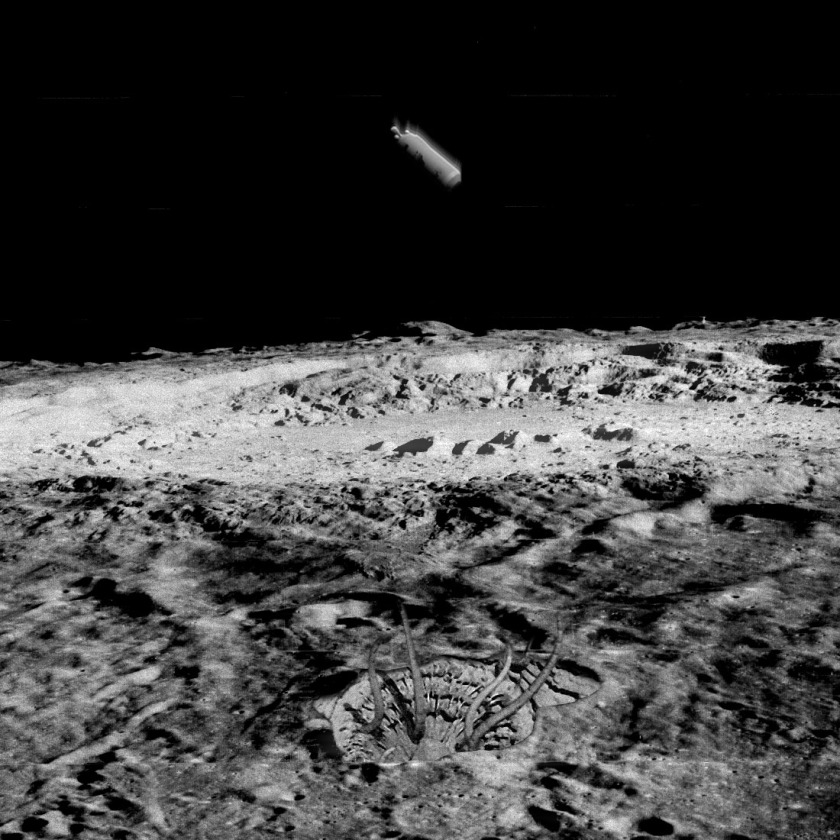
Don’t believe me? Moments before impact, NASA’s lunar satellite — the Lunar Reconnaissance Orbiter (LRO) — was approaching the location and it took this photo. What you see here will shock you. It will astound you. And what’s more, it’s REAL.

Aliens DO live on the Moon, and they were prepared for the NASA bombing…

lcross-conspiracy

</conspiracy mode>

I’m sorry, I couldn’t resist. In the run-up to the LCROSS impact, the sheer amount of crazy conspiracy theories hit fever-pitch (I blogged about it on Space Disco 2 hours before impact). Some of my favourite theories involved alien civilizations on the lunar surface, plutonium on LCROSS (to destroy the Moon), the “fact” that it was all just a publicity stunt and the LCROSS mission didn’t exist at all… and the strange theory that the Moon feels pain.

Yawn.

A polite message to the conspiracy theorists: Come on people, stop making stuff up and understand the real science. You might find reality more interesting than your twisted fantasies.

Image: The Sarlacc pit monster from Star Wars, Copernicus lunar crater and the LCROSS Centaur rocket. Photoshopping: Me.

Oops… I really geeked out this time, didn’t I.

Mars Crater’s Cracked Frosting

Subliming ice from the crater's edge (NASA/JPL/University of Arizona)
Subliming ice from the crater edge (NASA/JPL/University of Arizona)

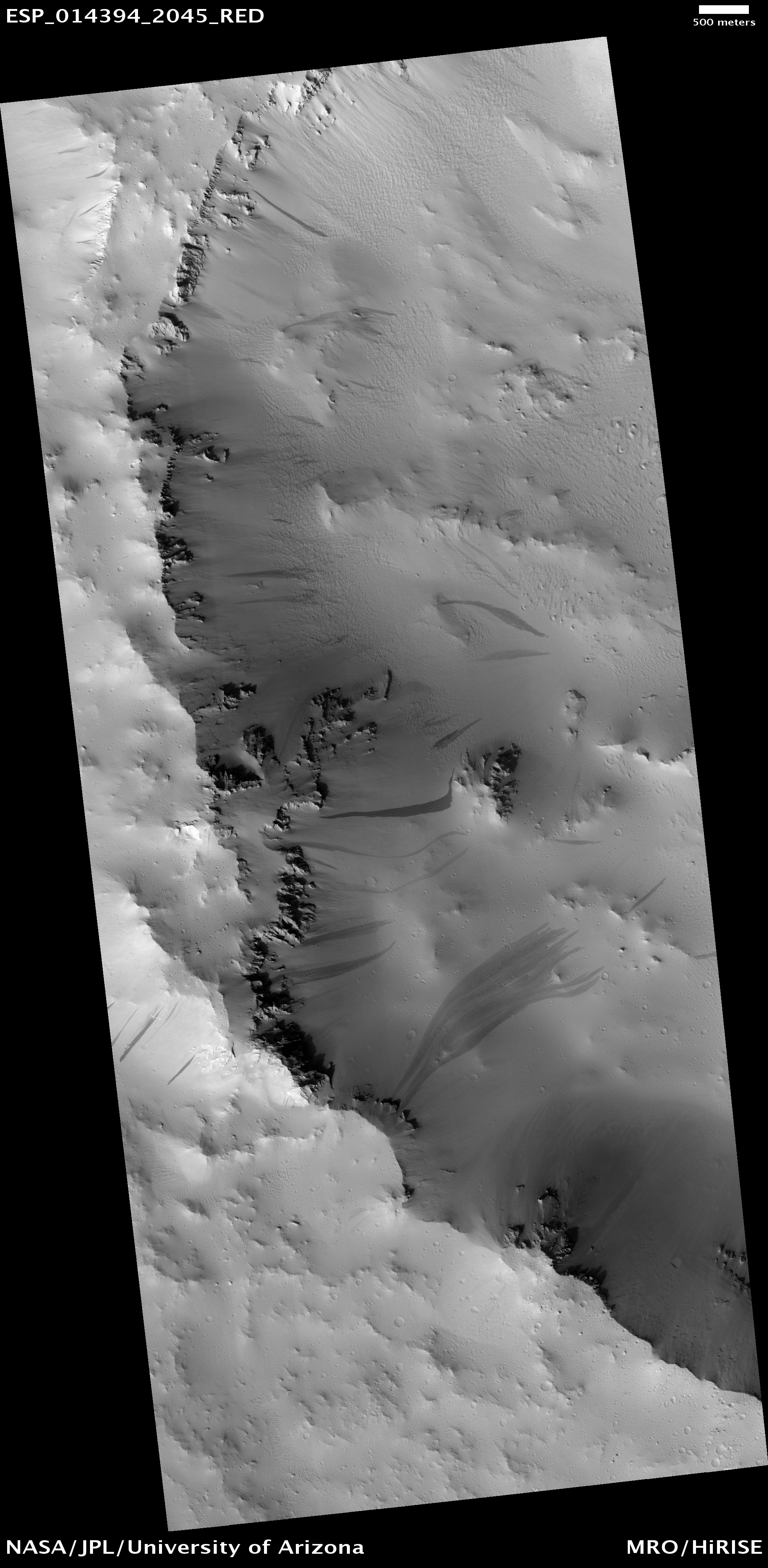
This image looks like the frosted top of an over-baked muffin, but it’s actually the side of a crater on Mars covered with ice. Taken by NASA’s Mars Reconnaissance Orbiter (MRO) High Resolution Imaging Science Experiment (HiRISE) over the Martian south pole, this example demonstrates an active process of weathering acting on the red landscape. According to the HiRISE site, the ice layer is approximately 3 km thick.

In regions situated closer to the equator, craters aren’t open to erosion by ice (not surface ice in any case), but in polar regions it’s a different story. Due to the Martian thin and cold atmosphere, water ice rarely melts into a liquid; it bypasses the liquid phase and turns straight into a gas. This process is known as sublimation. There are terrestrial examples of sublimation too, including frozen carbon dioxide (or “dry ice”) which sublimes at room temperature, generating a carbon dioxide vapour.

For this particular crater, it is obvious where there is a higher rate of sublimation than others. As the Sun illuminates the crater edge from the bottom right, the rim of the crater receives the most sunlight, heating up the darker regolith and causing more ice loss. The large cracked-like structure within the crater is most likely a combination of darker material under the ice receiving preferential heating and shrinkage of the subliming ice pack.

This seasonal freezing of water vapour and sublimation of water ice erodes the sides of these polar craters, wearing them down season after season.

I never tire of seeing HiRISE images of the Red Planet, especially when they include active atmospheric processes that continue to shape the landscape of this alien world.

Source: HiRISE

@Astroengine Got CNN’d (and other epic things)

cnn-banner

I’ve been pondering a word that could describe today.

I drew a blank.

It’s a very hard day to sum up in one word. In fact, this entire week has been something of a unique one. From a space point of view, it’s been busy, largely due to the endless supply of space science research spewing from the American Astronomical Society’s Division of Planetary Sciences meeting in Puerto Rico.

However, last night (and early this morning) is what topped it all off. The NASA LCROSS mission slammed into the lunar south pole at 4:31am (PDT) and I was there tweeting away, keeping abreast of all the juicy LCROSS news. That was until Time Warner Cable decided to pull the plug on my internet connection 10 minutes before the main event (I’m certain they did it deliberately, it’s the only explanation). Panic-stricken — and really peeved that I’d spent the whole night excited to see the glorious end to this Moon mission, only to be foiled by my ISP — I checked the TV, and it was working, plus a local channel was covering the event. Phew.

As it turned out, there wasn’t much to see. Oh well.

Anyway, on waking up this morning, I was shocked to find my inbox was stuffed full of Twitter follow messages and notes of congratulations from my team at Discovery News. CNN had picked me, with four heavy-hitters on Twitter as their #FollowFriday. But it wasn’t an ordinary #FollowFriday, the guys at CNN Technology posted this #FollowFriday on their site!

Editor’s note: In this new weekly feature, we highlight five recommended Twitter feeds about a hot topic in the news. Today’s list focuses on space-related tweets and NASA’s plan to crash two spacecraft on the moon Friday in a search for water in lunar soil.CNN Tech

So despite my internet woes, CNN had chosen me (@astroengine) with @BadAstronomer, @Astro_Mike, @LCROSS_NASA and @NASA_AMES. So I was in the company of an entire NASA facility (Ames), a NASA mission that had just hours before slammed into the Moon (LCROSS), the first astronaut to tweet from space (Mike Massimino) and the one, and only, Phil “The Bad Astronomer” Plait.

Wow.

They also added this very flattering description of @astroengine:

4. astroengine — Astroengine is the Twitter name of Ian O’Neill, a British-born physicist with a long resume and a healthy sense of humor. It’s also the name of his blog, which gathers articles and posts on such light-reading topics as quantum mechanics, solar physics, relativity, cosmology, space flight science and “some of the more bizarre theories that drive our universe.”

Number of followers: more than 1,700

Sample tweet: “Europa, Jupiter’s Moon, Could Support Complex Life http://bit.ly/3n6iKL (I, for one, welcome our alien Jellyfish Overlords)”

So, I’d like to take this opportunity to say “hello” to my hundreds of new followers!

And did I think of a word that describes today? Actually, I think I just did:

Epic.