Fire Fighters Will Defend Mount Wilson Observatory Overnight [Update]

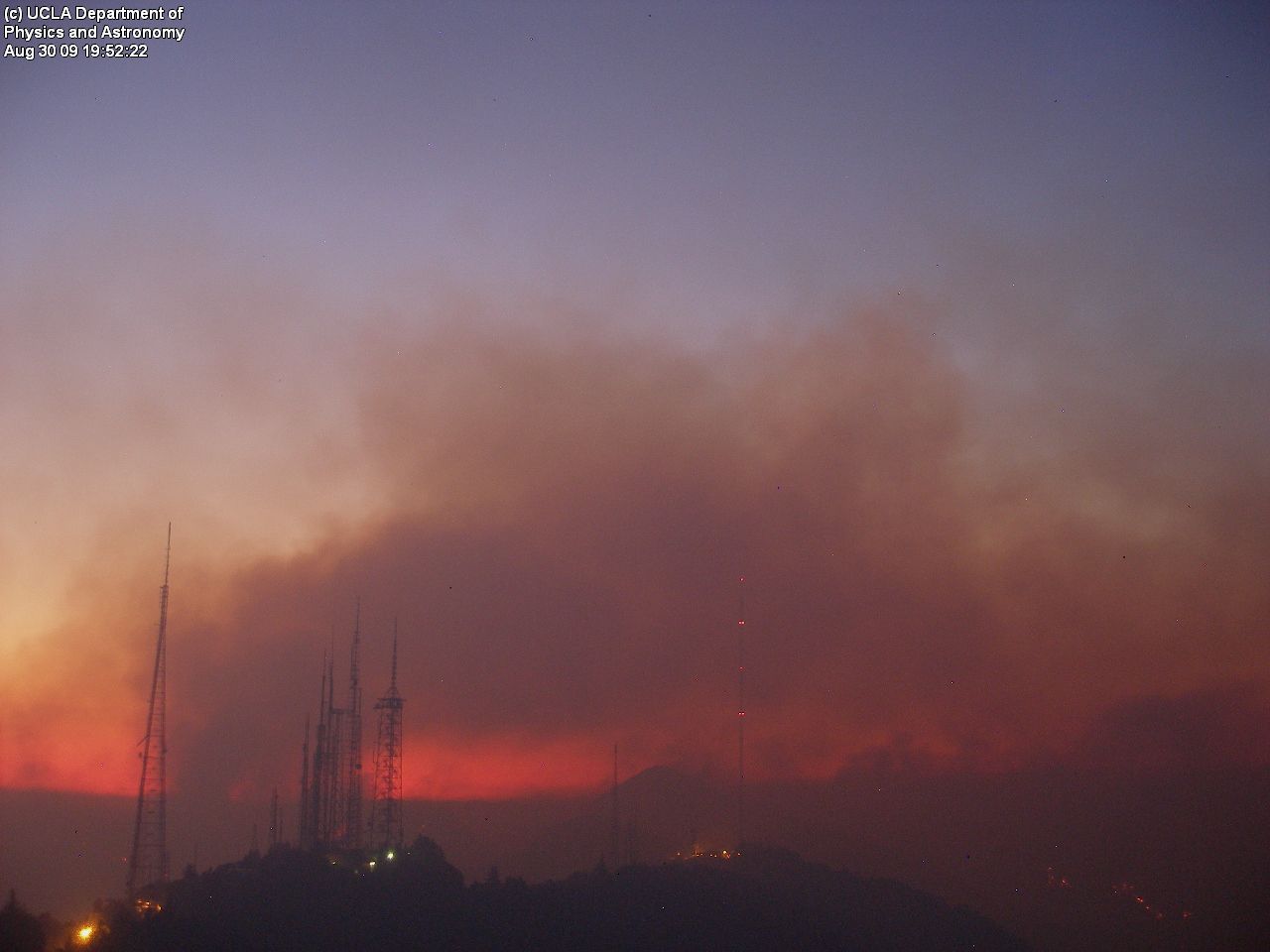
The view looking west from Mt. Wilson Observatory at 8:17pm PST (Aug. 30th)

Update: Monday, August 31st, 05:45 PDT: In the early hours of Monday morning, it would appear the situation atop Mt. Wilson remains the same. The Towercam is showing smoke and fires to the West of the summit, but there is no further breaking news from the Observatory:

Monday, 31 Aug 09, 4:50 am PDT – No reports from the mountain yet this morning. Towercam shows new fire encroachment. The Inciweb update is eight hours old – 42,500 acres, 2,575 personnel – and two fire fighters lost.Mt. Wilson Observatory

Sunday, August 30th, 20:30 PDT: According to the Mt. Wilson Observatory fire updates, fire crews have decided to remain at the summit of Mt. Wilson to fight the Station Fire blaze overnight. There were concerns this evening that the conditions would be too treacherous for the fire fighters to remain behind, but it would appear this has changed.

Sunday, 30 Aug 09, 8:07 pm PDT – A critical aspect to the survivability of the Observatory should the fire sweep across it is whether or not fire fighters will be on site during such an event. The U.S. Forest Service continually assesses the danger to fire fighters in any scenario and will withdraw fire crews in situations that are particularly precarious. Such an evaluation took place on Mount Wilson in the last half hour with the decision for the fire crews to remain in place tonight. That’s very good news.Mt. Wilson Observatory

But the fire continues and Mike Brown, an astronomer who lives near (but doesn’t work at) Mt. Wilson, tweeted his eye witness account of his view of the fire: “Holy smokes; massive glowing plume tonight just west of Mt. Wilson is scarier than last nights 50 ft flames. #stationfire.”

Unfortunately, in another location, two fire fighters have tragically lost their lives fighting a blaze in Acton. According to reports from @CalFireNews and the LA Times the fire fighters were involved in an accident where their vehicle apparently rolled over a mountainside. The accident happened during a period of intense fire fighting.

This is a horrific reminder that hundreds of brave men and women are currently out there battling against hellish heat and poisonous air. My thoughts are with the lost fire fighters families and the fire fighters that continue to push on through the night atop Mt. Wilson and the areas hit hard by the Station Fire.

Updates pending…

“Station Fire” Could Damage Mount Wilson Observatory [Update]

The Mount Wilson Observatory webcam, looking west. City lights to the left is the approximate location of Burbank (©UCLA)
The Mount Wilson Observatory webcam, looking west. City lights to the left is the approximate location of Burbank (image corrected for contrast. ©UCLA)

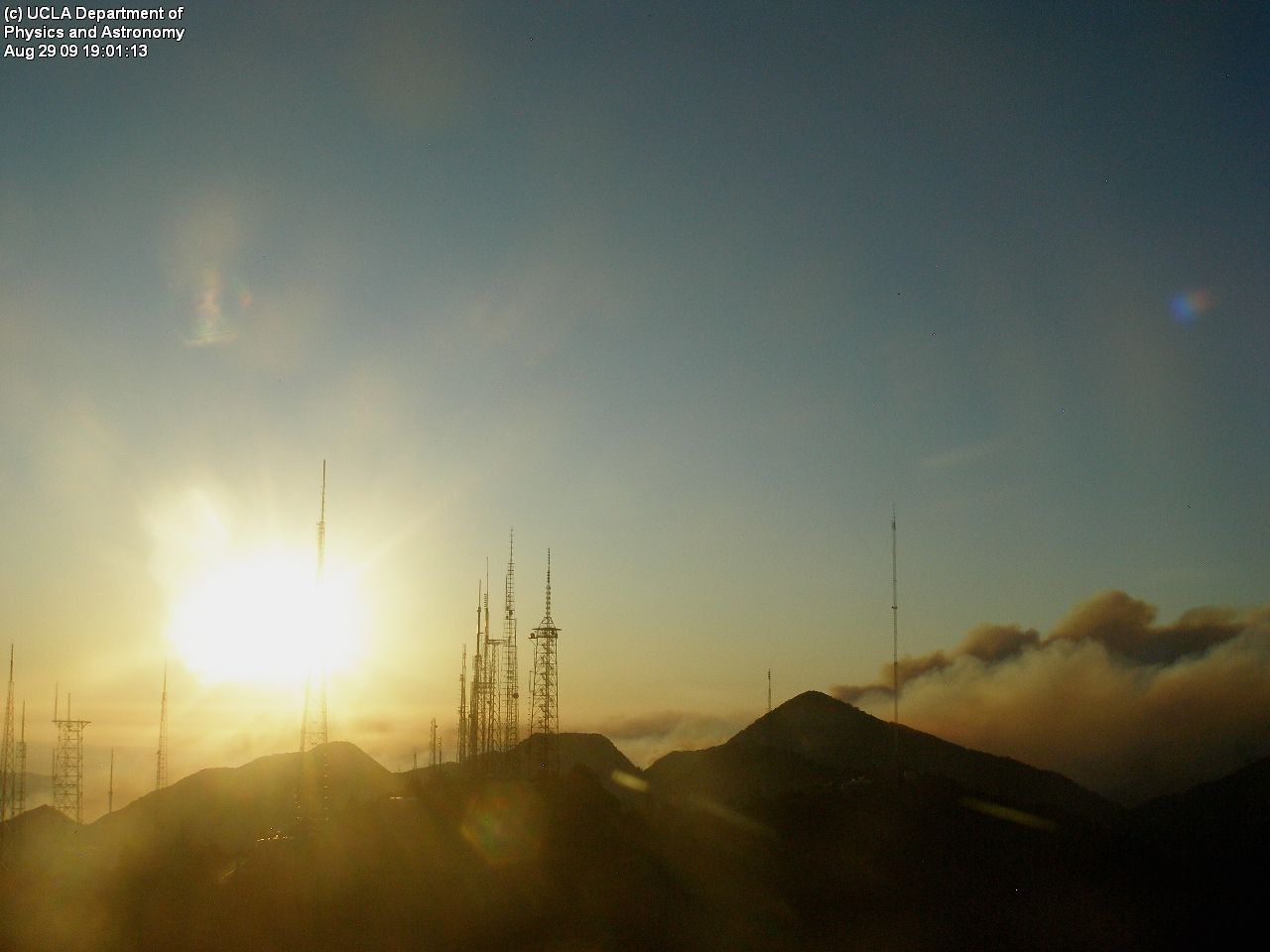
August 29th: As the fires rage in Southern California, the “Station Fire” continues to burn unnervingly close to the famous Mount Wilson Observatory, about 50 miles east from my location. The above image was captured at 8:29pm (PST) tonight from the observatory’s 150-foot Solar Tower webcam (called the “Towercam”), and it’s pretty obvious how close the fire is.

Mount Wilson at sunset earlier today (©UCLA)

Mount Wilson isn’t just important for the observatory, it is also home to telecommunication masts that are a lifeline for emergency services.

If Mount Wilson goes out, this news conference is done, because we won’t have any telecommunications,” Deputy Los Angeles County Fire Chief Jim Powers said in a press conference this morning.

Update (August 30th, 19:40 PST): Things are looking a little grim for Mt. Wilson. A couple of hours ago, the LA Times reported that the Station Fire was expected to reach the summit of Mt. Wilson in 2-4 hours. The worst news is, that due to a lack of escape routes at the observatory, fire crews will have to abandon the site should the fire get too close.

It’s a serious situation,” said Bob Shindelar, operations branch director of California Incident Management Team 5. “Is the observatory going to make it? We’re doing everything in our power. But I wouldn’t be surprised if it is impacted by fire today or tomorrow.”

The view from Mt. Wilson, facing west at 19:52 PST (Aug. 30th)

At 17:42 PST, the fire was within 2 miles of the summit and closing. Fire crews have been working on removing brush from the observatory buildings, structures that cover many acres.

I was driving through Woodland Hills today, and the view from here was ominous. The smoke is thick, and a huge cumulus cloud was rising high in the atmosphere. At one point, the scene looked like a volcano from a distance.

Reports from the observatory itself however remain a little more upbeat than the LA Times with this update on their website:

The LA Times has released this article in the last hour. Our reports on site are not presently so dire, but the “fog of war” certainly exists in a situation like this. Every preparation is being made for this scenario, and it may indeed yet happen. I remain optimistic for now.

Lets hope the spreading fire slows before it reaches the observatory and telecommunication masts…

Updates pending…

Thanks to Mike Brown (@plutokiller) for the link to the Towercam.

Lost In Space: India’s Chandrayaan-1 Moon Mission Goes Silent

A miniature replica of the Chandrayaan-1 spacecraft (V. Ganesan/The Hindu)

Just as one mission begins (Discovery’s STS-128), another ends. Unfortunately, only 10 months after launch, the Indian Space Research Organization’s (ISRO) lunar satellite Chandrayaan-1 has mysteriously ceased communication with mission control. ISRO officials have declared that the mission has ended, 14 months earlier than planned.

On Saturday, at 1:30am local time, the ISRO lost communications, and according to a spokesman, the agency is no longer in control of the spacecraft. Chandrayaan-1 data was being received by a monitoring unit in the southern city of Bangalore. There is currently no explanation for the failure.

The mission had completed 3,400 orbits of the Moon and everything seemed to be operational for the next few thousand orbits. The ambitious mission was launched by the fledgling space agency to allow India to stake a claim over lunar exploration with the future hope of exploiting the Moon’s natural resources (such as the abundance of uranium). This mission put India into a very exclusive club of only five international space agencies that had sent missions to the Moon before (NASA, JAXA, ESA, ROSCOSMOS and the CNSA).

This isn’t the first problem the satellite had suffered, however. In May, the probe lost a critical instrument called a star sensor, and then in July, the craft overheated. Fortunately, further damage to the rest of the satellite was averted by ground controllers.

Despite the obviously upsetting news about the loss of the $80 million piece of ISRO hardware, officials are surprisingly upbeat about the whole thing.

The mission is definitely over. We have lost contact with the spacecraft,” Project Director M. Annadurai said. “It [Chandrayaan-1] has done its job technically… 100 per cent. Scientifically also, it has done almost 90-95 percent of its job.”

Personally, I think the ISRO did a superb job at developing Chandrayaan-1 mission, and simply getting the thing into lunar orbit is an incredible feat. Another aspect I was impressed with was the ground controllers’ ability to deal with problems in-flight and fix them accordingly. This can only help to strengthen India’s ability when launching future missions to the Moon.

Sources: The Hindu, New York Times

Discovery is Still on the Launch Pad

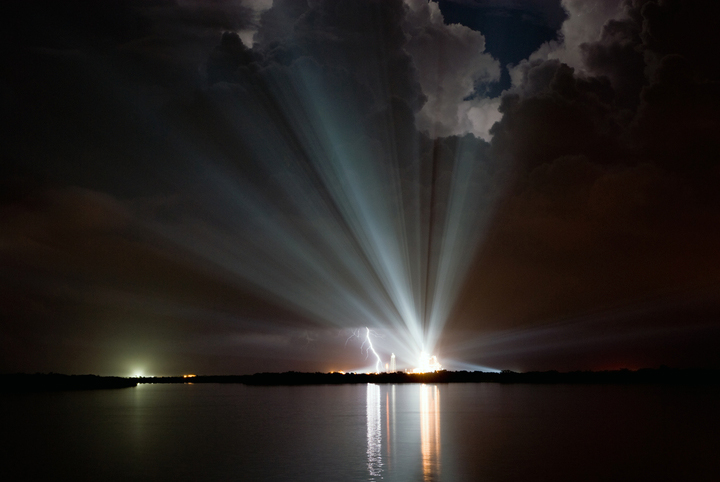
Discovery on Launch Pad 39A... Friday launch? (NASA)

To be honest, I wasn’t going to post an update on the progress of Discovery’s continuing delay, but when I saw this photo I couldn’t resist. In the shot, you can see the pad floodlights and a flash of lightning. Outstanding.

So, the next launch window is looking like it’s going to be at 11:59pm (EDT) Friday night. This will give launch crews some time to analyse results from tests they are carrying out on the potentially faulty valve that caused the previous launch scrub. However, NASA is hopeful the fault is with the sensors giving false readings rather than an engineering fault with the valve itself.

For more shuttle launch updates, keep an eye on Irene Klotz’s Free Space blog

“Knowing” How Solar Flares Don’t Work


knowing-flaming-earth

My wife turned to me as the credits rolled and asked, “Can you sue a production company for inaccurate science in a movie?

Hmmm… good point!” I said. “Unfortunately, though, I think it’s just called ‘being creative.’

But that got me thinking.

Knowing not very much

We’d just sat through the Nicholas Cage disaster movie Knowing after heavily criticising the last hour of magical solar flares, prophecies, silly religious undertones and complete disregard for a little thing called “science.” Oh, and there were aliens. Who would have guessed?!

I would say that apart from these things, it was actually a pretty good film… but I’d be lying. Well, a little. I was actually quite impressed by the assorted disaster CGI and the acting (I’m glad Rose Byrne is getting some big roles, as I think she rocked in Damages), but generally, I was disappointed. I think I would have enjoyed it more if the director Alex Proyas didn’t have such a contempt for asking a science advisor for… I dunno… “advice.”

In fact, I’m not even going to bother researching whether there was a science advisor in the production crew or not, because either a) the rest of the crew didn’t listen to him/her, b) the science advisor was lying about his/her credentials or, c) the science advisor was stoned/drunk while on the set. Therefore, in my mind, there wasn’t a science advisor involved in the making of this film.

Putting the stupid plot, aliens (double-facepalm), Byrne’s character’s death and no science advisor to one side, I still cannot understand how they got solar flares so wrong.

Kaboom! Whoooshhh! Fizzzzz….

I’m not being funny, it’s as if Proyas didn’t bother to Google “solar flare,” just to check to see how solar flares really do work. Hell, go to the self-explanatory HowStuffWorks.com and do a search for “Sun.” If either one of these things were done during pre-production, the science may actually have been plausable.

In a totally forgettable scene, right toward the end of the movie, the uber-scary solar flare waits to be blasted at Earth. Cage gets on the phone to his Dad saying something like, “You know it’s been pretty hot lately? Well, it’s about to get hotter!” That’s an epic solar fail already. For some reason, the world had gotten hotter and everyone just shrugged it off as a warm October? I’m thinking the Sun would need to be whacking out a huge increase in energy, and in which case, those bumbling solar physicists or the N.O.A.A. (or “EN-Oh-Ay-Ay” as the cast painstakingly spells out) might have noticed?

I’m a stickler for realism in movies — so this is just a personal gripe — but why weren’t real images of the Sun from SOHO, TRACE, Yohkoh, Hinode or STEREO (let alone the countless ground-based solar observatories) used at all through the entire film? Instead, we see a strange blob of CGI graphic, shimmering like a corporate logo on computer screens, being referred to as “our Sun.” I’m pretty sure NASA would have happily provided some real pictures of “our Sun” if they were asked.

Solar flares or cosmic death rays?

But the best part of the entire movie is when we get hit by the super flare. Oh dear lord. If you weren’t terrified of the Sun before, you will be now. That thing can incinerate cities! It’s radiation can penetrate the Earth a mile deep! Holy cow, it is like a trillion-billion atomic bombs all going off at the same time!!!

Ah, I stand corrected. The production crew obviously did Google “solar flare,” but only read the bit where it says “…an energy of 100 million Hiroshima bombs is released…” That’s big right? Yep, Earth is toast!

Unfortunately, they didn’t read the bit which points out that this huge explosion occurs deep in the solar corona, 100 million miles away (that’s a long way away).

Also, they didn’t realize that even the biggest solar flares and coronal mass ejections (the latter wasn’t mentioned once for the whole movie) are deflected by our planet’s magnetosphere and thick atmosphere.

The only science that was mentioned was that the “flare” would hit our atmosphere, destroying our ozone, thereby killing everything on the planet. In actuality, if you watched the “flare” hit Earth, I’m not sure what the ozone had to do with anything! That “flare” was like a cosmic ray gun, ripping through the atmosphere and the Empire State Building (oh yes, there was a lot of “famous landmark shredding”) as if it was a hot knife slicing butter. I don’t think we need to worry about excessive UV exposure due to lack of ozone when Earth is on fire.

There’s a list of things that annoyed me about this movie, and I don’t have the patience to mock all points, but after my wife wondered about suing a movie for bad science, I got to thinking what damage movies do to the perception of science. Oh yes, I know it’s sci-fi, I know it’s “just a movie,” I really do know that it’s not real, but wouldn’t it be fun to have a disaster flick that uses some real science for a change?

Real science is sexy too

As I was discussing with solar physicist Alex Young in last week’s filming of the Discovery Channel 2012 documentary, the real threat of a massive solar flare is actually pretty daunting. Granted, the Sun isn’t about to fire a cosmic death ray at us (and let’s face it, the Sun isn’t going to do anything any time soon), setting the planet on fire, but the real physics would be awesome if used in a disaster movie.

Just imagine if we had a disaster movie that depicted a solar flare erupting on the surface of the Sun, just above a highly active region of clustered sunspots and stressed coronal loops. We could see real movies of intense magnetic activity, and then suddenly the blinding burst of electromagnetic radiation. This flare could be the biggest the Earth has seen in modern times. The X-rays from this event knock out solar observatories, stunning the delicate light-collecting CCDs in their cameras. These X-rays immediately slam into our ionosphere, causing a massive surge of electrons, blocking global communications. This may have the knock-on effect of causing our atmosphere to heat up and swell, increasing the drag on our orbiting satellites.

In the first moment when we see the flare, already we see global problems. But this would only be a precursor to something a lot worse…

I can imagine the scene in the perfect movie: Our brave, and smart solar physicists are looking at live data streaming from the Solar and Heliospheric Observatory (SOHO), a multi-instrument telescope sitting between the Earth and the Sun. They see an expanding bubble growing well beyond the disk of the Sun. An alert is sent out to the authorities; a CME is coming… and it’s headed straight for us… it will hit in a few hours. Cue the countdown to CME impact (the suspense will be tangible, you won’t be moving from your seat). But wait! Communications are patchy, the ionosphere just blocked the satellite link to the US President… time is running out! Bruce Willis, our hero heliospheric expert, steps in and volunteers to notify the president himself (with a gun in his pocket, as there’s bound to be an assassin or terrorist out there to shoot at).

Planetary mayhem

But the fun would really begin when the CME slams into our magnetosphere. The magnetic field of the CME and that of the Earth’s hit in such a way that they reconnect, flooding the magnetosphere with high energy particles. The Earth’s Van Allen belts become supercharged like radioactive reservoirs. Satellites are overcome by high-energy particle impacts. Global Positioning Satellites (GPS) go offline. Communication satellites suffer drag and literally start to drop out of the sky.

And it gets worse!

The solar particles are deflected toward the poles, but the solar storm is so intense, particles penetrate deeper, generating vast aurorae at low latitudes. Even equatorial regions would see vast light shows as the particles flood in from space. Although amazingly beautiful, this has yet another side-effect, our atmosphere just became a huge conductor, where vast currents flow as electrojets. These electrojets generate massive magnetic fields, in turn overloading our national grids.

We now have no power and no means to communicate. We’re blind and unable to function. Governments are overwhelmed. Imagine Katrina-scale events all over the USA… all over the world. Who can help? Suddenly the $2 trillion damage estimate made by NASA seems too small… after all, we’d be plunged back into the dark ages, how can you count costs in dollars when a financial system no longer exists?

Conclusion

I don’t expect movies to be totally scientifically accurate. However, if you are basing an entire storyline on one harbinger of doom, at least get that right.

A solar flare will hit Earth in the future, there’s even a very good chance that we’ll get hit by a “big one” that could cause some collateral damage. In fact, if we are very unlucky, a large solar storm could be considered “civilization ending.” Yes, asteroids pose a clear and present danger to life on Earth, but don’t forget the Sun, it has a history of getting angry when the Earth is in the orbital firing line.

If that isn’t a great plot for a disaster movie, I don’t know what is.

Special Ops Bunnies

Blood-thirsty bunnies? If only you knew... (The Oatmeal)

Thank you Kate (@KateSherrod) for thinking of me and sending me this hilarious post called “8 Ways To Prepare Your Pets For War” from The Oatmeal. No science here, just funny cartoons.

However, do you think Barney could be trained for special ops? You decide:

He has the stealth of a ninja...
...but the brains of a bunny.
...but the brains of a carrot.

Unexpectedly Large Black Holes and Dark Matter

The M87 black hole blasts relativistic plumes of gas 5000 ly from the centre of the galaxy (NASA)

I just spent 5 minutes trying to think up a title to this post. I knew what I wanted to say, but the subject is so “out there” I’m not sure if any title would be adequate. As it turns out, the title doesn’t really matter, so I opted for something more descriptive…

So what’s this about? Astronomers think they will be able to “see” a supermassive black hole in a galaxy 55 million light years away? Surely that isn’t possible. Actually, it might be.

When Very Long Baseline Interferometry is King

Back in June, I reported that radio astronomers may be able to use a future network of radio antennae as part of a very long baseline interferometry (VLBI) campaign. With enough observatories, we may be able to resolve the event horizon of the supermassive black hole lurking at the centre of the Milky Way, some 26,000 light years away from the Solar System.

The most exciting thing is that existing sub-millimeter observations of Sgr. A* (the radio source at the centre of our galaxy where the 4 million solar mass black hole lives) suggest there is some kind of active structure surrounding the black hole’s event horizon. If this is the case, a modest 7-antennae VLBI could observe dynamic flares as matter falls into the event horizon.

It would be a phenomenal scientific achievement to see a flare-up after a star is eaten by Sgr. A*, or to see the rotation of a possibly spinning black hole event horizon.

All of this may be a possibility, and through a combination of Sgr. A*’s mass and relatively close proximity to Earth, our galaxy’s supermassive black hole is predicted to have the largest apparent event horizon in the sky.

Or does it?

M87 Might be a Long Way Away, But…

As it turns out, there could be another challenger to Sgr. A*’s “largest apparent event horizon” crown. Sitting in the centre of the active galaxy called M87, 55 million light years away (that’s over 2,000 times further away than Sgr. A*), is a black hole behemoth.

M87’s supermassive black hole consumes vast amounts of matter, spewing jets of gas 5,000 light years from the core of the giant elliptical galaxy. And until now, astronomers have underestimated the size of this monster.

Karl Gebhardt (Univ. of Texas at Austin) and Thomas Jens (Max Planck Institute for Extraterrestrial Physics in Garching, Germany) took another look at M87 and weighed the galaxy by sifting through observational data with a supercomputer model. This new model accounted for the theorized halo of invisible dark matter surrounding M87. This analysis yielded a shocking result; the central supermassive black hole should have a mass of 6.4 billion Suns, double the mass of previous estimates.

Therefore, the M87 black hole is around 1,600 times more massive than our galaxy’s supermassive black hole.

A Measure for Dark Matter?

Now that the M87 black hole is much bigger than previously thought, there’s the tantalizing possibility of using the proposed VLBI to image M87’s black hole as well as Sgr. A*, as they should both have comparable event horizon dimensions when viewed from Earth.

Another possibility also comes to mind. Once an international VLBI is tested and proven to be an “event horizon telescope,” if we are able to measure the size of the M87 black hole, and its mass is confirmed to be in agreement with the Gebhardt-Jens model, perhaps we’ll have one of the first indirect methods to measure the mass of dark matter surrounding a galaxy…

Oh yes, this should be good.

UPDATE! How amiss of me, I forgot to include the best black hole tune ever:

Publication: The Black Hole Mass, Stellar Mass-to-Light Ratio, and Dark Matter Halo in M87, Karl Gebhardt et al 2009 ApJ 700 1690-1701, doi: 10.1088/0004-637X/700/2/1690.
Via: New Scientist

No Matter How You Spin It, A Hole is Still a Hole

Mars Express to Beagle 2: But you forgot your... ah, never mind.
Mars Express to Beagle 2: "But you forgot your... ah, never mind." (ESA)

Over Christmas in 2003, I was watching the BBC news with my grandfather, hoping to hear that ESA or NASA had picked up a signal from the Martian surface. We waited.

We waited a bit more. However, it wasn’t until some weeks later (if I remember correctly) that the UK’s Beagle 2 Mars lander was officially declared dead (although I suspected as much in the 30 minutes of silence after the time it was supposed to touch down). The little lander’s taxi ride across millions of miles of space, the Mars Express, was working just fine, but Beagle 2? Not so much.

This was incredibly sad on so many levels. From a patriotic viewpoint, I was shattered. The chance to have a British presence on the Red Planet would not only have been inspiring, it may have given funding a small boost for the UK science community. Also, personally, only the week before, I’d been defending the mission to some friends who were convinced that the crazy idea of sending a British probe to Mars was pointless, as it was never going to make it.

What ever came before that December in 2003, it was all academic. Beagle 2, for whatever reason, didn’t phone home. Game over.

Of course, that wouldn’t be it. For months after, Martian satellites hunted for any evidence for a mini Beagle-shaped divot in the red dirt. Eventually, they found it, two years later.

So what happened to the little robot? Why did it turn into a meteorite and not a lander? Well, back in 2008, Madhat Abdel-Jawad and his engineer team at the University of Queensland thought they’d worked it all out. Apparently, Beagle 2’s gyroscopic spin was too fast, causing it to become unstable during re-entry. This may have caused it to tumble as it entered the Mars atmosphere. Obviously, tumbling isn’t good, so it hit the ground like scrap metal.

As it turns out, the Beagle 2 team are far from convinced this happened at all. Arthur Smith of Fluid Gravity Engineering in Emsworth, Hampshire, points out that Abdel-Jawad’s team did not simulate re-entry in a gravity field, and they failed to realize the lander had an offset centre of gravity. This means the simulation wasn’t complete, indicating the “tumbling Beagle” may not be the final explanation.

Now, Smith and his team will be publishing a paper with their findings

All our assumptions were valid over the time of flight we analysed,” Abdel-Jawad said in response to this news. “We would be delighted to accept the findings of the Beagle team’s new study if it were found to be valid after we review their analysis.”

Whether the Australian team is correct or not seems rather academic. Something went terribly wrong during re-entry, this is true, but there are so many variables that I’m not sure if we’ll ever hit on the real reason why Beagle 2 dropped from the sky that 2003 winter. Sure, it might aid future development of future landers, but unless they find a gaping design flaw or construction mistake (like the NASA Genesis “woops, I installed the accelerometer backwards” mission mishap), Beagle 2 made a crater in the Martian surface, and there won’t be a crash recovery team to pick up the bits for a long while yet…

Source: New Scientist

District 9: Grit, Gore and Glorious Science Fiction

Wikus (Sharlto Copley) on the run from the MNU (WingNut Films).

Astroengine District 9 Review.

I managed to watch District 9 last night, and it was awesome. I may as well tell you my conclusion up-front, just in case you don’t want to read on, because I’m not going to be able to avoid mentioning some spoilers. So, if you haven’t already done so, get down the theatre now to watch a unique and enthralling sci-fi docu-action-thriller (but beware, there’s lots of exploding heads and alien gore, so go easy on the popcorn and fizzy drinks).

Generally, it looks like District 9 has received good reviews and a robust nod from the science fiction community, and now I’m going to weigh in with a review from Astroengine.com.

First and foremost, I think D9 surpassed pretty much all of my expectations, which is rare for Hollywood produce these days. It was little surprise then, that this movie wasn’t of the Hollywood brand, it came from the genius mind of the South Africa-born director Neill Blomkamp and Peter Jackson‘s production company Wingnut Films. The whole thing was shot in the gritty South African city of Johannesburg.

Setting the scene

The face of a “prawn.” Kinda cute in a squiddy way.

An alien spaceship breaks down on Earth and comes to a stop over Johannesburg. After several weeks of not seeing any sign of life, the authorities decide to cut their way into the ship. They find hundreds of thousands of malnourished insect-like, human-sized aliens inside. Humans do the right thing by setting up a makeshift shelter in Johannesburg, called District 9 (it is of no coincidence that there’s a similarity with the real events in District Six during the 1966 apartheid government rule). So far, so good.

After a couple of decades of living in the D9 shanty town, the local human populous is getting fed up with their alien neighbours (they derogatively call “prawns”). As it turns out, these aliens don’t appear to be very smart and they are certainly not organized. They have no leader and they are thought to be the “workers” of their alien race. They are far from being the sophisticated invasion party one would expect a technologically advanced race to be like.

Alien underdogs

This is the coolest thing about this movie; the aliens are cast as the unfortunate underdogs that are being forced to stay on Earth by their human captors. Why? Technology, of course.

A military organization called Multinational United (MNU) is put in charge of moving the million-plus alien beings to a new concentration camp housing facility 200 miles away. The whole operation is led by a bumbling MNU field operative called Wikus van der Merwe (played by Sharlto Copley). Wikus is your standard trying-way-too-hard-to-please-and-failing guy with a loving wife (who can somehow see past his many social flaws) and tough father-in-law (who is the head of MNU and responsible for giving Wikus this “big break”). Wikus is almost like a South African hybrid of Steve Carrel, Steve Coogan and Simon Pegg.

Serving alien evictions. Not as easy as it sounds (that sounded easy?!)

There are some fantastic moments when an overly confident Wikus knocks on doors serving eviction notices to the aliens. It is an awkward, yet captivating scenario. The MNU, an organization that obviously has absolute power over the situation, has decided to make the eviction of the aliens seem “legal” by getting them to sign (or “scrawl”) their signature on a small piece of paper. Naturally, the aliens aren’t too happy about all this and Wikus is met with a variety of responses (one where the alien slaps the paper out of his hand and storms off — Wikus triumphantly points out that a tentacle hit the paper, it is therefore signed). Another funny legality is that the aliens have been given human names (such as “Christopher Johnson”) to make their very existence bona fide.

In the first third of the film there are several reminders that the MNU isn’t a tolerant organization. If the armed units are faced with any resistance, they kill on-site. However, they are faced with an impoverished, desparate alien populous that will do anything for a tin of cat food. They are more concerned about chewing on car tires than being shot at. The cat food actually becomes a commodity in District 9, a currency the local Nigerian gangs use to trade for weapons. There is also a hilarious reference to “inter-species prostitution.”

Human-prawn hybrid?

The movie starts off in hand-held documentary style (not in an annoying Blair Witch Project way), following Wikus on his alien eviction adventures, but the atmosphere of the story changes after he accidentally sprays himself in the face with a black fluid in an unidentified cylinder. There is then an altercation with one of “Christopher Johnson’s” friends who tries to distract attention away from the shack that contained Wikus was sprayed in.

Cue alien death, execution style, by the bald-headed bad-ass special unit military guy.

A dodgy stomach and a broken arm later, Wikus is stuck in a situation he can’t get out of. You remember that spray? It turns out that it’s not only a special, highly refined spaceship fuel, it’s also a way to really mess up your day if you breathe it in. Wikus has started to change into an alien.

This is probably one of the weaker parts of the story. How a nasal spray is going to tinker with your genetics in such a way that will turn you into a human-alien hybrid, I don’t know, but District 9 didn’t start with a claim that it was going to be totally scientifically accurate. Somehow Wikus’ left hand also turns into a clawed alien appendage. I’ll turn a blind eye to the fudged human-alien biology lesson.

Guards outside the grim District 9

So we’re locked in a race against time as MNU agents track down and capture Wikus as Wikus becomes more and more prawn-like. From being a flawed MNU officer, he has now become the most valuable human on the planet; he is the only one capable of operating the alien technology (their weapons only react to alien biology).

Prawn purée

During the period when Wikus has been captured and is being experimented on, the MNU shows itself for what it really is; a weapon research facility with little regard for human life, let alone alien life. In one particularly tough scene, Wikus has to fire an assortment of alien weaponry at animal carcasses against his will…

[If you told me before watching District 9 that I would feel shocked by the death of a CGI’d alien being, I’d assume I would have been drinking heavily beforehand. But no, I hadn’t had a beer (although the Pepsi was quite syrupy).]

…At this point, a live alien is dragged out with an X painted on its torso. When stood, shivering at the end of the shooting range, Wikus is ordered to shoot the alien. He refuses, crying. You see that Wikus does have a certain degree of respect for the aliens and he is certainly adverse to killing them. Unfortunately, tied in place, and alien weapon pushed in this hand, he’s forced to fire the gun at the frightened “prawn,” who explodes in a bloody mess.

It’s pretty grizzly and also a little upsetting. I think this is the moment in the movie that you know you are dealing with a different kind of sci-fi storyline and Blomkamp does an amazing job to shock, but not to go over the top.

Agony and terror

Christopher Johnson looks out of the prison van after being captured.

Also, you realize Sharlto Copley’s acting ability is nothing short of outstanding. Before the weapon testing scene, there’s a fair amount of humour angled at his character, afterwards you can feel his agony and terror.

Needless to say, Wikus escapes and runs to the only place he can find refuge: District 9. Fortunately, we are allowed a little time to recuperate after the MNU experiments as Wikus turns into a convict running through his own city.

After a period of making friends with the smart “Christopher Johnson” and little (and quite cute) pint-sized alien son, Wikus and “Christopher” work out they need each other to find a solution to the problems they are facing. “Christopher” needs to retrieve the mysterious cylinder from the MNU HQ to make the command ship (hidden under District 9) function, and Wikus needs alien technology from the mothership hovering overhead to stop him from going 100% prawn.

And so begins an orgy of human-popping. In the best human-alien buddy pairing since Han Solo and Chewbacca, Wikus and “Christopher” assault the MNU HQ with the best alien guns Wikus could steal from those Nigerian “inter-species prostitution” gangs (with a fetish for drinking alien blood and collecting alien junk they can’t use). Of course, now that Wikus can operate these guns, he can have some fun.

A clip from District 9: Wikus uses an alien weapon for the first time (language NSFW):

Many reviews of District 9 are critical of the amount of action in the rest of the film, but I thought it was pretty cool. Science-lite, but it sure was a tour de force of movie action imagination. My particular favourite was Wikus’ energy-lightning-bolt gun that had no difficulty in snuffing out MNU personnel in a cloud of blood vapour.

A few gun battles later, and we return to District 9, plus fuel cylinder. Quite a lot happens, but to cut a long story short… there were a lot of explosions. I don’t want to give away the ending, but it was fairly routine, with a couple of minor plot twists. When I say routine, I don’t mean it was boring, the movie simply went its course without too many surprises. Well, there might have been one or two