On its epic journey to Endeavour Crater, Mars Expedition Rover (MER) Opportunity passed a suspect looking boulder on July 18th. Dubbed “Block Island” by MER controllers, this dark rock looks very different from its surroundings, so Opportunity has been ordered to go off its planned route by 250 meters and have closer look.
Measuring approximately 0.6 meters across, the jagged specimen could be a meteorite, giving the rover a chance to carry out an in-situ analysis of its composition, determining whether or not this is indeed of extra-martian origin.
The odd-shaped and dark rock sits atop the regolith, and Opportunity will use its APXS instrument to determine its composition (NASA)
The next step is for the rover to extend its robotic arm, pressing the Alpha Particle X-Ray Spectrometer (APXS) up against the rock’s surface. The spectrometer will basically give the sample a blast of radiation, consisting of alpha particles and X-rays. The analysis of scattered alpha particles (after they have bounced off the material) will reveal the mass of the elements they collide with and the emission of X-rays will also reveal a lot about the material.
So could this be a meteorite? We’ll have to wait until the little robot has carried out its experiment… she may be getting old, but Opportunity is still carrying out some awesome science.
Dara O’Brian, Irish comedian, says it the way it is, and as Phil Plait said, “I sometimes think that comedians wield more skeptical leverage than bloggers.” This is true, but it’s up to us bloggers to post cool snippets from skeptical comedian sets and have a good giggle. So here’s the hilarious O’Brian, slamming crackpots across the board (beware the NSFW language):
All right, that title was a little harsh, but I think you get the point. It’s not that I don’t love Pluto, Pluto is a fine little planet… dwarf planet… hold on, plutoid. It holds a certain charm and mystique, plus we have the mother of all NASA missions (New Horizons) gliding its way to the outer icy reaches of the Solar System — the Kuiper Belt to be precise — to take a look at Pluto, up close, for the first time. I can’t wait for 2015 when the spacecraft starts taking snapshots, it will be awesome.
But what of the small planety-thingy’s status? Is it still a planetary outcast, destined for a life on Cosmic Skid Row? Or is Pluto about to get the mother of all reprieves and be re-classified as a planet? Does it really matter?
The reason why I ask is that the whole “demotion” thing was seen as bad news. I actually saw it as an exciting development in Solar System exploration (but hoped it wouldn’t tarnish the little rock’s popularity all the same). In actuality, Pluto is 27% less massive than the recently discovered dwarf planet Eris, so how could Pluto still be called a planet? Should Eris be classified as a planet, then? In light of new dwarf planet discoveries, Pluto became a rounding error and had to be re-classified. The International Astronomical Union drew up some planetary rules and found that Pluto didn’t have the gravitational clout to clear its own orbit and so was re-classified as a dwarf planet in 2006.
Suddenly, Pluto had “fans” that took the re-classification personally and got angry at the IAU for throwing Pluto out of the planetary club. Their reason? Only 4% of IAU members were present for the re-classification vote, they saw it as a personal slight against the “9th planet.” Even the nutty state of Illinois was FURIOUS and reinstated Pluto as a planet… (just in the state of Illinois).
We’ve heard this emotional story of planetary bullying over and over, so I won’t go over the details again. The whole Pluto story has been widely covered, many people pointing the finger at the evil IAU 4%, some have even gone as far as saying this is evidence that there is a growing rift between the public and scientists (let’s take national votes on scientific decisions! That would be fun). But what does it really matter? Really.
Is the Pluto re-classification a breech of our human rights? How about planetary rights? Is it indicative of the number of idiot scientists who voted in the 2006 IAU poll? Is this an indicator of poor scientific thinking? Could a war be sparked over this atrocity? Was it really a ‘bad’ decision?
Just so my opinion is known, I don’t care what Pluto is called. If NASA decided to explode Pluto as part of a Kuiper belt clearing project, then yes, I might be a bit annoyed; I’d even start a blog titled “Save Pluto.” But calling Pluto a dwarf planet (or the rather cute plutino) really doesn’t bother me. It’s a consequence of scientific endeavour, despite the perceived “controversy.” As the legendary astronomer Patrick Moore said, “…you can call it whatever you like!” Pluto is still Pluto.
However, it looks like Pluto might be re-classified again… big yawn.
This time, heavy hitter Alan Stern, Principal Investigator for the New Horizons mission, weighed in with his opinion on the matter. “Any definition that allows a planet in one location but not another is unworkable. Take Earth. Move it to Pluto’s orbit, and it will be instantly disqualified as a planet,” Stern said.
This implies that if Earth was moved to the Kuiper belt, as things move a lot more sluggishly out there, a planet with the gravitational pull of the Earth couldn’t clear its orbit, therefore the “must clear its own orbit” criteria is a bad location-based definition for a planet. (I would argue that there’s every possibility that Earth could clear it’s own orbit at that distance given enough time, but what would I know, I’m no planetary physicist, but everyone seems to have an opinion about Pluto, so there’s mine.)
This analogy is a bit like saying a car driven down a country lane is a car. But a car driven on a freeway is a bike.
There is the counter argument to this case; if there was something as big as Mars, or even Earth, it may have tunnelled out a path through the Kuiper belt, thereby clearing its orbit. Alas, there appears to be no solid consensus as to the nature of this littered volume of space (at least until 2015), hence all the fuss.
Now there’s some big noise that the IAU will reconvene and discuss the Pluto hoopla again, giving a vague glimmer of hope to pro-planet plutonites that the 2006 decision will be overthrown. Alas, I very much doubt that as, quite frankly, there are more pressing (and more interesting) matters to discuss such as: what the hell hit Jupiter?! We should re-classify Jupiter as ‘the inner Solar System’s gaseous protector’!
The National Space Society has done great work in the realms of space science outreach and project funding, and to be honest, I’m behind any non-profit that whips up enthusiasm and furthers mankind’s efforts in space. They are outspoken critics of space policy and NASA, which is usually pretty fair.
However, the NSS blog has dropped a few clangers of late, making me question whether they are on the right track.
Previously on the NSS blog, described in a misguided (yet well-made and undoubtedly enthusiastic) video, that by magically revisiting the Apollo era, the US can begin re-industrializing and build rockets. What happens then? A million jobs are created! Wow, why didn’t the NSS think of this years ago? Actually, as Greg Fish points out of Weird Things, snazzy videos and a triumphant call for factories to build stuff is a little naive at best.
Then there was the case of the publication of the draft Unified Space Vision headed by Buzz Aldrin that was picked up by New Scientist, only for the post to be hastily pulled from the NSS blog when it started to get all the wrong kinds of press (the draft letter was here, but now it’s not).
Assume that President Obama doesn’t care about NASA. When there was a talk of a missile gap [during the Cold War] NASA was important to show our technical prowess in a non-threatening way. NASA hasn’t been important to the President since. Presidents want NASA to demonstrate America’s technological leadership and not kill any one, that seems to be about it.
It is time for NASA to grow up and take responsibility for its self and its accomplishments, and do so within a flat budget. Don’t expect to see Apollo level funding again. Don’t expect a President with 2 wars going on, a third one possibly on the horizon, the worst economic crisis in the last 80 years, and a health care crisis to worry about NASA.
Barrak [sic] Obama put NASA in the able hands of Charlie Bolden and Lori Garver so he wouldn’t have to care about NASA and could simply make speeches about the wonderful things NASA is accomplishing during his administration.
Yey! Go US spaceflight! Woohoo! Doesn’t that make you feel all warm and fuzzy inside?
It’s one thing to criticise NASA and US space policy, but this is incredibly defeatist for an organization that should be working harder to promote the importance and shape the future of NASA science. Come on NSS! I’d happily see more enthusiastic videos about how a new spaceflight industry will save the economy (even if it’s unrealistic) rather than read someone’s depressing, and frankly limited, opinion that Barack Obama (note the correct spelling) doesn’t give a toss about NASA.
[ UPDATE:The site has now been updated with the correct spelling of the President’s name, but here’s the original post (thanks to Keith at NASAWatch and SpaceRef.com) ]
This blog post was picked up by NASAWatch.com, and Keith Cowling makes an interesting observation:
Ouch, this is rather gloomy and depressing talk from the National Space Society’s official blog given that two of its former Executive Directors are at NASA – one being Deputy Adminstrator and the other being Chief of Staff – and hold opposite, hopeful views of what lies ahead for NASA. It is also odd that the webmaster of this blog does not even bother to spell the President’s name correctly.
NASA is an easy target for critics, and the agency certainly has its problems, but I think this is a surprising cheap shot from a blog of the biggest US space advocacy non-profits.
When choosing a good April Fools joke, it must have several key attributes. But the priority is that it needs to be revealed on April 1st (obvious, right?). It is for this single reason why I suspect this isn’t a joke; the news was released in July.
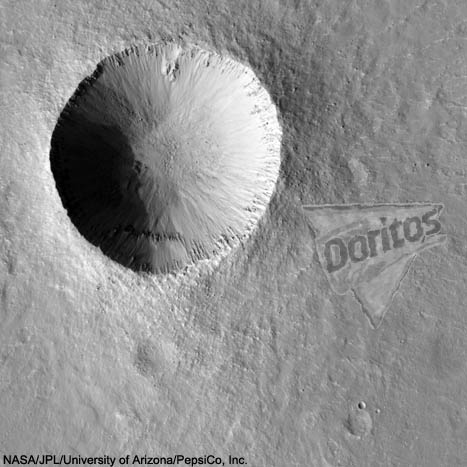
Before I get stuck into this article, let’s revisit a real April Fools joke I wrote for the Universe Today back in 2008, in which I talk about a fictional NASA press release that details the space agency’s plans to etch corporate logos into the Martian regolith (BTW this is a joke, just so there’s no confusion):
My pretend Doritos logo photoshopped next to a Mars crater (NASA/PepsiCo, Inc.)
Today, the space agency has announced an offbeat plan of their own: to burn sponsor logos into the surface of Mars. It’s not quite as reckless as it sounds, but existing technology on board the Mars Reconnaissance Orbiter (MRO) will be used to etch sponsor logos into the top layers of the Martian regolith. The stunt is expected to have minimal effect on the planet, as winds and dust storms will erase the ads within a couple of sols (Martian days). — Universe Today, April 1st, 2008.
In this April 1st article, I went into some detail about cash-strapped NASA reaching out to companies to invest in advertising campaigns. Advertising revenue from this could then be ploughed back into NASA science. It’s a win-win scenario, and what’s even better, the laser etched regolith (not an ability the Mars Reconnaissance Orbiter possesses, by the way) would be weathered away in a matter of sols (appeasing any Mars conversationalists). However, laser etching wasn’t the only idea I came up with. What about the Mars Expedition Rovers? Their tire tracks can be seen from space, why can’t they be used to sketch corporate logos in the red dirt?
Mars rover Opportunity's tiretracks as viewed by the Mars Reconnaissance Orbiter (NASA)
I had a lot of fun writing this, and I think it was convincing enough to be called a “good” space April Fools joke. Let’s put it this way, I had to think up an even more nefarious idea for the 2009 April Fools, but settled with the Brian Bat – NASA lawsuit story (which pissed a lot more people off than I thought possible. Score!).
So, right at the peak of the 40th Anniversary of the Apollo 11 lunar landing celebrations, a company that was founded in 2008 (apparently) called Moon Publicity unveiled its plans to sell advertising space on the Earth-facing side of the lunar surface, with this mouth-watering offer:
Exclusive transferable licensing is being made available for 44 regions of the visible side of the Moon. Bidding begins on July 20, 2009, the 40th anniversary of man’s first step on the Moon. Bidding will run for three months, closing on October 20, 2009. The winning bids will be announced in early November, 2009. Don’t miss this once in a lifetime opportunity. Minimum bids start as low as $46,000 (USD).
$46,000? Holy crapcakes! That’s not the half of it, if you want your ad to be placed in the dead-centre of the lunar disk (Mare Vaporum), be prepared write a $602,000 cheque.
Right… so how does Moon Publicity hope to succeed in this “once in a lifetime” marketing ploy? They are going to use their amazing “Shadow Shaping” technology (patent pending, obviously), otherwise known as ‘a moon rover with grooved grass rollers for wheels.’ Have a look:
As can be seen from the promo video, it certainly looks believable, but investing in a nice-looking bit of computer graphics is great if you consider there might be a minimum 5-figure return from an investor without a clue.
UPDATE: Just a thought. Since when was the lunar surface as flawless as a carefully smoothed golf sand trap? The ‘Shadow Shapers’ design obviously doesn’t cater for any obstacles (like, I don’t know… rocks) and is more accustomed to smoothing out the golden sands of Santa Monica beach. The lunar surface is covered in rocks of all sizes, ensuring the ad-making rovers will have a tough obstacle course at best. Most likely, these cumbersome rollers will get stuck, jammed or break down before they travel a couple of meters. What a great investment opportunity!
But what about the technical issues with this first-class money-making scheme? Actually, the company addresses quite a few on their “Shadow Shaping Challenges” page, that reads like a high school paper titled “Why Space Travel Is Really Hard” and describes every reason why there will be no investors in this project. Some of the best challenges are as follows:
“Gravity – It currently costs thousands of dollars per pound to move payloads from the Earth to the moon. Most of this is spent overcoming the Earth’s gravity.” Yep, right on, that’s rocket science 101. Call SpaceX, you’ll need them.
As the moon is so far away, the ads will need to be very big. “…images would need to be millions of square kilometers in size.” Yikes! “…a fleet of Shadow Shaping robots would be needed…” A big fleet, with at least a gazillion robots I reckon!
“Fire and Ice – Temperatures on the Moon range from 107°C during the day to -153°C at night…” Sure. “During the lunar nights, the Shadow Shaping robots can put themselves in hibernation mode to protect themselves from the cold. But during the days the robots need to be fully operational.” Sounds like standard phantom ad-making robot operating procedures to me.
“The wheels will also need to be hard so they do not wear out.” That sure would be useful.
[Shadow Shaping] “has no impact to the lunar environment, and it only creates images during partial lunar phases, leaving the full Moon unchanged.” I’m pretty sure the lunar aliens wouldn’t agree with you on this point.
So, apart from their patent pending we’re-going-to-dig-grooves-in-the-moon-using-our-make-believe-fleet-of-super-duper-roving-robots technique, I can’t see any real plan that this fanciful idea will ever see the light of day. And just in case you don’t believe me, Moon Publicity agrees, in a round-about way, in the disclaimer (I’ll emphasise the funniest bit):
Disclaimer: Investing involves risk. Licensing Shadow Shaping technology is no different. There are a number of identified challenges as well as unknown risks. Consult with professional advisers before registering to bid. The licensing offer is only available to accredited investors where permitted by law. Information provided is for educational purposes and is not guaranteed for accuracy or applicability. No warranties or guarantees, neither written nor oral, are provided with this offer. —Moon Publicity, LLC
To add insult to injury, in their blog, Moon Publicity says that they’re not really doing this for the money, they’re doing it for the sake of humanity.
However, consider the big picture. What is the biggest problem in the world? Is it hunger? Is it illness? Is it war? No. The largest problem is the inevitable extinction of the human species. The other problems don’t matter in a universe without people. Any number of global catastrophes could and eventually will end live on Earth. It could be a collision with an asteroid, a deadly virus, a nuclear war, a supervolcano, a hypernova explosion or our own sun eventually swallowing the Earth […] Creating images on the Moon provides a commercial incentive for turbo charging space travel technology. Shadows are only the beginning. These advancements will eventually place robots on other worlds building space stations and planting crops.
The Apollo 14 landing site as viewed from the Lunar Reconnaissance Orbiter. The astronaut footprints have remained for 40 years, imagine what that could do for advertising! (NASA)
Apparently, the largest problem is the inevitable extinction of the human species. No shit Sherlock! I’ll tell you what, throw in some 2012 rubbish and you’ll start to sound like one of the nutjobs with a doomsday book to sell.
It turns out Moon Publicity is a humanitarian operation too, jumping on the coattails of legitimate commercial spaceflight ideals in an attempt to profit from an idea that will never materialize. There’s also the argument that even if you did make the investment, and this company had the ability to etch ads in the dirt, would they even be allowed to? After all, who would have rights over the land they were etching?
I really do hope this is a poorly-timed joke, because it reads like one. If it’s not, it’s a rather stupid attempt at making a fast buck, using the 40th lunar landing anniversary as an opportunity to gain some publicity.
Still, I can’t help but wonder whether the Moon Publicity founder is a reader of the Universe Today, if so, I might start claiming I came up with the idea over a year ago…
Having a look at Mato Atom’s other videos, I found another creation that took my breath away. A computer generated flying saucer called the PussyMagnet 6009, animated to Bach’s Air (on a G-string). Once again, the title of the video suggests you might want to use this hi-tech flying saucer for something more than warping space-time, but this mock-advertisement is certainly in the style of an expensive BMW, Audi or Mercedes ad.
So, come the year 6009, you might see an ad like this on your TV screen (or whatever ‘screen’ we might use in 4000 years time), where the looks of space vehicles are just as important as their function. Some things don’t change…
So another eclipse, another momentous event if you could witness it, but if you couldn’t, at least you had some nice pictures to look at. However, there seems to be one forgotten spectator who had the best seat in the house to watch the moon pass in front of our Sun: the Hinode solar observatory.
Hinode (meaning “Sunrise”) is a space-based observatory launched by the Japanese space agency JAXA in 2006, and since then it has changed our perception of the inner dynamics of the solar corona. It can image the fine-scale magnetic structure of coronal loops and track plasma features with astounding precision.
Actually, I’m a little surprised there’s not much of a fuss about the eclipse from space. Admittedly, the lunar transit across the solar disk didn’t attain totality, but it sure looks amazing!
When I’m out of the office, it’s hard to get any blogging done. But when I’m out of the office in Las Vegas… it’s nigh on impossible to get any blogging done (not that I really should be blogging, but the roulette wheel bit me in the bum, so I’m back in the hotel room early). But I saw today’s superb XKCD comic and I had a giggle at the expense of my fellow physicists, so here’s an unexpected blog entry. Enjoy!
PS. If you don’t get it, I would explain it, but that would really be out of the scope of Astroengine. But if you’re interested in the physics more than the biology, here you go.
"It went bang!" exclaimed Barney, a rabbit who lives nearby.
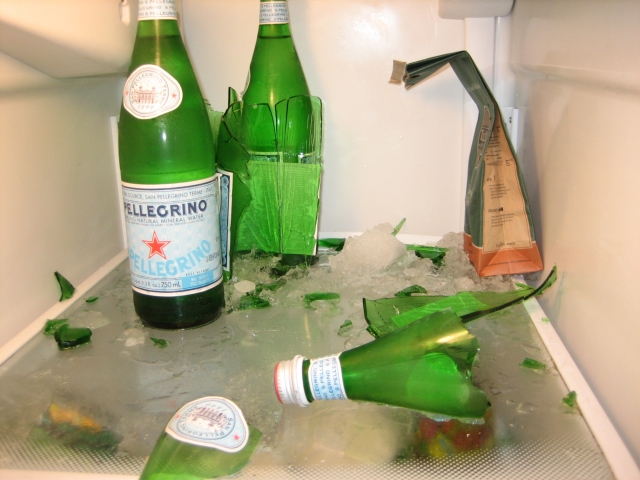
Interesting thing happened tonight. Not only did I accidentally pour dish soap into the dishwasher (yes, I know), two bottles of Pellegrino exploded in my fridge. Call it ‘applied physics’ if you like; water expands when it’s frozen, fizzy water explodes when frozen in a glass bottle! Hmmm… I never said my Ph.D. was in Common Sense… But in my defence, how was I supposed to know it was that cold in my refrigerator?
Barney was a little shaken from the loud bangs, but I think he’ll get over it (actually, he is over it, nom nomming on a bit of banana for his troubles).




 astroengine.com
