100th Carnival Of Space. Oh Yes! It’s the Centenary Edition!

header

One hundred Carnivals. Wow.

I think it goes without saying that this is a huge Carnival of Space, a celebration of the first century of space blogging as we move into the second. So long as I blog about space and science I will continue to participate in this supreme celebration of the space blogosphere.

So, over to Brian Ventrudo at One Minute Astronomer, for the huge 100th Carnival of Space!

Somewhere, something incredible is waiting to be known.” — Carl Sagan (from One Minute Astronomer)

Every Reason Not To Worry About Doomsday In 2012

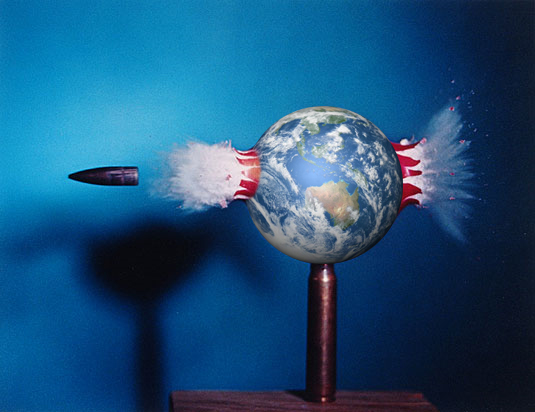
Image credits: Harold Edgerton (1964), NASA. Edit: Ian O'Neill

In today’s 365 Days of Astronomy, Cameron Hummels and Josh Schroeder from Columbia University, New York, discuss the 2012 doomsday hype. And it is awesome. The special thing about this podcast is that Cameron (who is working toward a PhD in astronomy) is clear, concise, and makes the whole crackpot 2012 doomsday scenario sound as petty as it really is.

In 10 minutes, the pair run through ancient prophecy, Mayan calendars, Planet X, galactic alignment and solar flares (to name a few) and carry out possibly one of the most comprehensive debunking efforts I have ever heard. They pretty much summed up all of my “No Doomsday in 2012” articles with a huge helping of skeptical thinking, plus extras, pointing out that all the doomsday hype is driven by little more than a small group of irresponsible individuals wanting to make some fast money from people’s fear.

Congratulations Cameron Hummels and Josh Schroeder, you’ve just scored one huge point for rational thinking and produced a wonderful celebration of scientific endeavour!

Go to the 365 Days of Astronomy podcast page to listen in »

Show description:

An increasing number of people believe that December 21, 2012 will mark the end of the world. Proponents of this idea cite diverse astronomical reasons for an imminent apocalypse: the end of the Mayan long-count calendar; an alignment between the Solar System and the Milky Way; the solar sunspot cycle reaching an all-time high; the reversal of the Earth’s magnetic field; and a devastating collision with ‘Planet X’. Tune in to hear to the facts and controversy surrounding this purported impending disaster.

Did Dark Matter Reionize the Universe?

Did dark matter characterize our early Universe?

Immediately after the Big Bang, 13.72 billion (±120 million) years ago, the Universe was filled with energy. Nothing but energy. No protons, electrons, quarks or photons; just energy. Even the fundamental forces of nature (gravity, weak, strong, electromagnetic) were a confused mess and could not be distinguished, but that issue didn’t last for long. 10-43 seconds after the Big Bang the grand unification epoch began, when gravity is thought to have separated from the soup. Shortly after, the strong force separated from the electroweak force in a period called the electroweak epoch.
Continue reading “Did Dark Matter Reionize the Universe?”

Flying Laser Ready to Begin Airborne Weapon Tests

The 747 plus ABL (USAF)

747 airliner? Check. Huge laser? Check. Huge-flying-missile-melting-laser? Nearly.

Actually, I’d want to fly the aircraft remotely, unmanned, and fire the oversized laser pointer at the 747 from a distance. Just to see how long it would take to melt. But that’s just me.

Boeing on the other hand, has succeeded in building a flying laser. Toward the end of 2008, the Airborne Laser (ABL) had been installed inside its Boeing 747 host and it was undergoing static tests. Sure enough, the megawatt laser had proven its worth and fired at a target, twice, in one-second bursts. Details are sketchy as to the damage the ABL caused, but Boeing and other US military contractors heralded the test as a success (if you ask me, the target probably looked like this afterwards).
Continue reading “Flying Laser Ready to Begin Airborne Weapon Tests”

Geodesy and GOCE: Astrocast.TV with Bente Lilja Bye

In the first episode of A Green Space — A Green Earth at Astrocast.TV, my friend and astrophysicist Bente Lilja Bye gives a superb overview about the Gravity field and steady-state Ocean Circulation Explorer (GOCE) that was finally launched in March. It’s a captivating show, detailing the history and science behind the study of geodesy (the gravitational field, shape and rotation of the Earth).

You may not be familiar with geodesy, but it is critical to advancing our understanding of the planet we live on. For example, GOCE observations could aid prediction techniques for earthquakes, or refine GPS data; suddenly geodesy has a very real and immediate relevance to us on the ground.

Be sure to check out the video below, it’s a very slick production. Great job Bente!

2012 Is Coming… And All I Got Was This Lousy Fridge Magnet

Screenshot from the Flash animation "The End of the World" by Fluid

Just when I was getting bored of the endless stream of 2012 doomsday hype (tripe), my interest was suddenly reinvigorated when I saw this advertisement:

2012 Calendar Magnet

$2.99 + shipping

Our calendar magnet is a real 2012 calendar. So you can have it on the refrigerator for 3 1/2 years! The calendar magnet is 4.25 inches wide and 5.5 inches long. It is also very clear and easy to read (looks better than the picture above, but is smaller). The shipping cost within the U.S. is $0.79 and for International orders $1.89.

No way. Oh yes. Yes, they did! The most well-known 2012 protagonist website is selling doomsday fridge magnets depicting an Earth plus comet barrelling towards it.

I had to triple-check, just in case this was the doomsday blogging equivalent to Punk’d. No, this is real: fridge magnets.
Continue reading “2012 Is Coming… And All I Got Was This Lousy Fridge Magnet”

Mars Chaos

Of all the places I’d want to visit on Mars, this would be high on my list. After travelling to the bottom of Hellas Planitia (for the thick atmosphere and possibly finding liquid water) and the summit of Olympus Mons (for the view), I’d be sure to have a scout around Ariadnes Colles, in the southern hemisphere (pictured above).

The Ariadnes Colles region may not be a household name, but looking at these new high resolution images coming from the Mars Express orbiter, I can’t help but be impressed…
Continue reading “Mars Chaos”

In 1911, Martians Were Building Canals

Martians Build Two Immense Canals In Two Years

On August 27th, 1911 the New York Times Sunday magazine ran an article entitled “Martians Build Two Immense Canals In Two Years”. Astronomer Percival Lowell had been studying the Red Planet and sketched what he saw, in this case, a growing complex of apparent canals on the Martian surface. There was even a nice little story that went along with this canal-building alien civilization theory. Lowell said, “The whole thing is wonderfully clear-cut,” that the Martian civilization was dying and they were building canals to reach the water ice in the Martian poles.

It turns out he was right about the water ice, but there’s no trace of this canal-building race on Mars… in fact there’s little trace of anything biological on the Red Planet. So apart from a few historic anecdotes, there’s still no life on Mars. The search continues.

Canals a thousand miles long and twenty miles wide are simply beyond our comprehension. Even though we are aware of the fact that … a rock which here weighs one hundred pounds would there only weigh thirty-eight pounds, engineering operations being in consequence less arduous than here, yet we can scarcely imagine the inhabitants of Mars capable of accomplishing this Herculean task within the short interval of two years. — Excerpt from the 1911 New York Times article.

Source: The Futility Closet (an awesome site)

Mars Can Be A Fuzzy Planet

The summit of Pavonis Mons (NASA)

This strange image was captured by the Mars Reconnaissance Orbiter’s (MRO) camera–the amazing High Resolution Imaging Science Experiment (HiRISE)–as it passed over one of the largest volcanoes in the Solar System, Pavonis Mons.

Located near the equator of Mars, atop the Tharsis bulge, Pavonis Mons is the second highest volcano after the huge Olympus Mons (towering over the Martian surface 27 km high). Pavonis Mons is still much higher than anything the Earth can muster, towering 14km into the atmosphere (compare that with the altitude of Mt. Everest’s peak height of 8.85 km).

So why is this picture so blurry? Is HiRISE suffering a malfunction? Did mission control send the wrong commands? Actually, HiRISE is working just fine. It’s the dust-covered surface that’s blurred.

As the ancient volcano is reaching so high into the Martian atmosphere, the air becomes very thin. The atmosphere was already thin; the average ground level atmospheric pressure is less than 1% of the Earth’s. At Pavonis Mons’ peak, the atmospheric pressure is ten-times thinner. Therefore any wind at these altitudes is extremely weak.

The extreme planet-wide dust storms that regularly engulf Mars dump huge quantities of dust on the top of the Martian volcanoes, but when the dust settles, there’s nothing to transport it elsewhere. Therefore, the thick layer of fine material remains where it is, tickled by the light-weight winds, rarely moving.

In the high resolution image, you can see some resolved features such as the odd impact crater and small ripples. Other than that, it’s a thick, smooth dust blanket that covers the Pavonis Mons summit, hiding any interesting geology for below, giving the impression any images of the summit are out of focus…

For more, check out The Blurry Summit of Mars’ Pavonis Mons on the Universe Today.

Asteroid Tanning in the Solar Wind Salon

Asteroids tan fast in the solar wind (ESO)

In a study carried out by European Southern Observatory (ESO) scientists, it was found that asteroids are susceptible to sunburn. By comparing the material found inside meteorites here on the ground with the colour of asteroids floating in space, there is a huge difference; the asteroids in space are redder.

So far, this might not be too surprising, after all, the surface of Mars is red with ferrous oxides (rust), why shouldn’t asteroids be red too? Actually, asteroids aren’t necessarily made of the same stuff as Mars, and they aren’t getting tanned due to the Sun’s ultraviolet rays; asteroids are bathed in ionizing solar wind particles, causing the asteroid’s surfaces to redden over a period of time. And that period is short when compared with Solar System time scales. It only takes a million years for the surface of young asteroids (born from energetic asteroid collisions) to weather under the constant barrage of particles from the solar wind.

This has some interesting implications for asteroid studies. Possibly the most striking factor this study uncovers is the nature of near-Earth asteroids that have been observed exhibiting comparatively “young” surfaces, apparently free from solar wind reddening. Previously, astronomers have agreed that these young surfaces were down to recent asteroid collisions. However, the period of the solar wind tanning effect is much shorter than asteroid collision frequency. So even if two asteroids collided, in all likelihood, if we observed one of these asteroids, the solar wind would have weathered the surface back to its reddened state.

It turns out that some near-Earth asteroids have “young” surfaces due to gravitational interactions with planets as they pass. When this happens, the red dust is “shaken off”, revealing the untouched rock beneath.

For more, check out my article Young Asteroids Age Fast with a Solar Wind Tan on the Universe Today.