Astroengine Live Show #12: Life on Europa?

promo10

In today’s Astroengine Live (WPRT Radio at 7pm EST), I’ll be discussing some of the exciting stuff that has been going on in space (and in the space blogosphere) over the past seven days. Also, I am very excited that today will air Astroengine Live’s first interview that was recorded last Friday. In the short discussion with Dr Greenberg (author of “Unmasking Europa”), I gained an insight to his excitement about Jupiter’s fourth largest Moon, Europa, and what implications this icy world holds for the search for extraterrestrial life.

All going well, this week should be free of technical hitches (if you listened to Show #11, it was a feast of the worst live radio could throw at me), but the thunder clouds are building outside…

Get Involved!

Have any articles or stories you want to contribute? Have an opinion on anything in the world of space? Email me on astro@wprtradio.com and I’ll be sure to give it a mention. Eventually, I hope to have telephone call-ins, but for now, email will do.

Listen to Astroengine Live using the Paranormal Radio player. Or, pick up the podcast feed to activate your favourite audio software.

Not Just a Satellite: NASA’s Orbiting Carbon Observatory Fails (Update)

The fairing of the Taurus XL rocket upper stage failed to separate correctly, in this morning's OCO launch (Vandenberg Air Force Base/NASA)
The fairing of the Taurus XL rocket upper stage failed to separate correctly in this morning's OCO launch (Vandenberg Air Force Base/NASA)

In the early hours of this morning at 1:55am PST, a carbon dioxide monitoring mission was launched from Vandenberg Air Force Base in California. NASA’s Orbiting Carbon Observatory (OCO) was being carried into a 700 km polar orbit by a Taurus XL rocket. Unfortunately, 12 minutes and 30 seconds into the flight, the rocket upper stage suffered an anomaly, and the fairing failed to separate. Although it appears the rocket attained the desired altitude The vehicle did not attain the desired altitude and the $270 million satellite was doomed, trapped inside the the nose cone. The upper stage fairing was protecting the OCO as it ascended through the atmosphere; once in space it should have separated, peeled off and dropped away. That didn’t happen.
Continue reading “Not Just a Satellite: NASA’s Orbiting Carbon Observatory Fails (Update)”

Mosquito Survives in Space for 18 Months

Mosquitos: Tougher than they look

According to results from a Russian biology experiment on the International Space Station (ISS), a mosquito has survived the rigours of space for 18 months. However, this little winged insect didn’t do it inside the comfort of the ISS, he did it outside, in a small can.

The experiment was carried out by the same Russian-Japanese collaboration that brought us Space Beer from space-grown barley (I think you know my feelings about that endeavour), to study the effects of microgravity on various organisms and plants. However, in this case, our little mosquito drew the short straw and was attached to the outside of the station.

The mosquito study is intended to see how the insect copes with being exposed to damaging cosmic rays and the extreme variations in temperature, in the build-up to a possible Russian manned mission to Mars. According to a Russian media source, the future Mars cosmonauts are already training for the mission in a forest outside Moscow
Continue reading “Mosquito Survives in Space for 18 Months”

Astroengine Interview with Dr Richard Greenberg: “Unmasking Europa”

A future mission to the Jovian moon Europa could incorporate a life-searching robotic submersible under the icy crust (NASA)

On Wednesday (Feb. 18th), NASA and ESA decided to “prioritize” a mission to Jupiter. Set to be launched in 2020 (for a 2026 arrival in the Jovian system), NASA will work on a spacecraft called the Jupiter-Europa mission and ESA will work on the Jupiter-Ganymede mission. Both probes will be launched at the same time to carry out this unprecedented planetary mission. However, this doesn’t mean a mission to Saturn will be off the cards; NASA hinted that a return trip to the ringed gas giant will also be planned in tandem (following in the footsteps of the Cassini Equinox Mission). But Jupiter comes first.

In an enlightening interview earlier today, Dr Richard Greenberg, an eminent Europa scientist, discussed this recent NASA/ESA announcement with Astroengine Live and his excitement that there will be a return mission to the Jovian system. He is an expert in celestial mechanics and worked on several NASA projects at the University of Arizona’s Lunar and Planetary Laboratory. Dr Greenberg has also published a book called “Unmasking Europa” (of which I am very excited to receive a copy soon), detailing the science under the icy crust of the moon, where there is a tantalizing possibility life may thrive in tidally-heated sub-surface oceans.

But that’s not the best part. Dr Greenberg provides an exciting narrative about what form this Europa (European?) life may take… It’s not just microbial extraterrestrials that could survive in these environments

Be sure to listen in to my radio show, Astroengine Live on Wednesday, February 25th to hear the full recording of my conversation with Dr. Richard Greenberg.

Pentagon Denies Space Weapons

“The United States is not developing space weapons and could not afford to do so even if it wanted to” said an official with the Pentagon last Thursday. Space weapons have always been a bit of a hush-hush topic, and it looks like the trend hasn’t been broken with this recent announcement. The real issue surrounding the announcement is what the Pentagon’s ideas of “space weapons” are.

Guest article by John Nestler (website: Space Marauder)

space_weapons

The United States is not developing space weapons and could not afford to do so even if it wanted to,” said an official with the Pentagon last Thursday. Space weapons have always been a bit of a hush-hush topic, and it looks like the trend hasn’t been broken with this recent announcement. The real issue surrounding this announcement is what the Pentagon’s ideas of “space weapons” are…
Continue reading “Pentagon Denies Space Weapons”

How Do You Spot Science Abuse in the Social Media Soup?

Heads should be held in shame...

You know the drill, we’ve all been there.

There you are, minding your own business, participating in the Web 2.0 phenomenon, scanning through the webpages on one of the countless social media sites. And then you see them, like coffee stains on your white upholstery, pages that seem a little out of place. One entry tells you that the world is coming to an end. Another tells you that the Illuminati have built a base on Pluto (with the obligatory IT’S A PLANET!!! comment underneath). Oh, and there’s another, claiming that a comet, twice the size of Jupiter is actually Planet X… and it’s coming right for us!

Of course, our common-sense neurons usually kick in, telling us that the author of the article is either a) nuts, b) an idiot, c) flying at half-mast or d) a troll. In which case, we are able to flex our social media muscles by burying, down-thumbing, down-arrowing, reporting or ignoring the offender.

There we go, social media in practice. One BIG victory for online democracy!

However, sometimes it’s not that simple. What if the author seems to be bona fide? What if the author is a so called “expert”? Say if the article uses some real science to explain their hopelessly flawed theory?

I may have been trawling around the dregs of the doomsday theory ilk for the past year, but the following list applies to pretty much any daft conspiracy theory or outrageous science claim, intended to misinform, scare or cause an online headache as you voyage through the increasingly accessible social media…
Continue reading “How Do You Spot Science Abuse in the Social Media Soup?”

Another Satellite Collision Simulation

50 minutes after collision, over the South Pole (University of Southampton)

On February 10th, Iridium 33 and Cosmos 2251 became the first ever satellites to collide in orbit. The event was unprecedented. Quickly, visualization companies (such as AGI) created stunning 3D animations of the event unfolding, modelling the resultant debris. Now, there’s another animation available, this time from the University of Southampton Astronautics Research Group.

Watch the University of Southampton simulation »

I really like this version, as a) it is modelled by software called “DAMAGE”, b) you get a real sense of orbital speed vs. the vanishingly tiny chance that two satellites, of that size, could possibly collide, and c) you can almost hear the *BOOM* when contact is made (it is a fanciful *BOOM*, because in space no one can hear a satellite scream).

Let’s just hope those hundreds of pieces of debris don’t amplify the space junk problem up there…

Source: Flightglobal/Hyperbola

Astroengine Live Show #11 – Is There Anything That Didn’t Happen?

astroengine_live2

It’s not only been a busy week in space, it’s been a busy two weeks in space… yes, I’m going to attempt to cram two weeks of space news into two hours in Wednesday’s Astroengine Live! Apologies for the break in service last week, but all going well I’ll make up for it this time ’round.

So where do I begin? We’ve had satellites colliding, “liquid water” discovered on Mars, fireballs over Texas, stimulus packages investing cash in science (yes, really), possible space tourism from Hawaii… and loads, loads more. I’ll try to fit as much in as possible, so it sould be a good one. Plus there will be plenty of superb tunes from my favourite artists…

Get Involved!

Have any articles or stories you want to contribute? Have an opinion on anything in the world of space? Email me on astro@wprtradio.com and I’ll be sure to give it a mention. Eventually, I hope to have telephone call-ins, but for now, email will do.

Listen to Astroengine Live using the Paranormal Radio player. Or, pick up the podcast feed to activate your favourite audio software.

Liquid Water on Mars?

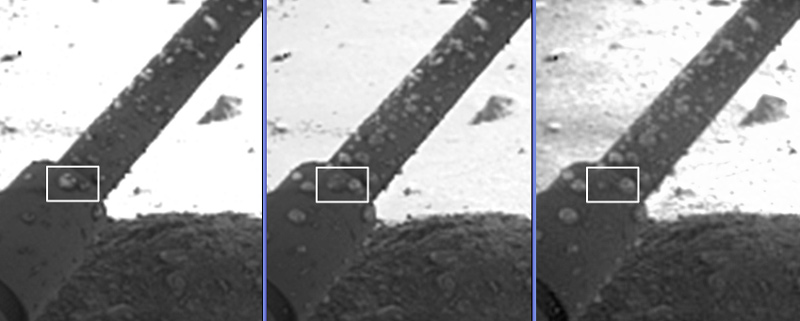
Water droplets appear to be growing on Phoenix's leg shortly after landing on Mars (NASA)
Water droplets appear to be growing on Phoenix’s leg shortly after landing on Mars (NASA)

NASA scientists are currently trying to understand a set of images taken by the Phoenix Mars Lander shortly after it landed on the Red Planet in May 2008. The images in question show one of the robot’s legs covered in what appears to be droplets of liquid water. The droplets remain on the lander for some time, appearing to get larger and changing shape.

By now, we know that liquid water (apparently) hasn’t existed on the Martian surface for hundreds of millions of years; the atmosphere is currently too thin and too cold to support liquid water. However, the confirmed presence of perchlorate in the regolith may provide an important clue as to what might be going on…
Continue reading “Liquid Water on Mars?”

Bad Astronomy Scoops Time “25 Best Blogs 2009” Award

Bad Astronomy - One of Time's top 25 blogs of 2009

It is always fantastic to hear blog has been recognised by the mainstream media, but when a site from the space blogosphere is recognized by Time.com as one of 25 best blogs of 2009, that’s a big deal. Phil Plait’s Bad Astronomy is officially up there with other blog monsters such as the Huffington Post, BoingBoing and Mashable (although few would argue against Bad Astronomy being the biggest space/astronomy/sceptical blogs out there).

So here is Phil, stepping up to the podium to accept his award:

They seemed to like the idea of a skeptical blog, which is probably what I like most about what they wrote. It’s very gratifying indeed to know that people out there appreciate a reality-based opinion. One of my overarching goals is to avoid dogma and bias and use only factual evidence on which to base my opinions. I know some people will disagree with this, but in general I think that’s because they don’t like the conclusions I reach. But I have found over the years that the hardest thing to accept as a skeptic is that the Universe doesn’t care what you think is true, it only cares about what is true.

There’s a big difference, sometimes.

–Phil Plait, Bad Astronomy (Feb. 17th, 2009)

Congratulations Phil! Your blend of healthy scepticism, astronomy, science and humour continues to inspire and motivate the rest of the science blogging world, this award recognizes Bad Astronomy as being one of the few “standard candles” cutting through the noise that is the Internet.