Listening Out for the Magnetospheres of Habitable Exoplanets

Searching for Earth-like exoplanets (© Mark Garlick)
Searching for Earth-like exoplanets (© Mark Garlick*)

Is there a new way to hunt for habitable Earth-like exoplanets? According to a US Naval Research Laboratory researcher there is an obvious, yet ingenious, way of listening for these worlds. Like most Earth-like exoplanet searches, we are looking for characteristics of our own planet. So what do we need to survive on Earth? Obviously we need water and the correct mix of oxygen with other atmospheric gases, but what about the magnetic bubble we live in? The Earth’s magnetosphere protects us from the worst the Sun can throw at us, preventing the atmosphere from being eroded into space and deflecting life-hindering radiation.

Although we have yet to develop sensitive enough radio telescopes, it may be possible in the future to detect the radio waves generated as charged particles in stellar winds interact with Earth-like exoplanetary magnetospheres. If there’s a magnetosphere, there may be a protected atmosphere. If there’s an atmosphere, perhaps there’s life being nurtured below

*This image is copyright Mark A. Garlick and has been used with permission. Please do not use this image in any way whatsoever without first contacting the artist.
Continue reading “Listening Out for the Magnetospheres of Habitable Exoplanets”

Here’s One We Didn’t Discover Earlier

The 1998 archive Hubble image of HR 8799 after image analysis - one of the star's exoplanets have been resolved (NASA/HST)
The 1998 archive Hubble image of HR 8799 after image analysis - one of the star's exoplanets have been resolved (D. Lafrenière et al., ApJ Letters)

What’s just as exciting as directly imaging an exoplanet in a new observing campaign? To discover an exoplanet in an old observing campaign.

Like so many significant astronomical discoveries, archival images of the cosmos provide a valuable tool to astronomers. On its most basic level, astronomers can compare new images with images taken by the same (or different) observatory months, years or decades ago. This method can lead to the discovery of planets, asteroids and comets (when comparing two pictures of the night sky, a celestial object appears to move relative to the background stars). However, a new technique to analyse archived Hubble data in the search for exoplanets, has just revealed one of three known exoplanets orbiting the star HR 8699. The image in question was captured in 1998, when astronomers thought HR 8799 was an exoplanet-less star
Continue reading “Here’s One We Didn’t Discover Earlier”

Carnival of Space Week 88 – The Spacewriter

sf-body2b_smaller_logo

Want to know what’s been happening in the Universe this week? Get over to Carolyn Collins Petersen’s space and astronomy blog (a.k.a. “The Spacewriter”) for a SUPERB Carnival of Space. I’m not entirely sure where to start for week 88, there’s so much to choose from! In fact, looking at the number of entries, I’d say this is one of the largest turnouts so far. Wow, there’s a lot of science writing going on!

From Carolyn’s well-crafted peek into the space blogosphere, here’s a tiny fraction of articles that caused a derailment to my plans for getting any work done this afternoon (plus my first reaction, in a word):

21st Century Waves (Bruce Cordell): Long Waves and the Future of Human SpaceflightWow

Centauri Dreams (Paul Gilster): A Workable Fusion Starship?Whoosh!

Space Video of the Day: Announcement by Pres. Regan after the Challenger disasterMoving

Mang’s Bat Page (David Gamey): How You Could Pilot a Space Telescope (Upside Down)Shiny!

Simostronomy (Mike Simonsen): Aperture FeverObsessed!

The Martian Chronicles (Ryan Anderson): The MOC “Book”: IntroductionInsightful

Starts With A Bang! (Ethan Siegel): Supernovae and Dark Energy: Part IIAha!

There are loads more where that came from, so get your bums down to The Spacewriter and enjoy!

From Astroengine.com, I submitted my musings about the secret payload on that Delta IV Heavy… just why are clandestine launches so damned sexy?

Solar Views from SOHO (Wallpapers)

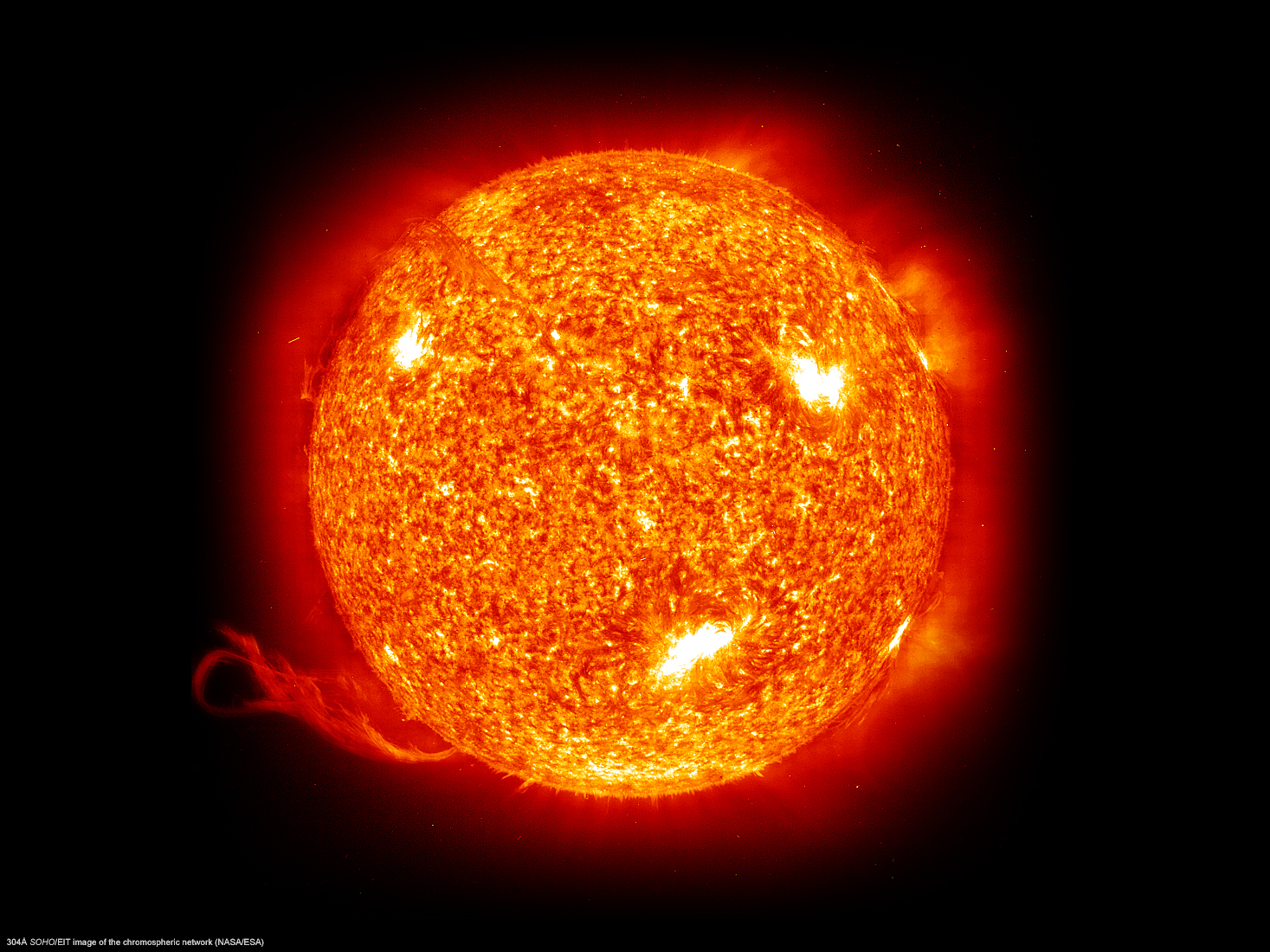
304A SOHO/EIT image of the solar disk (NASA/ESA)

Back in 2006, I was feeling a bit nostalgic about my four years of research at the University of Wales, Aberystwyth Solar Group, so I decided to try to find some high resolution prints of the Sun. After a lot of effort, I didn’t find any prints I could buy or download, but I did find some high resolution images from the Solar and Heliospheric Observatory (SOHO) image archive. Although some were a bit noisy, I was able to clean them up with Photoshop and did some layer tweaking/saturation/balance to draw out the fine detail of the chromospheric network–as seen above in the 304A Extreme ultraviolet Imaging Telescope filter–plus a distinct prominence (in the bottom left-hand of the image).

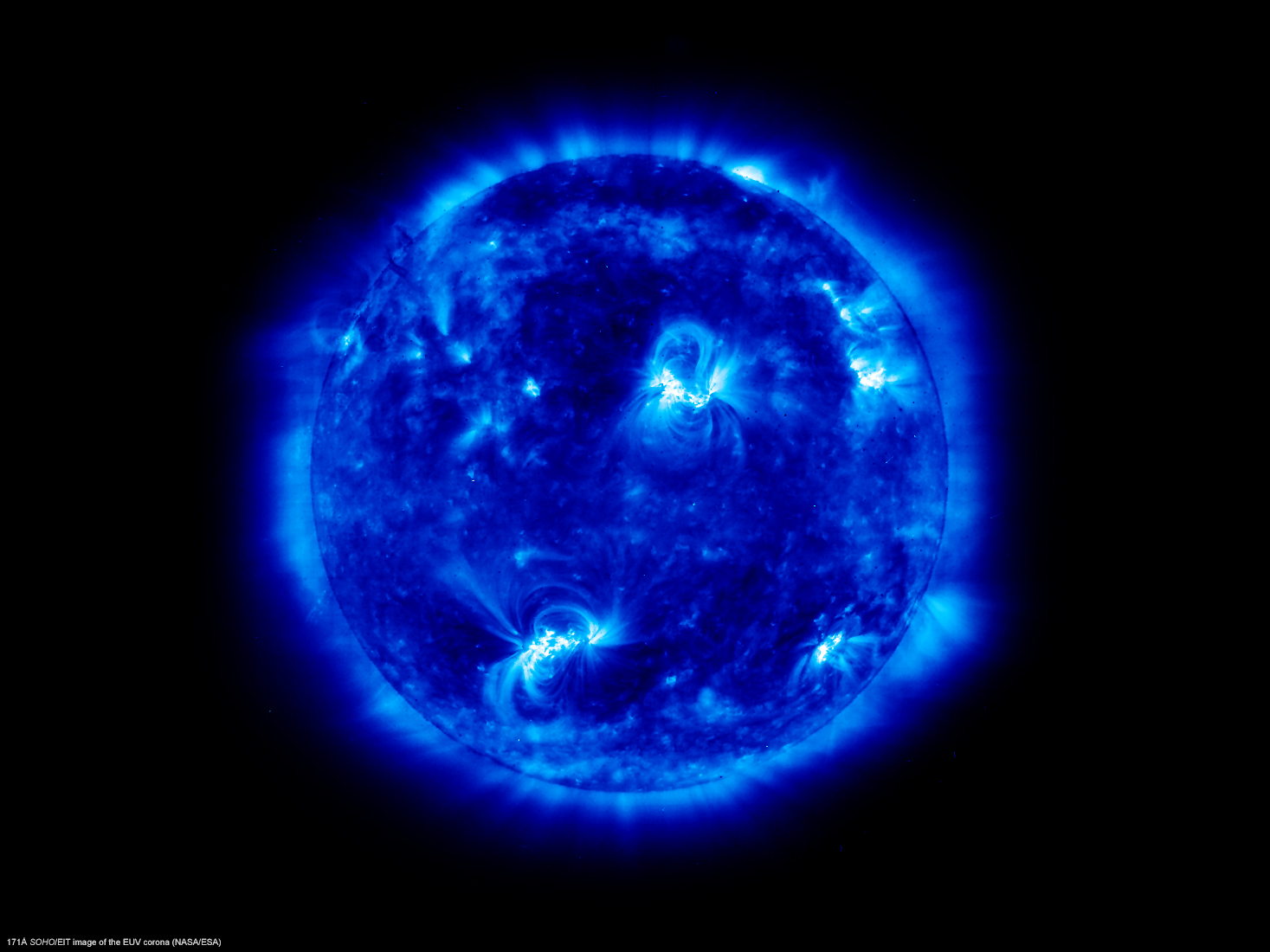
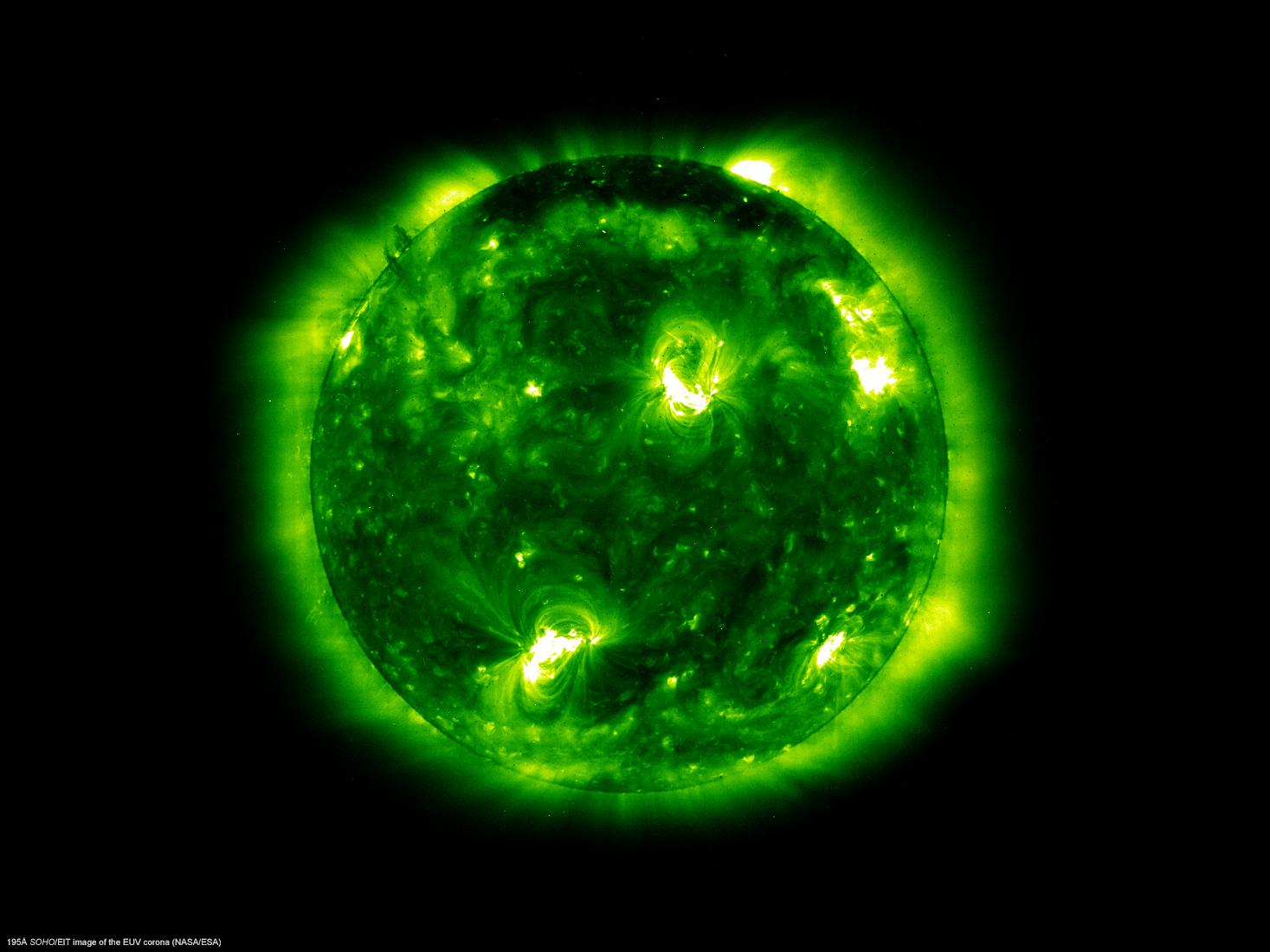
Not stopping there, I decided to give the same treatment to high resolution 171A and 195A images. They came out very well and I kept rotating them as my wallpaper for months. Having just read Phil’s post on today’s perihelion (the time of year when the Earth is at its closest to the Sun during its orbit), I came across a comment asking whether anyone had any wallpapers of the same 304A EIT image. Well, here it is! Plus two more!

If anyone wants to find out how the images were edited, feel free to ask and I’ll let you know. Truth be known, there’s thousands of space images held by NASA, ESA etc. open to the public domain that rarely get the “airtime” they deserve. So it’s about time I dust off these three-year old edits and share the magnetohydrodynamic love.

I miss active regions, I wish the Sun would amp it up a bit so we can see all those lovely flares, CMEs, filaments and coronal loops… ahhhh… coronal loops

Small but Mighty: KPD 0005+5106, the 200,000K White Dwarf

Sirius B1 - one of the more famous white dwarf stars (Frank Gregorio)

A white dwarf called KPD 0005+5106 has been identified as the hottest star observed, ever. KPD 0005+5106 lives in the globular cluster M4, 7,200 light years away, and astronomers have always been intrigued by this stellar lightweight as its emissions have previously hinted it was quite toasty. Now, astronomers using data from the defunct NASA Far-Ultraviolet Spectroscopic Explorer (FUSE), have studied the white dwarf in more detail. KPD 0005+5106 emits radiation in the far-ultraviolet, indicating that its surface has a temperature of 200,000K. This is an unprecedented discovery, far-ultraviolet emissions are usually reserved for superheated stellar coronae. It may be small, but it’s a record-breaker
Continue reading “Small but Mighty: KPD 0005+5106, the 200,000K White Dwarf”

Yet Another Fireball and Explosion, Over Colorado

Video of the fireball event over Colorado (Chris Peterson)

Early this morning, a huge explosion lit up the Colorado skies. According to one observatory that videoed the event with its ever-watching all-sky camera, the fireball (or bolide) peak brightness (magnitude -18) exceeded the brightness of a full Moon 100 times. An awesome event. The Cloudbait Observatory, near Denver, is calling on eye-witnesses to submit their reports so possible meteorite fragments can be found on the ground. Only last month, a similar effort resulted in Canadian meteorite hunters finding over two dozen fragments from the Saskatchewan fireball.

For all the information about the Colorado event, check out my Universe Today article Exploding Colorado Fireball, 100 Times Brighter than the Moon (Video).

I must admit though (as one of my readers pointed out), it is surprising to hear about this recent flurry of large fireball events. Some of these meteoroids are as big as 10 tonnes (in the case of the Saskatchewan fireball), and scattered meteorites are being found on the ground (fortunately over sparsely populated regions). Are these recent series of fireball spottings down to improved observation techniques and a bit of luck? After all, the October fireball was observed directly over several all-sky cameras dedicated to spotting meteors; the November fireball was seen by a huge number of people in cities across the Saskatchewan/Alberta border and last night’s fireball appeared above another dedicated meteor all-sky camera.

A few of these events are expected every year, so this is certainly nothing to be concerned about, we’re just getting better at observing these transient events…

Moon, Venus, Jupiter Conjunction Dazzles California

Tonight is a very special night. Three celestial bodies clustered together in the sky, signifying a rare conjunction between the Moon, Venus and Jupiter. If you missed it, you’ll have to wait five years until the natural satellite of the Earth and two planets align in a similar pattern again in 2013.

Having been a frustrated astronomer for many years, I decided to get outside to investigate the conjunction over California for myself. Sure enough, from dusk, I could see a bright, thin crescent Moon with two very bright dots to the right and below in the southwest. The same scene has been repeated across many nations, but from my perspective I was able to capture the moment with some basic equipment and a very steady hand (plus some folded business cards)…
Continue reading “Moon, Venus, Jupiter Conjunction Dazzles California”

The Search For Life, What’s the Point?

Another mission, another brave “search for life”…

Is it me, or does virtually every robotic foray into space have some ET-searching component attached? In the case of Mars exploration, every lander and rover’s prime directive is find life, evidence of past life, potential for life or the building blocks of life. Even the very first man-made artefact to land (crash) on the planet, the 1971 Soviet Mars 2 mission, was designed to find organic compounds and… any sign of life.

On writing an article yesterday (“Wasteful” Sample Storage Box Removed from Mars Science Laboratory), I started to think that we might just be trying a little too hard and spending too much money on this endeavour. Perhaps there’s another way for us to work out if we are, indeed, an interplanetary (possibly intergalactic?) oasis, or a component of a biological cosmic zoo…
Continue reading “The Search For Life, What’s the Point?”

Another Exoplanet Candidate Identified by ESO

It would appear that yet another extrasolar planet has been directly observed!

Only last week, the Hubble Space Telescope released news that it had spotted an exoplanet orbiting the star Fomalhaut. This is the first ever direct observation of an exoplanet in optical wavelengths. On the same day, joint observations by the ground-based (adaptive optics-powered) Keck II and Gemini infrared telescopes discovered a collection of three large alien worlds orbiting a star catalogued as HR 8799.

Today, a completely different observatory appears to have discovered yet another exoplanet orbiting the hot star Beta Pictoris (in the constellation of Pictor). European Southern Observatory (ESO) astronomers have directly imaged β Pictoris b, an alien planet orbiting 8 AU from its host star.

A phenomenal achievement considering β Pictoris is over 63 light years away…
Continue reading “Another Exoplanet Candidate Identified by ESO”

Alien Worlds: Extrasolar Planets Imaged for First Time

Two of the three confirmed planets orbiting HR 8799 indicated as
Two of the three confirmed planets orbiting HR 8799 indicated as “b” and “c” on the image above. “b” is the ~7 Jupiter-mass planet orbiting at about 70 AU, “c” is the ~10 Jupiter-mass planet orbiting the star at about 40 AU. Due to the brightness of the central star, it has been blocked and appears blank in this image to increase visibility of the planets (Gemini Observatory)

The day has finally come. We now have direct, infrared and optical observations of planets orbiting other stars. Yesterday, reports from two independent sources surfaced, one from the Gemini and Keck II observatories and the second from the Hubble Space Telescope. Brace yourself for an awe-inspiring display of planets orbiting two stars…

The Gemini/Keck observations were carried out using adaptive optics technology to correct in real-time for atmospheric turbulence. The stunning images of a multiple planetary star system were then constructed from infrared emissions (the image, top, was constructed by Keck II as a follow-up to to the Gemini observations). The system in question is centred around a star called HR 8799, approximately 130 light years from Earth and in the constellation of Pegasus. The entire press release can be found at the Gemini observatory site, where they give the discovery a full run-down.

On the same day, the Hubble Space Telescope team also released images of one extrasolar planet, only this time in optical wavelengths. Although the exoplanet in Hubble’s images is less obvious than the infrared Gemini/Keck II images, incredible detail has been attained, showing a ring of dust around the star Fomalhaut (located in the constellation of Piscis Austrinus). Fomalhaut is 25 light years away and the star’s daughter planet (Fomalhaut b) is only a little under 3 Jupiter masses.

Estimated to be no more than three times Jupiter's mass, the planet, called Fomalhaut b, orbits the bright southern star Fomalhaut, located 25 light-years away in the constellation Piscis Austrinus (NASA/ESA)
Estimated to be no more than three times Jupiter’s mass, the planet, called Fomalhaut b, orbits the bright southern star Fomalhaut, located 25 light-years away in the constellation Piscis Austrinus (NASA/ESA)

For more news on these discoveries, check out the Gemini/Keck II press release and the Hubble announcement. I’ll leave the ground-breaking announcement to the guys who have spent many years working to achieve this monumental goal.

Wow.

Sources: Gemini, ESA