New Addition to the Exoplanetary Menu: The WASP-12b Sizzler

The hotspot: A very, very hot Jupiter has been discovered (ESA/C Carreau)

So how hot is the hottest known planet? Usually the temperature of a planet orbiting another star is of little concern to us. At the end of the day, are we really looking for an interstellar getaway? The chance that we’ll be colonizing any extra-solar planets in the near future is pretty low, but that won’t stop us from peering up the the heavens studying “Hot Jupiters” orbiting stars hundreds of light years away. However, astronomers have just discovered a planet I doubt we’ll ever want to visit. Enter WASP-12b, the hottest, and fastest gas giant ever observed…
Continue reading “New Addition to the Exoplanetary Menu: The WASP-12b Sizzler”

Small Asteroid 2008 TC3 Will Hit Earth Tonight

Artist impression of a meteorite entering the Earth's atmosphere (©Leonard Wikberg III)

A newly discovered asteroid called 2008 TC3 will (with a 99.8-100% probability) hit the atmosphere over northern Sudan at 2:46 UTC (Oct 7th). The piece of rock will not threaten people or structures on the surface, it is likely to burn up during re-entry as a magnificent “air burst.” Estimates suggest that as 2008 TC3 burns up, it will detonate with an energy of a kiloton of TNT.

2008 TC3 is between 1-5 meters in diameter, so it’s not a threat by any means, but it should create a spectacular display. Usually the bright meteors we observe are generated by debris no bigger than a grain of sand, so this will be a huge astronomical event in comparison. The giant meteor will be visible from eastern Africa travelling very quickly from north-east to south-west and it is expected to create a very long trail as it will enter the atmosphere at a very shallow angle.
Continue reading “Small Asteroid 2008 TC3 Will Hit Earth Tonight”

The Final Full-Frontal: Virgin Galactic Declines $1 Million Space Sex Tape Offer

It had to happen some time - the first zero-G space sex tape may appear in the near future (Misha Gravenor)

Soon, space tourism companies such as Virgin Galactic will be flying several flights per day on sub-orbital joyrides. It is expected that this will be quickly followed by orbital “space hotels” where high-paying space sightseers can spend long periods looking down on the Earth (a venture being quickly developed by Las Vegas entrepreneur Robert Bigelow; there’s an unmanned space hotel prototype currently in orbit). It’s only a matter of time before space tourism becomes commonplace, opening a massive host of scientific and recreational possibilities.

Wherever humans go, sex quickly follows, and although we don’t fully comprehend the implications of sexual pursuits in zero-G, there’s certainly a lot of people on Earth who will want to experience the 100-mile high club for themselves. Although space agencies have flirted with space sex research, the act is generally frowned upon (although the Russian study into “human docking procedures” sounded interesting). Although we are limited in our space sex understanding, the porn industry is quickly catching on, wanting to create the world’s first space porn video, making a huge offer to Virgin Galactic ahead of their first flight at the end of 2009…
Continue reading “The Final Full-Frontal: Virgin Galactic Declines $1 Million Space Sex Tape Offer”

An Intimate View From the Space Shuttle Garage

"So what do you do?" "Oh, I have the boring job attaching rocket engines to the Shuttle..." (NASA/Kim Shiflett)
"So what do you do?" "Oh, I'm just the Shuttle rocket engine crane operator..." (NASA/Kim Shiflett)

If you thought that Shuttle launches were easy, think again. Preparing each Shuttle launch is a laborious task, taking several months and thousands of NASA employees. Pictured above is one of Atlantis’ Space Shuttle Main Engines (SSMEs) being installed back on June 11th at Kennedy Space Center’s Orbiter Processing Facility bay 1, and I think this image epitomizes what space flight is all about. Rocket science is complex, we know that, but when I see just how big these things are, I gain a better respect for how far we have come. Best thing is, this is an image of a 23 year old space vehicle, just imagine what the future Ares V will look like…
Continue reading “An Intimate View From the Space Shuttle Garage”

Phoenix Welcomes in Sol 90 and Mars Winter

Phoenix sees the Sun dip below the horizon for the first time in 90 sols. It's going to get pretty cold here on in... (NASA/JPL/UA)
Phoenix sees the Sun dip below the horizon for the first time in 90 sols. It's going to get pretty cold out there... (NASA/JPL/UA)

This stunning image was taken by Phoenix on the 90th sol (Mars day) – or August 25th here on Earth – of its mission to the Red Planet. Until now the Sun has remained in the sky continuously due to the Mars Arctic summer, perfect for the landers solar panels to receive 24-hour solar energy. Sol 90 marks colder days and less sunlight for Phoenix as we push into Mars winter…
Continue reading “Phoenix Welcomes in Sol 90 and Mars Winter”

Meet Sagittarius A*, Our Very Own Supermassive Black Hole

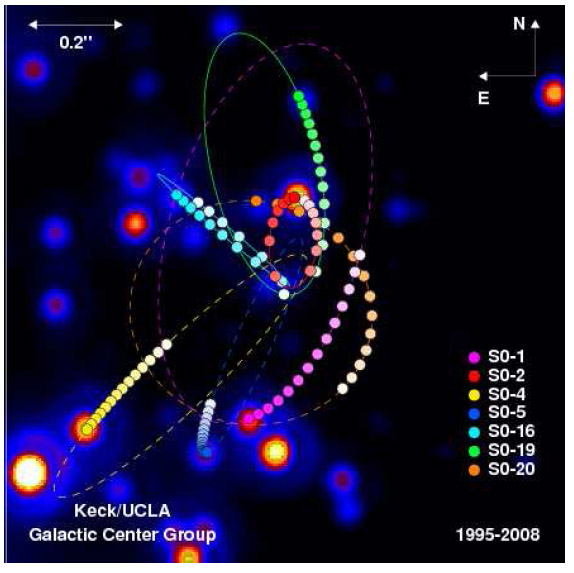
Yearly location of stars within 0.2 parsecs from Sagittarius A* orbiting the common, compact radio source (A. Ghez)

We are told there is a supermassive black hole living in the centre of our galaxy. Apparently, supermassive black holes can be found in the centre of most galactic nuclei, and all the stars within the surrounding galactic disk will orbit around it. But how do we know there is a huge black hole in the centre of the Milky Way? What evidence is there? It turns out there is quite a lot, actually.

In a recent review of the subject, the radio emissions observed since the 1950’s are examined. However, probably the most striking piece of evidence is the figure to the left. Of course, we know black holes exert a massive gravitational pull on local space, and by observing the centre of our galaxy, we find there is a huge gravitational influence over a compact cluster of stars, all orbiting a common point, reaching orbital velocities of 5000 km/s…
Continue reading “Meet Sagittarius A*, Our Very Own Supermassive Black Hole”

International Space Station Solar Transit

The International Space Station Transits the Sun (© Martin Wagner)

Sometimes the NASA Astronomy Picture of the Day (APOD) is just too hard to pass up. Yesterday’s APOD features our sunspot-less Sun with a strange shape in the lower left-hand side of the image. On closer inspection suddenly it becomes clear as to what we are looking at. It’s the International Space Station transiting the solar disk. Stunning
Continue reading “International Space Station Solar Transit”

IBEX, The Energetic Neutral Atom Hunter

The termination shock, the point at which the interstellar medium interacts with the heliosphere (NASA)

The Interstellar Boundary Explorer (IBEX) is set for launch in October and it will carry out some pretty cool science when in space. Orbiting Earth 200,000 miles away, IBEX will be on the lookout for tiny, but significant particles originating from the edge of our solar system. Why? It turns out these neutral atoms will provide information on the location and characteristics of the point at which the Solar System’s edge mixes with the tenuous gas between the stars. So how are they generated? How do we know they originate from the termination shock?
Continue reading “IBEX, The Energetic Neutral Atom Hunter”

New Russian-European Manned Space Vehicle Announced

Russian firm RKK Energia's new manned space vehicle (RKK Energia)

NASA’s Constellation Program may be faltering, but the next Russia/ESA manned space vehicle set to replace the reliable Soyuz vehicle has been unveiled in the UK. It is designed to transport astronauts to the International Space Station and it has a unique soft-landing thruster mechanism that will make re-entry a little less dramatic. The new design has been designed by Russian manufacturer RKK Energia and a first look at the 4-6 man capsule was showcased at the annual Farnborough Air Show in the UK last week. ESA has been discussing the collaboration with the Russian space agency Roscosmos on the Crew Space Transportation System (CSTS) since 2006 and now it seems that this vehicle may rival the Orion/Ares system being developed by NASA. What’s more, the CSTS is designed to transport a crew of four to the Moon…
Continue reading “New Russian-European Manned Space Vehicle Announced”

Huge Refrigerator-Sized Space Station Debris Observed From Earth – Where will it Land?

The EAS as photographed by the ISS crew in 2007 (NASA)

On July 23rd, 2007, the crew of the International Space Station did some orbital fly-tipping. They dumped a double refrigerator-sized piece of equipment overboard and sent it toward Earth. Mission control at the time assured the public that it would orbit for about 300 days and most of it would burn up. The first issue is that, a year on, it is still orbiting and it is expected to do so until the end of 2008 at the earliest. Second issue is that a large portion of the kit will survive re-entry. Uncontrolled re-entry like this is by nature hard to predict where it will impact. Although the ISS had little option but to dump the used Early Ammonia Servicer (EAS), was there a better, safer alternative?
Continue reading “Huge Refrigerator-Sized Space Station Debris Observed From Earth – Where will it Land?”