2012 Is Coming… And All I Got Was This Lousy Fridge Magnet

Screenshot from the Flash animation "The End of the World" by Fluid

Just when I was getting bored of the endless stream of 2012 doomsday hype (tripe), my interest was suddenly reinvigorated when I saw this advertisement:

2012 Calendar Magnet

$2.99 + shipping

Our calendar magnet is a real 2012 calendar. So you can have it on the refrigerator for 3 1/2 years! The calendar magnet is 4.25 inches wide and 5.5 inches long. It is also very clear and easy to read (looks better than the picture above, but is smaller). The shipping cost within the U.S. is $0.79 and for International orders $1.89.

No way. Oh yes. Yes, they did! The most well-known 2012 protagonist website is selling doomsday fridge magnets depicting an Earth plus comet barrelling towards it.

I had to triple-check, just in case this was the doomsday blogging equivalent to Punk’d. No, this is real: fridge magnets.
Continue reading “2012 Is Coming… And All I Got Was This Lousy Fridge Magnet”

Mars Chaos

Of all the places I’d want to visit on Mars, this would be high on my list. After travelling to the bottom of Hellas Planitia (for the thick atmosphere and possibly finding liquid water) and the summit of Olympus Mons (for the view), I’d be sure to have a scout around Ariadnes Colles, in the southern hemisphere (pictured above).

The Ariadnes Colles region may not be a household name, but looking at these new high resolution images coming from the Mars Express orbiter, I can’t help but be impressed…
Continue reading “Mars Chaos”

In 1911, Martians Were Building Canals

Martians Build Two Immense Canals In Two Years

On August 27th, 1911 the New York Times Sunday magazine ran an article entitled “Martians Build Two Immense Canals In Two Years”. Astronomer Percival Lowell had been studying the Red Planet and sketched what he saw, in this case, a growing complex of apparent canals on the Martian surface. There was even a nice little story that went along with this canal-building alien civilization theory. Lowell said, “The whole thing is wonderfully clear-cut,” that the Martian civilization was dying and they were building canals to reach the water ice in the Martian poles.

It turns out he was right about the water ice, but there’s no trace of this canal-building race on Mars… in fact there’s little trace of anything biological on the Red Planet. So apart from a few historic anecdotes, there’s still no life on Mars. The search continues.

Canals a thousand miles long and twenty miles wide are simply beyond our comprehension. Even though we are aware of the fact that … a rock which here weighs one hundred pounds would there only weigh thirty-eight pounds, engineering operations being in consequence less arduous than here, yet we can scarcely imagine the inhabitants of Mars capable of accomplishing this Herculean task within the short interval of two years. — Excerpt from the 1911 New York Times article.

Source: The Futility Closet (an awesome site)

Mars Can Be A Fuzzy Planet

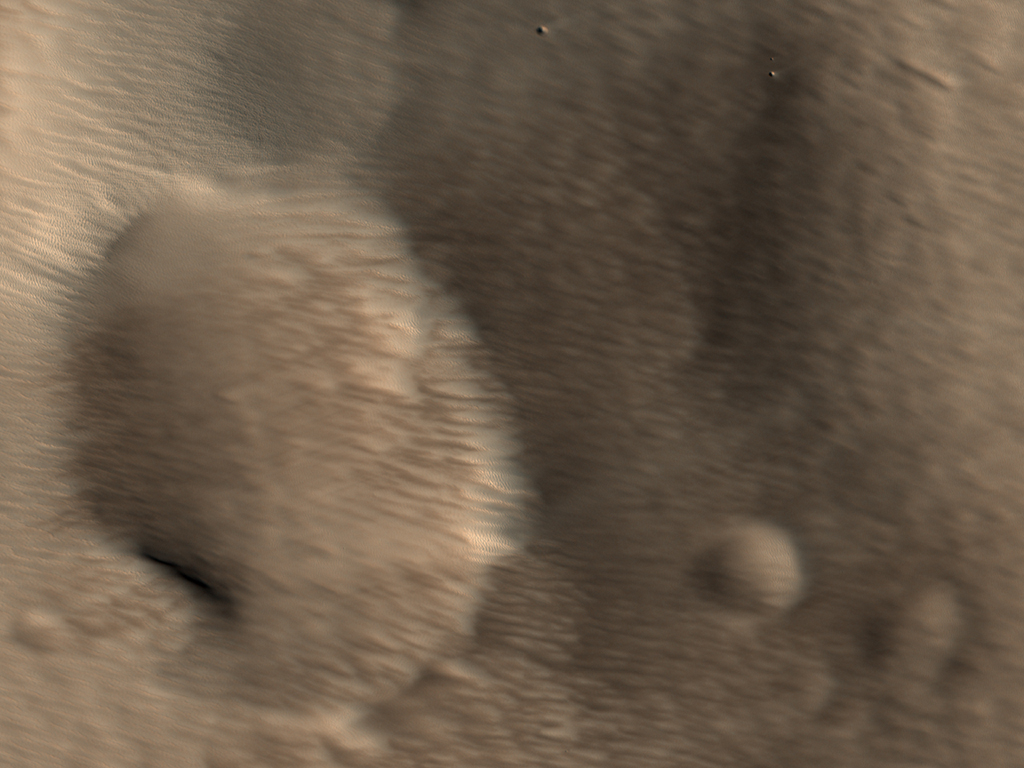
The summit of Pavonis Mons (NASA)

This strange image was captured by the Mars Reconnaissance Orbiter’s (MRO) camera–the amazing High Resolution Imaging Science Experiment (HiRISE)–as it passed over one of the largest volcanoes in the Solar System, Pavonis Mons.

Located near the equator of Mars, atop the Tharsis bulge, Pavonis Mons is the second highest volcano after the huge Olympus Mons (towering over the Martian surface 27 km high). Pavonis Mons is still much higher than anything the Earth can muster, towering 14km into the atmosphere (compare that with the altitude of Mt. Everest’s peak height of 8.85 km).

So why is this picture so blurry? Is HiRISE suffering a malfunction? Did mission control send the wrong commands? Actually, HiRISE is working just fine. It’s the dust-covered surface that’s blurred.

As the ancient volcano is reaching so high into the Martian atmosphere, the air becomes very thin. The atmosphere was already thin; the average ground level atmospheric pressure is less than 1% of the Earth’s. At Pavonis Mons’ peak, the atmospheric pressure is ten-times thinner. Therefore any wind at these altitudes is extremely weak.

The extreme planet-wide dust storms that regularly engulf Mars dump huge quantities of dust on the top of the Martian volcanoes, but when the dust settles, there’s nothing to transport it elsewhere. Therefore, the thick layer of fine material remains where it is, tickled by the light-weight winds, rarely moving.

In the high resolution image, you can see some resolved features such as the odd impact crater and small ripples. Other than that, it’s a thick, smooth dust blanket that covers the Pavonis Mons summit, hiding any interesting geology for below, giving the impression any images of the summit are out of focus…

For more, check out The Blurry Summit of Mars’ Pavonis Mons on the Universe Today.

Asteroid Tanning in the Solar Wind Salon

Asteroids tan fast in the solar wind (ESO)

In a study carried out by European Southern Observatory (ESO) scientists, it was found that asteroids are susceptible to sunburn. By comparing the material found inside meteorites here on the ground with the colour of asteroids floating in space, there is a huge difference; the asteroids in space are redder.

So far, this might not be too surprising, after all, the surface of Mars is red with ferrous oxides (rust), why shouldn’t asteroids be red too? Actually, asteroids aren’t necessarily made of the same stuff as Mars, and they aren’t getting tanned due to the Sun’s ultraviolet rays; asteroids are bathed in ionizing solar wind particles, causing the asteroid’s surfaces to redden over a period of time. And that period is short when compared with Solar System time scales. It only takes a million years for the surface of young asteroids (born from energetic asteroid collisions) to weather under the constant barrage of particles from the solar wind.

This has some interesting implications for asteroid studies. Possibly the most striking factor this study uncovers is the nature of near-Earth asteroids that have been observed exhibiting comparatively “young” surfaces, apparently free from solar wind reddening. Previously, astronomers have agreed that these young surfaces were down to recent asteroid collisions. However, the period of the solar wind tanning effect is much shorter than asteroid collision frequency. So even if two asteroids collided, in all likelihood, if we observed one of these asteroids, the solar wind would have weathered the surface back to its reddened state.

It turns out that some near-Earth asteroids have “young” surfaces due to gravitational interactions with planets as they pass. When this happens, the red dust is “shaken off”, revealing the untouched rock beneath.

For more, check out my article Young Asteroids Age Fast with a Solar Wind Tan on the Universe Today.

Ask the Astroengine Community a Question

question

In an effort to enhance the Astroengine.com community, I’ve now added a rather exciting new feature to the site. If you scroll down, and look at the right-hand side bar, you’ll notice an “ask a question” panel. This gadget is driven by Google Friend Connect, so this should appeal to the majority of readers.

What makes this even more exciting is that the panel is specific to each page you browse on Astroengine.com, so you can ask a question about a certain article and interact with other readers who might have a link or explanation to help you out. For example, I posed a question on the recent article “Mystery Blob Detected 12.9 Billion Light Years Away,” asking what people thought the “blob” was (and my hope that it’s a supermassive black hole… cue a bit of Muse awesomeness).

So, have a play, keep it clean and have fun! Any problems, drop me a comment and I’ll see if I can help.

Thank you Avi for bringing my attention to this great little gadget 🙂

Cheers, Ian

Mystery Blob Detected 12.9 Billion Light Years Away

The Himiko object, the most massive object ever discovered in the early universe (M. Ouchi et al.)

Take a good look, this is one of the most mysterious, massive objects ever discovered in the cosmos. We don’t really know what it is, but this thing is huge, spanning 55,000 light years across (the approximate radius of our Milky Way). What makes this all the more intriguing is the fact that this object formed only 800 million years after the Big Bang and it is 10 times more massive than the next biggest object observed in the early Universe. But what is it?
Continue reading “Mystery Blob Detected 12.9 Billion Light Years Away”

Astroengine Live Show #17: Not-So-Brown Dwarf

promo12

In today’s show, I’ll be giving brown dwarfs some airtime. They may be considered to be “failed stars”, but are they? Also, I’ll be giving a rundown of the week’s space news with some surprises thrown in. Be sure to tune in at 4pm PST/7pm EST!

Get Involved!

Have any articles or stories you want to contribute? Have an opinion on anything in the world of space? Follow me on Twitter to send me live input when I’m on the air, or email me on astro@wprtradio.com and I’ll be sure to give it a mention. Eventually, I hope to have telephone call-ins, but for now, email will do.

Listen to Astroengine Live using the Paranormal Radio player. Or, pick up the podcast feed to activate your favourite audio software.

Could Active-SETI Learn From… Twitter?

twitter_earth

The Search for Extraterrestrial Intelligence (SETI) has been an ongoing endeavour for the last 50 years. Detecting radio communications from an alien civilization would be the most profound event in mankind’s history; its effect would change the way we view our origin and our place in the Universe. It could mean that far from “being alone” we could be existing in a cosmic ecosystem, where life is more common than not and advanced extraterrestrial civilizations are no longer science fiction. A positive SETI signal would affect us globally; science, religion, society, daily life would alter radically.

Unfortunately, SETI is currently drawing up blanks. Apart from one or two inconclusive signs, it looks like we live in a dead part of the galaxy. Life As We Know It™ is an Earth-only affair. Who knows, we might be searching for another five decades and still be no closer to answering the question “are we alone?

Not to be too downhearted, scientists have been trying to make our presence felt by reversing SETI; we’ve been Messaging Extraterrestrial Intelligence (METI, a.k.a. “Active-SETI”) ever since we attached a plaque depicting the human form and a handy galactic map to Earth to the side of the Pioneer probes in the 1970s. Now we send a variety of radio signals to the stars in the hope of attracting ET’s attention.

But what signal do we send? Do we send a message with only good stuff from Earth? Or should we send a more gritty message, detailing our flaws as well as achievements? What actually makes a “good” METI signal in the first place?

Perhaps SETI could take some advice from the evolving social media scene, after all, when done right, there’s no more efficient way of conveying a clear message via 140 characters or less…
Continue reading “Could Active-SETI Learn From… Twitter?”

Brown Dwarfs: “Over-Achieving Jupiters” not “Failed Stars”

browndwarf3

Why is the term “failed star” synonymous with brown dwarfs? On the one hand, brown dwarfs lack the mass to sustain nuclear fusion in their cores. On the other hand, who said brown dwarfs were trying to be stars? Who ever said that becoming a star was the pinnacle of stellar living? Perhaps brown dwarfs are perfectly happy the way they are. In a world of equality and political correctness, brown dwarfs could be viewed as “over-achieving Jupiters”, or gas supergiants
Continue reading “Brown Dwarfs: “Over-Achieving Jupiters” not “Failed Stars””