Heavy Stellar Traffic Sends Dangerous Comets Our Way

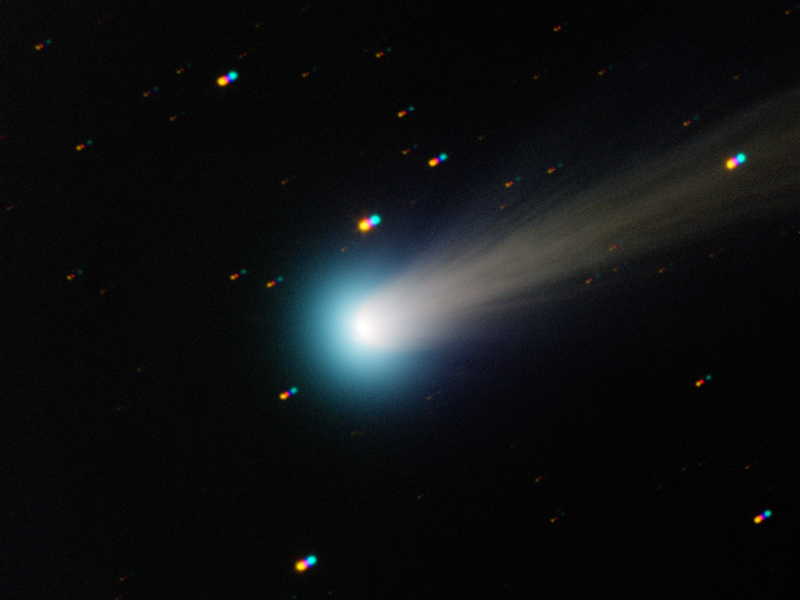
New image of comet ISON
Comet C/2012 S1 (ISON) as imaged by TRAPPIST–South national telescope at ESO’s La Silla Observatory in 2013 (TRAPPIST/E. Jehin/ESO)

Sixty-six million years ago Earth underwent a cataclysmic change. Back then, our planet was dominated by dinosaurs, but a mass extinction event hastened the demise of these huge reptiles and paved the way for the mammalian takeover. Though there is some debate as to whether the extinction of the dinosaurs was triggered by an isolated disaster or a series of disasters, one event is clear — Earth was hit by a massive comet or asteroid and its impact had global ramifications.

The leading theory is that a massive comet slammed into our planet, creating the vast Chicxulub Crater buried under the Yucatán Peninsula in Mexico, enshrouding the atmosphere in fine debris, blotting out the sun for years.

Although there is strong evidence of comet impacts on Earth, these deep space vagabonds are notoriously hard to track, let alone predict when or how often they may appear. All we know is that they are out there, there are more than we thought, they are known to hit planets in the solar system and they can wreak damage of apocalyptic proportions.

Now, using fresh observations from the European Space Agency’s Gaia mission, astronomer Coryn Bailer-Jones, who works at the Max Planck Institute for Astronomy in Munich, Germany, has added an interesting component to our understanding of cometary behavior.

Stellar Traffic

Long-period comets are the most mysterious — and troubling — class of comet. They will often appear from nowhere, after falling from their distant gravitational perches, zoom through the inner solar system and disappear once more — often to be never seen again. Or they hit something on their way through. These icy bodies are the pristine left-overs of our solar system’s formation five billion years ago, hurled far beyond the orbits of the planets and into a region called the Oort Cloud.

In the Oort Cloud these ancient masses have remained in relative calm far from the gravitational instabilities close to the sun. But over the eons, countless close approaches by other stars in our galactic neighborhood have occurred, causing very slight gravitational nudges to the Oort Cloud. Astronomers believe that such stellar encounters are responsible for knocking comets from this region, sending them on a roller-coaster ride to the inner solar system.

The Gaia mission is a space telescope tasked with precisely mapping the distribution and motion of stars in our galaxy, so Bailer-Jones has investigated the rate of stellar encounters with our solar system. Using information in Gaia’s first data release (DR1), Bailer-Jones has published the first systematic estimate of stellar encounters — in other words, he’s estimated the flow of stellar traffic in the solar system’s neighborhood. And the traffic was found to be surprisingly heavy.

In his study, to be published in the journal Astronomy & Astrophysics, Bailer-Jones estimates that, on average, between 490 and 600 stars will come within 16.3 light-years (5 parsecs) of our sun and 19-24 of them will come within 3.26 light-years (1 parsec) every million years.

According to a press release, all of these stars will have some gravitational effect on the solar system’s Oort Cloud, though the closest encounters will have a greater influence.

This first Gaia data release is valid for five million years into the past and into the future, but astronomers hope the next data release (DR2) will be able to estimate stellar traffic up to 25 million years into the past and future. To begin studying the stellar traffic that may have been responsible for destabilizing the dinosaur-killing comet that hit Earth 66 million years ago will require a better understanding of the mass distribution of our galaxy (and how it influences the motion of stars) — a long-term goal of the Gaia project.

An Early Warning?

Spinning this idea into the future, could this project be used to act as an early warning system? Or could it be used to predict when and where a long-period comet may appear in the sky?

In short: “No,” Bailer-Jones told Astroengine via email. “Some close stellar encounters will for sure shake up the Oort cloud and fling comets into the inner solar system, but which comets on which orbits get flung in we cannot observe.”

He argues that the probability of comets being gravitationally nudged can be modeled statistically, but this would require a lot of assumptions to be made about the Oort Cloud, a region of space that we know very little about.

Also, the Oort Cloud is located well beyond the sun’s heliosphere and is thought to be between 50,000 and 200,000 AU (astronomical units, where 1 AU is the average distance between the sun and the Earth) away, so it would take a long time for comets to travel from this region, creating a long lag-time between stellar close approach and the comet making an appearance.

“Typically it takes a few million years for a comet to reach the inner solar system,” he added, also pointing out that other factors can complicate calculations, such as Jupiter’s enormous gravity that can deflect the passage of comets, or even fling them back out of the solar system again.

This is a fascinating study that goes to show that gravitational perturbations in the Oort Cloud are far from being rare events. A surprisingly strong flow of stellar traffic will constantly rattle otherwise inert comets, but how many are dislodged and sent on the long journey to the solar system’s core remains a matter for statistics and probability.
Repeating “Fast Radio Bursts” Detected in Another Galaxy — Probably Not Aliens, Interesting Anyway

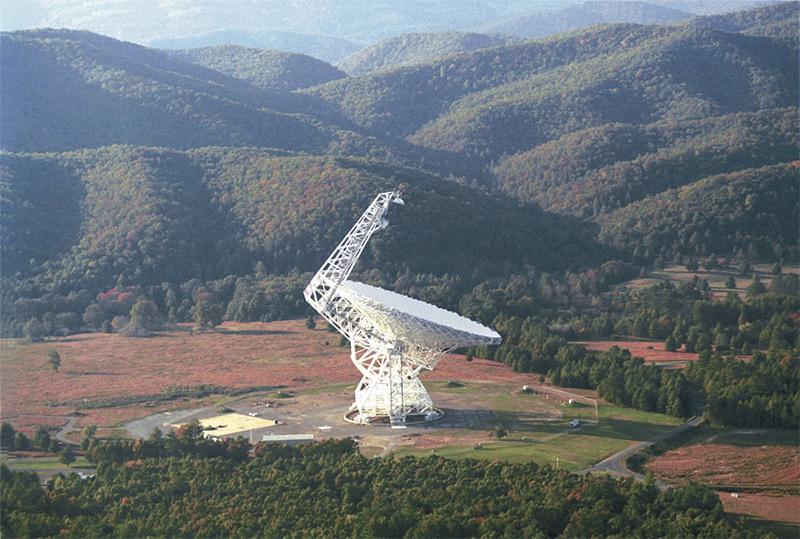
green-bank
The Green Bank Radio Telescope (NRAO)

A radio astronomy project intended to find signals from intelligent aliens has announced the intriguing detections of “repeating” fast radio bursts (FRBs) from a single source in a galaxy three billion light-years distant. This is definitely an exciting development, but probably not for the reasons you think.

The ambitious $100 million Breakthrough Listen project aims to scan a million stars in our galaxy and dozens of nearby galaxies across radio frequencies and visible light in hopes of discovering a bona fide artificial signal that could be attributed to an advanced alien civilization. But in its quest, Breakthrough Listen has studied the signals emanating from FRB 121102 — and recorded 15 bursts — to better understand what might be causing it.

FRBs remain a mystery. First detected by the Parkes Radio Telescope in Australia, these very brief bursts of radio emissions seemed to erupt from random locations in the sky. But the same location never produced another FRB, making these bizarre events very difficult to understand and impossible to track.

Hypotheses ranged from powerful bursts of energy from supernovae to active galactic nuclei to (you guessed it) aliens, but until FRB 121102 repeated itself in 2015, several of these hypotheses could be ruled out. Supernovae, after all, only have to happen once — this FRB source is repeating, possibly hinting at a periodic energetic phenomenon we don’t yet understand. Also, because FRB 121102 is a repeater, in 2016 astronomers could trace back the location of its source to a dwarf galaxy 3 billion light-years from Earth.

Now we ponder the question: What in the universe generates powerful short bursts of radio emissions from inside a dwarf galaxy, repeatedly?

Using the Green Bank Telescope in the West Virginia, scientists of Breakthrough Listen recorded 400 TB of data over a five hour period on Aug. 26. In these data, 15 FRBs were recorded across the 4 to 8 GHz radio frequency band. The researchers noted the characteristic frequency dispersion of these FRBs, caused by the signal traveling through gas between us and the source.

Now that we have dedicated and extremely detailed measurements of this set of FRBs, astrophysicists can get to work trying to understand what natural phenomenon is generating these bursts. This is the story so far, but as we’re talking radio emissions, mysteries and a SETI project, aliens are never far away…

Probably Not Aliens

It may be exciting to talk about the possibility of aliens generating this signal — as a means of communication or, possibly, transportation via beamed energy — but that avenue of speculation is just that: speculation. But to speculate is understandable. FRBs are very mysterious and, so far, astrophysicists don’t have a solid answer.

But this mystery isn’t without precedent.

In 1967, astronomers Jocelyn Bell Burnell and Antony Hewish detected strange radio pulses emanating from a point in the sky during a quasar survey to study interplanetary scintillation (IPS). The mysterious pulses had an unnaturally precise period of 1.33 seconds. At the time, nothing like it had been recorded and the researchers were having a hard time explaining the observations. But in the back of their minds, they speculated that, however unlikely, the signal might be produced by an alien intelligence.

During a dinner speech in 1977, Bell Burnell recalled the conundrum they faced:

“We did not really believe that we had picked up signals from another civilization, but obviously the idea had crossed our minds and we had no proof that it was an entirely natural radio emission. It is an interesting problem – if one thinks one may have detected life elsewhere in the universe how does one announce the results responsibly? Who does one tell first? We did not solve the problem that afternoon, and I went home that evening very cross here was I trying to get a Ph.D. out of a new technique, and some silly lot of little green men had to choose my aerial and my frequency to communicate with us.”

This first source was nicknamed “LGM-1” (as in “Little Green Men-1”), but far from being an artificial source, the duo had actually identified the first pulsar — a rapidly-spinning, highly magnetized neutron star that generates powerful emissions from its precessing magnetic poles as it rotates.

This is how science works: An interesting signal is detected and theories are formulated as to how that signal could have been generated.

In the case of LGM-1, it was caused by an as-yet-to-be understood phenomenon involving a rapidly-spinning stellar corpse. In the case of FRB 121102, it is most likely an equally as compelling phenomenon, only vastly more powerful.

The least likely explanation of FRB 121102 makes a LOT of assumptions, namely: aliens that have become so incredibly technologically advanced (think type II or even type III on the Kardashev Scale) that they can fire a (presumably) narrow beam directly at us through intergalactic space over and over again (to explain the repeated FRB detections) — the odds of which would be vanishingly low — unless the signal is omnidirectional, so they’d need to access way more energy to make this happen. Another assumption could be that intelligent, technologically advanced civilizations are common, so it was only a matter of time before we saw a signal like FRB 121102.

Or it could be a supermassive black hole (say) doing something very energetic that science can’t yet explain.

Occam’s razor suggests the latter might be more reasonable.

This isn’t to say aliens don’t exist or that intelligent aliens aren’t transmitting radio signals, it just means the real cause of this particular FRB repeater is being generated by a known phenomenon doing something unexpected, or a new (and potentially more exciting) phenomenon that’s doing something exotic and new. It doesn’t always have to be aliens.

h/t:

The Solar Eclipse Is Going to Cost the U.S. $700 Million? Good.

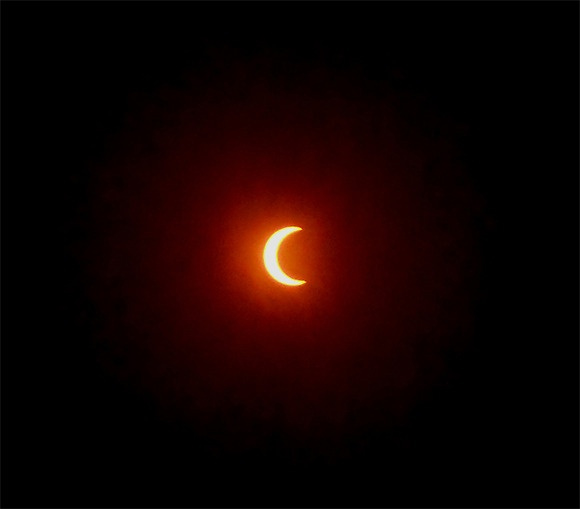
annular
A photo of the 2012 annular eclipse from Malibu, Calif., using an old digital camera and solar filter (Ian O’Neill)

The U.S. media is currently saturated with hot takes, histories, weird facts, “how to’s” and weather reports around the Great American Eclipse that will glide across the continent on Monday (yes, THIS Monday, it’s finally here). But, today, one news report stood out from the crowd:

Inevitably, Twitter had an opinion about this.

On reading the NBC News report (that was penned by an unknown Reuters writer), it is as tone deaf as the headline.

“American employers will see at least $694 million in missing output for the roughly 20 minutes that outplacement firm Challenger, Gray & Christmas estimates workers will take out of their workday on Monday to stretch their legs, head outside the office and gaze at the nearly two-and-a-half minute eclipse,” they write.

“Stretch their legs” for a “two-and-a-half minute eclipse,” — wow, what a waste of time. Worse than that, “[m]any people may take even longer to set up their telescopes or special viewing glasses, or simply take off for the day.” Unbelievable. Those skiving freeloaders.

How dare they take some time to step away from their computer screens to take a little time to gaze in awe at the most beautiful and rare natural celestial event to occur on our planet.

How dare they put pressure on the U.S. economy by bleeding hundreds of millions of dollars in lost revenue from the monstrous multi-trillion dollar consumerist machine.

How dare they be moved to tears as the moon completely blocks the sun, an event that has caused fear, suspicion, omen, wonderment, joy, inspiration, excitement and unadulterated passion throughout the history of our species.

How dare th— oh wait a minute. The lede appears to be buried:

“Compared to the amount of wages being paid to an employee over a course of a year, it is very small,” Challenger said. “It’s not going to show up in any type of macroeconomic data.”

So what you’re staying is, $700 million won’t even show up as a blip in economic analyses? Tell me more.

“It also pales when compared with the myriad other distractions in the modern workplace, such as March Madness, Cyber Monday, and the Monday after the Super Bowl,” they write. Well, whatdoyouknow, the Super Bowl is a distraction too? Those monsters.

So what you’re saying is, this isn’t really news. As a science news producer, I completely understand the pressures to keep up with the news cycle and finding fresh takes on tired stories (and let’s face it, 2017 has seen its fair share of eclipse articles). But for this particular angle, I think I would have most likely relegated the “lost” revenue to a footnote in a more informative and less clickbaity piece.

Monday’s eclipse will do untold good to this nation. The U.S. is going through a tumultuous stage in its young history, to put it mildly. This nation needs perspective to overcome the ineptitude, anti-science rhetoric and messages of segregation coming from its government; it needs an event that will be enjoyed by everyone, not just a fortunate subsection of society or the elite. The eclipse will inspire millions of people to look up (safely!) and ponder why is it that our planet’s only natural satellite can exactly fit into the disk of the sun.

Astronomy is an accessible gateway to the sciences and the eclipse will inspire, catalyzing many young minds to consider a future in STEM fields of study. This will enrich society in a myriad of ways and the economic gains from events such as Monday’s eclipse will make “$700 million” look like a piss in a swimming pool.

So, you know what? I’m glad this eclipse will “cost” the U.S. $700 million — I see it as an accidental investment in the future of this nation, a healthy nation that will hopefully put the antiscience stance of its current leaders behind it.

Want more eclipse stuff? Here’s a couple of my favorite angles:
How Eclipses Reveal Information About Alien Worlds, Light-Years Away
How a Total Solar Eclipse Helped Prove Einstein Right About Relativity

Also, be sure to view the eclipse safely:
Total Solar Eclipse 2017: When, Where and How to See It (Safely)