No, Jon & Kate aren’t going to be screaming at each other (why do people find that pair interesting anyway?), the 2012 movie teaser campaign will go up a notch after Sony decided it would be awesome if they throw even more money at this over-hyped End Of The World advertising campaign. 2012 will, quite literally, be spewing its CGI glory across the majority of TV stations.
Although it’s probably pretty obvious by now that 2012 is a marketing opportunity rather than anything that might really happen, even after 18 months since my original No Doomsday in 2012 article, I still receive countless emails about the subject. Some emails are angry (how dare I give scientific reasons why Planet X is bunk!), others are weird, but the majority are from people who have a genuine concern that they (and their family) might not live past Dec. 21st, 2012.
So for those of you who think there might be an ounce of truth in the doomsday claims you see on the ‘net, or the ones depicted in tonight’s 2012 trailer, to borrow the advice from Alan Boyle at Cosmic Log:
DON’T PANIC!
And why shouldn’t you panic? The simplest reason not to panic is that ancient civilizations (like the Maya) have never, ever predicted anything with any degree of accuracy (and no, just because they apparently had good astronomy skills does not mean they did a good Nostradamus impression). Quite simply, time is a one-way street, you can never foretell anything before it happens. It is a physical impossibility.
If you still don’t believe me and think that the cosmos has marked us for death on Dec. 21st 2012, check out my other articles on the subject: Could Planet X make an appearance?No, nope, no way, nah. What about a solar-fried Earth?Balls, bullshit… grapefruit? Geomagnetic shift?Don’t even go there!
Still in doubt? Please, just read through EVERYTHING listed on Astroengine.com and the Universe Today about the topic.
So, in short, ignore the 2012 viral campaign, but enjoy the movie for what it is, a disaster movie (and nothing more sinister). Will I be watching the movie? Hell yes, I want to be one of the first to review it!
In a discussion I seem to keep having these days when I mention that human spaceflight is actually a valuable endeavour for a nation, I’m usually met with a look of incongruity. Then the question: What has space exploration ever done for us?
I used to get a little angry about this question (of course space exploration is important!) but in actuality, I have to explain the answer because it isn’t necessarily obvious. By pushing into space, a nation can enrich its technology, improve education, boost employment in skilled areas, thereby improving the economy and generally improving a nation’s standing in the world. That’s the eco-friendly version. There are other applications such as military prowess, strategic advantage and business potential. Unfortunately, doing bold things in space requires money, and to get money you need to convince the government that it’s worth spending money on. Last time I looked, there’s no Space Race 2 going on, so we can’t rely on politics to see the necessity of space flight.
However, the US has invested billions of dollars in the exploration of space, and although NASA is a money-hungry entity, it produces results and has shaped the world as we know it. Granted, the US space agency was built on Cold War ideals and was hinged around the sole purpose of beating the Soviets to the Moon, but modern NASA is still relevant, if not more so.
Rockets and healthcare
From space, and back to Earth with a bump.
I watched a series of fascinating videos of the protests that went on in Washington D.C. on September 12th concerning President Obama’s healthcare reform plans. The Tea Party (not Twinnings, or Boston… some other tea party that didn’t have a lot of tea) exploded to life to the sound of tens of thousands of voices protesting “socialist” healthcare. Apparently, a nationalized healthcare system is a bad thing. The arguments against Obama’s plan seem rather outlandish to me, and a hardcore group of protesters (not all the protesters, just a few apparently missing a sanity gene) accused the US President of being a “communist,” “socialist,” “Marxist” and (most shockingly) a “Nazi.”
So, here we are, with a field-full of rabid protesters that have been whipped up into a frenzy by the media, special interest groups and political antagonizers. These geniuses see a nationalized healthcare system as a socialist agenda. Of course, this means communism is just down the garden path. Last time I looked, the UK wasn’t a communist state, and although the British National Health Service (NHS) isn’t perfect, it’s a damn sight better than the US health insurance insanity.
The point I’m trying to make is that tens of thousands of people descended on the US capital to protest a healthcare bill that actually seems quite sensible. Unfortunately, this huge group believe this bill is actually a government conspiracy intended to dupe the public, bankrupt the country and control the nation.
NASA losses
Now let’s wind back the clock to last year, when it was announced NASA would be shedding thousands of jobs when the space shuttle is retired. More recently, a task group was formed to discuss NASA’s options considering its budget isn’t going to grow any time soon — unfortunately, Bush’s “Vision for Space Exploration” can’t be done because the Constellation Program will cost too much. Now the Augustine Commission has set out some plans that may curtail NASA’s big projects, possibly even cancelling Constellation.
To top all this off, there is a 5-year gap (minimum) between the shuttle being retired and Constellation taking over (if that even happens), that means there will be at least 5 years the US will have without a manned launch vehicle. Yes, the US has gone through this before (between the end of the Apollo Program in 1970 and the Shuttle Program in 1982), but this time we could lose access to the space station, a $100 billion project the US is heavily invested in.
Fortunately, US companies are seeing business opportunities in space, so given enough funding, start-ups like SpaceX could start ferrying NASA astronauts into LEO sooner rather than later. There are also other nations involved in the space station and they can give us a lift into space. Unfortunately, apart from the Shuttle, there’s only one other spacecraft that’s human-rated in the world. That’s Soyuz.
Russian Roulette
Soyuz is great, it’s a sturdy vehicle and it’s received little complaint from the astronauts and cosmonauts that have been ferried around in it (well, most of the time). The Russian space agency will basically be offering NASA taxi rides into space so the US can still use the International Space Station.
The cost? $50 million per seat.
Wow, what a bargain. The space shuttle costs the best part of a billion dollars to launch every time. Compare that with $50 million, it almost seems as if this 5-year gap is a good thing. It might save NASA some money!
However, in the process of retiring the shuttle, skilled US jobs will be lost. Even the transition from the shuttle program to Constellation will cause a re-shuffle of NASA employees. Last year, Senator Bill Nelson pointed out that shedding jobs from the US space agency, only to rely on a Russian launch vehicle, will have the effect of generating jobs in Russia. This might seem like an over-exaggeration, but it may indirectly be the case.
The added concern is that the $50 million value per Soyuz seat could increase. After all, US-Russia relations aren’t exactly toasty, the Russian space agency could set its own price for taxi rides to the space station. NASA money will be spent, not on advancing US spaceflight capabilities, but on another nation’s spaceflight capabilities. Sure, NASA and Roscosmos are co-operating now, but both are government-backed entities and that co-operation could turn south during the next East-West political upset.
Conclusion
In summary, until US spaceflight companies develop human-rated space vehicles, or until the Constellation Project (or equivalent) is finished, the US will be wholly dependent on Russia for human spaceflight. NASA will be paying a premium rate for that privilege.
So when I see thousands of individuals crowding on Capitol Hill, angrily protesting about the idiotic belief that the President of the USA is on the verge of creating a communist state, I think about NASA and the fact that the US space agency has been forced to pay for seats on board a spaceship maintained by an ex-communist state the US government is having problems with.
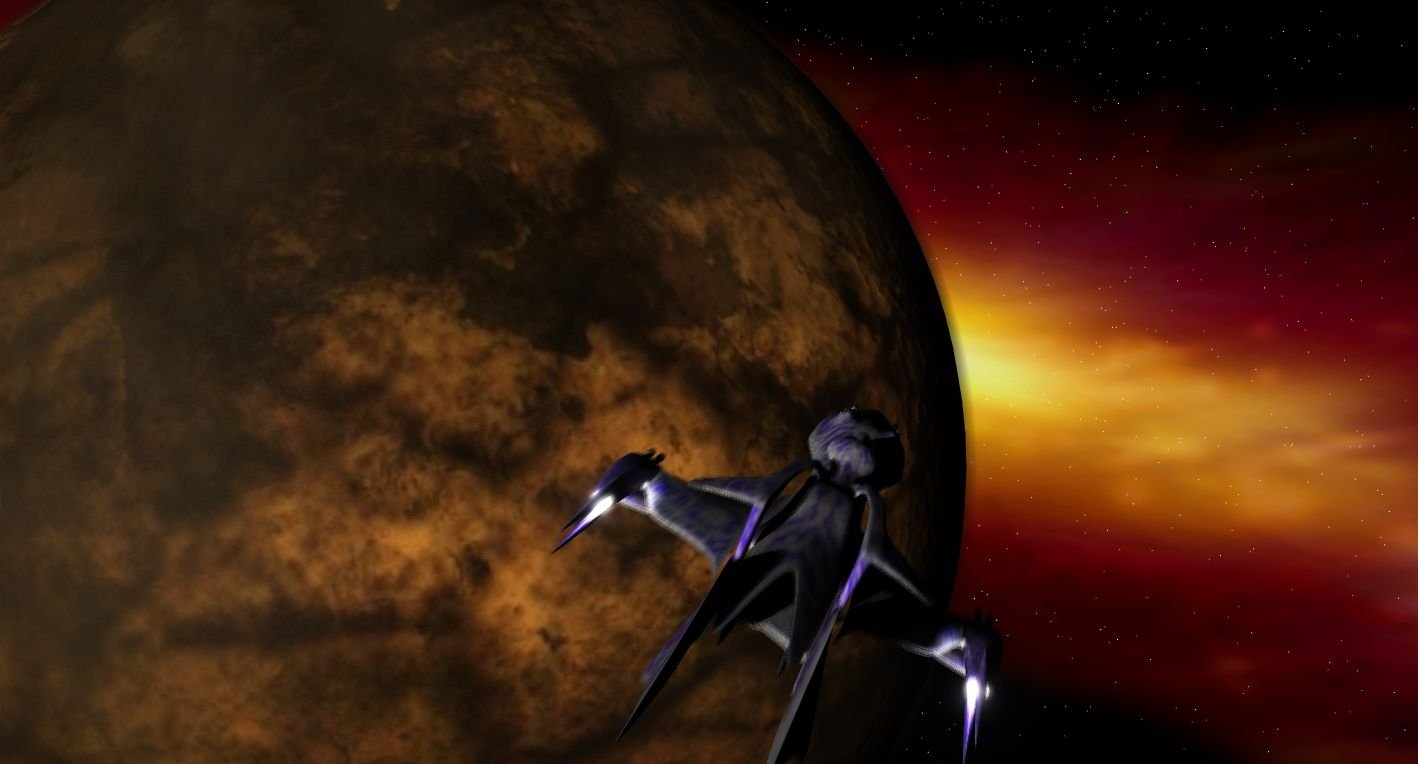
The White Star approaches the Shadow’s homeworld of Z’ha’dum on the Galactic Rim.
It would appear that scientists have confirmed that the outer edge of the Milky Way is a bad location for life to even think about existing.
This research reminded me of the “Galactic Rim” in the 90’s sci-fi TV series Babylon 5. The Rim is the mysterious region of space right at the edge of our galaxy where only the hardiest of explorers dared to venture. As explained in the season 2 episode of B5, “In the Shadow of Z’ha’dum,” Captain Sheridan (Bruce Boxleitner) discovers that his wife (when exploring The Rim) went missing on a planet called Z’ha’dum. It turns out that an angry ancient alien race — called the Shadows — lived on this mysterious world and their discovery led to them being used in all kinds of plots during the latter four seasons of this awesome sci-fi show.
However, the existence of any kind of life (let alone life as complex as the evil Shadows) in the badlands of the Milky Way is looking very unlikely.
Located some 62,000 light years from the core of our galaxy (over twice the distance of the Earth from the galactic centre), two very young star clusters in the constellation of Cassiopeia have been studied. Chikako Yasui, Naoto Kobayashi and colleagues at the University of Tokyo, Japan, found these clusters in a vast cloud of gas and dust called Digel Cloud 2. The stars inside these clusters are only half a million years old, and the majority of them should possess proto-planetary disks (which is characteristic of local star-forming regions). However, it would appear that these stars contain very little oxygen, silicon or iron (i.e. they have very low metallicity) and only 1 in 5 of the 111 baby stars analysed in both clusters have disks.
If proto-planetary disks are rare, this means there will be a rarity of planets. This is an obvious bummer for life to form. After all, Life As We Know It™ is quite attached to evolving on Earth-like planets.
So why are these young stars lacking proto-planetary disks, when local star forming regions don’t seem to have this affliction? The authors of the paper, soon to be published in the Astrophysical Journal, suggest that these stars did have disks, but some mechanism is rapidly eroding them.
The most likely scenario is that low metalicity proto-planetary disks are more susceptible to photoevaporation. Simply put, these disks evaporate when exposed to EUV and X-ray radiation from their parent stars far more rapidly than disks that are metal-rich.
Therefore, if an alien race was able to form, they’d be very rare or they’d be very different from what we’d expect “life” to be like (i.e. they thrive in low metalicity star systems). Sounds like the mysterious Shadow homeworld of Z’ha’dum would be a very rare sight on The Rim of our Milky Way after all.
Oh dear. Just when I was actually beginning to care about the cast of Defying Gravity, it was cancelled half-way through the first season. I was a little annoyed about this as #DefyingGravity on Twitter was fast becoming a weekly ritual; a group of us die-hard sci-fi viewers scoffing at the science atrocities the ABC show was inflicting on us. In fact, the bad science, when coupled with a spaceship full of horny crew mates (a.k.a. friends with benefits… why not?) almost made it compelling viewing (almost).
Apart from hammering home the inevitability of astronauts having sex in space, I almost stood up and cheered when, in the last episode (called “Love, Honor, Obey“), the cast did a great job at explaining the quantum physics thought experiment, Schrödinger’s cat. As the crew was stuck inside a shielded compartment to protect themselves against an impending solar flare (it turned out to be a false alarm), mission control had no way to communicate with the crew. Steve Wassenfelder, the out-of-shape physicist, likened the crew to Schrödinger’s cat; to mission control, as they had no way of knowing whether they were alive or dead, the crew were in fact alive and dead. Clever.
The show also handled the solar flare event pretty well, although they avoided a lot of the details (but kept it within the realms of possibility, as opposed to some movies I won’t mention).
Then, after some fractal tomato plants (I didn’t say all the science was kosher), the crew opened mysterious Pod 4 to see…
…I don’t know what they saw as that was the cliff-hanger of the last episode. I’m sure I’ll end up watching it on Hulu.com, but I don’t think it will be the same without mocking it live on Twitter with the #DefyingGravity contributors (you know who you are).
Then, as quickly as Defying Gravity dropped off our screens, another compelling sci-fi series appears on ABC featuring a competent-looking cast (led by Joseph Fiennes and John Cho). It’s called FlashForward, and after only the first episode, I’m hooked. It’s actually the same feeling I had when I watched the very first episode of Heroes.
In FlashForward, we start off in Los Angeles, looking into several people’s lives, when suddenly the entire planet blacks out for 2mins 17seconds. During that time, everyone has a vision of 6 months into the future.
The series is based on the 1999 novel Flashforward by Canadian science fiction writer Robert J. Sawyer, and the premise is pure sci-fi joy. In fact, I was lucky enough to be sent a behind the scenes video by Times.com science comedian Brian Malow (be warned, there’s a fairly huge spoiler, but it’s an awesome spoiler that will get you nodding with joy… but you’ve been warned):
Robert J. Sawyer calls himself a “hard science fiction writer,” so it will be very interesting to see how the show deals with the speculative quantum-conciousness link. Still, it has to be better than that silly mag grav idea in Defying Gravity.
In other news: The lovely Eliza Dushku will live-tweet during the season 2 premier of Dollhouse (on FOX) if she gathers 100,000 Twitter followers before it airs… in 20 minutes on the West Coast. She’s only on about 92,000 at the moment, so it’s not looking likely. Still, I’ll be watching!
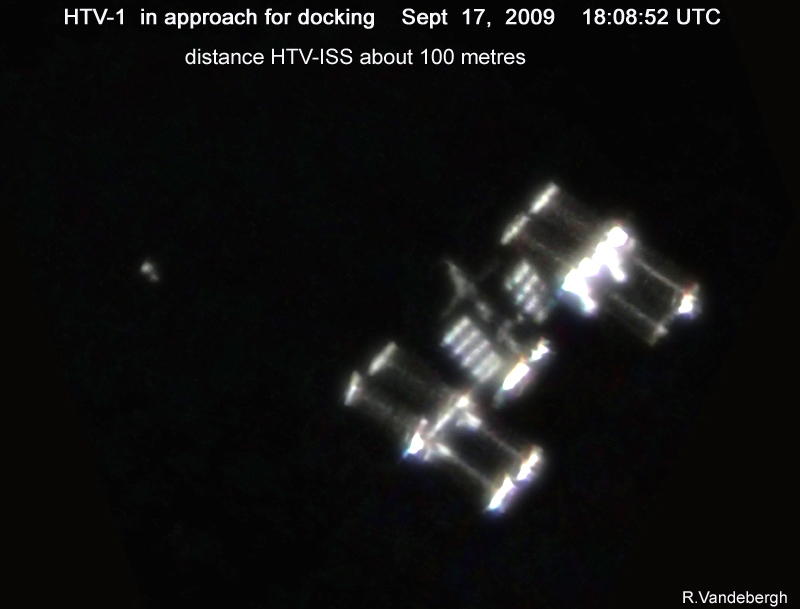
I first came across Ralf Vandebergh’s outstanding astrophotography when I was inquiring about a “mystery” object that appeared to be stalking the International Space Station (ISS) in July. As it turned out, it wasn’t a UFO, it was in fact a Russian Progress re-supply space vehicle testing out a new automated docking procedure with the orbiting outpost. Vandebergh managed to image the ISS and Progress vehicle with amazing clarity from his home in Wittem, the Netherlands.
Today, he’s done it again, only this time his target was the first flight of the robotic Japanese H-II Transfer Vehicle, HTV-1.
On day 3 of the mission (Sept. 13th) to supply the ISS with over 4 tonnes of food, water, fuel and equipment, Vandebergh captured this incredibly detailed picture of the vehicle, speeding overhead at an altitude of just under 300km (pictured top). He also took a shot of the HTV-1 as it was approaching the ISS on Sept. 17th (right).
I’m totally in awe of these shots, and there’s a lot more where this came from. In Vandebergh’s gallery there are pictures of spacewalking astronauts, shuttle cockpits and amazingly detailed portraits of the ISS… all taken with a camera, through a telescope, on terra firma. Enjoy.
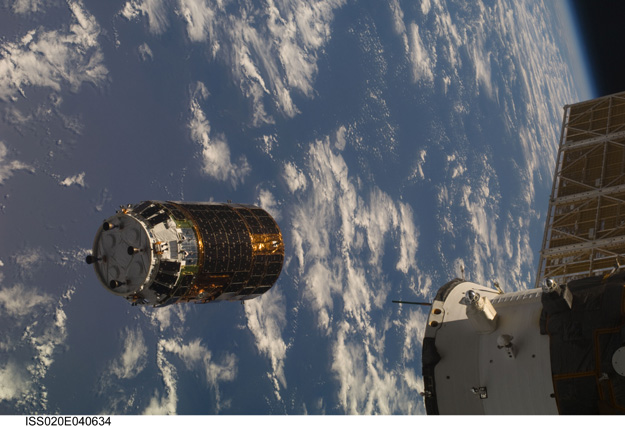
For reference, here’s a shot of the HTV-1 from the ISS shortly before docking:
The HTV-1 approaches the space station on Sept. 17th (NASA)
The biggest factor hanging over human settlement of other worlds is the question of water. We need it to drink, we need it to cultivate food, we need it for fuel (indeed, we need it for the first lunar microbrewery); pretty much every human activity requires water. Supplies of water could be ferried from Earth to the Moon, but that would be prohibitively expensive and ultimately futile. For us to live on the Moon or further afield, H2O needs to already be there.
Ever since the Apollo lunar landings when samples of rock were transported to Earth we’ve been searching for the mere hint of this life-giving molecule. There have been indications that the lunar regolith may indeed contain trace amounts of the stuff, but on the whole, scientific endeavour has yet to return evidence of any large supply of water that could sustain a colony.
Until today.
Up until now, scientists haven’t been able to seriously entertain the thought of water on or near the surface of the Moon, apart from in the depths of the darkest impact craters. However, data from the recently deceased Indian Chandrayaan-1 mission has supported data taken by the Cassini probe (when it flew past the Moon in 1999 on its way to Saturn) and NASA’s Deep Impact probe (which made several infrared observations of the lunar surface during Earth-Moon flybys on its way to the 2010 rendezvous with Comet 103P/Hartley 2). Both Cassini and Deep Impact found the signature of water and hydroxyl, and now, a NASA instrument on board Chandrayaan-1 reinforces these earlier findings.
The NASA-built Moon Mineralogy Mapper (M3) on board the Indian satellite detected wavelengths of light reflected off the surface that indicated hydrogen and oxygen molecules. This is convincing evidence that water is either at, or near, the lunar surface. As with the previous measurements, the water signal gets stronger nearer the lunar poles.
So what does this mean for the future of manned space exploration? Although water has been detected, this doesn’t mean there are huge icy lakes for us to pitch a Moon base and pump out the water. In actuality, the signal indicates water, but there is less water than what is found in the sand of the Earth’s deserts (you can pack away the drinking straws now).
“It’s still pretty damn dry, drier than anything we have here. But we’ve found this dynamic, ongoing process and the moon was supposedly dead,” University of Maryland senior research scientist Jessica Sunshine told Discovery News. “This is a real paradigm shift.”
If there are widespread water deposits (despite the low concentrations), even in regions constantly bathed in sunlight, there is huge potential for water deposits in those mysterious, frozen craters. Interestingly, these measurements indicate that the water may not have just been deposited there by comets; the interaction between the solar wind and the existing lunar mineralogy could be a mechanism by which lunar ice is constantly being formed.
“Every place on the moon, at some point during the lunar day, though not necessarily at all times, has water and OH [hydroxyl],” Sunshine said.
We may see self-sufficient lunar colonies yet. But the saying “getting blood out of a stone” should probably be replaced with “getting water out of the lunar regolith”…
Next up is NASA’s LCROSS mission that is scheduled to impact a crater in the south pole on October 9th. Analysis from the impact plume will supplement this positive Chandrayaan-1 result, hopefully revealing yet more water in this frozen region.
The space station as reflected in John “Danny” Olivas’ spacesuit visor on September 3, 2009 (NASA)
When I came across this image in NASA’s Human Space Flight gallery, I stopped. I was looking for the “perfect” shuttle image during the STS-128 mission to the International Space Station earlier this month, but I got sucked into browsing through the hundreds of EVA photographs NASA has stockpiled in their archives.
This particular scene was taken by NASA astronaut John “Danny” Olivas when he was out on a spacewalk installing a new Ammonia Tank Assembly. The EVA was over six hours long and Olivas was able to do some digital photography in that time. This picture shows his spacesuit helmet visor, with a reflection of the camera at arms length below.
Also visible in the reflections in the visor are various components of the station and European Space Agency astronaut Christer Fuglesang, mission specialist, anchored to a Canadarm2 mobile foot restraint. —NASA
The reflection captures so much detail. The curvature of the Earth can be seen in the distance, with space station solar arrays jutting in front. Even the two docked Soyuz vehicles (TMA-14 and TMA-15) are in shot. To top it all off, ESA astronaut Fuglesang is dangling in the vacuum of space attached to a robotic arm.
The shapes of fractals appear in nature all the time, but when I saw this Earth Observatory image from the International Space Station, I thought I was looking at a zoomed-in portion of the famous Mandelbrot set graphic. This picture wasn’t formed by the calculations of a computer, however. This is what nature does when chaos comes out to play.
Imaged from orbit on August 25, 2009, an astronaut was able to get the timing just right with his/her Nikon D2Xs digital camera (plus 180 mm lens) so that sunlight was reflecting off Brazil’s Lago (Lake) Erepecu and Rio (River) Trombetas. Usually, water masses in the Brazilian Rainforest are too dark to be picked out in any detail, so this sunglint was very useful to pick out the fine detail of the waterways.
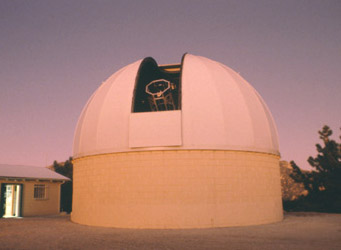
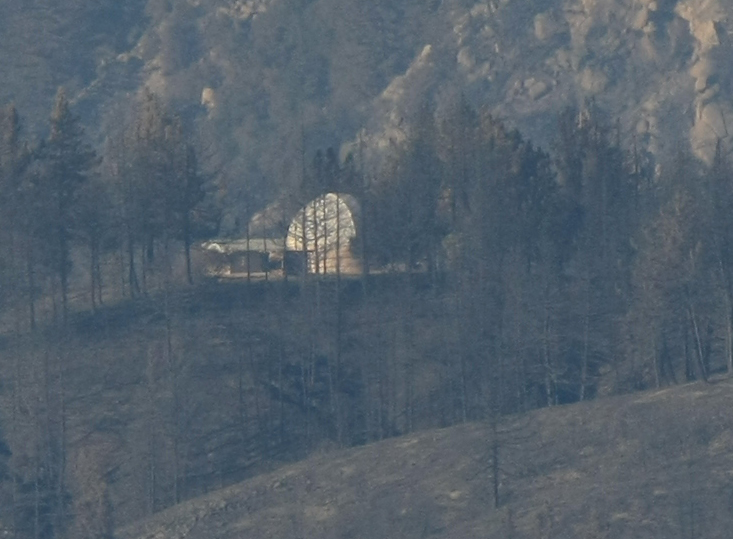
The observatory, located approximately 5 miles north east of the larger Mt. Wilson Observatory, was built and is run by amateur astronomers. Also, the site is a lot smaller, meaning the single observatory dome couldn’t receive the same amount of fire fighting attention as the historic Mt. Wilson site. Fortunately, it would appear the 30-inch Newtonian-Cassegrain telescope is safe inside it’s domed home.
The Stony Ridge Observatory from Mt. Wilson. Credit: Dave Jurasevich, Mt. Wilson Observatory Superintendent
“For those of you who have expressed your support for Stony Ridge Observatory — thank you! As you can imagine, it’s been a stressful time for all of us, and we very much appreciate all the kind thoughts and expressions of support we’ve received. Although we’ve not been able to look inside the buildings yet, it appears at least from the outside that Stony Ridge has been spared damage but will require extensive cleanup. Keep checking the website every so often. More info/photos will be posted there as we get them.” —Kay Meyer, Stony Ridge Observatory webmaster
Tonight, Pam Sable, a member of the Stony Ridge Observatory, sent me a message confirming that the site was safe. However, the wildfire has left its mark.
“Our site is in what used to be, a lovely forest only 50 minutes from my home in Glendale, which itself is an area only 20 minutes from Downtown L.A. Once in the Angeles Forest, all the sights and sounds of the city are gone. The damage to the forest is very sad but at least it will return in time. Yet if Stony Ridge had been destroyed, it would have been irreplaceable by today’s costs. We are very, very fortunate.” –Pam Sable, Stony Ridge Observatory astronomer.
Indeed, the fire is still burning. Unfortunately, fire fighters are hurrying to extinguish the blaze as hot weather is forecast for the next week. There’s also the spectre of the Santa Ana winds that could cause some complications.
Today is H.G. Wells’ birthday! And I must admit, the Google logo is pretty cool. A UFO and a couple of tripods (with more in the distance) rampaging through the sleepy rural village of Horsell in Surrey is depicted. This relates to last week’s Google Doodle of crop circles and tweeted map reference to the same village near the town of Woking where H.G. Wells lived and wrote the famous War of the Worlds novel.
In my first post about the doodle, I followed the trail as far as H.G. Wells’ birthday, although last week it wasn’t Wells’ birthday. But the clues were there for something to happen today and it has. Even the logo’s filename is unambiguous: “hgwells09.gif”
So no puzzle this time, just a celebration of a legendary writer who imagined the first ever sci-fi Martian invasion in Surrey. If there’s a deeper puzzle behind this doodle, I don’t see it.







 astroengine.com