Introducing Little SDO

The Solar Dynamics Observatory (NASA)

Playing on our love for WALL-E, our amazement for the Pixar Lamp and some great animation, Chris Smith, an employee at NASA Goddard Flight Center, has given the upcoming Solar Dynamics Observatory a personality.

Apart from obviously having too much time on his hands, Smith is a very talented guy (as all NASA employees are) and is showing that, once again, the space agency is doing a fantastic job of reaching out to the public.

As proven by the efforts of the Phoenix Mars Lander team in 2008, communication goes a long way and by harnessing social media, NASA can make its missions household names. Phoenix was tweeting, blogging and podcasting to its hearts content for five months, from touchdown to frozen death; it was Big Brother for robots living on Mars.

Now most NASA missions have Twitter feeds and devoted blogs, ensuring everyone’s interest is piqued. It also helps to have a Twitter feed talking in first-person, giving these brave rovers, landers, orbiters and probes a much needed personality.

So now, Chris Smith has done something very cool with the SDO; he’s given it an animated personality in a short animation reminiscent of a movie teaser for an upcoming Disney-Pixar feature film. Behold, the Little SDO:

It’s a really fun little piece,” says Wade Sisler, a television producer for NASA. “And we’re hoping to use it as a way of waking some kids and folks up to solar science.”

And so NASA should, I like it! It’s going to get people interested in a comparatively small mission, and let’s face it, the satellite lacks character (the boxy 4-eyed robot doesn’t do much for me). However, now that Smith has added squeaky solar panel wings, and blinking “eyes” (without changing the design of the craft at all), he’s boosted the SDO’s likeability. Suddenly I care for the little guy. I hope he doesn’t get hit by a solar flare.

Due for launch in October, the SDO will be inserted into a geosynchronous orbit above New Mexico, gathering data from the Sun, so solar physicists can better understand space weather. The cool thing is that with those four eyes, the SDO will capture high-definition images of the Sun continuously.

It might not have the dazzle of the Phoenix Mars Lander, but it has a personality and people will love him (I await the Twitter feed).

Learn more about the Solar Dynamics Observatory »

Source: Wired Science

Space Station Flare Captured On Film

I’ve been watching this short video clip over and over. It may only be two seconds long, but it is such a unique view of the space station that I find it mesmerizing. Each time the animated GIF loops, another detail seems to reveal itself.

The ISS flare, as observed by Nicolas Biver from Versailles, France, on April 28th (©Nicolas Biver)

It’s also kinda hypnotizing in a rhythmic way; the space station appears to turn and boost away into the black of space, but just before its massive solar arrays capture the sunlight, dazzling the observer with a flash.

Is it me, or are those solar panels reminiscent of the sails hoisted up the masts of canon-touting battleships before the age of iron-hulled vessels and steam-powered engines? These slightly fuzzy images could even be from the turn of the 20th Century, when one of the first movie cameras filmed a ship steering out of port.

Of course, this isn’t a wooden ocean-going ship, it’s the space station, in orbit. And the video was taken with a modern digital camera through a 16-inch Dobsonian telescope by a highly skilled amateur astronomer called Nicolas Biver from Versailles, France. The reason why the station appears to “turn” is because the perspective of the observer changes as the station flies overhead, he did a great job of tracking it.

On April 28th, Biver tracked the space station through his ‘scope. Whether it was intentional or not, he was fortunate to capture an intense flare as the space station’s solar panels reflected sunlight at his location. The resulting flare was much brighter than Venus (after the Moon, the station is the second brightest object in the night sky). Usually when I hear about observations of flares made by stuff in orbit, I usually think of Iridium flares that occur at predictable times and locations, providing a target for observers on the ground to capture a meteor-like streak across the sky. The Iridium satellite network provides a great chance for astronomers to see the reflected light when the angle between them, the satellite’s solar panels and Sun is just right.

My astronomer friend Tavi Greiner (who has just joined the Astrocast.TV team as host of Our Night Sky, be sure to check it out!) is very skilled at observing the Iridium flare-ups, and as can be seen in this image, those things are bright.

However, on the 28th, it was the space station’s turn to reflect some light for Nicolas Biver.

In March, Space Shuttle Discovery completed the construction of the ISS solar arrays during the STS-119 mission. Over a series of space walks, the solar array had its area boosted to 16,000 square feet. With this extra surface area, comes the potential for very bright flaring events.

For the chance to view the ISS and possible flaring, check out SpaceWeather.com’s Simple Satellite Tracker.

Source: Space Weather

Slow News Day: Alien Skull On Mars

PD*28522608

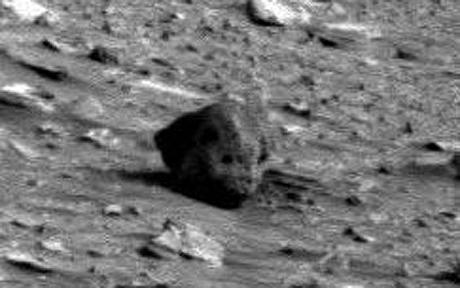
This just came in from the Telegraph, apparently Mars Exploration Rover Spirit has spotted a random skull on the Martian surface. This is obviously the only interpretation… as we know what an alien looks like, don’t we? Big head, big eyes, pasty grey skin. Something like this? Or, more likely, like this? Or this? Wow, it could be any one of them.

However, it’s not quite that exciting.

It’s a rock, as you may have already guessed. And no, the Telegraph isn’t taking it seriously either. (Although The Sun’s microreport could be taken either way.)

Although the newspaper’s article resembles a badly conditioned April Fools gag, there is one glaring error, well two actually. No, three.

Firstly, Spirit is not a camera – it’s a whole robot with a camera attached (called the Panoramic Camera, or Pancam for short). If it was just a camera, could you imagine the movie location costs?

Second, I’m not sure why this was filed in “Science News”. It obviously needs to be filed under “It’s a Slow News Day, We’ll Report Anything”.

And thirdly, I seriously doubt this image got “space-gazers talking”. When I last looked at one of Opportunity’s panoramic shots, I could see all kinds of strange things in the Mars dirt. If I was a conspiracy theorist, I’d love poking around the shapes and shadows, thinking I could see skulls, flying hubcaps and mysterious plant-like features. But I’m not a conspiracy theorist, I’m a “space-gazer”, but I’m not “talking”.

As it’s late, I’ve given up trying to find the source of the article (no links – come on Telegraph, if you’re gonna play blogging for the day, at least reference your lead!). Apparently some “UFO hunters” were being serious, but then joking, about this rock that looks like a skull. So, what the Telegraph is really trying to tell us is:

A stone. On Mars. Might look like a skull. Doesn’t really. Even ufologists don’t take it seriously. So it’s not really news. Move along.

I’m not suggesting the Telegraph isn’t a good newspaper, on the contrary, but really, what’s the point?

Why did I even bother to report on this? Oh yeah: It’s a stone that looks like a bunny skull. Now try explaining how a rabbit got up there…

Astroengine Featured on CNET

cnet

In an article written by Don Reisinger for CNET News, Astroengine.com was selected as one of the “18 cool sites and apps that teach you about space.”

This is awesome as one of my main effort on Astroengine is to not only promote space news, opinion, skepticism and logical thinking, I also hope the site serves as an educational medium, so readers can understand the science that hides beneath the headlines. “Outreach” is a lot more than a group of scientists trying to work out how best to promote their work to the world; it’s a way of communicating advanced scientific theories to an audience who don’t necessarily have a specialized knowledge of the subject matter. Even though I have an education in a small aspect of astrophysics, it is often hard to understand the next big discovery in cosmology (don’t get me started on quantum dynamics, that stuff is insane!), so the more explaining the better in my books.

Also, to add to the coolness, by virtue of alphabetical luck, Astroengine.com takes the #2 slot in the top 18 space websites. And to top the whole thing off, Don Reisinger’s article hit the front page of Digg.com this morning. Needless to say, Astroengine was busier than Grand Central Station on a Friday evening this afternoon (thank goodness I have a brand new server to deal with demand)!

Thank you Don, I really appreciate the mention and the really cool review!

For more, check out “18 cool sites and apps that teach you about space” on CNET.com »

Laboratory Ice Links Comets with Life On Earth

Artist impression of the nucleus of Comet Tempel (NASA)

It is an established theory that comets may have, in some way, seeded life on Earth. Some extreme ideas support the panspermia concept (where bacterial organisms hitched a ride on comets, asteroids or some other planetary debris, spreading life throughout the Solar System), while others suggest comets may have contributed the chemical building blocks essential for life to form 4 billion years ago. We know these icy bodies are also awash with organic compounds, so it’s not a huge leap of the imagination to think comets may have donated life-making material to the early Earth.

In an effort to study cometary material and its possible influence for nurturing early life on Earth, Prof. Akiva Bar-Nun of the Department of Geophysics and Planetary Sciences at Tel Aviv University has been creating his own comets in the laboratory. By doing this, Bar-Nun is hoping to gain a better perspective on how comets acquired their composition of the noble gases Argon, Krypton and Xenon.

The proportion of these elements are found in the Earth’s atmosphere, but are not thought to have originated from the rocky material our planet consists of. By understanding the proportions of these elements that formed in the icy laboratory environment, if the proportions match that of what we’ve measured on Earth, it goes to some way in explaining how comets formed in space and how they delivered organic compounds to the surface.

Now if we look at these elements in the atmosphere of the Earth and in meteorites, we see that neither is identical to the ratio in the sun’s composition,” said Bar-Nun. “Moreover, the ratios in the atmosphere are vastly different than the ratios in meteorites which make up the bulk of the Earth.”

So we need another source of noble gases which, when added to these meteorites or asteroid influx, could change the ratio. And this came from comets.”

Prof. Bar-Nun and his team carried out the research using a comet-making machine unique to Tel Aviv University, and although the original press release is light on the details, it is assumed the chemical composition of the early Solar System was recreated and then deep-frozen.

Comets bombarded the Earth 4 billion years ago. Organic chemicals were therefore deposited, possibly kick-starting life (NASA)

Comets formed some distance from the Sun (and a vast number of them populate the Oort Cloud), water vapour would have condensed and frozen, in temperatures as low as -250°C, trapping a primordial collection of chemicals inside their dusty, icy interiors. Some time after, these comets may have fallen into the inner Solar System, many impacting the Earth. Amino acids may have been introduced to the surface and oceans, or vital chemical components from the comets combined with chemicals already on Earth and life was sparked. When this happened, these comets would have left a chemical fingerprint.

Bar-Nun’s team were successful in creating their own synthetic comet, freezing water vapour, creating a natural ratio between the three elements. Then a link could be made, from the laboratory comet, with the very definite noble gas proportions, and the proportions of these gases found in the atmosphere.

The pattern of trapping of noble gases in the ice gives a certain ratio of Argon to Krypton to Xenon, and this ratio — together with the ratio of gases that come from rocky bodies — gives us the ratio that we observe in the atmosphere of the Earth,” added Bar-Nun.

Judging by the information available (the paper is published in the journal Icarus), Bar-Nun’s research has provided evidence that comets left a unique ratio of stable noble gases in the atmosphere, a ratio of necessary materials for life to eventually form.

Source: Tel Aviv University, EurekAlert via @Avinio

The Russian Rocket-Powered Lander. What Could Possibly Go Wrong?

russian_spaceship_next

Let’s face it, Soyuz is getting old. It’s not that the spaceships themselves are getting rickety, there have been many incarnations, but the original Soyuz design was first conceived in 1966, so the Russian space agency (Roscosmos) is feeling it’s about time for a change. Soyuz has carried out the most manned missions into space out of any other space flight system (over 100 since the 1960s), so Russia has every right to be proud of its achievements.

So what system does Roscosmos want to replace Soyuz with? Perhaps a bigger version of Soyuz? Perhaps a revolutionary winged spaceplane? Nope. They are currently looking at plans for a Soyuz-esque capsule that will re-enter the Earth’s atmosphere much like before. But due to political pressure (spawning the need to move Roscosmos’ operations out of Kazakhstan), engineers must find a way to land the return vehicle in a minuscule area. Measuring only 2×5 km (yes, that’s a tight 10 km2), the landing strip will be as unforgiving as the new method to land the descent vehicle.

There will be no parachutes and no wings; the new concept will use a rocket-powered landing system alone, creating the first ever rocket-powered Earth-lander. If you thought that was a rather extreme design specification, you might be surprised to hear that engineers want to start firing these landing thrusters when the descent module is only 600-800 metres from the ground
Continue reading “The Russian Rocket-Powered Lander. What Could Possibly Go Wrong?”

Cassini Detects Salt: Enceladus Probably Has a Liquid Ocean

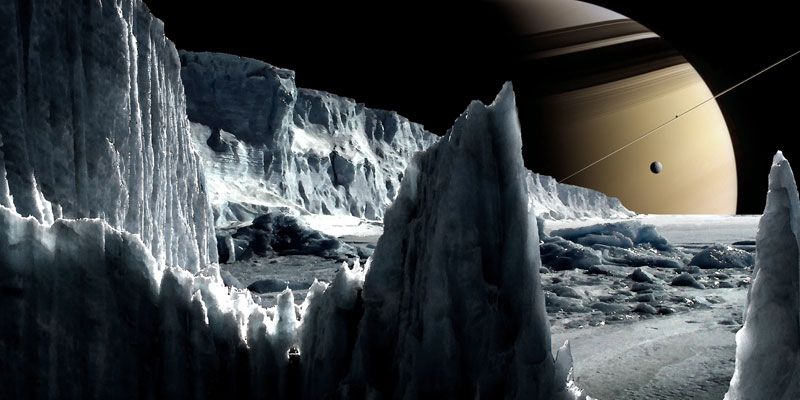
The small icy Saturn moon might have liquid sub-surface oceans after all (NASA)

In October 2008, Cassini flew very close to the surface of Saturn’s icy moon Enceladus. From a distance of only 50 km from the moon, the spacecraft was able to collect samples of a plume of ice. In an earlier “skeet shot”, Cassini captured detailed images of the cracked surface, revealing the source of geysers blasting the water into space. At the time, scientist were able to detect that it was in fact water ice, but little else would be known until the molecular weight of chemicals in the plume could be measured and analysed.

At the European Geophysical Union meeting in Vienna this week, new results from the October Enceladus flyby were presented. Frank Postberg and colleagues from the Max Planck Institute for Nuclear Physics have discovered traces of sodium salts and sodium bicarbonate in the plume for the first time.

It would appear that these chemicals originated in the rocky core of the moon and were leached from the core via liquid water. The water was then transported to the surface where it was ejected, under pressure, into space. Although scientists are aware that the chemical composition in the plume may have originated from an ancient, now frozen, sub-surface ocean, the freezing process would have isolated the salt far from the surface, preventing it from being released.

It is easier to imagine that the salts are present in a liquid ocean below the surface,” said Julie Castillo of NASA’s Jet Propulsion Laboratory in Pasadena, California. “That’s why this detection, if confirmed, is very important.”

This is the best evidence yet that Enceladus does have a liquid ocean, bound to cause a stir amongst planetary scientists and re-ignite excitement for the search for life living in a salty sub-surface ocean.

Source: New Scientist

A Hole In Arizona

©Stan Gaz

This picture was posted by Phil Plait and I was mesmerized. Stan Gaz, the photographer of Meteor Crater in Arizona, will be laying on an exhibition in New York from April 30th to June 6th. If this is anything to go by, it’s an event you can’t afford to miss out on… if you’re in or near New York that is. As I am quite literally on the other side of the country, I’ll miss it, but here’s more info if you are more fortunate.

100th Carnival Of Space. Oh Yes! It’s the Centenary Edition!

header

One hundred Carnivals. Wow.

I think it goes without saying that this is a huge Carnival of Space, a celebration of the first century of space blogging as we move into the second. So long as I blog about space and science I will continue to participate in this supreme celebration of the space blogosphere.

So, over to Brian Ventrudo at One Minute Astronomer, for the huge 100th Carnival of Space!

Somewhere, something incredible is waiting to be known.” — Carl Sagan (from One Minute Astronomer)

Every Reason Not To Worry About Doomsday In 2012

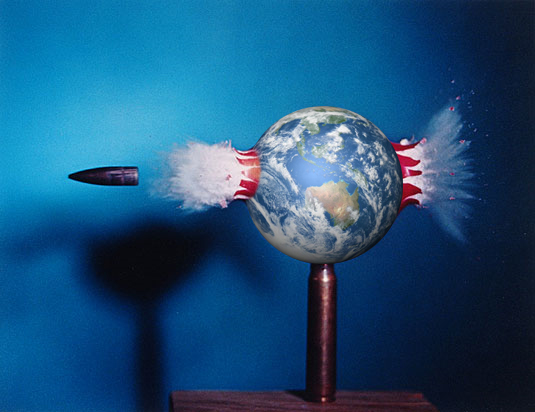
Image credits: Harold Edgerton (1964), NASA. Edit: Ian O'Neill

In today’s 365 Days of Astronomy, Cameron Hummels and Josh Schroeder from Columbia University, New York, discuss the 2012 doomsday hype. And it is awesome. The special thing about this podcast is that Cameron (who is working toward a PhD in astronomy) is clear, concise, and makes the whole crackpot 2012 doomsday scenario sound as petty as it really is.

In 10 minutes, the pair run through ancient prophecy, Mayan calendars, Planet X, galactic alignment and solar flares (to name a few) and carry out possibly one of the most comprehensive debunking efforts I have ever heard. They pretty much summed up all of my “No Doomsday in 2012” articles with a huge helping of skeptical thinking, plus extras, pointing out that all the doomsday hype is driven by little more than a small group of irresponsible individuals wanting to make some fast money from people’s fear.

Congratulations Cameron Hummels and Josh Schroeder, you’ve just scored one huge point for rational thinking and produced a wonderful celebration of scientific endeavour!

Go to the 365 Days of Astronomy podcast page to listen in »

Show description:

An increasing number of people believe that December 21, 2012 will mark the end of the world. Proponents of this idea cite diverse astronomical reasons for an imminent apocalypse: the end of the Mayan long-count calendar; an alignment between the Solar System and the Milky Way; the solar sunspot cycle reaching an all-time high; the reversal of the Earth’s magnetic field; and a devastating collision with ‘Planet X’. Tune in to hear to the facts and controversy surrounding this purported impending disaster.