AAS Update: The Story So Far

The galactic centre in unprecidented detail from Hubble (NASA, ESA, and Q.D. Wang)

Day One: Information overload! When Fraser and I turned up in Long Beach, CA yesterday for the 213th American Astronomical Society meeting, I had an overwhelming feeling that I should have done my homework before travelling to the event. Hundreds of participants, hundreds of posters and hundreds of presentations… as an astrophysicist, I feel like a kid in a candy shop, but as a blogger, it’s hard to know where to start!

A shredded asteroid around a white dwarf star (NASA/JPL)

Fortunately Team Universe Today has some strong backup in the form of Nancy Atkinson who is operating from home, delivering a huge amount of AAS coverage on the Universe Today. This is good, as the Internet connection at the Long Beach Convention Center is patchy at best. It’s great to meet Pamela and everybody else involved in the Astronomy Cast effort, and everyone seems to be finding articles and lining up the press releases rather nicely.

Also, I echo Scott Miller’s sentiments about “Rock Bottom” pub. Had a couple there last night. The “Mad Lizard” beer. 8.2%. Never again… (well, not till Wednesday in any case!)

I am just about to attend the 10am Session 328 Black Holes I presentations, and I’ll hopefully be adding a long “live blogging” post about each of the speakers. All going well a couple of interviews might come out of the session too. Until then, here’s a brief run-down of the Universe Today coverage of the various press releases, from supermassive black holes, brand new Hubble views of the galactic centre, shredded asteroids around white dwarfs to the heavy Milky Way…

Young Stars Forming Near Galactic Black Hole

The Case of the Disappearing Planetary Disks

Broken-up Asteroids Found Orbiting White Dwarfs

Hubble, Spitzer Collaborate for Stunning Panorama of Galactic Center

Triple Whammy: Milky Way More Massive, Spinning Faster and More Likely to Collide

But ultimately, be sure to keep an eye on Astronomy Cast LIVE, for ALL coverage from us in Long Beach!

In a Picture: Snoopy’s Apollo 10

Apollo 10 commander Tom Stafford pats the nose of a stuffed Snoopy held by Jamye Flowers (Coplin), Gemini astronaut Gordon Cooper's secretary (NASA)

On May 1969, Apollo 10 astronauts Gene Cernan, John Young and Thomas Stafford orbited the Moon on a reconnaissance mission that would lead to the first lunar landing by Apollo 11 later that year. During the mission, the lunar module came within 50,000 feet of the surface, to “snoop around”. It is therefore fitting that the module should be called Snoopy and the Apollo command module be named Charlie Brown.

In the scene above, Jamye Flowers Coplin (Gemini astronaut Gordon Cooper’s secretary) hugging a stuffed Snoopy, sees off the Apollo 10 crew as they make their way to the launch pad. Mission commander Tom Stafford gives Snoopy a rub on the nose.

Later this month, Charles M. Schulz Museum in Santa Rosa, will be celebrating the 40th anniversary of the Apollo 10 mission with an exhibition of the connection between the three pioneering astronauts and the tenacious cartoon beagle.

Snoopy’s connection with NASA actually began before Apollo 10. In 1968, NASA chose the beagle as an icon who would “emphasize mission success and act as a ‘watchdog’ for flight safety.”

Established that same year, the agency’s “Silver Snoopy Award” is considered the astronauts personal award, given for outstanding efforts that contribute to the success of human space flight missions. Award winners receive a sterling silver Snoopy lapel pin flown in space, along with a certificate and letter of appreciation from NASA astronauts. Fewer than 1% of the workforce is recognized with a Silver Snoopy annually, making it one of the most prized awards in the industry.

NASA press release, Jan. 5th 2009

For me, the scene captures a very special moment in space flight history, one that I find strangely moving. The pride, excitement and bravery of the time are communicated wonderfully.

snoopy_moon

Solar Views from SOHO (Wallpapers)

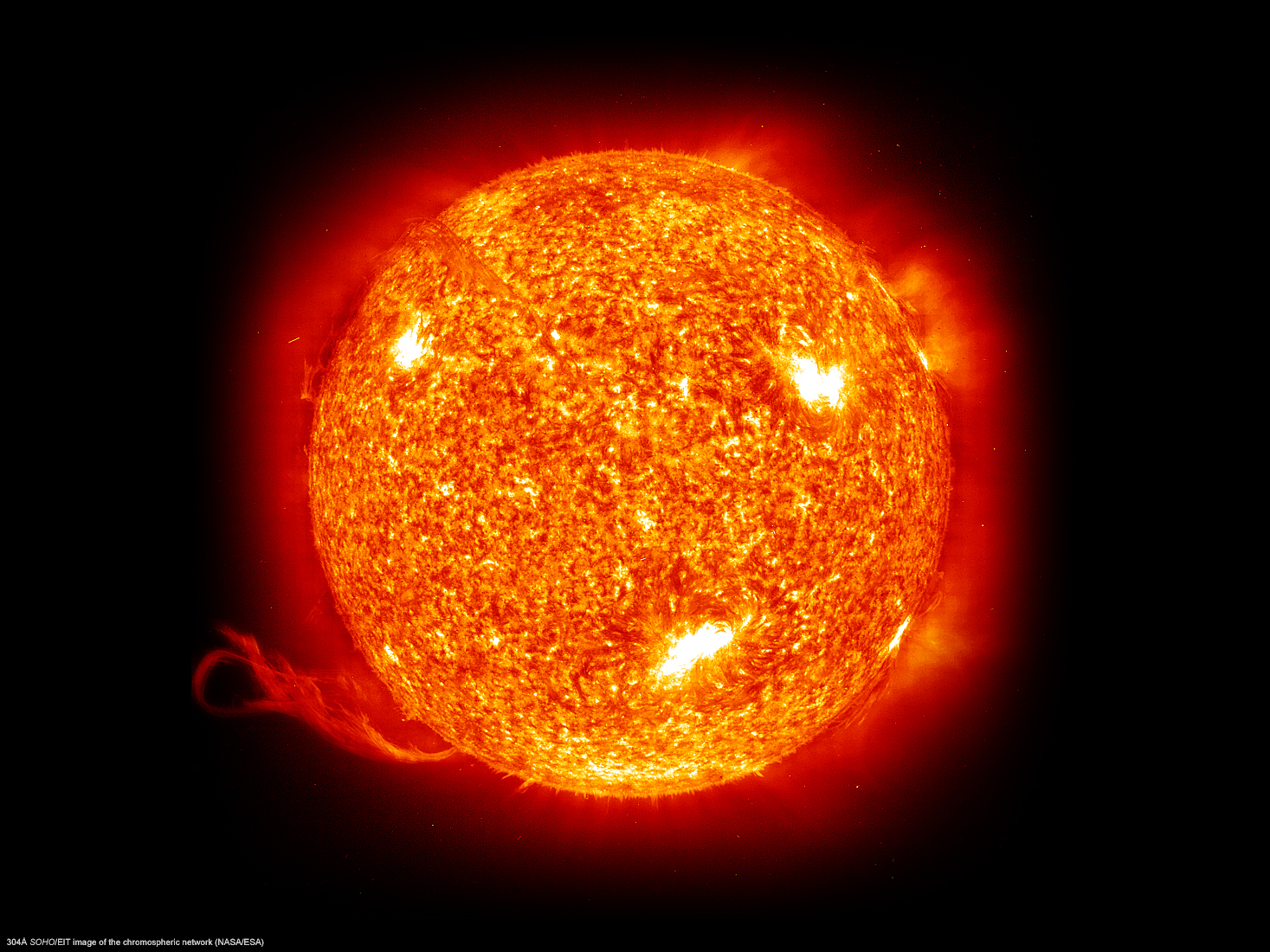
304A SOHO/EIT image of the solar disk (NASA/ESA)

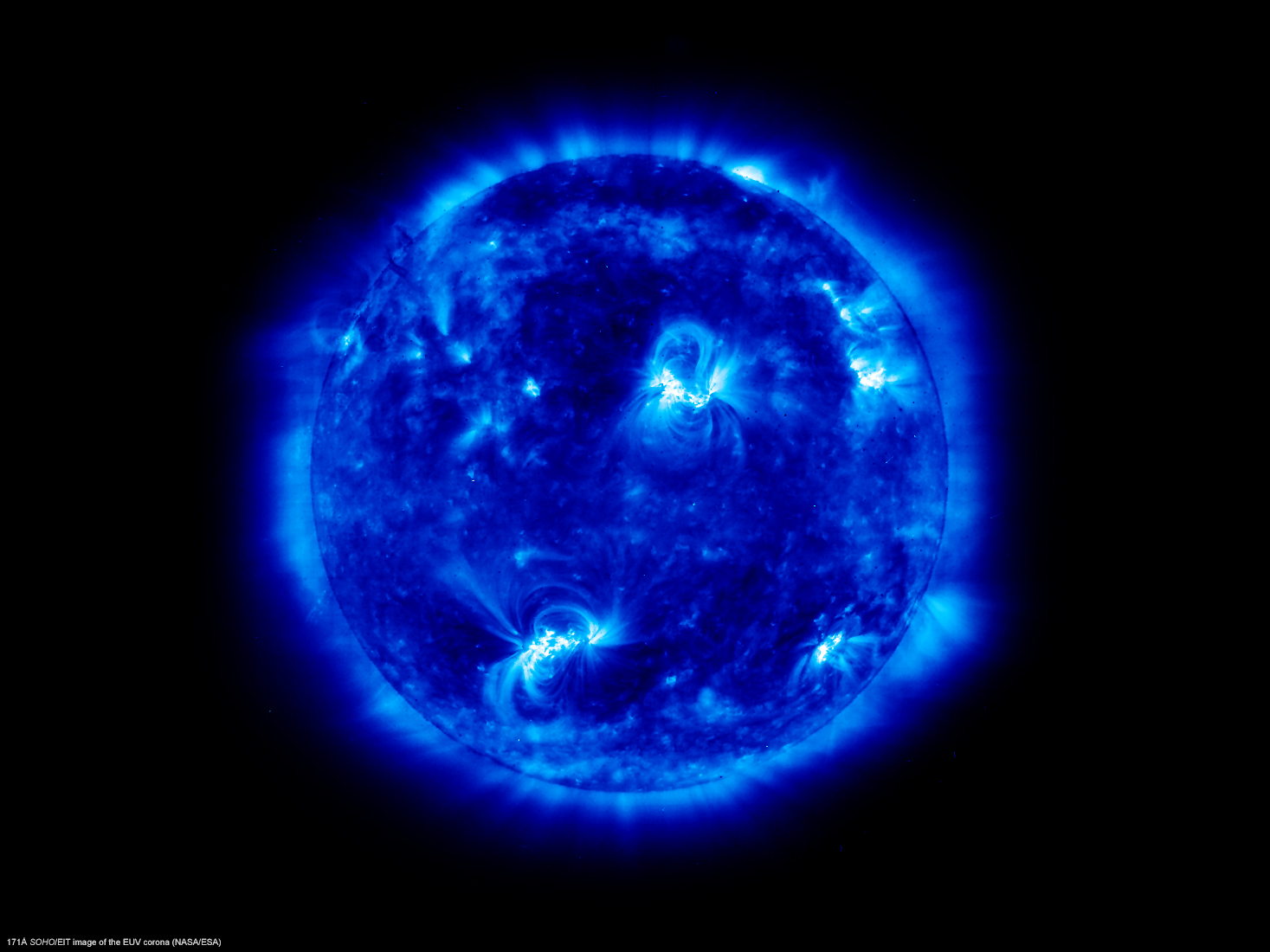
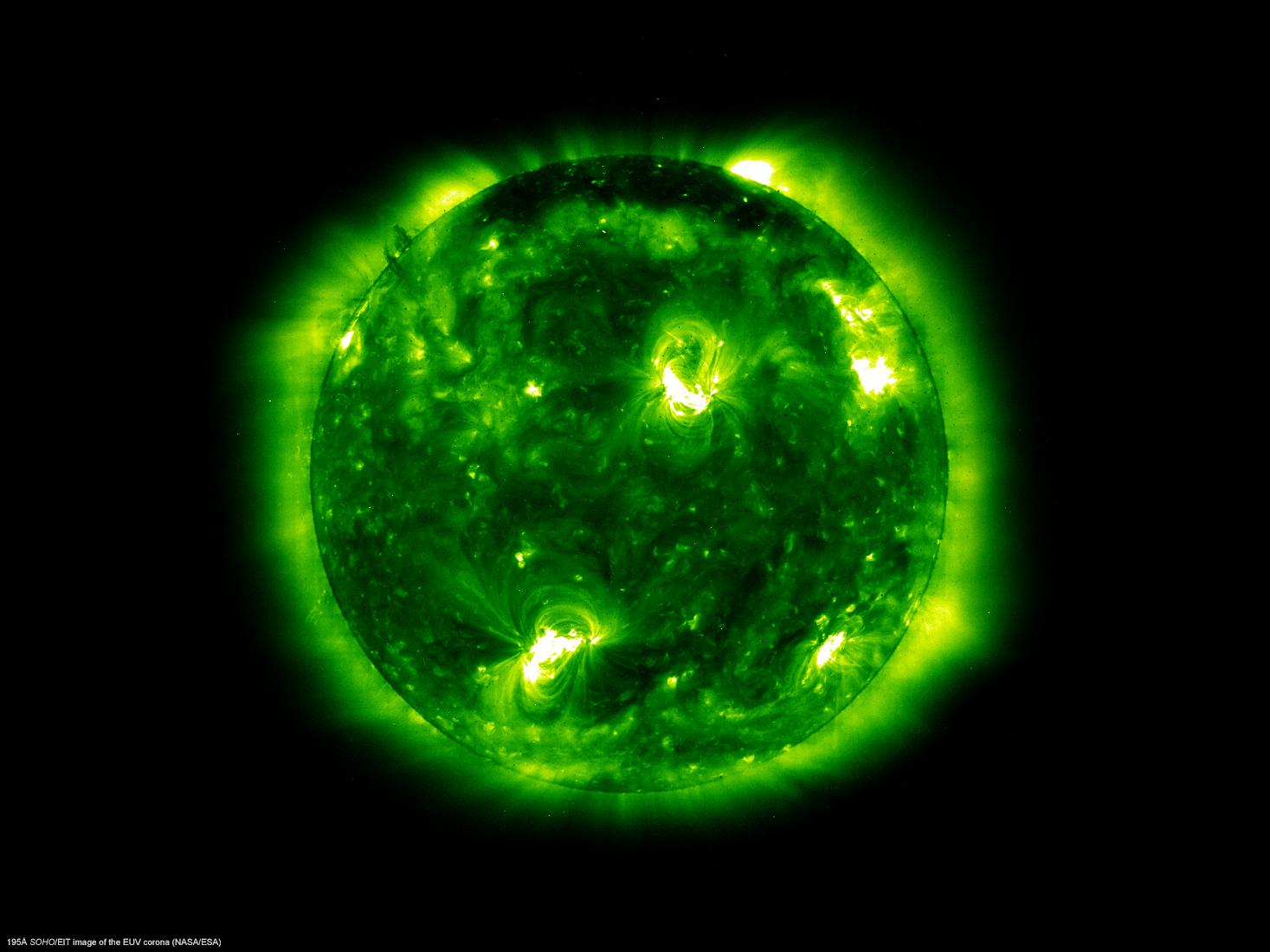
Back in 2006, I was feeling a bit nostalgic about my four years of research at the University of Wales, Aberystwyth Solar Group, so I decided to try to find some high resolution prints of the Sun. After a lot of effort, I didn’t find any prints I could buy or download, but I did find some high resolution images from the Solar and Heliospheric Observatory (SOHO) image archive. Although some were a bit noisy, I was able to clean them up with Photoshop and did some layer tweaking/saturation/balance to draw out the fine detail of the chromospheric network–as seen above in the 304A Extreme ultraviolet Imaging Telescope filter–plus a distinct prominence (in the bottom left-hand of the image).

Not stopping there, I decided to give the same treatment to high resolution 171A and 195A images. They came out very well and I kept rotating them as my wallpaper for months. Having just read Phil’s post on today’s perihelion (the time of year when the Earth is at its closest to the Sun during its orbit), I came across a comment asking whether anyone had any wallpapers of the same 304A EIT image. Well, here it is! Plus two more!

If anyone wants to find out how the images were edited, feel free to ask and I’ll let you know. Truth be known, there’s thousands of space images held by NASA, ESA etc. open to the public domain that rarely get the “airtime” they deserve. So it’s about time I dust off these three-year old edits and share the magnetohydrodynamic love.

I miss active regions, I wish the Sun would amp it up a bit so we can see all those lovely flares, CMEs, filaments and coronal loops… ahhhh… coronal loops

AAS Meeting, Long Beach, 4-8 January 2009

The January AAS meeting is being held in Long Beach, CA (Image by Kevin Stanchfield)

I’m currently organizing myself for this week’s AAS meeting down in Long Beach, so expect a feast of breaking news and information from one of the biggest astronomical conferences on the planet! Dictaphone? Check. Pen? Check. Laptop? Check. Camera? Check… Beer money? What do you think?

Who?

I’ll be travelling down to Long Beach tomorrow to join forces with the rest of the New Media crowd, including my Universe Today publisher, Fraser Cain. Joining us will be Pamela Gay (a.k.a. Star Stryder), Chris Lintott, Michael Koppelmann, Georgia Bracey and Jordan Raddick. It will be great to finally put a face to all these names I’ve become so used to in the last year of blogging.

What?

This will be a new experience for me, as although I’ve been to many conferences, this will be the first time I’ll be reporting on other people’s research. So, the pressure is off and I can enjoy the vast ocean of knowledge being shared with the world. However, this isn’t going to be your normal reporting gig. Pamela and Fraser have been organizing this New Media venture to distribute information accurately and rapidly. This is the power of blogging; we are on the ground publishing articles as the news becomes available. This means you don’t have to wait to get your conference news fix, it will appear on the blogs as soon as we hear it.

Astroengine Live!

Internet connections permitting, I’ll be running my Wednesday Astroengine Live from the scene at the Long Beach Convention Center. I’ll see if I can get some interviews in, and a lot of the reporting will be done on-the-fly, but it should make for an interesting show! That’s 4pm PST, Wednesday January 7th, Astroengine Live via WPRT Radio!

When?

So, from Monday Jan. 5th, to Thursday Jan. 8th, I hope to stack Astroengine.com full with breaking news articles from the frontier of astrophysics, astronomy and space exploration.

How?

I will also be dumping as much information onto the Universe Today as possible. Plus, ace Universe Today writer Nancy Atkinson will be back at UT Mission Control overseeing the whole event. This way, you don’t only get your regular news updates, you also get the best the AAS has to offer!

All blog posts on every space news website will be linked to via Astronomy Cast LIVE, so be sure to check on that regularly for your up-to-the-minute news.

Don’t forget Twitter! I will be firing microblog posts out every time I get a new piece of news, so be sure to follow Astroengine.com’s Twitter Feed. I might even activate the Twitter feed though my main blog on Astroengine.com, but we’ll see how quickly the news breaks before I do this (I don’t want to create a bottleneck of news overflow!).

Meet Us!

Rock Bottom Brewery... Location for the Wednesday meetup!

If you just happen to be in the Long Beach area on Wednesday, drop by the Rock Bottom bar and restaurant from 6pm-9pm to meet me, Fraser and the whole New Media/Astronomy Cast LIVE team!

Rock Bottom is located at 1 Pine Ave, at the E Ocean Blvd./Pine Ave. cross street. This place is big, in a prominent location on the corner of Pine, so you shouldn’t miss it. Check out Google Maps for the location.

So, keep an eye on Astronengine.com, Universe Today, Astronomy Cast LIVE and my Twitter feed for the full spectrum of the conference… it’s going to be awesome.

Visualizing the Yellowstone Earthquake Swarms

The hot spring, Sapphire Pool at the Biscuit Geyser Basin in Yellowstone National Park (Getty)

Since December 26th, hundreds of small earthquakes have shimmied Yellowstone National Park.

Earthquake swarms are a collection of small earthquakes over a short space of time. These aren’t aftershocks of one primary, larger quake, they are quakes in their own right. Yellowstone National Park, located mainly in the state of Wyoming (stretching into Montana and Idaho), plays host to the Yellowstone Caldera, a volcanic hotspot where molten mantle rock bubbles to the surface. This activity creates hot springs and is the energy source of many geysers.

The last Yellowstone “supereruption” occurred 640,000 years ago, but there have been many smaller eruptions and lava flows since then; the most recent being 70,000 years ago.

Any earthquake in the largest volcanic system in North America will therefore cause excitement and a little concern, and these recent earthquake swarms are an oddity. Yellowstone is no stranger to earthquake swarms, but the recent frequency of events are unusual scientists say.

In an effort to track the swarms, I’ve stumbled across an interesting article where a numerical modelling package has been used to locate and simulate the earthquake swarm breakouts…
Continue reading “Visualizing the Yellowstone Earthquake Swarms”

Merge NASA with the Military? Scrap Constellation? Really?

A Delta IV Medium rocket launch (USAF)

Actually, I’m not overly surprised by this news, but it could be a kick in the teeth for the future of the US civilian space program. According to Bloomberg News late Thursday night, the Obama transition team will probably (note “probably”, not “possibly”) advise a collaboration between NASA and the Pentagon to fast-track development of the next launch vehicle.

But there’s a catch, Constellation doesn’t appear to be a part of the plan.

Apparently feeling the pressure from diplomatic issues with Russia, and China signalling a renewed vigour in their intent to land on the Moon before NASA’s planned 2020 landing, the Obama administration is looking for a cost-effective solution to the Shuttle decommissioning in 2010. Unfortunately the Constellation program has never been considered “cost effective”, it’s always been considered the best course of action. With the economic noose tightening around all government departments, the US space agency has been finding it very hard to explain the ballooning costs and technical challenges associated with Constellation.

Last year, the Pentagon’s space program received $22 billion, one third more than NASA’s entire budget, so it seems reasonable that funds could be shared. But it sounds like NASA could be merging certain aspects of the civilian space program with the US military space program, probably scrapping Constellation and making military Delta IV and Atlas V rockets “human rated”…
Continue reading “Merge NASA with the Military? Scrap Constellation? Really?”

Frosty Phoenix Not Snowed Under… Yet.

The Mars Reconnaissance Orbiter's HiRISE instrument spots the dead Phoenix Lander on December 21st (NASA/HiRISE)

NASA lost contact with the Phoenix Mars Lander at the start of November 2008, as its batteries were drained and sunlight began to dwindle. With no sunlight came no charge for the batteries from Phoenix’s solar panels, and the robot’s fate was sealed: a sun-deprived coma. A dust storm hastened the lander’s fate, but it certainly wasn’t premature. The Phoenix mission was intended to last three months, but in the same vein as the Mars Exploration Rovers, Phoenix’s mission was extended. In the high latitude location of the Martian Arctic, a dark winter was fast approaching, so Phoenix didn’t have the luxury of time and it transmitted its last broken signal before the cold set in, sapping the last volt of electricity from its circuits…

Although there was some excitement about the possibility of reviving the lander next summer, it is highly unlikely Phoenix will be in an operational state, even if it did have an abundant source of light to heat up its solar panels once more. No, Phoenix is dead.

However, that doesn’t mean the orbiting satellites won’t be looking out for it. So long as there is a little bit of light bouncing off the frosted Martian surface, the Mars Reconnaissance Orbiter can image Phoenix, keeping track of the encroaching ice around its location. The HiRISE team seem to be assembling a series of images throughout the change in seasons at the landing site, so it will be interesting to see the full set…

Source: HiRISE blog

Confidence is High for LHC Science this Summer

Engineers are working hard to repair the damage to the LHC (CERN)

In a recent BBC interview with the LHC project director Dr Lyn Evans, the Welshman talks about the “collateral damage” caused by the collider’s catastrophic quench that damaged a section of the aligned superconducting magnets in September.

Although the £14 million repairs are challenging, Evans is very confident CERN engineers and scientists are on-track for the LHC to go online in the summer of 2009.

But we now have the roadmap, the time and the competence necessary to be ready for physics by summer,” he said. “We are currently in a scheduled annual shutdown until May, so we’re hopeful that not too much time will be lost.”

Continue reading “Confidence is High for LHC Science this Summer”

The Moon and a Jet: Astrophotography by Stephen Sykes

Photography by Steven Sykes
Photography by Stephen Sykes

If you’ve listened to my Astroengine Live show, you may have noticed that I am a (very) frustrated practical astronomer. I have yet to save up for my first telescope (thanks Mike Simonsen for making me even more eager to hand over my credit card!), and I still want to upgrade my camera equipment so I can begin taking some shots of the night sky.

So when I see images like the one above, I move one step closer to making that big purchase (upgrading to a digital SLR, followed closely by my dream telescope). This shot was taken by Stephen Sykes in his back yard in Alabama. Intending to capture the Moon alone, his luck was in and a commercial jet passed right in front. Luck is a huge part of astronomy, and when a skilled astrophotographer is there to capture the moment, stunning shots like these are possible.

Be sure to check out his site, StephenSykes.us, for all the images in this set. He’s even put together a superb animation of the series of shots he was able to capture during the jet transit.

The Universe Today Top 10 Scientific Endeavours of 2008 — Published!

ut_top_10

The nominations are in, the votes are counted and the Universe Today writers have been consulted; the Top 10 Scientific Endeavours of 2008 has been published! This was probably one of the toughest top 10 lists to compile as 2008 has been a landmark year for all the sciences. Of course, the Universe Today has a focus on space science endeavours, but there is also a healthy mix of physics, biology and technology, so expect to be surprised at some of the entries in this top 10.

So, get over to the Universe Today and see the definitive Top 10 Scientific Endeavours of 2008!