The MSL is Too Expensive? Who Cares! We’re Searching For Life!

$2.2 billion eggs. One basket. The MSL "Skycrane" lowers the 850kg rover to the Martian surface (NASA)
$2.2 billion eggs. One basket. The MSL Skycrane lowers the 850kg rover to the Martian surface (NASA)

Don’t get me wrong, I am incredibly excited about any planetary mission, no matter how much it costs. However, there is something about the Mars Science Laboratory (MSL) that makes me uneasy. The project may be delayed (the MSL is scheduled for a 2011 launch) and it may be costing more than NASA projected, but it’s not these factors I’m worried about.

The MSL is built on a “bigger and better” mentality; it dwarfs both of the Mars Exploration Rovers Spirit and Opportunity, plus it is packing a rather impressive suite of 10 complex scientific instruments to carry out an unprecedented campaign in the Martian dirt. Oh, and did I mention it will be powered by radioisotope thermoelectric generators (RTGs), a complete departure from the tried and tested solar panelled rovers? Oh hold on, as the MSL weighs nearly a tonne, a brand new method of landing the thing is required (simply parachuting, air bag bouncing or rocket thruster powered landings are now passé). The “Skycrane” that looks like one of those hoverboards from Back to the Future II has been invented to gently lower the MSL (pictured above).

Still, I’m not too concerned, NASA has proven itself countless times at overcoming technological challenges. That’s why NASA is there, to research and develop new technologies and science. But what if the MSL has gone too far? What if the technology is too untried and untested? Unfortunately, it looks like the recent turn of events have taken even the MSL program manager by surprise
Continue reading “The MSL is Too Expensive? Who Cares! We’re Searching For Life!”

Visualizing the Iridium 33 and Cosmos 2251 Collision (Update: Video Added)

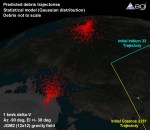
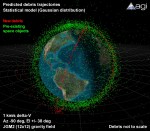
Less than a day after news of the unprecedented in-orbit collision between the active Iridium communications and defunct Russian satellites, the software company AGI has already carried out an analysis of the event. A detailed animation has been released depicting the velocity, angle of impact and statistical distribution of debris. Although the CGI is missing (I would have liked to have seen at least an explosion, shockwave and shards of twisted smoking metal. Come on guys, have a little fun!), it is a great visual aid for us to get a grip of what happened up there. To be honest I’m still blown away that this happened at all. There might be a lot of junk up there, but the statistical likelihood of this happening is still low.

You can also download the full-resolution AGI animation of the incident at their website…

Here are some visualizations of the impact in full 3D glory. All images courtesy of Analytical Graphics, Inc. (www.agi.com):

A special thanks to Stefanie Claypoole at AGI for notifying me about this material.

It’s Not One-Way Traffic: Satellites Collide at 790 km

© David Clark
© David Clark

On Tuesday, at approximately 5pm GMT, two satellites made history. They became the first artificial satellites ever to collide accidentally in low-Earth orbit. The event happened between a defunct Russian satellite (Cosmos 2251, launched in 1993) and an active commercial Iridium communications satellite (Iridium 33, launched in 1997), destroying the pair. Now there’s a mess up there, pieces of debris threatening other satellites, possibly even the International Space Station
Continue reading “It’s Not One-Way Traffic: Satellites Collide at 790 km”

Can SpaceX Benefit from NASA’s Share of the Economic Stimulus Package?

The Falcon 9/Dragon launch configuration for crew transport. Note the launch escape rocket added to the Dragon capsule nose cone (SpaceX)

Over the weekend, I discussed the pros and cons of a recent article written by Mars Society President Robert Zubrin. In his discussion for a Washington D.C. political website, he outlined his thoughts on how to enrich the US economy. One of the points raised was the argument that a manned mission to Mars would have a huge economic impact on the USA; creating jobs, invigorating science education and boosting national well being. This is a worthy argument that, in principal, holds a lot of merit. After all, the Apollo Program in the 1960’s had a lasting effect on the US, creating jobs in the aerospace industry, bolstering the economy and creating a generation of highly skilled scientists and engineers.

So why not do Apollo 2.0? Send man to Mars as a measure to recreate the economic benefits generated by the Space Race against the Soviet Union. Unfortunately, no modern government would sensibly invest in such a plan. There is no political incentive to do so (well, no acute incentive that requires the US to “beat” a competing superpower in the race to strategically dominate space).

But what if the recent economic $800+ billion stimulus package could be used to stimulate another, burgeoning sector of space flight, that has both political and financial merit?

Elon Musk’s SpaceX is asking the same question. Could NASA’s Commercial Orbital Transportation Services (COTS) contracts get a boost in funding, accelerating a commercial answer to the looming 5-year gap in US manned spaceflight? This is where SpaceX needs your help…
Continue reading “Can SpaceX Benefit from NASA’s Share of the Economic Stimulus Package?”

Can a Mission to Mars Stimulate the Economy?

Could a NASA manned mission to Mars really stimulate the economy? (Mars Society/Ian O'Neill)

When times get tough, the world needs visionaries.

Visionaries find solutions, they invent systems and invoke change. One such figure in current events with a weight of 300 million people on his shoulders, is the new US President Barack Obama. His entire political campaign is based on bringing change to the USA (and the world), making him the most prominent political figure out there. Is he a visionary? Some would argue that he is, others would say that history will decide that point. I’m on the fence as to whether Obama will find historic solutions to these seemingly insurmountable global crises. But the thing I admire about the new US President is that he is a strong leader, and sometimes, that is all a country needs to pull itself from the precipice and back to prosperity.

So, the Obama-backed $800+ billion economic stimulus package is currently pumping through the system to eventually be divvied up and sent to areas of the economy that need to be reinvigorated. In principal, it’s a good idea. But what if it fails? Unfortunately there’s an awful lot more riding on Obama’s shoulders than 300 million hopes; $800 billion of their taxes will be keeping the new President awake until the early hours. If this all goes right, Barack Obama will go down as one of history’s visionaries; if it all goes wrong… well, let’s just not go there for the time being

There will be critics of any economic bailout, and others who think there are better options. Robert Zubrin, founder and President of the Mars Society, has come forward with his suggestions to aid economic recovery…
Continue reading “Can a Mission to Mars Stimulate the Economy?”

The Essential Selection for Space Exploration (Music)

The Astroengine Live Top 10 Space Tunes

Disco balls at Spundae, Hollywood in December 2006 (© Ian O'Neill)

Often when writing about space, I like to listen to music. Unfortunately, my brain is terrible at multitasking, so any music with vocals slows me down. However, trance music doesn’t seem to hurt my thinking-typing skills (probably due to minimal vocal tracks), so on go the headphones as I get lost in a mix of space and sound.

If you are a listener of my radio show Astroengine Live, you may be forgiven in thinking that it is based more on the music selection than my opinions on the current state of manned space flight! So I’ve decided to pair up trance and space to compile my favourite space-based tracks of all time (mainly trance and electro, but with some surprises thrown in).

Here’s Astroengine Live’s Top 10 Space Tunes, or the Essential Selection for Space Exploration
Continue reading “The Essential Selection for Space Exploration (Music)”

If There’s an Alien Race Living on our Doorstep, Why Can’t We Hear Them?

alien_world1
An alien civilization could be transmitting, but we can't hear them (© Steve Swayne via Flickr)

As I was watching Battlestar Galactica last night, I was thinking about the lack of alien civilizations in the show. To be honest, I tire easily of humanoid alien beings with curiously shaped heads synonymous with Star Trek et al., so I’m loving the fact a far-off human colony created their own evil race, the Cylons. So far, so good, I’m getting sucked into BSG (will it be as good as, or even better than Bablyon 5? That has yet to be seen, but it looks promising).

These thoughts took me back to an Astroengine article I wrote in November with my usual gripe about our obsession for looking under rocks on Mars (The Search For Life, What’s the Point?). I reached the conclusion that I’d much rather be pottering around in an empty cosmos, devoid of life, than bumping into an angry neighbour who wants to probe/assimilate/hybridize me. Science fiction musings I know, but it isn’t that far from some of the conclusions that could arrive from using the famous Drake equation that underpins our incessant search for intelligent extraterrestrial life.

Today, I was referred to some research addressing the Fermi Paradox, although we haven’t heard from our extra-terrestrial neighbours yet, doesn’t mean they’re not transmitting. The galaxy could be teeming with intelligent aliens, but we just can’t hear them
Continue reading “If There’s an Alien Race Living on our Doorstep, Why Can’t We Hear Them?”

When the Space Hotel’s a Rockin’…

Guest article by Greg Fish (blog: world of weird things)

zz_space_hotel

You can’t go on vacation any more without your video camera, especially if you’re going some place spectacular and exciting. When the new wave of space tourists soars into orbit, they’re going to come back with some spectacular home movies. Some of them may be a lot steamier than others because there’s bound to be a couple just itching to be the first humans to have sex in space and capture it on high definition video to bolster their claim to fame. Yes, sex in space in inevitable and the moment people finally get a little privacy and a little room in which to play (something that’s missing on today’s space missions), it’s going to happen.

But before you rush to reinvent the Kama Sutra in 360 degree freedom, a few tips for you aspiring 60+ mile high club members…
Continue reading “When the Space Hotel’s a Rockin’…”

Mount Asama Erupts, Ash Rains Down on Tokyo

Mount Asama erupts early in the morning of February 2nd. (AP)
Mount Asama erupted early in the morning of February 2nd. (AP)

Only a few hours after the Japanese authorities issued an alert for the imminent eruption of Mount Asama, the volcano erupted at 1:51 am local time (Feb. 2nd), spewing thick smoke nearly 2 km high. Ash is falling on parts of Tokyo, 140 km away and chunks of rock have been ejected 1 km away from the volcano. There are no reports of damage or injury so far to local infrastructure or in the nation’s capital.

Japan’s Meteorological Agency has maintained the Level 3 warning (5 being the worst), preventing people from approaching the erupting Mount Asama, urging local residents to take caution. Should the warning level be raised to 4, residents will be advised to prepare for evacuation, and a Level 5 will enact an evacuation.

So far, the eruption appears to be limited, but Japan will be keeping a close eye on the situation for some time to come. Watch this space

For more, check out Mount Asama Eruption Imminent, Japan on High Alert

Source: AP via @LouisS

Mount Asama Eruption Imminent, Japan on High Alert (Update)

In 2004, smoke rises from Mount Asama in Tsumagoi, 140 km northwest of Tokyo (Reuters)

There will be growing tension in central Japan tonight. Mount Asama, an active complex volcano, is stirring and Japan’s Meteorological Agency has put the region on high alert. Geophysicists predict the volcano could explode within the next 48 hours, possibly powerful enough to blast rocks from its peak, causing damage up to four kilometres away.

Mount Asama is infamous for the 1783 eruption that devastated the region straddling the Gunma and Nagano prefectures, killing 1,500 people. Since then, Asama has remained active, with a significant eruption in 1972. However, 2004 did see the volcano explode, ejecting volcanic material up to 200 km away, but very little damage was caused.

Building seismic activity in the area suggested an imminent eruption, prompting the authorities to raise the threat level to a 3 out of 5. A Level 3 alert means that there could be significant damage caused to nearby non-residential areas and a no-go zone has been imposed. This is the first time the Meteorological Agency has used the volcanic warning levels since they were adopted in December 2007…
Continue reading “Mount Asama Eruption Imminent, Japan on High Alert (Update)”