The H-II Transfer Vehicle (HTV-1) Photographed… from 300km Below

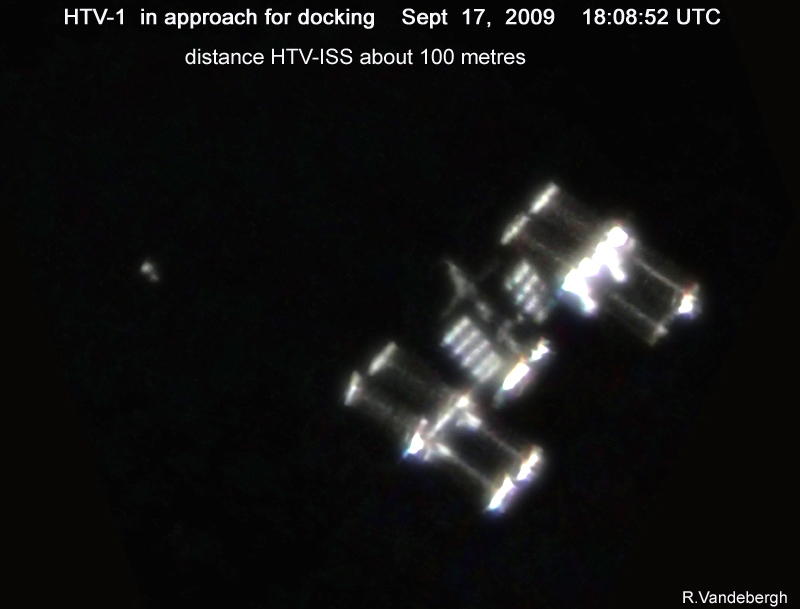
The Japanese HTV-1 taken 3 days after launch at an altitude below 300km (©Ralf Vandebergh)

I first came across Ralf Vandebergh’s outstanding astrophotography when I was inquiring about a “mystery” object that appeared to be stalking the International Space Station (ISS) in July. As it turned out, it wasn’t a UFO, it was in fact a Russian Progress re-supply space vehicle testing out a new automated docking procedure with the orbiting outpost. Vandebergh managed to image the ISS and Progress vehicle with amazing clarity from his home in Wittem, the Netherlands.

HTV-1 approaches the ISS on Sept. 17th (©Ralf Vandebergh)

Today, he’s done it again, only this time his target was the first flight of the robotic Japanese H-II Transfer Vehicle, HTV-1.

On day 3 of the mission (Sept. 13th) to supply the ISS with over 4 tonnes of food, water, fuel and equipment, Vandebergh captured this incredibly detailed picture of the vehicle, speeding overhead at an altitude of just under 300km (pictured top). He also took a shot of the HTV-1 as it was approaching the ISS on Sept. 17th (right).

I’m totally in awe of these shots, and there’s a lot more where this came from. In Vandebergh’s gallery there are pictures of spacewalking astronauts, shuttle cockpits and amazingly detailed portraits of the ISS… all taken with a camera, through a telescope, on terra firma. Enjoy.

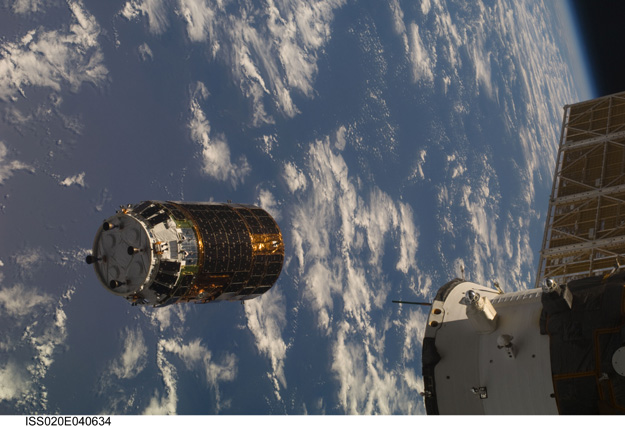
For reference, here’s a shot of the HTV-1 from the ISS shortly before docking:

The HTV-1 approaches the space station on Sept. 17th (NASA)

A Visor Filled With Awesomeness

The space station as reflected in John "Danny" Olivas' spacesuit visor on September 3, 2009 (NASA)
The space station as reflected in John “Danny” Olivas’ spacesuit visor on September 3, 2009 (NASA)

When I came across this image in NASA’s Human Space Flight gallery, I stopped. I was looking for the “perfect” shuttle image during the STS-128 mission to the International Space Station earlier this month, but I got sucked into browsing through the hundreds of EVA photographs NASA has stockpiled in their archives.

This particular scene was taken by NASA astronaut John “Danny” Olivas when he was out on a spacewalk installing a new Ammonia Tank Assembly. The EVA was over six hours long and Olivas was able to do some digital photography in that time. This picture shows his spacesuit helmet visor, with a reflection of the camera at arms length below.

Also visible in the reflections in the visor are various components of the station and European Space Agency astronaut Christer Fuglesang, mission specialist, anchored to a Canadarm2 mobile foot restraint. —NASA

The reflection captures so much detail. The curvature of the Earth can be seen in the distance, with space station solar arrays jutting in front. Even the two docked Soyuz vehicles (TMA-14 and TMA-15) are in shot. To top it all off, ESA astronaut Fuglesang is dangling in the vacuum of space attached to a robotic arm.

Quite simply, awesome.

War of the Worlds Google Doodle Celebrates H.G. Wells’ Birthday

hgwells09

Today is H.G. Wells’ birthday! And I must admit, the Google logo is pretty cool. A UFO and a couple of tripods (with more in the distance) rampaging through the sleepy rural village of Horsell in Surrey is depicted. This relates to last week’s Google Doodle of crop circles and tweeted map reference to the same village near the town of Woking where H.G. Wells lived and wrote the famous War of the Worlds novel.

In my first post about the doodle, I followed the trail as far as H.G. Wells’ birthday, although last week it wasn’t Wells’ birthday. But the clues were there for something to happen today and it has. Even the logo’s filename is unambiguous: “hgwells09.gif”

So no puzzle this time, just a celebration of a legendary writer who imagined the first ever sci-fi Martian invasion in Surrey. If there’s a deeper puzzle behind this doodle, I don’t see it.

Happy 143rd birthday H.G.!

UPDATE: Google has confirmed the above, but mentions nothing about the War of the Worlds arcade game. It looks like there may have been too much lateral thinking going on that night…

Google Crop Circle Doodle: A Celebration of Vector Graphics and H. G. Wells’ Birthday?

A screenshot of the 1982 colour version of the arcade game (via klov.com)

Thanks to an eagle eyed Astroengine.com reader, we may have an answer to the current Google doodle conundrum. Having spent a lot of last night following the mystery trail from crop circles, to Woking, to War of the Worlds, to H. G. Wells… I was stuck. The only thing that made this time of the year special was the fact that it’s H. G. Wells’ 143rd birthday on Monday.

For the complete background, check out last night’s post.

However, in keeping with Google’s previous tribute to the classic computer game Zero Wing, could this new puzzle relate to another game? StockbrdigeT thinks this might be the case:

Today’s clue is co-ordinates that only have significance in their relation to War of the Worlds. Today is also what appears to be the 30th anniversary of the release of the War of the World Arcade game (the original monochrome version, not the 1983 color version).

So I had a look around, and indeed there was a (very rare) War of the Worlds arcade game released in 1979. There was a colour follow-up version in 1982 as well (a screenshot is shown above). From Wikipedia:

The War of the Worlds is an arcade game based on the H. G. Wells novel The War of the Worlds. There were two versions of this game, identical in gameplay but differing in graphics. The first version was released by Cinematronics in 1979, and featured black and white vector graphics. A color version was later made in 1982.

The War of the Worlds arcade game, developed by the pioneering company Cinematronics, was one of the first games to use vector graphics (the very first Cinematronics game to use vector graphics was Space Wars, released in 1977).

goog_e

So, what has this got to do with the Google doodle? Remember I was trying to find an explanation for the missing “l”? In actuality, the “l” in “Google” isn’t missing (as pointed out by another commenter, jurl), it’s there, but it’s in the process of being drawn by the little combine harvester in the crop.

I think that the Google logo is a celebration of one of the first uses of vector graphics in computer games — the “l” represents a vector being drawn by graphics software (i.e. the combine harvester).

So, the best I can do is the doodle is a celebration of:

  • H. G. Wells’ birthday on September 21st.
  • the 30th anniversary of the release of the War of the Worlds arcade game.
  • the first uses of vector graphics in computer games.

If that’s not it, I give up!

The Google Logo, H. G. Wells’ Birthday and the War of the Worlds Invasion Site

goog_e

UPDATE: For an update, check out my follow-up post: Google Crop Circle Doodle: A Celebration of Vector Graphics and H. G. Wells’ Birthday?

OK, so now I’m hooked. This evening, the Google logo changed into a doodle of a crop circle (above). This may seem a little innocuous, after all, Google is always jazzing up their logo with celebratory bits of art. But what did this resemble?

For starters, this isn’t the first time this has happened. A couple of weeks ago, another mini brain-teaser was posted with a flying saucer “beaming up” one of the “o”s in Google. CNET blogger Chris Matyszczyk managed to follow the clues and deduced that the missing “o” could be found in the numerical clue of one of @Google’s tweets. The numbers related to letters in the alphabet and spelled out, “All your O are belong to us.” This was in reference to the classic game Zero Wing (creator of the now famous gamer war cry “All your base are belong to us). It was the computer game’s 20th anniversary.

The logo was explained, the missing “o” was explained and it all related to an event (i.e. the Zero Wing anniversary).

So now we are presented with another conundrum. What does it mean? We have crop circles (linking to the search query “crop circles“, thanks @astrobio74 for pointing that out), a missing “l” in “Google” this time…. and a tweet from @Google with the map co-ordinates: 51.327629, -0.5616088.

Typing the longitude and latitude into Google Maps takes us to a location in Woking, Surrey, UK. The exact address is on Woodham Road in a village/town called Horsell.

Doing a search for the exact address and digging around the houses turned up precious little, until I typed in “Horsell” into Google. In the results is Horsell’s Wikipedia page. Horsell was made famous as being the place where Martians invaded in H. G. Wells’ classic sci-fi novel, War of the Worlds.

Jumping over to the War of the Worlds Wikipedia page, more information unfolds:

Much of the The War of the Worlds takes place around Woking and nearby suburbs. The initial landing site of the Martian invasion force, Horsell Common, was an open area close to Wells’ home. In the preface to the Atlantic edition of the novel, he wrote of his pleasure in riding a bicycle around the area, and imagining the destruction of cottages and houses he saw, by the Martian heat-ray or the red weed.

Great, so I’m almost 100% certain this little Google treasure hunt is pointing to War of the Worlds in some way. But why would Google pick today to do this?

A little more digging into H. G. Wells himself points to a possible answer (although I’m not totally convinced this is the sole reason). Next Monday marks the 143rd birthday of H. G. Wells (on 21 September, 1866). 143 years doesn’t strike me as a significant number, but the trail seems to lead here.

I’m now trying to work out where the “l” in “Google” fits into all this…

Off The Record: Time Stands Still for The Daily Galaxy

Oh peachy! I was having a browse through the blogs just now and I stumbled across an interestingly titled article called New Theory Nixes “Dark Energy”: Says Time is Disappearing from the Universe. This is going to be good! I mused.

I really enjoy the Dark Energy debate. On so many levels, invoking Dark Energy as a possible answer to the rapid expansion of the Universe in the infinitesimally short moments after the Big Bang seems like a logical notion. There has to be a force acting in the reverse to gravity, it’s the only way we can explain how our Universe is expanding now.

However, like the Pluto debate, there’s a lot of anger in the opposing wings. The reasons why the IAU would choose to demote the dinky plutoid seems like planetary blasphemy to many (although, personally, the IAU could call Pluto an asteroid and I doubt my blood would boil too much). Mention Dark Energy, and you can expect the “that’s not science, that’s nonsense!” argument to echo too.

Dark Energy, in all honesty, is a tough theory to argue, but cosmologists have formulated this theory based on a collection of evidence from a range of sources. Until a better idea comes around, Dark Energy will remain as some invisible force that’s messing with our cosmos.

But hold on, what’s this article about time disappearing? There IS an alternative theory, and The Daily Galaxy has the scoop! Let’s have a read.

Oh… but what’s this? There’s no links to external sources… oh yes there is, they’re at the bottom — not hyperlinked, just printed. OK, no biggie, would be nice to link to the source material you are using, but hey, we can’t all be the world’s best bloggers can we.

Hmmm… that’s strange. Two of the referenced sources are over two years old, and the other no longer exists. In fact, I remember this research, I read about it ages ago. This isn’t new research. In fact, this isn’t a new article, it is an exact copy of an article written by Rebecca Sato, posted by The Daily Galaxy on January 3rd, 2008: Is Time Literally Slowing Down and Disappearing From the Universe?

So basically, The Daily Galaxy is recycling its own articles. Why? I’m not too sure, but I’m thinking the Dark Energy debate is still pretty lively; it’s no bad thing to be publishing articles about this subject around now. And there was me thinking The Daily Galaxy was a reputable source of science writing that doesn’t stoop to misleading tricks to boost traffic–

Hold on, they’ve done this before. Oh, and againand again.

Please, not again!

In actuality, this is a new twist on an old technique used by the site to squeeze as much traffic out of the web as possible. In the past, they’ve re-published old articles as “Daily Galaxy Classics.” Obviously that didn’t work, so now they pretend that old news is just as good as new news (and their audience won’t notice). Genius.

If you read The Daily Galaxy, check their sources. Also, do the famous teacher-plagiarism-Google trick on each of the Daily Galaxy articles you see (copying and pasting a section of text — paragraph-length — into Google). If it’s a unique article, you’ll just have that article indexed. If not, you’ll see that article, plus an old Daily Galaxy article (from the “archives”) and every other site that linked back to the old article.

I’m sorry Daily Galaxy, but misleading your own readers just ain’t cricket.

Chandrayaan-1 is Lost, Astroengine Appears on Al Jazeera

As far as blogging about space news goes, this is most definitely the pinnacle of my writing career. After hearing the frustrating news that the Indian Space and Research Organization (ISRO) had lost touch with their Chandrayaan-1 lunar mission, I, of course, felt compelled to blog about it.

Not 24 hours later, I receive an email from the producer of an Al Jazeera news show called Inside Story asking me if I’d be interested in sharing my views about Chandrayaan-1 on the show early Monday morning. Hell yes!

So I spent the rest of Sunday cramming the (very interesting) history of the Indian space program, along with some of the specifics of Chandrayaan-1. By Monday, I was ready to go.

The filming for the show started at 7:05am in a studio in Culver City and lasted about 25 minutes. And it was a lot of fun! Check out the video above, I think the Inside Story production is highly professional, with a very BBC feel to it. I’m very happy to have been asked for my opinion live on air, on the international stage.

Although my brain wasn’t functioning particularly fast at such an early hour, I think it went well, and I eventually got my points across…

Wildfire? Volcano? Warzone? Hell? All of the above?

wildfires

I think this timelapse video pretty much puts the Station Fire into perspective. The fire has so far destroyed over 120,000 acres of land, gutted dozens of homes and taken the lives of two fire fighters. Although it would appear fire crews are slowly getting a handle on the blaze (it was around 20% contained at time of writing), should there be a change in weather, the fires could flare up once more, but there are hopes that humidity should continue to rise through the night.

Also, it would appear the earlier fires spotted on the summit of Mount Wilson were primarily controlled backfires (i.e. small fires started deliberately by the fire service to burn off brush, thereby removing fuel for an uncontrolled fire). Now, an airborne assault has begun, water and fire retardant being dropped to slow the advance of the Station Fire around the mountain leading to the observatory. And now, the word is that fire crews seem to be winning the fight to save the Mount Wilson Observatory (thank you @palomarskies for the update!).

So, for now, I’ll leave you with this phenomenal HD timelapse video of the Station Fire created by willieworks. The view is of the mountains to the north of LA, from Mulholland Drive, above Universal Studios. It’s a scene that really does belong in the movies. What a sight.

“Knowing” How Solar Flares Don’t Work


knowing-flaming-earth

My wife turned to me as the credits rolled and asked, “Can you sue a production company for inaccurate science in a movie?

Hmmm… good point!” I said. “Unfortunately, though, I think it’s just called ‘being creative.’

But that got me thinking.

Knowing not very much

We’d just sat through the Nicholas Cage disaster movie Knowing after heavily criticising the last hour of magical solar flares, prophecies, silly religious undertones and complete disregard for a little thing called “science.” Oh, and there were aliens. Who would have guessed?!

I would say that apart from these things, it was actually a pretty good film… but I’d be lying. Well, a little. I was actually quite impressed by the assorted disaster CGI and the acting (I’m glad Rose Byrne is getting some big roles, as I think she rocked in Damages), but generally, I was disappointed. I think I would have enjoyed it more if the director Alex Proyas didn’t have such a contempt for asking a science advisor for… I dunno… “advice.”

In fact, I’m not even going to bother researching whether there was a science advisor in the production crew or not, because either a) the rest of the crew didn’t listen to him/her, b) the science advisor was lying about his/her credentials or, c) the science advisor was stoned/drunk while on the set. Therefore, in my mind, there wasn’t a science advisor involved in the making of this film.

Putting the stupid plot, aliens (double-facepalm), Byrne’s character’s death and no science advisor to one side, I still cannot understand how they got solar flares so wrong.

Kaboom! Whoooshhh! Fizzzzz….

I’m not being funny, it’s as if Proyas didn’t bother to Google “solar flare,” just to check to see how solar flares really do work. Hell, go to the self-explanatory HowStuffWorks.com and do a search for “Sun.” If either one of these things were done during pre-production, the science may actually have been plausable.

In a totally forgettable scene, right toward the end of the movie, the uber-scary solar flare waits to be blasted at Earth. Cage gets on the phone to his Dad saying something like, “You know it’s been pretty hot lately? Well, it’s about to get hotter!” That’s an epic solar fail already. For some reason, the world had gotten hotter and everyone just shrugged it off as a warm October? I’m thinking the Sun would need to be whacking out a huge increase in energy, and in which case, those bumbling solar physicists or the N.O.A.A. (or “EN-Oh-Ay-Ay” as the cast painstakingly spells out) might have noticed?

I’m a stickler for realism in movies — so this is just a personal gripe — but why weren’t real images of the Sun from SOHO, TRACE, Yohkoh, Hinode or STEREO (let alone the countless ground-based solar observatories) used at all through the entire film? Instead, we see a strange blob of CGI graphic, shimmering like a corporate logo on computer screens, being referred to as “our Sun.” I’m pretty sure NASA would have happily provided some real pictures of “our Sun” if they were asked.

Solar flares or cosmic death rays?

But the best part of the entire movie is when we get hit by the super flare. Oh dear lord. If you weren’t terrified of the Sun before, you will be now. That thing can incinerate cities! It’s radiation can penetrate the Earth a mile deep! Holy cow, it is like a trillion-billion atomic bombs all going off at the same time!!!

Ah, I stand corrected. The production crew obviously did Google “solar flare,” but only read the bit where it says “…an energy of 100 million Hiroshima bombs is released…” That’s big right? Yep, Earth is toast!

Unfortunately, they didn’t read the bit which points out that this huge explosion occurs deep in the solar corona, 100 million miles away (that’s a long way away).

Also, they didn’t realize that even the biggest solar flares and coronal mass ejections (the latter wasn’t mentioned once for the whole movie) are deflected by our planet’s magnetosphere and thick atmosphere.

The only science that was mentioned was that the “flare” would hit our atmosphere, destroying our ozone, thereby killing everything on the planet. In actuality, if you watched the “flare” hit Earth, I’m not sure what the ozone had to do with anything! That “flare” was like a cosmic ray gun, ripping through the atmosphere and the Empire State Building (oh yes, there was a lot of “famous landmark shredding”) as if it was a hot knife slicing butter. I don’t think we need to worry about excessive UV exposure due to lack of ozone when Earth is on fire.

There’s a list of things that annoyed me about this movie, and I don’t have the patience to mock all points, but after my wife wondered about suing a movie for bad science, I got to thinking what damage movies do to the perception of science. Oh yes, I know it’s sci-fi, I know it’s “just a movie,” I really do know that it’s not real, but wouldn’t it be fun to have a disaster flick that uses some real science for a change?

Real science is sexy too

As I was discussing with solar physicist Alex Young in last week’s filming of the Discovery Channel 2012 documentary, the real threat of a massive solar flare is actually pretty daunting. Granted, the Sun isn’t about to fire a cosmic death ray at us (and let’s face it, the Sun isn’t going to do anything any time soon), setting the planet on fire, but the real physics would be awesome if used in a disaster movie.

Just imagine if we had a disaster movie that depicted a solar flare erupting on the surface of the Sun, just above a highly active region of clustered sunspots and stressed coronal loops. We could see real movies of intense magnetic activity, and then suddenly the blinding burst of electromagnetic radiation. This flare could be the biggest the Earth has seen in modern times. The X-rays from this event knock out solar observatories, stunning the delicate light-collecting CCDs in their cameras. These X-rays immediately slam into our ionosphere, causing a massive surge of electrons, blocking global communications. This may have the knock-on effect of causing our atmosphere to heat up and swell, increasing the drag on our orbiting satellites.

In the first moment when we see the flare, already we see global problems. But this would only be a precursor to something a lot worse…

I can imagine the scene in the perfect movie: Our brave, and smart solar physicists are looking at live data streaming from the Solar and Heliospheric Observatory (SOHO), a multi-instrument telescope sitting between the Earth and the Sun. They see an expanding bubble growing well beyond the disk of the Sun. An alert is sent out to the authorities; a CME is coming… and it’s headed straight for us… it will hit in a few hours. Cue the countdown to CME impact (the suspense will be tangible, you won’t be moving from your seat). But wait! Communications are patchy, the ionosphere just blocked the satellite link to the US President… time is running out! Bruce Willis, our hero heliospheric expert, steps in and volunteers to notify the president himself (with a gun in his pocket, as there’s bound to be an assassin or terrorist out there to shoot at).

Planetary mayhem

But the fun would really begin when the CME slams into our magnetosphere. The magnetic field of the CME and that of the Earth’s hit in such a way that they reconnect, flooding the magnetosphere with high energy particles. The Earth’s Van Allen belts become supercharged like radioactive reservoirs. Satellites are overcome by high-energy particle impacts. Global Positioning Satellites (GPS) go offline. Communication satellites suffer drag and literally start to drop out of the sky.

And it gets worse!

The solar particles are deflected toward the poles, but the solar storm is so intense, particles penetrate deeper, generating vast aurorae at low latitudes. Even equatorial regions would see vast light shows as the particles flood in from space. Although amazingly beautiful, this has yet another side-effect, our atmosphere just became a huge conductor, where vast currents flow as electrojets. These electrojets generate massive magnetic fields, in turn overloading our national grids.

We now have no power and no means to communicate. We’re blind and unable to function. Governments are overwhelmed. Imagine Katrina-scale events all over the USA… all over the world. Who can help? Suddenly the $2 trillion damage estimate made by NASA seems too small… after all, we’d be plunged back into the dark ages, how can you count costs in dollars when a financial system no longer exists?

Conclusion

I don’t expect movies to be totally scientifically accurate. However, if you are basing an entire storyline on one harbinger of doom, at least get that right.

A solar flare will hit Earth in the future, there’s even a very good chance that we’ll get hit by a “big one” that could cause some collateral damage. In fact, if we are very unlucky, a large solar storm could be considered “civilization ending.” Yes, asteroids pose a clear and present danger to life on Earth, but don’t forget the Sun, it has a history of getting angry when the Earth is in the orbital firing line.

If that isn’t a great plot for a disaster movie, I don’t know what is.

Special Ops Bunnies

Blood-thirsty bunnies? If only you knew... (The Oatmeal)

Thank you Kate (@KateSherrod) for thinking of me and sending me this hilarious post called “8 Ways To Prepare Your Pets For War” from The Oatmeal. No science here, just funny cartoons.

However, do you think Barney could be trained for special ops? You decide:

He has the stealth of a ninja...
...but the brains of a bunny.
...but the brains of a carrot.