I just saw this stunning image on Phil Plait’s Bad Astronomy and I assumed it was a fancy bit of art… or a computer generated view of glacial Britain… or UK-shaped frosted cake. Nope, it’s the UK as it looks from space, right now.
The UK is experiencing record low temperatures and I just got off the phone to my mum to hear that Bristol (my hometown, somewhere in the south-west of England) hit a bone shattering -15°C low last night. Yikes! And here I am looking out of my office window feeling the heat of the Sun of a 24°C California day. Truth be told, I’m a little jealous, I haven’t felt sub zero cold for years. In fact, the last time I saw negative temperatures in double figures was when I lived in the Arctic in 2002.
For now, I’ll just have to enjoy the view from space and hope this cold spell doesn’t cause too much hassle for my family and friends. My advice: Stay indoors, only go outside if you have a warm local pub within walking distance.
The strange objects orbiting the two stars could be mangled white dwarfs... but the jury is still out (NASA)
The first results from NASA’s Kepler exoplanet hunter are in and a perplexing early result has been announced. Yes, the space telescope is working fine, and no, it hasn’t spotted an alien homeworld (yet), but the Kepler team have uncovered something pretty cool.
Kepler may have discovered a new class of celestial object (possibly).
But before we start scratching our heads in confusion or popping the champagne corks in celebration, let’s try to work out what Kepler has observed.
Kepler is currently monitoring 100,000 stars in an effort to seek out extra-solar planets (or “exoplanets”) orbiting these stars. Although Kepler was only launched in March 2009 and early doubts about the observatory’s capabilities caused some low-level concern, Kepler appears to be functioning well and mission controllers are already reporting early results.
In sifting through the Kepler data taken so far, postdoctoral student Jason Rowe found a very curious light signature. When an object passed behind its central star, the light from the system dropped significantly. This means the object — called KOI 74b — must be glowing fiercely with its own light that was blocked out when the object was eclipsed.
Hold up, the light dimmed when the exoplanet passed behind its parent star? Something’s not right here. Kepler detects exoplanets when the worlds pass in front of their parent stars, thereby dimming the starlight, not vice versa!
Actually, this is exactly what’s happened. The “exoplanets” orbiting two otherwise ordinary stars appear to be brighter — and hotter — than their host stars. It’s as if the roles of the stars and the exoplanets have been reversed; the stars are dimming the exoplanetary light as the exoplanet passes behind the star.
Needless to say, there is currently no stellar model that predicts this kind of behavior from extra-solar planetary systems.
This means the object — called KOI 74b — must be glowing fiercely with its own light that was blocked out when the object was eclipsed […] It is seething at 70,000 degrees Fahrenheit while the parent star is 17,000 degrees Fahrenheit. The strange object can’t be a star because the transit data show that it is no bigger than Jupiter. —Ray Villard, Discovery News.
One theory is that KOI 74b (and the other strange object, KOI 81b) could be a white dwarf star that migrated close to its stellar partner. Through binary interactions, the white dwarf was stripped of some of its mass, causing it to puff up and appear like a gas giant exoplanet. That would certainly go to some way of explaining why these two “exoplanets” are so hot.
Of course, the other option is that Kepler has made a groundbreaking discovery and identified a whole new class of celestial object… but I suspect there are other, more mundane reasons for these observations.
I suppose we’ll just have to wait and see until followup observations are made…
There I was idly checking out SpaceWeather.com, seeing whether there was any sunspot activity going on… and then I saw this. At first, I assumed it was a highly symmetrical sunspot, but no! It was something far more sinister, but I didn’t recognize the hallmark signature. Neal Wiser saw it instantly and informed me via Twitter. A Borg Cube!
Of course it isn’t a Borg Cube (it’s just missing data), but this little Twitter joviality reminded me of the 2012/Planet X doomsday conspiracy theorists who seem to have the uncanny ability to read anything into, well, anything. Take the observations made by the Solar and Heliospheric Observatory (SOHO) which have been used over and over again as “proof” that UFOs and other scary things are orbiting the Sun, preparing for Armageddon… or the next Star Trek movie.
I love today’s XKCD comic. It depicts Sagan-Man, a superhero who possesses Carl Sagan’s ability to communicate science to the world. In this case Sagan-Man uses his inspirational tone to stop a thief in the act.
Unfortunately, I was too young to experience Carl Sagan when he was in his prime years presenting Cosmos, and it is only comparatively recently that I have been watching recordings of this legendary series. I have since brought the book too.
Sagan captures the child-like wonder of the Universe that is so often missing in the world today, and while there are many outstanding scientists and presenters who fill this roll of outreach, nobody does it quite like he did.
Update: With thanks to @acsnotsettled for the suggestion, perhaps the next Carl Sagan should team up with Buzz Aldrin. That way they can really smack down the crazy conspiracy theorists (i.e. if Sagan can’t convince then the Universe is way cool without UFOs and Bigfoot, Aldrin will beat it into ’em).
On the red carpet: John Cusack tells me what he'll be doing on Dec. 21st, 2012. Skiing (credit: Debra O'Neill/Discovery News)
Currently sitting in the departure lounge in LAX before I fly out to Washington D.C. to meet up with the Discovery News crew ahead of the launch of our brand new site (keep an eye on Discovery Space, it will soon be integrated into the Discovery News redesign — the beta version looks awesome).
Before I fly, I just wanted to post the news that the Discovery Channel will be airing the documentary I was interviewed for by KPI Productions in August. According to my DVR, the show “Surviving 2012” will be showing on Sunday (Nov. 8th). I’m not certain when it will be showing internationally, but in the US it will be on at 9pm PDT — so check your local listings for any slight changes in schedule. I think it’s going to be a great show as science is the focus, not the hype (unlike the idiotic History Channel-esque Nostradamus nonsense). However, I think fellow interviewee Dr. Alex Young and myself arrived at a very interesting conclusion as to the realities of being hit by an aggressive solar storm. Although our conclusions are far from the rip-roaring, solar blowtorch popular in sci-fi, we do point out that solar physics research is horribly underfunded considering our dependence on vulnerable power and communications systems.
This is hardly surprising if we consider that the lifespan of Spirit should have been 3 months, the fact that it has lasted 69 months (so far) is nothing short of miraculous. In rover-mission-lifetime years, doesn’t that make Spirit and her twin sister Opportunity 1380 years old? (I decided that a “lifetime” is 60 years, in case you were wondering.) Perhaps that’s not how it works, but for NASA to build a robot that has lived 23 times longer than the mission specified is pretty damn impressive. No wonder Spirit is losing her memory. I’m surprised she hasn’t lost the will to live.
Spirit has lost the use of one of her wheels and remains stuck in the sand… so she is showing her age. But still, 23× longer than planned? When I’m 1380 years old, I hope I’m only suffering amnesia every now and again.
“25 billion of your biggest bombs please. I’ll pay credit, thanks!”
"I love the smell of venting volatiles in the morning..."
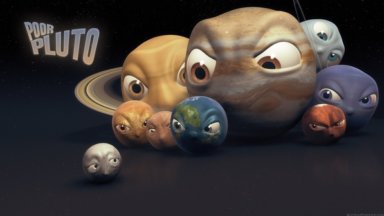
The Pluto debate frustrates me, as you may have noticed. It’s not that I have particularly strong views about whether it should be called a planet or a dwarf planet or a plutoid or pygmy planetoid, it’s that I really don’t care; I actually see Pluto’s “demotion” as exciting progress in the field of Solar System science rather than any derogatory gesture aimed at Pluto. Pluto is still Pluto; it hasn’t been knocked out of orbit, it hasn’t even been “bombed” (unlike our poor old Moon), it’s just being filed under a different category.
A King Amongst Dwarfs
In my opinion, calling Pluto a “planet” was unworkable, especially after a bigger dwarf planet was discovered in 2005 by a team of astronomers led by Dr. Mike Brown. This dwarf planet was named Eris (or 136199 Eris) and at first it seemed like we had gained a tenth planet.
The “ten planets” thing was short lived, however. In recognition that Eris probably represented the beginning of a spate of discoveries of welterweight worlds, the International Astronomical Union (IAU) took a vote in 2006 and decided to redefine what constitutes a planet. Pluto was in the firing line, became a rounding error and was dropped from the planetary club.
Kicked out and nowhere to go.
But it wasn’t all bad for the little guy. Pluto was designated king of all “plutoids” (trans-Neptunian dwarf planets) in 2008, meaning another three dwarf planets now orbited the Sun with this designation (Eris, Haumea, and Makemake in addition to Pluto).
Just so my opinion is known, I don’t care what Pluto is called. If NASA decided to explode Pluto as part of a Kuiper belt clearing project, then yes, I might be a bit annoyed; I’d even start a blog titled “Save Pluto.” But calling Pluto a dwarf planet (or the rather cute plutino) really doesn’t bother me.
I haven’t really thought much about this statement until, today, @PlutoKiller himself (Mike Brown) tweeted, “Seriously, what just happened? The entire discussion is on placing explosives in the solar system. Pluto has not even been mentioned.” I then fired off a reply saying something about building a New Horizons 2 and packing it with plutonium to which @PlutoKiller said, Evil Santa-style: “Just in time for Xmas.”
And then the penny dropped.
Kuiper Belt Cruelness
To be honest, I’m astonished I haven’t thought of this before. Looking at Mike’s Twitter feed should have been enough inspiration, but until I wondered down the bombing Pluto => plutonium enrichment => lets fly a shedload of plutonium to Pluto path, that I asked the question: How much energy is needed to completely destroy Pluto?
Now we’re talking! Time for some Kuiper belt mayhem!
It might seem quiet now...
I’m not talking about simply bombing Pluto and making a big crater, I’m not even talking about fire bombing all the volatiles out of its frozen surface, I want to remove Pluto from existence. Why do I want to do this? Well, for fun, and because @PlutoKiller himself said so. And it’s Halloween, so why not?
Now, energy is energy and mass is mass, let’s give Pluto the same treatment. Using the following equation (known henceforth as the “Plutoid Killing Equation”, or simply PluKE), we can find out how much energy we need to erase Pluto:
This equation is the total gravitational binding energy of a sphere of mass, M and radius, R. G is the Gravitational Constant. For Pluto, a sphere, its vital statistics are:
MPluto = 1.305 × 10²² kg
RPluto = 1.153 × 10⁶ m
and
G = 6.673 × 10⁻¹¹ m3 kg-1 s-2
Plugging the numbers into PluKE, we can derive the total energy required to kill Pluto, literally:
EPluto(dead) = 5.914×1027 Joules
Oops, who put those WMDs there?
But what does this number mean? This is the bare minimum energy required to match the gravitational binding energy of Pluto. If you want to rip the dwarf planet apart (plus pyrotechnics and speeding debris), you’ll need a lot more energy. However, nearly 6×1027 Joules (that’s a 6 followed by 27 zeros) delivered into Pluto in one second should give the little world a very bad day.
Tsar Very Much
But how can we “deliver” this vast quantity of energy in one second? I suspect that any super-advanced civilization hell-bent of wiping out planets will have a better idea of this than me, but using weapons that are available to modern man might be a good place to start. Forget the uber-powerful death ray emitted by the Death Star, that’s sci-fi. It may not be sci-fact, but how about sending some nuclear bombs to the Kuiper belt?
How many bombs will we need? Ten? Ten dozen? A thousand?
The most powerful nuclear weapon tested was the Soviet 58 MT Tsar Bomba in 1961. So if we know how much energy is released by one of those beasts, we should be able to work out how many we’ll need to send to the unsuspecting Pluto.
1 MT = 1 megaton of TNT = 4.184×10¹⁵ Joules
therefore, a single Tsar Bomba has the potential to release an energy of:
We needed 6×1027 Joules to wipe out Pluto, obviously the 2.4×10¹⁷ Joules a single bomb can deliver is woefully short of our goal. So how many Tsar Bomba weapons do we need?
(6×1027 Joules) / (2.4×10¹⁷ Joules) = 2.5×10¹⁰
We need to build 25,000,000,000 nuclear bombs. 25 billion. Ouch.
Obviously, looking at this estimation, it is impossible to destroy a dwarf planet as puny as Pluto using the most powerful weapon known to man. Also, it’s worth keeping in mind that this is the bare minimum of energy that needs to be applied to Pluto to match its gravitational binding energy, so to destroy it, you’ll need a lot more bombs.
There’s also the question of how to distribute the weapons. Would you put them all in one place? Distribute them all around the globe? Perhaps burrow into the centre of the body? I suppose putting all the bombs in one place might be impressive, kicking a chunk of plutoid into space.
Now I must report these findings to @PlutoKiller himself, I fear he won’t be happy with the outcome of my calculations…
Although I’ve been neck-deep in Ares I-X launch news today, I’ve had some time to see what else has been going on in the Universe. I really hope I’ll find the time to get to this stack of blog post ideas over the weekend, one of them is a particular peach.
But before I turn in for the night, an interesting little debate has been sparked over at Keith Cowing’s NASA Watch. Keith, the ever watchful eye over all things NASA, somehow stumbled across the NASA 360 blog and pointed out that the agency might be trying too hard to be “hip.”
I think that one of the hardest things NASA has to do is to communicate their incredible science to the general public — no one said outreach was easy. Every day I am challenged with this issue on Discovery News. On the one hand I want to talk about the quantum effects of Hawking Radiation at the event horizon of a black hole, but on the other, I have to realize that most of my audience didn’t take Advanced Quantum Mechanics at school.
Realizing how to approach an audience with science is a bit like approaching a crème brûlée with a blowtorch; you have to do it slowly, with enough distance between the caramelizing sugar (audience) and the flame (science). You get too close and the mix gets burned (confused), get too far away and the mix is undercooked (bored).
This by no means is equivalent to “dumbing down,” it’s simply a method to find analogies and examples that can connect the mind-bending science with a tangible reality (like comparing the curvature of space-time with the curvature of a rubber sheet when a heavy ball is placed on top of it). If you start over-simplifying the science, you end up sounding like a tool and your audience thinks you’re lame/boring/condescending.
If analogies and examples aren’t forthcoming, try humour. One example of this is “5 Frightening (But True) Space Stories,” a guest blog post for Space Disco Robert Lamb posted today. Robert is an expert at blending science and humour. So much so, this blog post teaches some spaceflight history without you even realizing it.
So, back to NASA Watch and the comments about the NASA 360 blog post written by presenter Jonny Alonso:
I am certainly all for trying to connect to a broader audience but this NASA 360 post by Johnny Alonso (the MTVish on-air host) is just silly with its attempt at teen Twitter and SMS lingo i.e. “hai guyz” and “that would totally suck. lol”, “it was hawt :)” and “These cats Mike and Barry”. –Keith Cowing, NASA Watch
Running the risk of sounding a little long in the tooth, Keith is obviously a little riled about the standard of writing on this particular post. At first, I was mildly amused, but the more I looked at it, the more I realized NASA’s outreach style might be flawed. Using text-speak to convey his work presenting for NASA makes Alonso sound limited (which I’m sure he’s not, although I haven’t seen him in action, so I might be wrong), but worst of all it knocks the credibility of NASA outreach.
This might be one form of communication, but there must be some kind of editorial control? Are there standards? Granted, I think the content produced by NASA online is second to none, which is probably why NASA 360 is standing out like a sore thumb. Also, this blog post is the personal angle written by an enthusiastic young guy in a conversational, loose tone who probably has a lot of fans.
Perhaps I’m just old fashioned in agreeing with Keith, but “outreach” doesn’t mean NASA should be publishing blogs like this to try to appeal to a younger/trendy audience. As sad as it may be, if the younger generation isn’t interested in NASA, I doubt a presenter saying “hai” all the time is going to change that.
What do you think? Am I being picky? Is this just a symptom of what we can expect from blogs in the future?
(Note the clever use of CAPS and excessive exclamation marks in the title. It speaks volumes.)
I guess this confirms I was wrong. Consider this an apology to all the crackpots, doomsayers, cranks and Walter Wagner. I’m sorry I got it all… so… wrong.
While out on the town in London, Bad Astronomer Phil Plait pulled Prof. Brian Cox out of a pub and subjected him to some intense interrogation. Obviously caught with his guard down, Cox folded under the pressure and briefly told the world what we can expect when the Large Hadron Collider (LHC) recommences experiments in November. Wow, just… wow.
This made me giggle. Looks like TAM London was a tonne of fun, hopefully next time I can go.
As we have probably all guessed by now, the Institute for Human Continuity is a viral campaign designed to generate a huge buzz around the upcoming November 13th movie called 2012.
Ever since I started writing about 2012 (way back in May 2008 with “No Doomsday in 2012“), I’ve been inundated with emails, tweets, comments, even phone calls about the 2012 doomsday phenomena. These messages have ranged from mild curiosity to outright panic. I’ve also had many crackpots trying to convince me that my scientific reasoning is not valid (which it is).
However, in the run-up to a perfectly timed movie about the “Mayan prophesy,” Sony Pictures kick-started the mother of all viral campaigns in January. The movie 2012 will be a huge event, but basing an entire marketing ploy on fear and disinformation left a lot to be desired. So for the last 10 months, I’ve been busy writing not so much about the bad science being used in these wacky 2012 theories (check out my 2008 “No Doomsday in 2012” series for the science), but about the various advertising campaigns for the movie.
However, up until this point, there’s been little official comment from NASA about all the nonsense that has been stirred up. This seems surprising as most doomsday theories involve butchered astronomical objects, surely the US space agency should take a stance on the whole matter?
Now, NASA astrobiologist Dr David Morrison has gone on the record to say the 2012 doomsday theories are bunk. It turns out that Dr Morrison has also been flooded with messages from people worried that all the hype might be real.
Interestingly, in response to accusations that Sony Pictures’ viral campaign was irresponsible, Sony’s publicity director said, “It is very clear that this site is connected to a fictional movie. This can readily be seen in the logos on the site.”
However, in January when the Institute for Human Continuity went live, indications that the site had anything to do with a fictional movie could only be found if you dug very deep into the well-polished Flash website depicting Planet X causing death and destruction on Earth. I don’t recall any logos.









 astroengine.com