Mount Asama Erupts, Ash Rains Down on Tokyo

Mount Asama erupts early in the morning of February 2nd. (AP)
Mount Asama erupted early in the morning of February 2nd. (AP)

Only a few hours after the Japanese authorities issued an alert for the imminent eruption of Mount Asama, the volcano erupted at 1:51 am local time (Feb. 2nd), spewing thick smoke nearly 2 km high. Ash is falling on parts of Tokyo, 140 km away and chunks of rock have been ejected 1 km away from the volcano. There are no reports of damage or injury so far to local infrastructure or in the nation’s capital.

Japan’s Meteorological Agency has maintained the Level 3 warning (5 being the worst), preventing people from approaching the erupting Mount Asama, urging local residents to take caution. Should the warning level be raised to 4, residents will be advised to prepare for evacuation, and a Level 5 will enact an evacuation.

So far, the eruption appears to be limited, but Japan will be keeping a close eye on the situation for some time to come. Watch this space

For more, check out Mount Asama Eruption Imminent, Japan on High Alert

Source: AP via @LouisS

Mount Asama Eruption Imminent, Japan on High Alert (Update)

In 2004, smoke rises from Mount Asama in Tsumagoi, 140 km northwest of Tokyo (Reuters)

There will be growing tension in central Japan tonight. Mount Asama, an active complex volcano, is stirring and Japan’s Meteorological Agency has put the region on high alert. Geophysicists predict the volcano could explode within the next 48 hours, possibly powerful enough to blast rocks from its peak, causing damage up to four kilometres away.

Mount Asama is infamous for the 1783 eruption that devastated the region straddling the Gunma and Nagano prefectures, killing 1,500 people. Since then, Asama has remained active, with a significant eruption in 1972. However, 2004 did see the volcano explode, ejecting volcanic material up to 200 km away, but very little damage was caused.

Building seismic activity in the area suggested an imminent eruption, prompting the authorities to raise the threat level to a 3 out of 5. A Level 3 alert means that there could be significant damage caused to nearby non-residential areas and a no-go zone has been imposed. This is the first time the Meteorological Agency has used the volcanic warning levels since they were adopted in December 2007…
Continue reading “Mount Asama Eruption Imminent, Japan on High Alert (Update)”

When in the Solar Cycle were You Born?

My birthday, right smack bang in the middle of solar maximum (Space Weather)

I just came across this rather nifty little tool via fellow Twitterer TaviGreiner, and I really like it. It’s yet another wish-I’d-thought-of-that moments. You input your date of birth, and a sunspot number chart appears, displaying the solar activity on your birthday…
Continue reading “When in the Solar Cycle were You Born?”

Peter Higgs Discovers Higgs Boson… in the Mail!

Dr Peter Higgs holds his very own Higgs boson (©Particle Zoo/Peter Higgs)
Peter Higgs holds his very own Higgs boson (©Particle Zoo/Peter Higgs)

In October, something very special happened to me. There, on the doorstep, a Higgs boson sat, waiting to be picked up and unwrapped from his packaging (and yes, I can confirm, he is a he).

Of course, he wasn’t the same Higgs boson physicists at the Large Hadron Collider (LHC) were looking for, he was a Higgs boson plushie from Julie Peason’s Particle Zoo.

Since that day, Higgsy (as I affectionately call him) has been sitting on my desk, watching me write, whilst holding down a stack of papers when I have my office window open.

Yesterday, I received some more good news via email from my friend Julie, the Particle Zookeeper. The particle physicist whom the Higgs boson is named after has also discovered his very own Higgs boson… at his home in Scotland!
Continue reading “Peter Higgs Discovers Higgs Boson… in the Mail!”

Is the Universe a Holographic Projection?

Luke and Obi-Wan look at a 3D hologram of Leia projected by R2D2 (Star Wars)

Could our cosmos be a projection from the edge of the observable Universe?

Sounds like a silly question, but scientists are seriously taking on this idea. As it happens, a gravitational wave detector in Germany is turning up null results on the gravitational wave detection front (no surprises there), but it may have discovered something even more fundamental than a ripple in space-time. The spurious noise being detected at the GEO600 experiment has foxed physicists for some time. However, a particle physicist from the accelerator facility Fermilab has stepped in with his suspicion that the GEO600 “noise” may not be just annoying static, it might be the quantum structure of space-time itself
Continue reading “Is the Universe a Holographic Projection?”

Our (Painfully) Featureless Sun

The Sun, being boring on Jan. 13th 2009, a whole year after Solar Cycle 24 was supposed to start (solar astrophotography by ©Stephen Sykes)

This morning I realised it’s been a whole year since we saw the first reversed polarity sunspot pair on the surface of the Sun. A year ago, Solar Cycle 23 was running out of steam and Cycle 24 was about to take over. Solar physicists the world over were making predictions, some thought Cycle 24 was going to be a “doozy”, others were a little more conservative, saying it might just be an “average” cycle. However, 12 months on, it would appear Cycle 24 is off to a very lazy start. Once again, we have a “blank” Sun, a perfect sphere, looking like a marble, or as my wife observed: a jawbreaker (or as us Brits like to expressively call them, gobstoppers).

The stunning image above was shot by skilled astrophotographer Stephen Sykes, over at AstroSlacker.com, demonstrating what superb views of the Sun can be captured by amateur astronomers. When I (eventually) get my telescope, and/or a new camera, the Sun will be my first astronomical object to observe, but I doubt I’ll get as good a view as this.

So, another day, another featureless Sun. That’s not to say it’s been a totally boring year; we’ve had flares from “left over” active regions from Cycle 23 and we’ve had a bit of action from Cycle 24 (the most recent set of spots–Sunspot 1010–have just rotated out of view), and I’m pretty sure this time next year we’ll be inundated with sunspots… fingers crossed (I can’t wait to see some coronal loop arcades again). For now, good night our lazy Sun, I look forward to seeing more action in the coming months…

Magnetars Born Through Quark Star Switch?

Could quark stars be magnetar progenitors? (© Mark Garlick)
Could quark stars be magnetar progenitors? (© Mark Garlick*)

If you thought neutron stars and magnetars were exotic, think again. In studies of magnetars that occasionally blink to life, generating an intense blast of X-rays and gamma-rays, astronomers have been at a loss to explain why these objects have such strong magnetic fields. After all, after a supernova, a neutron star remnant conserves the angular momentum and magnetic field of the parent massive star; it is therefore a rapidly spinning, magnetically dominant entity, often observed emitting intense radiation from its poles (a.k.a. a pulsar).

However, magnetars (the most magnetically powerful objects observed in the Universe) do not have such a reasonable explanation for their magnetic field, it is simply too strong.

During the AAS conference last week, one scientist presented his research, possibly indicating another state of matter may be at play. A massive neutron star may pass through a “quark star phase”, kick starting a mechanism known as colour ferromagnetism

*This image is copyright Mark A. Garlick and has been used with permission. Please do not use this image in any way whatsoever without first contacting the artist.
Continue reading “Magnetars Born Through Quark Star Switch?”

Solar Views from SOHO (Wallpapers)

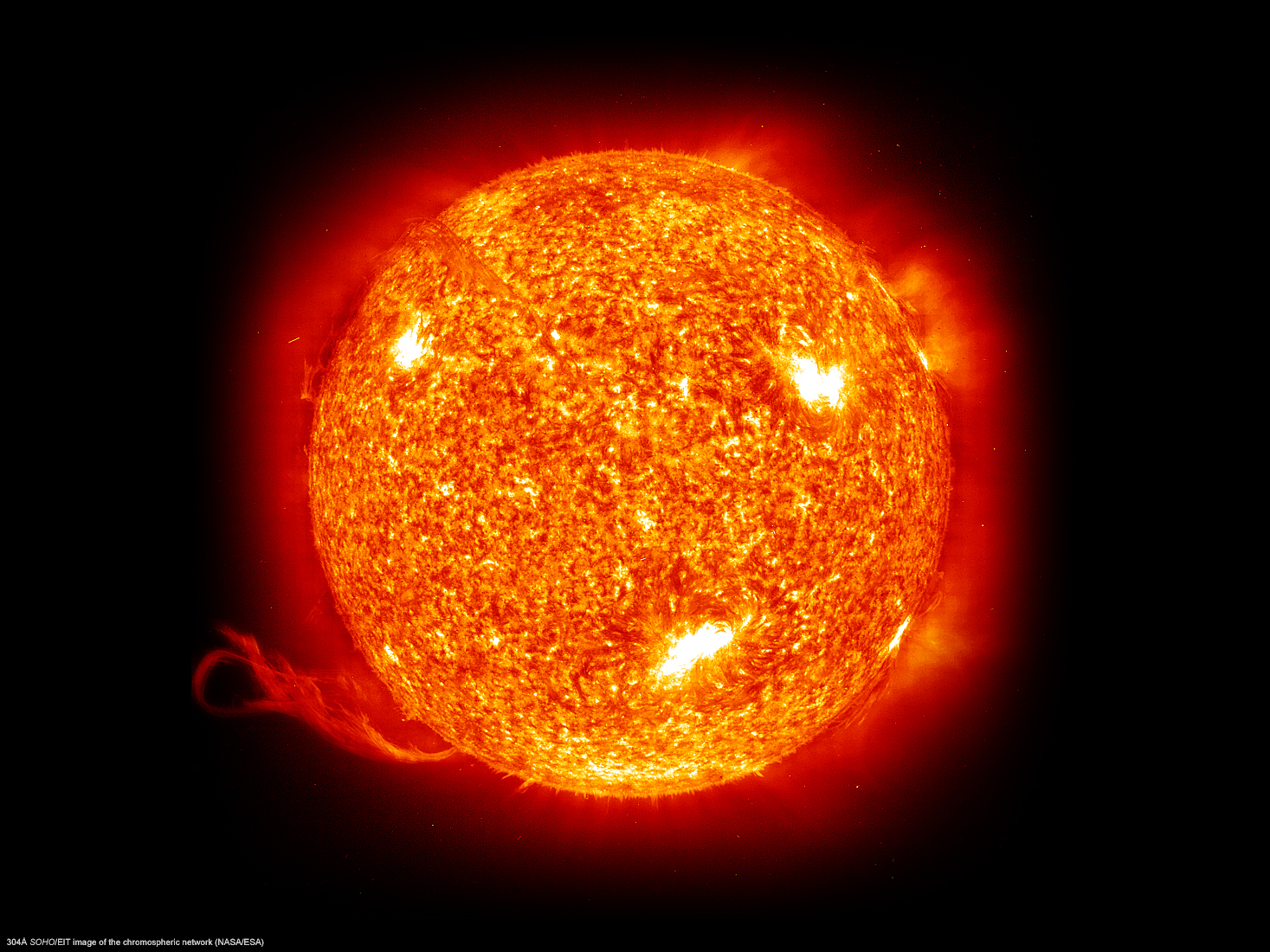
304A SOHO/EIT image of the solar disk (NASA/ESA)

Back in 2006, I was feeling a bit nostalgic about my four years of research at the University of Wales, Aberystwyth Solar Group, so I decided to try to find some high resolution prints of the Sun. After a lot of effort, I didn’t find any prints I could buy or download, but I did find some high resolution images from the Solar and Heliospheric Observatory (SOHO) image archive. Although some were a bit noisy, I was able to clean them up with Photoshop and did some layer tweaking/saturation/balance to draw out the fine detail of the chromospheric network–as seen above in the 304A Extreme ultraviolet Imaging Telescope filter–plus a distinct prominence (in the bottom left-hand of the image).

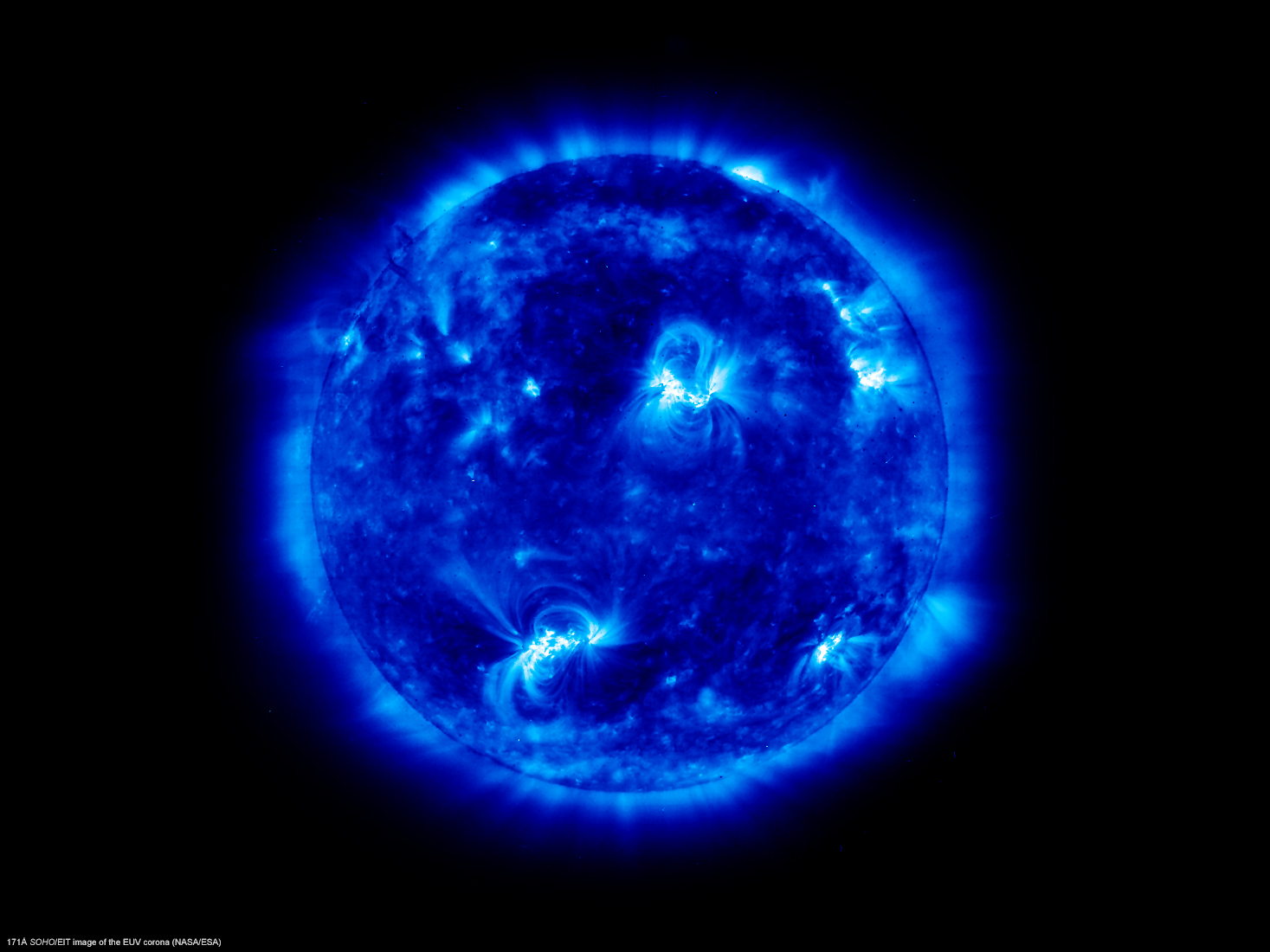
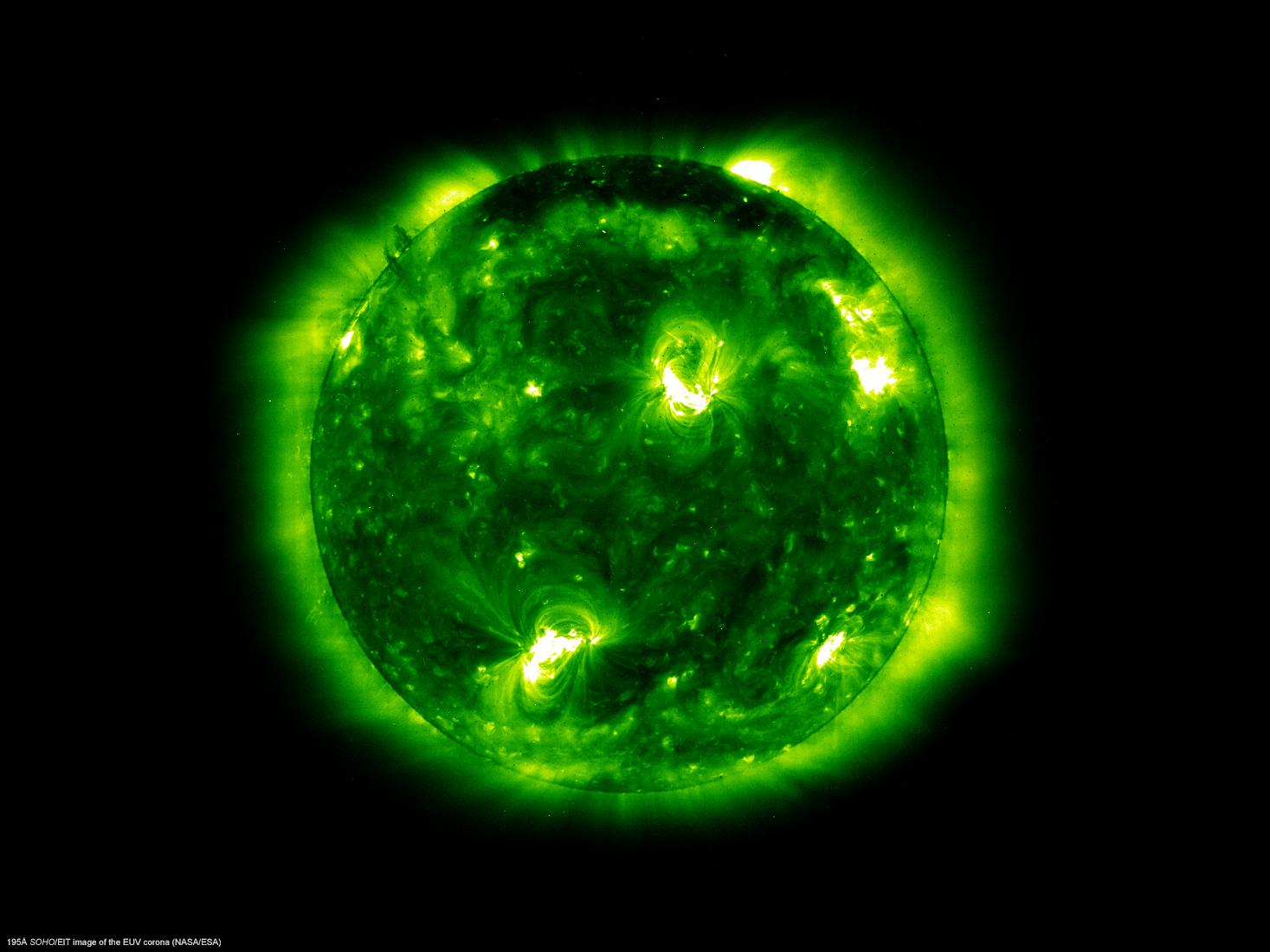
Not stopping there, I decided to give the same treatment to high resolution 171A and 195A images. They came out very well and I kept rotating them as my wallpaper for months. Having just read Phil’s post on today’s perihelion (the time of year when the Earth is at its closest to the Sun during its orbit), I came across a comment asking whether anyone had any wallpapers of the same 304A EIT image. Well, here it is! Plus two more!

If anyone wants to find out how the images were edited, feel free to ask and I’ll let you know. Truth be known, there’s thousands of space images held by NASA, ESA etc. open to the public domain that rarely get the “airtime” they deserve. So it’s about time I dust off these three-year old edits and share the magnetohydrodynamic love.

I miss active regions, I wish the Sun would amp it up a bit so we can see all those lovely flares, CMEs, filaments and coronal loops… ahhhh… coronal loops

Confidence is High for LHC Science this Summer

Engineers are working hard to repair the damage to the LHC (CERN)

In a recent BBC interview with the LHC project director Dr Lyn Evans, the Welshman talks about the “collateral damage” caused by the collider’s catastrophic quench that damaged a section of the aligned superconducting magnets in September.

Although the £14 million repairs are challenging, Evans is very confident CERN engineers and scientists are on-track for the LHC to go online in the summer of 2009.

But we now have the roadmap, the time and the competence necessary to be ready for physics by summer,” he said. “We are currently in a scheduled annual shutdown until May, so we’re hopeful that not too much time will be lost.”

Continue reading “Confidence is High for LHC Science this Summer”

I Wish Office Work Was This Interesting

Having just stumbled around the space blogs, I was enthusiastic that I would find some inspiration toward my next Astroengine.com article. Along the way, I found this rather entertaining short film on Phil Plait’s Bad Astronomy website. As Phil points out, “black holes don’t work this way.” Although, that is a shame.

There’s a strong moral to this story: don’t photocopy alone, as you never know when your Xerox machine will print out a singularity. Well, not really, perhaps the guy should have stopped at stealing a snickers bar, a lesson we could all learn from. Actually, I might have walked off with just one wad of cash… actually, maybe two… you get the picture.

Needless to say, this isn’t actually how a black hole works… it’s not even how a wormhole would work. But take the short film at face value and get some entertainment from it, I thought it was quite good fun.